In this guide
A fixed air conditioning system for one room in the UK costs around £1,900 installed, based on the Energy Saving Trust's figure for a single-unit air-to-air system serving a single room1. The labour part of that price is usually charged by the day: Checkatrade figures put air conditioning installation at £500 to £720 per day, and state that equipment prices usually start at around £1,000 for a ducted ceiling-mounted unit2.
Cooling more of the house multiplies the cost. Nesta gives a rough estimate of £1,500 to £2,700 per room for a split system feeding several rooms, and £6,000 to £10,800 upfront for a three-bedroom house with a single open-plan living area3. At the bottom of the market, a portable unit needs no installer at all, and one installer publishes guide prices from £595 for most domestic fitting work4.
The purchase price is only part of the picture. Every system runs on grid electricity, so running cost follows the tariff: a single split system costs £0.21 to £0.65 an hour at the July 2026 price cap of 26.11p per kWh5. Air conditioning makes a home less dependent on the weather during a heatwave, but it deepens its dependence on the electricity supplier, on a refrigerant-qualified installer for repairs, and, for app-controlled units, on the manufacturer's cloud service.
What air conditioning costs to buy and install in the UK
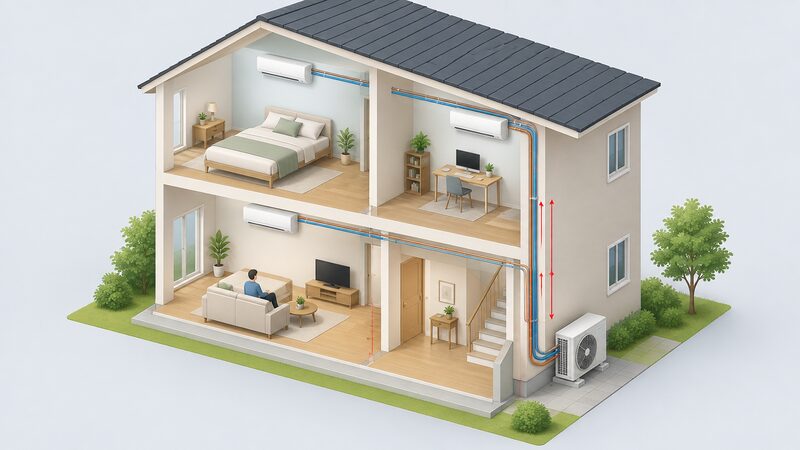
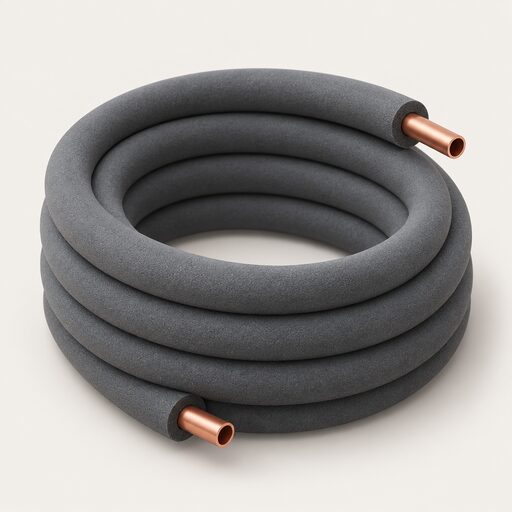
An installed price has four parts: the indoor and outdoor units, the refrigerant pipework and condensate drain that join them, the electrical supply, and the engineer's time, including commissioning. The type of system decides how much of each is needed. A portable unit is all equipment and no installation. A single split adds one pipe run and one outdoor unit. A multi-split or ducted system adds more pipe, more wiring and more making good. The types of air conditioning page sets out how each works.
The published figures fall into clear bands:
| System | Published cost | What the figure covers |
|---|---|---|
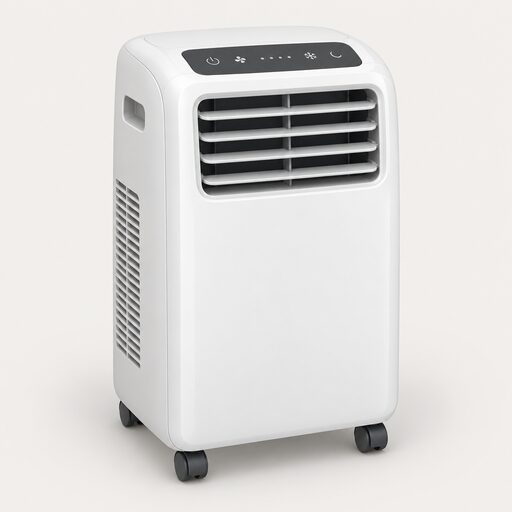
| Portable air conditioner | £385.49 to £739.997 | Unit only, no installation |
| Single split, one room | around £1,9001 | Installed, single-unit system |
| Ducted ceiling-mounted unit | from around £1,0002 | Equipment starting price |
| Split system, several rooms | £1,500 to £2,700 per room3 | Rough installed estimate |
| Air-to-air, one-bedroom flat to four-bedroom house | £2,400 to £8,8008 | Typical installation costs |
| Three-bedroom house, open-plan living area | £6,000 to £10,8003 | Upfront cost |
The Energy Saving Trust's figure of about £1,900 for a single room appears in its own advice as well as in Which? reporting of it9. Nesta's two sets of figures differ because they describe different homes: the per-room range assumes a system feeding several rooms, while the £2,400 to £8,800 range runs from a one-bedroom flat to a four-bedroom house8.
Mitsubishi Electric states for its wall-mounted range that "installation costs will vary depending on the equipment installed and the complexity of the project"10. That is the practical reality: the figures above are reference points, and prices for fixed systems are installer-quoted after a survey. The steps of that survey are covered on the air conditioning installation page.
Installation labour: £500 to £720 per day
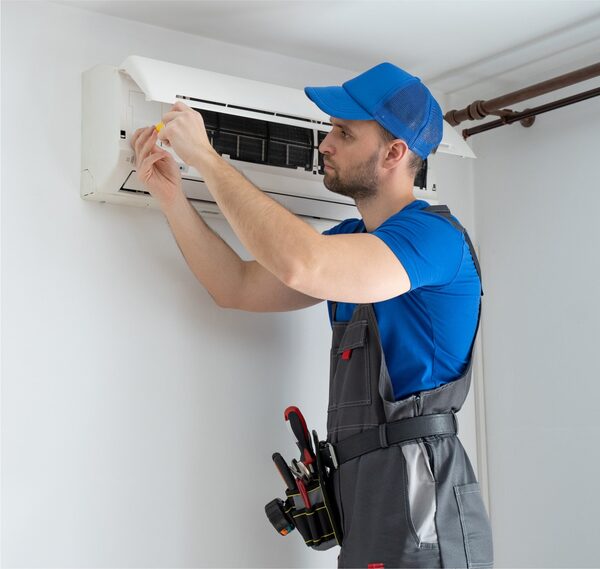
The engineer's time is the part of the price most sensitive to the individual job. Checkatrade figures, quoted by Hive, put air conditioning installation at £500 to £720 per day2. The published figures do not break that down, but a fixed system involves refrigerant handling and electrical work as well as mounting the units, which sets it apart from general trades. For comparison, Warmup, an underfloor heating maker, suggests about £200 to £300 per day for a fully qualified floor heating installer11, and £150 to £250 a day for a qualified engineer on a retrofit, varying by location12. Those figures are for a different trade and are given only to show where air conditioning labour sits.
What pushes the number of days up:
- Pipe run length: the further the outdoor unit is from the indoor unit, the more pipe, insulation and drilling is needed. A short run through the wall directly behind the indoor unit is the simplest case. There are also minimum lengths, explained on why there is a minimum pipe length.
- Electrical work: a new dedicated circuit or a consumer unit that needs attention adds time and cost.
- Access: an outdoor unit on a flat roof, high wall or bracket above ground floor may need access equipment.
- Making good: ducted and multi-room systems run pipes through floors, ceilings and walls that then need finishing.
The Chartered Institute of Plumbing and Heating Engineering notes that with fixed air conditioning, "issues such as cost, available space, installation disruption, aesthetics and air distribution performance all need to be considered"13. Disruption and cost are linked: the more of the house a system touches, the more days it takes. The published figures give a daily rate rather than a total, so a quote that states the number of days allowed makes two quotes easier to compare.
A single room: around £1,900 installed
For one room, the independent reference figure is the Energy Saving Trust's: around £1,900 to install a single-unit system to serve a single room1. The Energy Saving Trust describes this as an air-to-air heat pump, which is a reverse-cycle air conditioner by another name; the relationship is explained on air conditioning that heats. The figure covers equipment and installation together.
Around that reference point sit the published components. Equipment prices for a ducted ceiling-mounted unit usually start at around £1,000, according to Checkatrade2. A wall-mounted high-wall unit is the more common single-room choice, and retailer listings for 2.5kW models are covered in the unit price section below. On labour, one installer covering Wales and the west of England states that most domestic installs start at £5954.
The range in practice is driven by:
- Unit choice: a basic wall-mounted unit and a premium model with purification and Wi-Fi differ by several hundred pounds at list price.
- Capacity: 2.5kW is a common size for bedrooms and small living rooms; larger rooms need more, which raises equipment cost. The sizing guide explains the calculation.
- The installation itself: pipe run, wiring, access and the number of days.
A single split is also the cheapest fixed system to run per hour. Uswitch puts a single-split system of 0.8 to 2.5kW at £0.21 to £0.65 per hour at the July 2026 price cap of 26.11p per kWh5. For the difference between a fixed system and a portable one in the same room, see split vs portable air conditioning.
For independence, a single split gives a household control of one room's temperature without relying on outdoor conditions, but it adds a new electrical load and a sealed refrigerant system that only a certified engineer can open for repair; the rules are on F-gas rules for air conditioning.
Multi-room systems: £1,500 to £2,700 per room
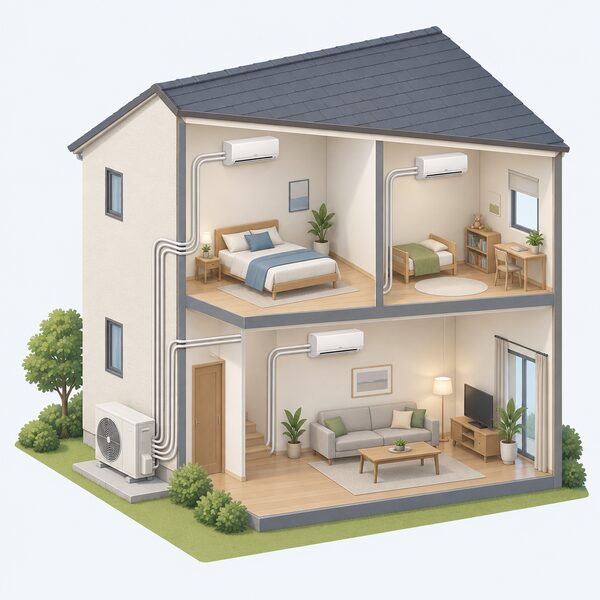
Cooling two or more rooms raises a layout choice: one outdoor unit serving several indoor units (a multi-split), or separate single splits. Nesta's rough estimate for a split system feeding multiple rooms is anywhere between £1,500 and £2,700 per room3. Its separate figures for whole homes run from £2,400 in a one-bedroom flat to £8,800 in a four-bedroom house8.
The range reflects the same drivers as a single room, multiplied: each indoor unit needs its own pipe run back to the outdoor unit, and longer runs through the house cost more. The per-room figure can therefore fall where rooms are close to each other and to the outdoor unit, and rise where they are spread across floors. How many indoor units one outdoor unit can serve is covered on multi-split: how many indoor units, and the trade-off between layouts on single split vs multi-split.
Running cost rises with capacity. Uswitch gives a multi-split or ducted system of 1 to 5kW at £0.26 to £1.31 per hour, at the July 2026 cap of 26.11p per kWh5. The upper end of that range reflects a larger system running hard; in a home where only one room is in use at a time, the load is nearer the bottom.
A multi-split concentrates dependence in one outdoor unit: if it fails, every connected room loses cooling (and heating, where the system provides it). Separate single splits cost more in outdoor units but keep each room independent. Neither is presented here as the better choice; the multi-split air conditioning page sets out how each behaves.
Whole-house systems: £6,000 to £10,800 for a three-bedroom home
For a whole house, Nesta puts the upfront cost of a split system for a three-bedroom house with a single open-plan living area at £6,000 to £10,8003. Its range for air-to-air systems across home sizes reaches £8,800 for a four-bedroom house8. Ducted systems, which hide the indoor units in ceiling voids and distribute air through grilles, start at around £1,000 for a single ducted ceiling-mounted unit before installation2; the ducted and cassette air conditioning page explains where they fit.
These figures are often compared with the cost of an air-to-water heat pump, which heats radiators and hot water. That is a different system, but the numbers put whole-house air conditioning in context:
| Air-to-water heat pump figure | Cost | Source date |
|---|---|---|
| Average installation cost | around £13,00014 | 2026-07-02 |
| Average installation cost | £12,50015 | 2026 |
| Median installation cost | around £12,00016 | 2024-12-12 |
| Typical installation (£4,500 after subsidy) | around £12,00017 | 2024-06-13 |
| Typical installation range | £8,000 to £16,50018 | 2025-04-23 |
| Median installed price | just under £13,00019 | 2024-11-07 |
In Scotland, Nesta's modelling assumes installation costs for clean heating will fall by 17.5% from their current average of £12,000 by 203020. That is a modelled assumption, not a price.
Two points follow for a household. First, whole-house air conditioning at £6,000 to £10,8003 is in the same order of cost as an air-to-water heat pump, and reverse-cycle units also heat, so some households weigh one against the other. Second, an air-to-air system does not produce hot water, so a home that removes its boiler still needs another way to heat water.
Fixed-price installation offers and how VAT applies
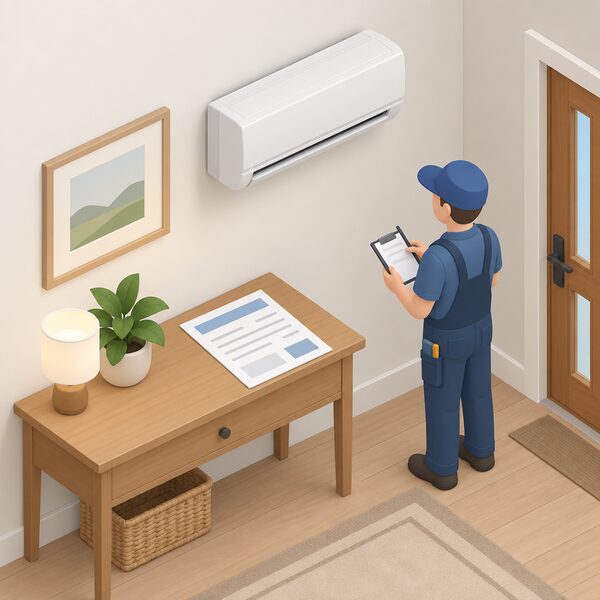
Some installers publish guide prices for standard jobs. One installer covering Wales and the west of England lists domestic installation from £595, garden room installation from £595, and commercial installation from £6954. The published guide prices do not state whether VAT is included, what pipe length is allowed, or which equipment the figure assumes. A "from" price is the simplest case; the survey sets the actual quote. Garden rooms have their own considerations, covered on air conditioning for a garden room.
VAT is where published claims most often go further than the guidance. HMRC's reduced-rate relief applies to installing "energy-saving materials", and its worked examples use insulation and solar panels, not air conditioning. In the draft guidance, an installer is charged £400 (excluding VAT) for insulation material and charges the customer £1,000 (excluding VAT) for the installation21. HMRC's Northern Ireland examples show how the relief depends on the share of materials in the price:
| Example (Northern Ireland) | Charge excluding VAT | Materials | Labour | VAT treatment |
|---|---|---|---|---|
| Insulation | £1,000 | £400 | £600 | Reduced 5% on the total, materials being 40% of the cost |
| Solar panels and battery | £5,385 | £3,500 | £1,885 | Standard 20% on materials, 5% on labour, materials being 65% of the cost |
The Northern Ireland rule turns on whether materials are 60% or less of the total cost22. None of the guidance cited here names air conditioning as an energy-saving material. Retail listings show air conditioning equipment priced both including and excluding VAT: the LG Artcool Gallery Special System, for example, is listed at £360.00, and at £300.00 excluding VAT23.
Unit prices compared: LG Artcool, Samsung WindFree and Mitsubishi Electric
Retailer listings for wall-mounted systems show a sale price beside a "high street" comparison price. The figures below are as listed on 23 September 2026. Several of the lower listed figures (for example £42.51 or £47.50 for a complete system) sit far below the same listing's high-street comparison; the listings do not state whether these are full system prices, deposits or instalments, so they are best read as listed prices only.
| Exact model | Listed price | High-street comparison | Notes |
|---|---|---|---|
| LG Artcool Gallery Special System | £360.00 (£300.00 ex VAT)23 | £1,619.9923 | Also listed at £1,349.99 high street; the listings disagree |
| Samsung WindFree AVANT S2 High Wall Air Conditioning System | £829.9924 | £919.9924 | |
| Samsung WindFree AVANT S2 2.5kW High Wall Air Conditioning System | £736.6625 | not given | Also listed at £883.99; the listings disagree |
| Samsung WindFree COMFORT S2 High Wall Air Conditioning System | £62.5024 | £662.4924 | |
| Mitsubishi Electric Low Wall Air Conditioning System | £210.00 and £1,599.9926 | not given | Two figures on the same listing |
| Mitsubishi Electric Classic Wall Mounted Air Conditioning System | £47.5026 | not given | |
| Mitsubishi Electric Elegance 2.5kW Wall Mounted Air Conditioning System | £42.5125 | £791.6725 | High street also listed at £950.00; the listings disagree |
| Mitsubishi Electric ZEN 2.5kW Air Conditioning System | £103.3325 | £944.9925 | Also listed at £1,009.99, high street £1,133.99; the listings disagree |
| Mitsubishi Electric Premium 2.5kW Air Conditioning System | £954.1625 | not given | Also listed at £1,144.99; the listings disagree |
Powrmatic also sells air conditioning in the UK; its range is described on Powrmatic cooling. Portable units are listed separately: the 12,000 BTU 3-in-1 Portable Air Conditioner with Dehumidification Function (Smart Wifi App) at a regular price of £649.99; the 14,000 BTU 3-in-1 model at a sale price of £433.49 (regular £739.99); and the 12,000 BTU 4-in-1 Portable Air Conditioner, Heater with Dehumidification Function at a sale price of £385.49 (regular £659.99)7. More on each maker is on air conditioning brands, LG air conditioning, Samsung air conditioning and the Mitsubishi Electric range comparison.
What the extra money buys: purification, quiet running and app control
At the same 2.5kW capacity, list prices for wall-mounted units span several hundred pounds25. The difference is largely features, as the makers describe them.
Air purification. Mitsubishi Electric states that the Premium 2.5kW has built-in Plasma Quad Technology which "removes viruses, bacteria, allergens, and dust", while the ZEN 2.5kW is compatible with an optional Plasma Quad Connect device for air purification25. LG states that the Artcool Gallery Special System's Plasmaster Ionizer+ "actively removes airborne bacteria, viruses, and allergens"25. These are the makers' claims; no independent test of them is cited here.
Quiet running. The LG Artcool Gallery Special System is listed as operating as low as 19dB23, and the retailer states that LG Artcool Gallery and Samsung WindFree models "operate as low as 19dB"24. That figure refers to the indoor unit at its lowest setting; outdoor unit noise and neighbours are covered on air conditioning noise and the quietest air conditioning for a bedroom.
Controls and connectivity. The Samsung WindFree AVANT S2 2.5kW allows remote access and adjustment through the Samsung SmartThings app; the Mitsubishi Electric Elegance 2.5kW has built-in Wi-Fi for the MELCloud app and voice control compatible with Alexa and Google Assistant25. LG describes AI-powered operation that "adapts to your habits and environment"23.
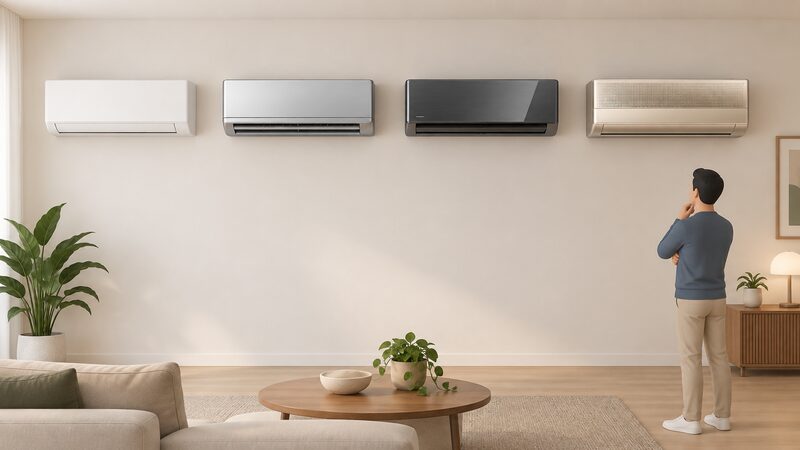
Appearance. The ZEN comes in Black, Silver or White, and the Premium in Red, Black, White or Silver25.
App control brings a dependence of its own: remote features rely on the manufacturer's cloud service and the household's broadband. The unit's own remote or wired controller continues to work without them. Controls are compared on air conditioning controls and Wi-Fi and units that work with Alexa and Google.
Running costs: 21p to £1.31 an hour for fixed systems
Once installed, air conditioning costs whatever the electricity it uses costs. At the July 2026 Ofgem price cap of 26.11p per kWh, Uswitch puts running costs at5:
| System | Power | Cost per hour |
|---|---|---|
| Single-split system | 0.8 to 2.5kW | £0.21 to £0.65 |
| Multi-split or ducted system | 1 to 5kW | £0.26 to £1.31 |
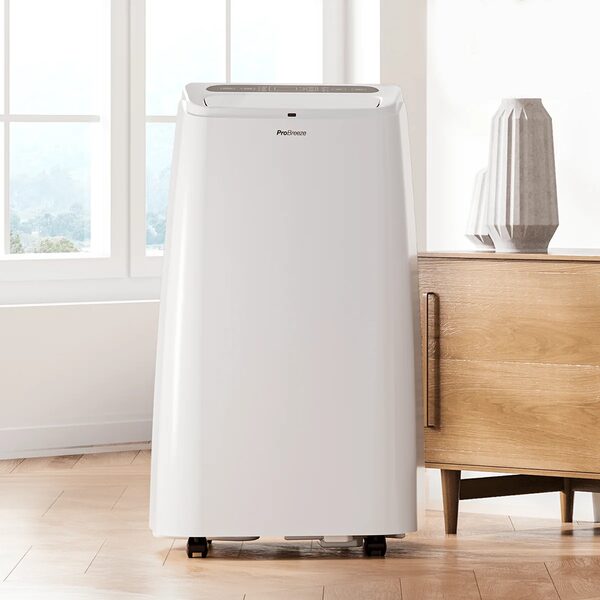
For portable units, National Energy Action states: "A typical portable air conditioner (1,000 to 1,500W) can cost around 26 to 39p per hour, roughly 14 to 20 times more than a fan."6
Over a week of heavy use, Uswitch's April 2026 comparison at the cheapest fixed rates, with average use of 9.1 hours a day for seven days, gives £36.10 a week for a 2.7kW built-in unit and £13.37 a week for a 1kW portable unit27. The portable is cheaper per week there because it draws less power, not because it cools more efficiently; a smaller unit delivers less cooling.
These figures depend entirely on the tariff, so a household on a different rate or with its own solar generation will see different numbers. Running on solar is covered on running air conditioning on solar panels, and the fuller breakdown is on air conditioning running costs and portable air conditioner running cost per hour.
Most units heat as well as cool
A reverse-cycle air conditioner is an air-to-air heat pump, and many units sold as air conditioning also heat. Mitsubishi Electric states: "Our wall-mounted units can both heat and cool your space"10. NAPIT, the certification body, describes air-to-air heat pumps as a technology "which can provide heat in winter and cooling in summer"28. Some portable units are sold the same way, such as the 12,000 BTU 4-in-1 Portable Air Conditioner, Heater with Dehumidification Function7.
This changes the cost calculation. A system bought for a few hot weeks a year may also serve as room heating for months, spreading its purchase price over more use. It also moves winter heating from gas, oil or direct electric heaters onto a heat pump running on electricity, so the household's dependence shifts from one fuel to the electricity supply. The comparison with direct electric heaters is on air conditioning vs electric heater efficiency.
Planning permission, building regulations and the outdoor unit
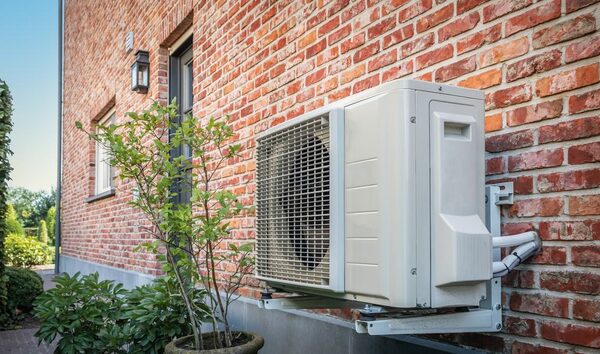
In England, the Planning Portal states that adding air conditioning to a home may be permitted development, provided all the limits and conditions set in legislation are met, covering function, size, placement and the number of units29. Protected areas and listed buildings are the main exceptions:
"If your home is in a protected area such as a Conservation Area then permission will be required."
If the home is a listed building, listed building consent is required29. Separately from planning, "the installation of air conditioning must comply with building regulations", and the Planning Portal advises using an installer who belongs to the Microgeneration Certification Scheme or a relevant Competent Person Scheme29.
In Wales, planning permission is not generally required for installing or replacing electrical circuits30, though an additional air source heat pump at a property that already has one requires an application for planning permission31. Rules differ across the four nations, and each has its own page: England, Scotland, Wales and Northern Ireland. Flats raise lease and freeholder consent as well; see air conditioning in flats.
Planning affects cost directly. An application or listed building consent adds fees and time, and conditions on where the outdoor unit may go can lengthen the pipe run. Where no outdoor unit is possible, through-wall and portable units are the alternatives, described on air conditioning without an outdoor unit.
How long installation takes
No published figure in the evidence here gives a standard duration for fitting air conditioning; installers price by the day2, and the survey sets the number of days. The nearest published comparisons are for air-to-water heat pumps, a larger job involving the heating and hot water system: a typical installation takes around 3 to 5 days32, and the average on site takes 2 to 5 days15. By contrast, heating controls and smart systems are usually installed in a few hours32.
A single wall-mounted unit on a short run is at the quick end; each additional indoor unit, a long or awkward pipe route, or a new electrical circuit adds time and, at a day rate, cost.
Keeping the bill down: capacity, layout and quotes
The largest controllable costs are the size of the system, the layout, and the running hours afterwards.
Capacity. Mitsubishi Electric states that "an approved installer will be able to calculate what the best size air conditioning system will be for your property"10. An oversized unit costs more to buy without cooling better. The same principle holds across heating: the Energy Saving Trust states that topping up wall, floor and loft insulation before installing a heat pump will help reduce its running costs33; Which? advises that a heating system should be sized to suit the reduced demand of a well-insulated home, and that a lower-output system is likely to be cheaper to buy and install, with lower running costs34; and the Centre for Sustainable Energy notes that an insulated, airtight home may get by with a smaller and cheaper boiler35. For cooling, the equivalent is cutting heat gain first; shading and ventilation are covered on passive cooling and external shading.
Layout. Cooling only the rooms that overheat, rather than the whole house, reduces both equipment and pipework. Whether one air conditioner can cool several rooms and which dwellings overheat most help narrow where cooling is needed.
Comparing quotes. Quotes are comparable when each states:
- the exact indoor and outdoor models and their capacity
- the pipe length allowed and the charge for extra metres
- electrical work included or excluded
- the number of days and any access equipment
- the VAT rate applied and its basis
Running costs. Uswitch's view in April 2026 was that "for most households, the best way to cut their bills right now is to ditch the price cap and get a decent fixed-rate deal"36. That is a comparison site's opinion rather than official guidance, and tariff choice is outside the scope of this page.
For a household aiming at independence, the cheapest air conditioning is often the least of it: a smaller system in a home that gains less heat uses less grid electricity and fits more easily within what rooftop solar can supply. The wider picture is on home cooling and energy independence and the full home cooling guide.
Sources36 cited
- How a heat pump can cool your home, Which?, 2026-07-17
- Air source heat pumps vs air conditioning, Hive, 2025-10-17
- Why a heatwave is a good time to think about home heating, Nesta, 2026-07-08
- Air conditioning installation, Wales and West of England, CoolEasy, 2026-09-23
- Is air conditioning worth it in the UK?, Uswitch, 2026
- Summer energy tips, National Energy Action, 2026-08-13
- Air conditioners, Pro Breeze, 2026-09-23
- Should I choose an air source or an air-to-air heat pump?, Nesta, 2025-01-21
- Air-to-air heat pumps, Energy Saving Trust, 2026-09-11
- M Series wall-mounted air conditioning, Mitsubishi Electric, 2026-09-17
- Underfloor heating installation, Warmup, 2026-09-20
- Retrofitting underfloor heating, Warmup, 2026-09-20
- HVAC choices for the home, CIPHE, 2024-03-12
- Beyond affordability: why heat pumps feel like a gamble, Which?, 2026-07-02
- Air source heat pump, Plymouth Energy Community, 2026-09-20
- Getting a heat pump should be a small step, not a giant leap, Nesta, 2024-12-12
- How to make heat pumps more affordable, Nesta, 2024-06-13
- Fixing the levy system could save billions on heat pump subsidies, Nesta, 2025-04-23
- Government must do more to tackle cost and other barriers to heat pumps and EVs, Which?, 2024-11-07
- Using home purchase regulations to grow the market for clean heating in Scotland, Nesta, 2025-05-13
- Draft VAT guidance on changes to energy-saving materials, HM Revenue and Customs, 2026-09-17
- VAT on energy-saving products, HM Revenue and Customs, 2026-09-20
- LG Artcool air conditioning, CoolEasy, 2026-09-23
- Ultra quiet air conditioning, CoolEasy, 2026-09-23
- Home office cooling and heating systems, CoolEasy, 2026-09-23
- Single split air conditioning, CoolEasy, 2026-09-23
- The cost of keeping cool, Uswitch, 2026-04-30
- NAPIT welcomes extra technologies in the Boiler Upgrade Scheme, NAPIT, 2025-11-18
- Planning permission FAQs, Planning Portal, 2026
- Planning permission: electrics, Welsh Government, 2026-09-17
- Planning permission: wind turbines, Welsh Government, 2026-09-17
- How disruptive is retrofit and how to plan it properly, Plymouth Energy Community, 2026-09-20
- Is now a good time to get a heat pump?, Energy Saving Trust, 2025-12-12
- How to make your home more energy efficient, Which?, 2026-05-05
- Upgrading and replacing your boiler, Centre for Sustainable Energy, 2026-06
- Uswitch responds to government plans on gas and electricity prices, Uswitch, 2026-04-20
 The Full Cooling and Air Conditioning GuideDo you really need air conditioning in a British summer, or would a fan and better shading do the job?
 Types of Air ConditioningPortable, wall-mounted, multi-room or ducted: which air conditioning suits your home?
 Running CostsA portable air conditioner costs roughly twenty to forty pence for every hour it runs, while a fixed unit uses far less electricity for the same cooling.
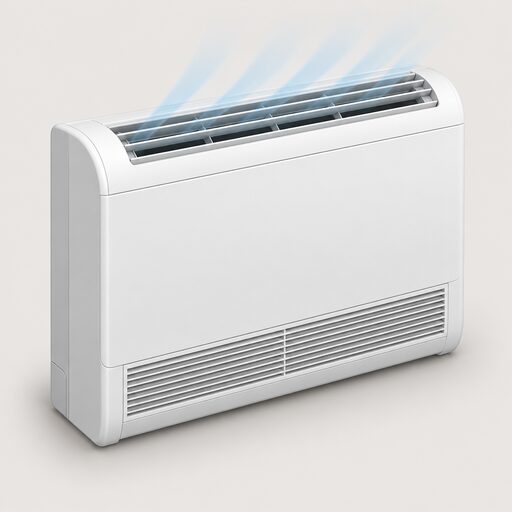 Split Air ConditioningA split air conditioning system cools or heats one room using an indoor unit and an outdoor unit linked by pipes.
 UK Cooling DemandPublished data on air conditioning ownership and home overheating, with projections for summer temperatures in each UK nation, and what rising cooling demand means for summer electricity use.
 Air Conditioning InstallationHow long does air conditioning installation take, and what happens on the day?