
In this guide
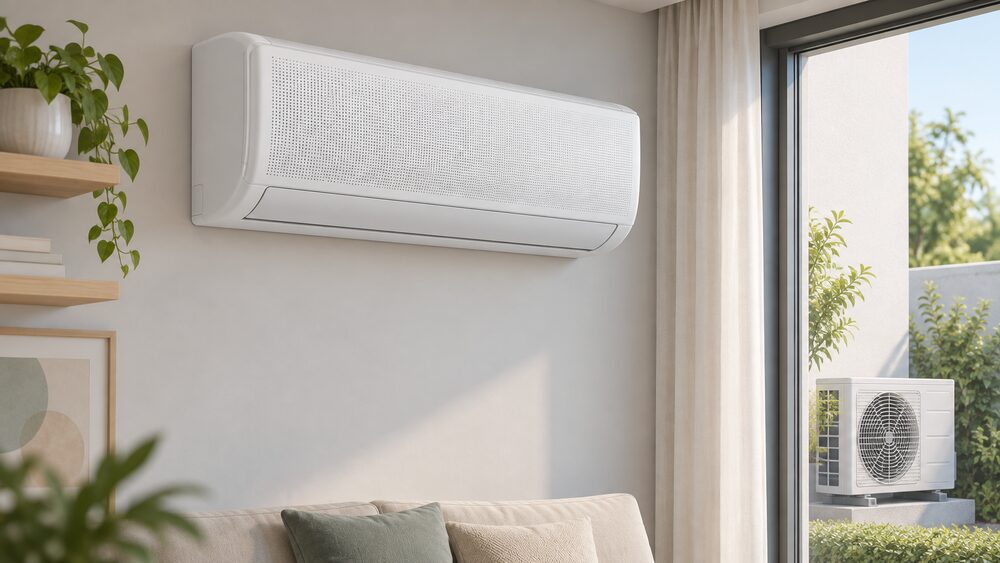
Samsung sells air conditioning in the UK across three indoor formats: high wall units, floor or low wall consoles, and ceiling cassettes. The high wall range is the widest, running from the Cebu S2 at £559.99 down to £466.66 in one listing, through the WindFree COMFORT S2 and WindFree AVANT S2 families, up to the 5.0kW AVANT S2 at £1,299.991. The 1 Way WindFree ceiling system is listed at £1,322.994.
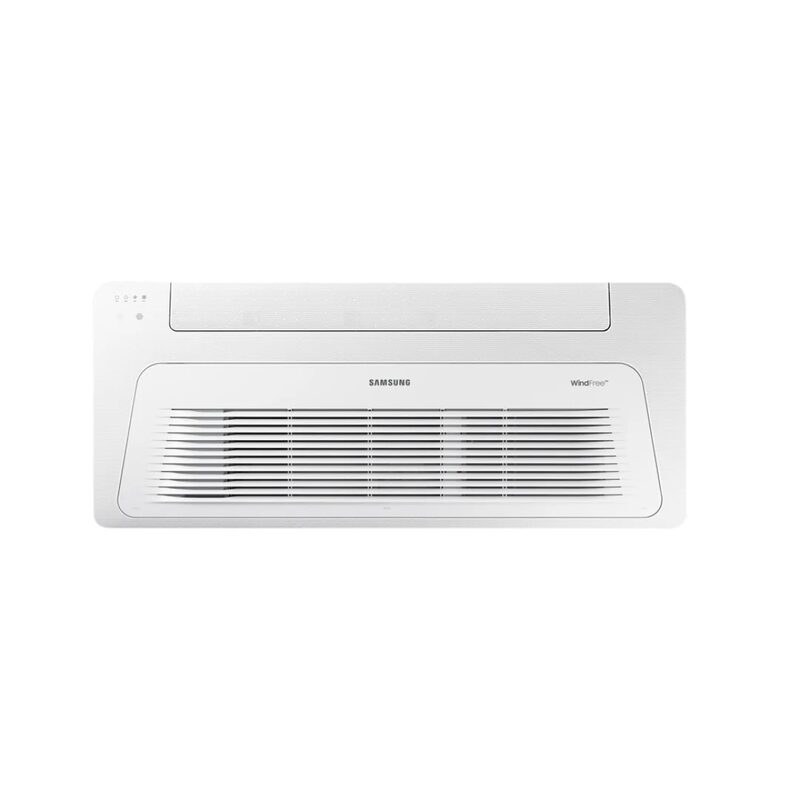
The defining feature of the range is WindFree, which cools a room through thousands of micro-holes in the indoor unit rather than by projecting a directed draught. Samsung describes it as cooling without the discomfort of direct airflow, ensuring a gentle breeze3. The same technology appears on the ceiling unit, where the maker says it disperses fresh air uniformly4.
Capacities follow the standard UK pattern. A 2.5kW unit suits a small room, 3.5kW is given as suitable for up to 30 m², and 5.0kW for up to 45 m²5. Every model in the range is a reverse-cycle heat pump, so it heats as well as cools, and several carry Wi-Fi control through the Samsung SmartThings app1.
The range at a glance: high wall, console and ceiling systems
Samsung's UK air conditioning splits into three mounting families. High wall units are installed high on an interior wall and deliver heating and cooling for a single room, connecting one indoor unit to one outdoor unit2. The Cebu S2 is the entry point, listed with cooling, heating and Wi-Fi functions1. Above it sit the WindFree COMFORT S2 and WindFree AVANT S2, both high wall, both with advanced filtration that captures dust, allergens and pollutants3.
Console units sit at floor level or on a low wall. The Samsung 3.5kW console system is described as perfect for low wall installation, with powerful cooling and heating for consistent comfort through the year9. This format exists for rooms where a high wall position is awkward, and the wider console category is aimed at homes where walls have limited space or are not strong enough to carry a standard unit10.
The ceiling option is the 1 Way WindFree ceiling system, a cassette that uses a one-way airflow design to direct air precisely where it is needed, with even airflow across the room4. It is supplied with basic materials for a domestic single split installation, supporting a standard back-to-back 6m pipe run4.
| Format | Model | Sizes | Control |
|---|---|---|---|
| High wall | Cebu S2 | Not stated | Wi-Fi via SmartThings1 |
| High wall | WindFree COMFORT S2 | Not stated | Not stated8 |
| High wall | WindFree AVANT S2 | 2.5kW, 3.5kW, 5.0kW | Wi-Fi via SmartThings3 |
| Console | Samsung 3.5kW console | 3.5kW | Not stated9 |
| Ceiling | 1 Way WindFree | 2.5kW, 3.5kW | Wi-Fi optional, dongle required4 |
WindFree technology: cooling without direct airflow
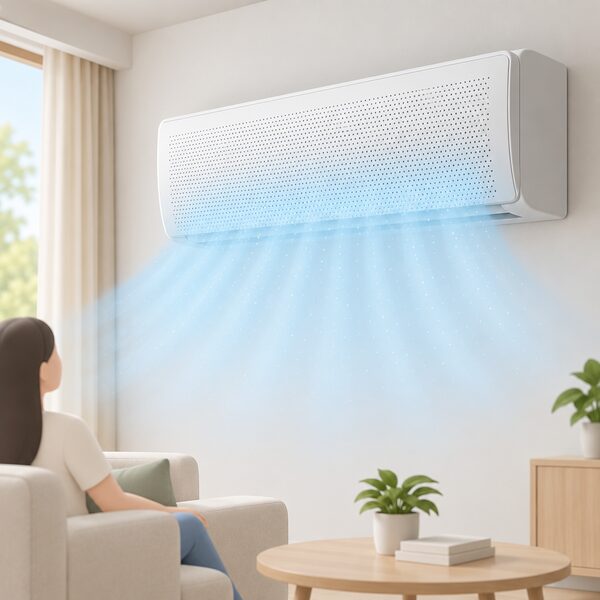
WindFree is Samsung's answer to the main complaint about air conditioning in a home: the draught. Instead of a louvred outlet pushing a stream of cold air across a room, the indoor unit's front panel is perforated with thousands of micro-holes, and cooled air seeps through them uniformly. Samsung's own description is that WindFree technology delivers cooling without the discomfort of direct airflow, ensuring a gentle breeze3. On the ceiling model the maker says the technology uses thousands of micro-holes to disperse fresh air uniformly4.
The practical effect is that a WindFree unit can run for long periods in an occupied room without the sense of being in a draught, which matters in bedrooms and living rooms where a conventional high wall unit blowing directly at a sofa or bed is uncomfortable. The trade-off is that dispersing air through many small openings is a gentler delivery than a focused jet, so a room takes longer to reach temperature than with a direct-blast unit of the same nominal output.
Noise is the other half of the WindFree proposition. Samsung WindFree models are listed among the quietest units in the UK market, operating as low as 19dB, alongside LG Artcool Gallery8. That figure is a maker claim for the quietest models in the range rather than a rating that applies across every size and fan speed.
WindFree is a delivery method, not an efficiency rating. The efficiency of any of these units comes from the inverter compressor, which modulates rather than switching on and off, and from correct sizing for the room. A WindFree unit that is oversized for its room will still cycle and still cost more to run than a correctly sized one.
Sizes and capacities: 2.5kW, 3.5kW and 5.0kW
Samsung's high wall and ceiling ranges are built around three nominal outputs: 2.5kW, 3.5kW and 5.0kW. The AVANT S2 high wall family covers all three3, and the 1 Way WindFree ceiling system comes in 2.5kW and 3.5kW4.
The sizing table used across the UK market maps those outputs to floor area. A 3.5kW unit, equivalent to 12,000 BTU, is given as suitable for rooms up to 30 m² or 300 ft², and a 5.0kW unit, 18,000 BTU, for up to 45 m² or 450 ft²5. For context, the same table puts 1.5kW at 12 m², 7.0kW at 55 m², 12.5kW at 100 m² and 14.0kW at 110 m²5.
Floor area is only the starting point. Guidance for the 3.5kW size describes it as often better for larger bedrooms, larger home offices, garden rooms, small living rooms, or spaces with more sunlight and glazing4. A south-facing garden room with a lot of glass can need the next size up for the same floor area, and a well-shaded bedroom of the same size can be comfortable on the smaller unit.
For a fuller treatment of matching output to room, see what size air conditioner you need and the direct comparison of 2.5 kW and 3.5 kW units.
Prices: what Samsung systems cost in the UK
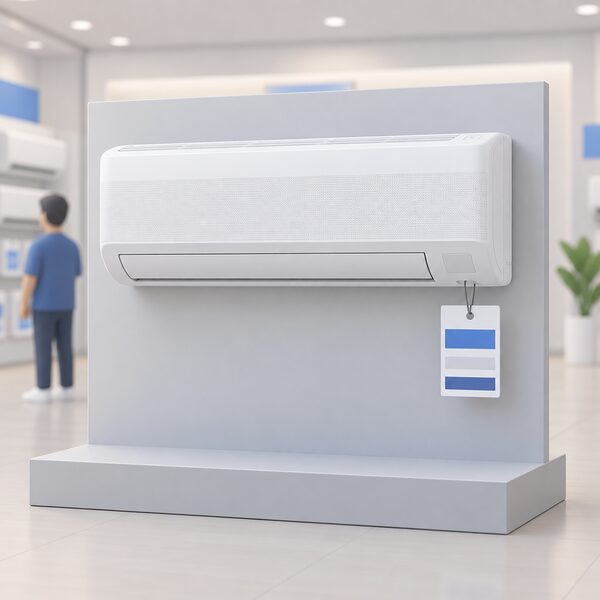
Samsung air conditioning prices in the UK are published as unit prices by retailers, not as installed prices, and several models carry two figures. The Cebu S2 high wall system is listed at £559.99 and £466.661. The WindFree AVANT S2 2.5kW is listed at £736.66 and £883.99, and the 3.5kW at £804.16 and £964.993. The 5.0kW AVANT S2 is listed at £1,299.99, with a high street figure of £1,241.667.
The WindFree COMFORT S2 appears at £62.50 in one listing and £75.00 in another, with high street figures of £794.99 and £662.49, and a sale price of £599.99 excluding VAT8. The 1 Way WindFree ceiling system is listed at £1,322.99 and £1,102.494. The Samsung 3.5kW console system is listed at £1,149.99 including VAT and £958.33 excluding VAT9.
| Model | Listed price | Second figure |
|---|---|---|
| Cebu S2 high wall | £559.99 | £466.661 |
| WindFree AVANT S2 2.5kW | £736.66 | £883.993 |
| WindFree AVANT S2 3.5kW | £804.16 | £964.996 |
| WindFree AVANT S2 5.0kW | £1,299.99 | £1,241.66 high street7 |
| WindFree COMFORT S2 | £62.50 | £75.008 |
| 1 Way WindFree ceiling | £1,322.99 | £1,102.494 |
| Samsung 3.5kW console | £1,149.99 inc VAT | £958.33 ex VAT9 |
Where two figures exist for the same model, both are given here. VAT treatment is stated on only some listings, so a quoted price should be confirmed as inclusive or exclusive before comparing. None of these figures includes installation, pipework, electrical work or commissioning, and there is no published installed price for a Samsung system in the UK. For the wider picture on installed costs, see how much air conditioning costs to buy and install.
Controls and SmartThings: Wi-Fi remote access
Samsung's control layer is the SmartThings app, which the maker describes as connecting, automating and managing Samsung and SmartThings-compatible appliances and electronics in a single app13. On the air conditioning side, the WindFree AVANT S2 5.0kW lists Wi-Fi control allowing remote access and adjustments through the app7, the 2.5kW AVANT S2 lists the same11, and the Cebu S2 high wall system lets settings be adjusted remotely through it2.
The 1 Way WindFree ceiling system is different: Wi-Fi control there is optional and requires a Wi-Fi dongle, after which remote operation and adjustments work through the app4. That unit also carries AI Auto Comfort, which analyses room conditions and usage patterns and adjusts the temperature automatically, with remote management through SmartThings4.
The dependence this creates is worth stating plainly. Local control at the indoor unit and through its own remote continues without an internet connection, but scheduling from outside the home, energy monitoring and any remote diagnostics run through a home broadband connection, Samsung's servers and a manufacturer's app. If the broadband drops or the service changes, the remote layer goes with it. Independent guidance on smart heating makes the same point in general terms: app control gives comfort at your fingertips from anywhere, and it is a convenience layer on top of the system rather than the system itself14. Official sustainability guidance for self-build homes recommends smart systems that control lighting, heating and cooling based on occupancy and time of day15. More on this subject sits in air conditioning controls and Wi-Fi.
Filtration and inverter efficiency
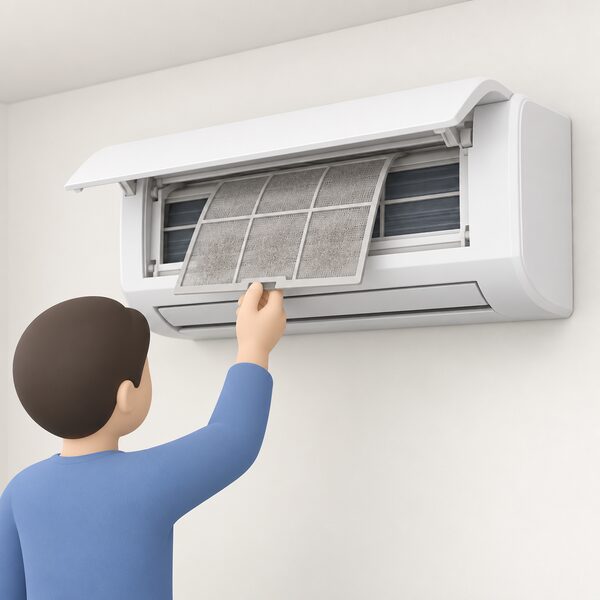
Every Samsung air conditioning model in the UK range uses inverter technology, which varies compressor speed rather than switching it on and off, holding room temperature steadier and reducing electricity use compared with a fixed-speed unit. The Cebu S2 lists inverter technology for energy efficiency2, the 3.5kW console system lists energy-efficient performance through advanced inverter technology9, and the WindFree COMFORT S2 lists inverter technology providing energy-efficient performance while reducing electricity consumption8. The wider UK market describes the same principle: many models include inverter technology, reducing energy use and maintaining a consistent temperature12, and easy-fit single split systems use inverter technology to optimise energy consumption13.
Filtration is the other feature Samsung promotes on the WindFree high wall units. The AVANT S2 range lists advanced filtration that captures dust, allergens and pollutants for cleaner, healthier air8. That is a maker claim about the filter's capture performance, and it depends on the filter being cleaned or replaced on schedule; a loaded filter restricts airflow and works against the efficiency the inverter is there to provide.
Neither inverter technology nor filtration changes where the electricity comes from. A Samsung air conditioner is an electric appliance, and its running cost tracks the electricity price and the number of hours it runs. Independent consumer guidance notes that air drying laundry is free, a reminder that not every cooling or drying job in a home needs a powered appliance16. Running costs for this category are covered in air conditioning running costs.
Console systems and how they compare with LG
The console format is the answer for rooms where a high wall unit will not fit or will not look right. Samsung's 3.5kW console system is described as perfect for low wall installation, with powerful cooling and heating9. The wider console category is aimed at homes where walls have limited space or are not strong enough to support a standard air conditioning unit; consoles connect to an outdoor unit and most can also heat rooms when it is cooler outside, offering an alternative to traditional heating systems10.
LG's console system is the direct comparator. It is described as perfect for low wall installation, fitting under windows or along walls, and it uses a dual airflow system delivering cooling from both top and bottom vents9. The LG 3.5kW console is given as covering up to 30 m² and carries Wi-Fi-enabled smart control through the LG ThinQ app17. Hitachi's console range takes a different approach to air distribution, emitting air from the bottom of the unit so it rises gradually through the room for consistent heating, and using a high-efficiency inverter compressor for low-energy heating and cooling18.
| Feature | Samsung 3.5kW console | LG 3.5kW console |
|---|---|---|
| Mounting | Low wall9 | Low wall, under windows or along walls9 |
| Coverage | Not stated | Up to 30 m²17 |
| Airflow | Not stated | Dual airflow, top and bottom vents17 |
| App control | Not stated | LG ThinQ17 |
| Price | £1,149.99 inc VAT, £958.33 ex VAT9 | Not stated |
The comparison is not a ranking. Console units suit different rooms for different reasons, and the choice turns on where the unit can physically go, how the air is distributed once it is there, and which control ecosystem the household already uses. A wider view of the format is in types of air conditioning.
What a Samsung system means for household energy independence
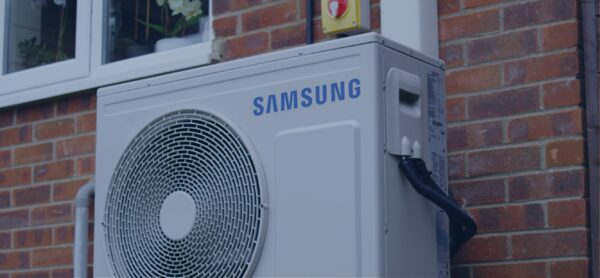
A Samsung air conditioner is a reverse-cycle heat pump, so it moves heat rather than generating it, and that is the source of its efficiency advantage over a resistive heater. The same principle runs through Samsung's monobloc heat pumps, which the maker says convert heat from the outside air to indoor heat through radiators, underfloor heating and hot water20. Official guidance for Northern Ireland states that a heat pump can give both heating and cooling, making it versatile21, and independent guidance notes that many heat pumps function as heating and cooling systems and can provide summer air conditioning22.
What that buys a household is a reduction in the energy needed per unit of heat or cooling delivered, and a shift of the remaining demand onto electricity. It does not buy independence from the grid. A Samsung air conditioner runs on mains electricity from a supplier, and its outdoor unit, refrigerant circuit and controls are the manufacturer's. The SmartThings layer adds a dependence on broadband and on Samsung's servers for anything beyond local control.
The wider case for decentralised energy is that it brings better energy security, cost savings for homes, reduced carbon emissions, increased grid resilience and empowerment for people23. A home only reaches that position through generation and storage of its own, not through a more efficient appliance. Independent guidance on decarbonising social homes defines a decarbonised home as adequately insulated and heated by clean heat technology, typically a heat pump24, which places insulation and system balancing ahead of equipment choice. Balancing a heating system lets radiators heat evenly and in most cases lets the boiler run at a lower temperature, increasing efficiency with cost savings and emission reductions25.
For a household weighing a Samsung system, the honest position is this: it is an efficient way to cool and heat a room, it can replace some gas or resistive heating with a heat pump cycle, and it leaves the home on the electricity grid, on a supplier, and on a manufacturer's app for its remote features. The routes that change that position are covered in home cooling and energy independence and air conditioning that heats.
Sources25 cited
- High wall mounted air conditioning systems, CoolEasy, 2026-09-23
- High wall mounted single split air conditioning systems, CoolEasy, 2026-09-23
- Living room cooling and heating systems, CoolEasy, 2026-09-23
- Samsung 1 Way WindFree ceiling system, CoolEasy, 2026-09-23
- Air conditioning size guide, CoolEasy, 2026-09-23
- Kitchen cooling and heating systems, CoolEasy, 2026-09-23
- Conservatory cooling, CoolEasy, 2026-09-23
- Ultra quiet air conditioning for peaceful spaces, CoolEasy, 2026-09-23
- Conservatory cooling and heating systems, CoolEasy, 2026-09-23
- Air conditioning and heat pump systems for home renovations, CoolEasy, 2026-09-23
- Home office cooling and heating systems, CoolEasy, 2026-09-23
- Easy-fit air conditioning, CoolEasy, 2026-09-23
- Easy-fit single split air conditioning systems, CoolEasy, 2026-09-23
- Take control of your comfort with smart heating, Plymouth Energy Community, 2026-09-20
- Self-build homes sustainability, Planning Portal, 2026
- Save money using your electrical appliances, Citizens Advice, 2023-05-10
- Console air conditioners, Hitachi Air Conditioning, 2026-09-17
- Air conditioner buying guide, Hitachi Air Conditioning, 2026-09-17
- How does air conditioning work, Hitachi Air Conditioning, 2026-09-17
- Samsung heating, Samsung, 2026-09-18
- Heat pumps, nidirect, 2025-02-24
- Heat pumps vs boilers, The CPA, 2025-02-18
- How does energy get to our homes, Low Carbon Hub, 2023-06-02
- Hard to decarbonise social homes, National Housing Federation, 2022-07-20
- Consumer guide to balancing the central heating system, HHIC, 2018-04-11
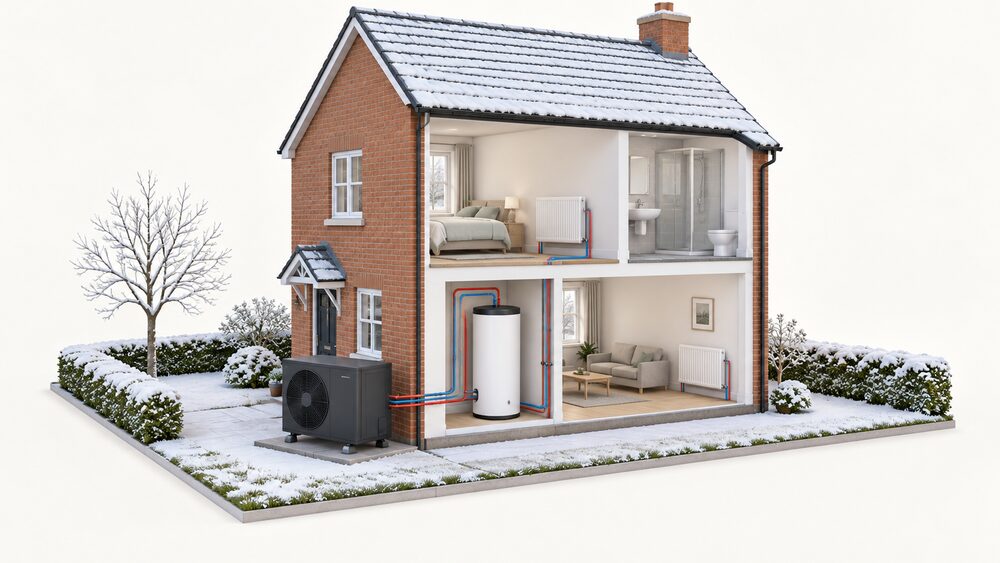 Samsung EHS heat pumps in the UKSamsung EHS is the company's air to water heat pump line for UK homes, sold as monobloc units in single and three phase versions.