In this guide
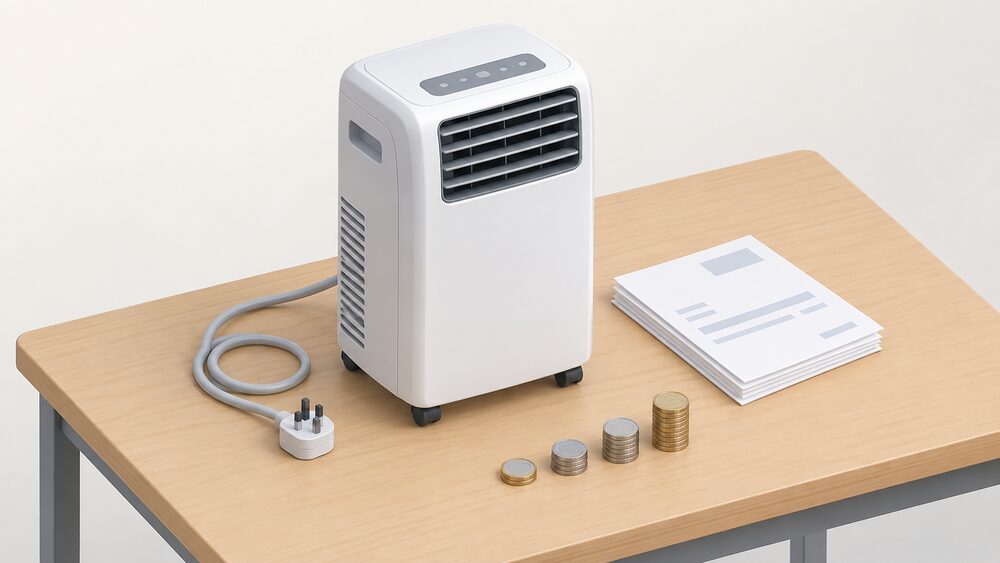
A typical portable air conditioner draws 0.75 to 1.5 kW of electricity, which at the July 2026 Ofgem price cap unit rate of 26.11p per kWh costs about £0.20 to £0.39 for each hour it runs at full power1. National Energy Action gives almost the same band, around 26 to 39p an hour for a typical 1,000 to 1,500W portable unit, and notes that this is roughly 14 to 20 times the cost of running a fan2.
Over a week of heavy summer use the totals become noticeable. Modelling published in April 2026 put a 1kW portable unit, run for an average of 9.1 hours a day for seven days, at £13.37 a week on the cheapest fixed rates, and a 2.7kW built-in unit at £36.10 a week on the same rates, rising to £42.43 a week at the April price cap3. Portable units also use 30 to 50% more electricity than fixed systems4.
The running cost of any air conditioner comes down to three things: the power it draws, the hours it runs and the price paid per kWh. This page works through each, then covers efficiency ratings, heating mode, setup, planning rules, VAT relief and where free advice on bills is available. All the electricity it uses comes from the grid or from home generation; air conditioning adds to a household's electricity demand, and so to its exposure to supplier prices.
What it costs to run: the headline figures
Air conditioning sits among the heavier electrical loads in a home. The Centre for Alternative Technology describes bolt-on cooling systems as tending to "use a lot of electricity, leading to higher bills"6. End Fuel Poverty Coalition material reports that using air conditioners increases energy bills by 42%7. That figure is reported without a stated household type or period, so it indicates scale rather than a rule for any given home.
Set against familiar appliances, the scale becomes clearer. Which? testing found washer dryers to be the costliest appliances to run, at over £216 a year on average8. An F-rated fridge freezer costs £93.50 a year to run9, and the most expensive air fryer Which? tested costs £53 a year10. A portable air conditioner at the top of the 0.75 to 1.5 kW band, costing up to £0.39 an hour1, spends in a single hour what an efficient appliance might use over days. The difference is that cooling demand is seasonal and concentrated: a week of hot weather can account for a large share of a year's cooling cost.
The table below brings together the weekly figures modelled for April 2026, assuming 9.1 hours of use a day for seven days3.
| Device | Power | Weekly cost, cheapest fixed rates | Weekly cost, April 2026 price cap |
|---|---|---|---|
| Portable air con unit | 1kW | £13.37 | not stated |
| Built-in air con unit | 2.7kW | £36.10 | £42.43 |
| Air cooler | 75W | £1 | not stated |
The built-in unit's higher weekly total reflects its higher power draw in this model; fixed systems generally deliver more cooling per unit of electricity than portables4, so the weekly bill depends as much on what the unit is sized to do as on its type. For purchase and installation prices, see how much air conditioning costs to buy and install.
Running cost per hour and per day: worked examples
The formula
Every hourly running cost on this page follows the same arithmetic. National Energy Action in Northern Ireland sets it out as:
"Appliance running cost (p/hr) = Power rating (W) x Electricity unit rate (p/kWh) ÷ 1000"
Which? gives a worked case with a different appliance: a 2,000 watt (2kW) washing machine run for an hour uses 2kWh, costing 52p at 26p per kWh12. The Centre for Sustainable Energy shows how the same logic extends to a whole day: a 500W dehumidifier running for 24 hours uses 12kWh, which at 26p per unit comes to £3.1213. Which? also shows how the unit rate changes the answer: at 27.69p per kWh, a 2kW fan heater costs 55p every hour14.
Applying it to air conditioning
The inputs that matter for an air conditioner are its rated power input (not its cooling output), the hours it actually runs at that power, and the unit rate on the household's tariff. Uswitch's per-hour band for portable units rests on a 0.75 to 1.5 kW power rating and the July 2026 cap rate of 26.11p per kWh1. National Energy Action's slightly lower fan figures use 25.7p per kWh2, which is why published costs differ by a penny or two for the same device.
| Appliance | Power or condition | Stated running cost |
|---|---|---|
| Portable air conditioner | 0.75 to 1.5 kW, 26.11p/kWh | £0.20 to £0.39 per hour1 |
| Portable air conditioner | 1,000 to 1,500W | around 26 to 39p per hour2 |
| Dehumidifier | depends on size and settings | about 4p to 15p per hour15 |
| Fan heater | 2kW at 27.69p/kWh | 55p per hour14 |
| Pedestal fan | 50W at 25.7p/kWh | 1.3p per hour2 |
For a daily figure, the maker of the electriQ AirFlex 14000 BTU portable air conditioner states a running cost of £1.50 per day, based on typical daily use of 4 hours16. That is a maker's claim for its own product; the assumptions on unit rate and duty cycle behind it are not given alongside.
Time of use tariffs
On a time of use tariff the unit rate in the formula changes through the day, so the hour a unit runs changes the cost as much as its power does. Pre-cooling a room during a cheaper period, or running cooling from rooftop solar generation, reduces what is bought from the grid at peak rates. No published tariff rates for cooling are given here; the tariff guides and the page on running air conditioning on solar panels cover how households use them.
Why a 1.5 kW unit can deliver 4 kW of cooling
An air conditioner does not make cold; it moves heat out of a room using a refrigerant cycle, so the cooling it delivers can exceed the electricity it uses. The Centre for Sustainable Energy's summer fuel poverty modelling assumes a cooling system operating at a coefficient of performance (COP) of 3.5, where "1 kWh electricity gives 3.5 kWh cooling"17.
This is why two different kilowatt figures appear on a specification sheet. The cooling output describes how much heat the unit can remove; the power input sets the bill. A sizing guide notes that a 3.5 kW air conditioning system can provide around 3.5 kW of cooling output18, meaning the 3.5 kW label refers to the cooling capacity, not the electricity drawn. The electriQ AirFlex 14000 BTU unit is listed with 4.1kW of cooling power against a running power consumption of 1.5 kW16.
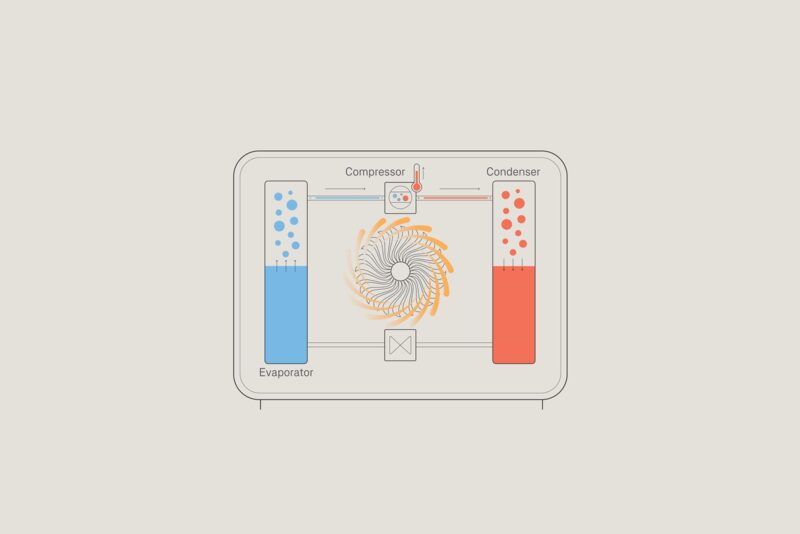
By contrast, an evaporative air cooler at 75W3 uses a small fraction of an air conditioner's power, but it works by evaporating water rather than running a refrigerant cycle, and the comparison is covered in portable air conditioner vs evaporative cooler.
What this means in practice is that running cost is set by the power input figure multiplied by hours and unit rate. A unit marketed by its cooling capacity or BTU rating tells a household how much heat it can shift, not what it will cost; the power input line on the specification is the one that feeds the bill calculation.
Efficiency ratings: what A/A+ means for the bill
Energy labels on air conditioners changed format. Hitachi's guidance advises equipment with "A, B or C efficiency (until 2022 classified as A+, A++ or A+++)"19. A label reading A+ on older stock and one reading A on newer stock can therefore sit in similar territory, and the letter alone does not give a running cost.
For fixed comfort cooling in new and altered dwellings in England, Approved Document L sets a performance floor: the seasonal energy efficiency ratio of an air conditioner working in cooling mode "should be a minimum of 4.0"20. The seasonal ratio averages performance over a cooling season rather than at a single test point, which is closer to how a unit behaves in a home.
Efficiency also varies by system type. Which? notes that air-to-air heat pumps (the fixed split systems commonly called air conditioning) have "lower running costs than with other types of electric heating and plug-in air conditioning"21. Independent guidance puts the gap between portable and fixed units at 30 to 50% more electricity for the portable4. Inverter compressors, which modulate speed rather than switching fully on and off, are one reason fixed and better portable units hold a room at temperature with less electricity; the comparison is set out in inverter vs non-inverter portable air conditioners.
For a household, the efficiency rating works on the power input side of the formula: a more efficient unit draws fewer kWh for the same cooling, so every hour costs less at any unit rate. The full explanation of SEER, SCOP and EER is on the air conditioning efficiency ratings page.
The electriQ AirFlex 14000 BTU: a portable with heating
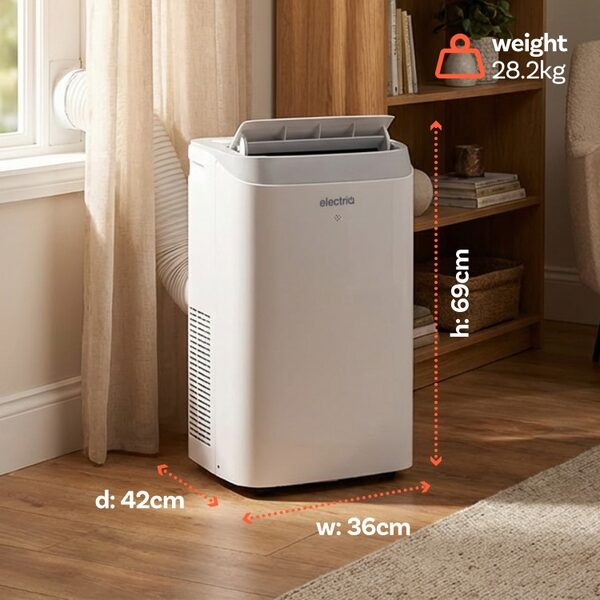
The electriQ AirFlex 14000 BTU Portable Air Conditioner with Heating Function and Venting Kit is a single-hose portable unit sold in the UK. All the figures below are the maker's own16.
| electriQ AirFlex 14000 BTU specification | Maker's figure |
|---|---|
| Cooling power | 4.1kW |
| Heating output | 3.2 kW |
| Running power consumption | 1.5 kW (cooling), 1.5 kW (heating) |
| Running current | 7 Amps (cooling) / 6.8 Amps (heating) |
| Energy rating | A/A+ |
| Hose length | 1.5m |
| Stated running cost | £1.50 per day, based on 4 hours' typical use |
| Warranty | 12 Month warranty |
At 1.5 kW of input the unit sits at the top of the portable power band, where independent figures give up to £0.39 an hour at the July 2026 cap1. The A/A+ label uses the pre-2022 style described above19.
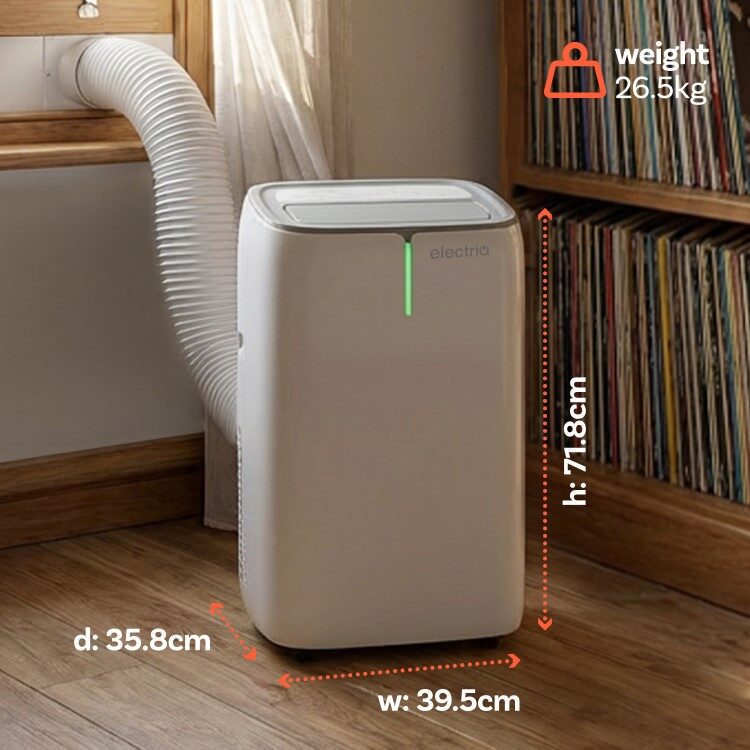
Across the market, portable packaged air conditioners cost between £170 and £700 depending on capacity and features, according to Netatmo22. Portables sit on castors so they can be wheeled between rooms, but they can only cool small spaces22. A fixed wall mounted unit costs more but "will generally be more efficient at cooling the home"22. The portable's independence lies in needing no installer or outdoor unit; the dependence that remains is the grid, and the higher electricity draw per unit of cooling. Other models are covered on the portable air conditioners page and in single hose vs dual hose portable air conditioners.
Matching the unit to the room

Sizing affects running cost from both directions. An undersized unit runs flat out for long periods without reaching the set temperature; an oversized one costs more to buy and draws more power than the room needs. Published sizing tables relate cooling output to floor area18:
| Cooling output | BTU | Room size up to |
|---|---|---|
| 6.2 kW | 21,000 BTU | 50 m² / 500 ft² |
| 10.0 kW | 34,000 BTU | 80 m² / 800 ft² |
| 12.5 kW | 43,000 BTU | 100 m² / 990 ft² |
| 14.0 kW | 48,000 BTU | 110 m² / 1,090 ft² |
Sizing tables do not all agree. One maker's table pairs 34,000 BTU with 80 m² or 800 ft², while another row elsewhere pairs 27,000 BTU with 65 m² or 645 ft², so there is no single agreed figure for how much capacity a given area needs. These are rules of thumb built on assumed ceiling heights, glazing and insulation, and a sunny top-floor room or conservatory needs more capacity than the same floor area in a shaded, well-insulated room. A 14000 BTU unit such as the AirFlex falls below the smallest row in the table above, so it suits a single room rather than an open-plan floor.
For fixed systems, Which? cites Energy Saving Trust figures of around £1,900 to install a single-unit system serving a single room21. Heat gain from larger homes also scales: Energy Saving Trust notes that bigger houses are likely to cost more to run because there is more space to condition, a point made about heating that applies equally to cooling. For worked conversions, see air conditioner kW to BTU conversion and what size air conditioner is needed.
Heating mode: running costs in winter as well as summer
Reverse-cycle units heat as well as cool, and in heating mode the same principle applies: the unit moves heat into the room, delivering more heat than the electricity it uses. The electriQ AirFlex 14000 BTU is rated at 3.2 kW of heat output for 1.5 kW of power input, according to its maker16. Packaged reverse cycle air conditioners offering both cooling and heating cost from £400 to £2,000 depending on features22.
Direct electric heating costs more to run. A 2kW fan heater costs 55p an hour at 27.69p per kWh14. Which? calculated that a Dimplex Rugged Fan Heater used for four hours a day from November to February (20 weeks) would cost £414.4023. A direct electric heater turns each kWh into one kWh of heat, so its running cost follows its rating directly.
The Centre for Sustainable Energy's comparison of electric heating puts whole-home heat pumps at around £800 to £1,050 a year to run, "one of the cheapest electric heating options", against a typical £912 a year for night storage heaters in a flat24. Those are whole-home heating figures, not room air conditioners, but they show the same pattern: heat-moving systems sit at the lower end of electric heating costs.
For a household, a reverse-cycle unit used in winter spreads its purchase cost across two seasons and can reduce reliance on gas for a single room. The dependence on the grid and on the electricity unit rate stays, and a portable still uses 30 to 50% more electricity than a fixed system4. The comparison is covered on air conditioning that heats and air conditioning vs electric heater efficiency.
Drain hose and venting: what setup affects performance
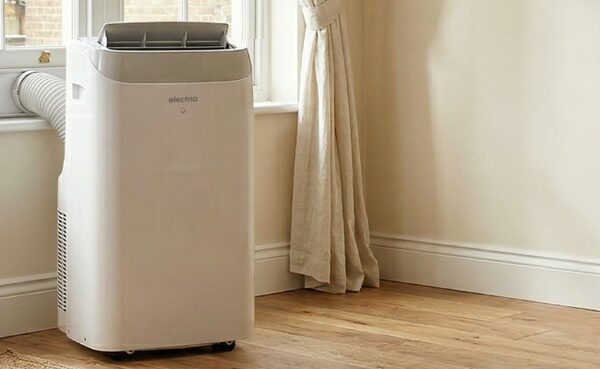
Two setup choices affect how much electricity a portable unit uses for a given amount of cooling: how the warm exhaust air leaves the room, and how condensate is handled.
A single-hose portable pushes warm air out through its exhaust hose; the AirFlex 14000 BTU ships with a 1.5m hose and a venting kit16. A long, kinked or poorly sealed hose, or a gap around the window kit, lets heat back in, so the unit runs longer to hold the set temperature. That is one reason portable units use 30 to 50% more electricity than fixed systems, where the heat is rejected by a separate outdoor unit4.
On condensate, the retailer states that the electriQ AirFlex 15 is self-evaporating in cooling mode and needs a drain hose only when its tank is full (shown by an E4 error code) or in dehumidifier mode, with a hose of about 13 mm internal diameter on the drain port. Other portable models and all fixed split systems handle condensate in their own way.
In practice, the unit's rated power is the ceiling on what it draws; setup decides how many hours it spends near that ceiling. For more detail, see does a portable air conditioner need a drain hose and does a portable air conditioner need venting outside.
Planning and permitted development: rules for fixed air conditioning
Portable units need no consent. Fixed systems with an outdoor unit are subject to planning and building rules that differ across the four nations.
In England, the Planning Portal states that adding air conditioning "may be considered permitted development provided all the limits and conditions set" in legislation are met, with limits covering function, size, placement and the number of units. Protected areas are treated differently: "If your home is in a protected area such as a Conservation Area then permission will be required", and a listed building needs listed building consent25. Installing a fixed air-conditioning system is also listed by GOV.UK as an alteration that falls within building regulations approval26.
Local planning services can confirm whether a project needs permission, sometimes for a fee. Frome Town Council notes that Somerset's "Do I Need Planning Permission?" service charges £66.50 as of August 202527.
| Nation | Point relevant to fixed cooling |
|---|---|
| England | May be permitted development within limits; permission in Conservation Areas; listed building consent for listed buildings25 |
| Scotland | The impact assessment on permitted development rights puts the planning application fee for domestic air source heat pumps at £20228 |
| Northern Ireland | Energy performance regulations set a £300 penalty charge for breaches of air-conditioning inspection and record duties29 |
| Wales | Covered on the Wales planning page |
The Northern Ireland penalty relates to specific inspection duties under the 2008 regulations; it is shown here as the figure those regulations give, not as a general charge on householders. Nation-specific guidance is on air conditioning planning permission in England, Scotland, Wales and Northern Ireland.
VAT relief: 0% until 31 March 2027
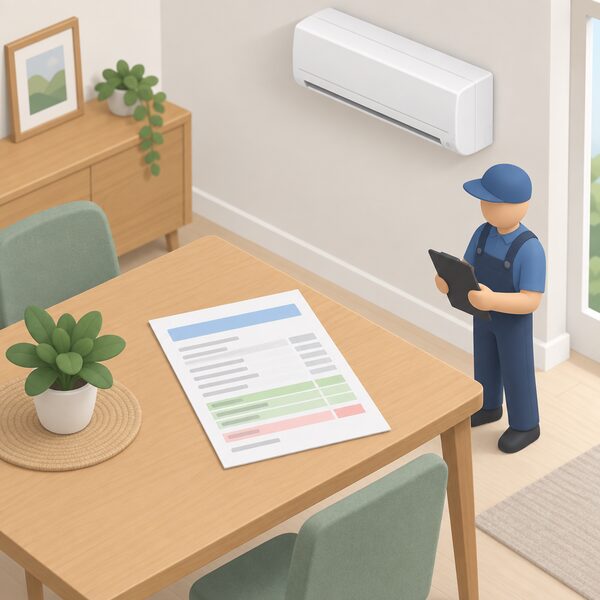
Qualifying energy-saving materials installed in homes are currently zero-rated for VAT. The legislation states the relief "is currently set to a temporary zero rate of VAT which applies until 31 March 2027"5, and the implementing regulations set the rate "from 1st February 2024 to 31st March 2027"30. HMRC guidance repeats that energy saving materials "are subject to VAT relief at 0% until 31 March 2027"31, and government guidance on the extension confirms the zero rate for installations in residential accommodation to the same date32.
In Great Britain, GOV.UK states households pay 0% VAT on both certain products supplied by the installer and the cost of all work to install those products33. The relief applies to installation: a portable unit bought off the shelf is not an installation. Whether a given air conditioning system qualifies turns on how the relief defines the products, so installers set out the VAT position on their quotes.
When a reduced rather than zero rate applies, earlier HMRC guidance illustrates the arithmetic with an insulation example: "5% of £1,000 = £50"34. VAT affects the upfront price, not running cost; it has no bearing on the electricity each hour of cooling uses. Grant availability is covered on are there grants for air conditioning.
Why households are considering cooling, and the cost barriers
Summer heat inside UK homes is now a subject of official study. The Climate Change Committee's work with Arup on existing homes considers "the current and future risks posed by summertime overheating" to the housing stock, which factors influence risk, and how homes can be adapted and at what cost35. The wider picture is on will UK homes need air conditioning.
Running costs are a recognised brake on new electric systems. In the Winter 2025 public attitudes tracker, 35% of owner-occupiers unlikely to install low carbon heating cited concerns about running costs36. National Energy Action reports that its advisers are "increasingly discussing" year-round comfort, including managing ventilation, reducing overheating and understanding the costs of cooling devices such as electric fans37.
Measures that cut heat gain reduce how long a unit needs to run. Solid wall insulation is described as bringing benefits including being cheaper to run and "feeling warmer in winter and cooler in summer"38. How cost is spread also shapes decisions: in Nesta's trial, 53% of respondents (n = 467) in one condition said spreading costs over monthly payments at 0% interest made low-carbon heating affordable39.
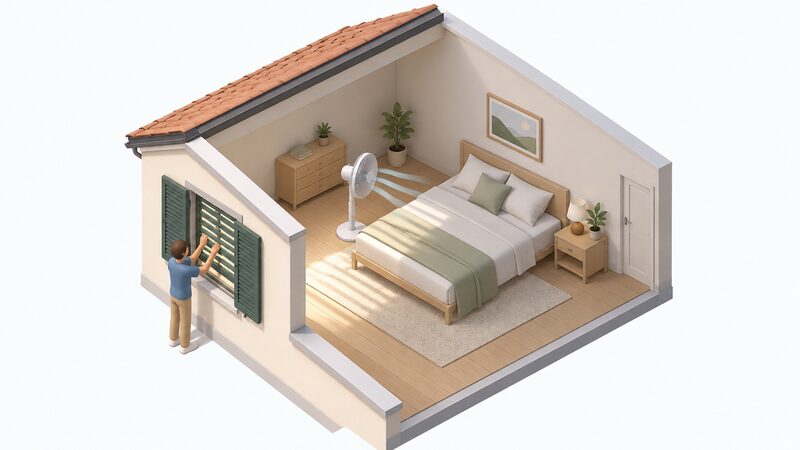
For energy independence, the most secure kWh is the one not used. Passive cooling, external shading and night ventilation lower the load before any electricity is bought; a fan at around 3p an hour4 then covers many hot days, as set out in air conditioning vs fans. Air conditioning remains dependent on grid supply, the unit rate and, for fixed systems, an F-gas certified engineer for servicing.
Help with bills: where to get free advice
Several free services give advice on energy bills, including the cost of cooling:
- WASH helpline: a free support service giving advice to householders in England and Wales on their energy bills and keeping warm40.
- National Energy Action: publishes summer energy tips with running costs for fans and portable air conditioners2, and its advisers cover ventilation and overheating37.
- Centre for Sustainable Energy: publishes guidance on keeping homes cool in hot weather and on working out appliance electricity use4.
- Local authority schemes: Manchester, for example, runs a free Home Repairs Support Service41; similar help varies by council.
Advice is not the same in every nation: WASH covers England and Wales, while National Energy Action publishes separate leaflets for Northern Ireland11. The page on whether there is a Hot Weather Payment covers state support during heatwaves, and home cooling and energy independence sets cooling within the wider aim of a self-sustaining home. The full guide to cooling is at home cooling and air conditioning.
Sources41 cited
- Is air conditioning worth it in the UK?, Uswitch, 2026
- Summer energy tips, National Energy Action, 2026-08-13
- The cost of keeping cool, Uswitch, 2026-04-30
- How to keep your home cool in hot weather, Centre for Sustainable Energy, 2026-07
- Explanatory memorandum, VAT energy-saving materials 2024, legislation.gov.uk
- Home cooling, Centre for Alternative Technology, 2025-06-27
- How fuel poverty is still an issue during the summer, End Fuel Poverty Coalition, 2025-08-31
- 10 ways to save on energy bills, Which?, 2026-08-27
- How to save energy at home: home appliances, Ivie
- How much your appliances cost to run, Which?, 2026-10-01
- Electrical items cost leaflet, National Energy Action NI, 2025-04
- How to estimate your energy use, Which?, 2026-08-03
- How much electricity am I using?, Centre for Sustainable Energy, 2026-07
- Are electric heaters eco-friendly?, Which?, 2026-01-15
- Condensation, damp and mould, Plymouth Energy Community
- electriQ AirFlex 14000 BTU portable air conditioner, electriQ, 2026-09-23
- Summer fuel poverty and the new price cap, Centre for Sustainable Energy, 2026-08-26
- Air conditioning size guide, CoolEasy
- How to calculate air conditioning power for a surface area, Hitachi
- Approved Document L, Volume 1: Dwellings, GOV.UK
- How a heat pump can cool your home, Which?, 2026-07-17
- Packaged air conditioning, Netatmo
- Beware cheap appliances that cost you twice as much, Which?, 2024-03-05
- Electric heating, Centre for Sustainable Energy, 2026-06
- Planning permission FAQs, Planning Portal
- Building regulations approval, GOV.UK
- Planning and solar, Frome Town Council, 2025-08
- Permitted development rights: impact assessments, Scottish Government
- Energy Performance of Buildings Regulations 2008, Building Control NI, 2008-04-10
- The Value Added Tax (Installation of Energy-Saving Materials) Order 2024, legislation.gov.uk, 2024-01-10
- VAT rates on goods and services, HMRC, 2026-07-10
- Extension of VAT energy-saving materials relief, GOV.UK, 2024-01-11
- Tax on shopping: energy-saving products, GOV.UK
- Draft VAT guidance on energy-saving materials, HMRC
- Addressing overheating risk in existing UK homes, Climate Change Committee
- DESNZ Public Attitudes Tracker: heat and energy use, Winter 2025, Department for Energy Security and Net Zero, 2025
- Beyond retrofit, National Energy Action, 2026-07-14
- Insulating solid walled homes can save on energy bills, SWIGA
- Testing offers for a coordinated approach to low-carbon heating, Nesta, 2025-04-14
- Lived experiences of fuel poverty, National Energy Action, 2026
- Home improvement assistance, Manchester City Council
 Air Conditioning CostPublished UK equipment prices and the parts of an installed price for portable, single split, multi-split and whole-house air conditioning.
 Appliance Running CostsWorking out what your appliances cost to run comes down to two things: how much power they use and what you pay per unit of electricity.
 Electric Radiators and PanelsDo electric radiators cost more to run than gas heating, and are they worth it for one room or a whole house?
 Portable Power Station CostHow much does a portable power station cost in the UK, and what does the money actually buy?
 Electric Heating CostsHow to work out what electric radiators, panel heaters, infrared and storage heaters cost to run per hour and per season.
 Split Air ConditioningA split air conditioning system cools or heats one room using an indoor unit and an outdoor unit linked by pipes.