

In this guide
- What Counts as Air Conditioning
- Permitted Development Rules
- Conditions to Qualify
- When Full Permission Is Required
- Listed Buildings and Limits
- How to Apply Step by Step
- Building and Electrical Rules
- Noise and Condenser Placement
- Portable and Single Hose Units
- Costs and Refused Permission
- Differences from England
Air conditioning in a Scottish home usually turns on a single question: does the equipment count as an air source heat pump for planning purposes? If it does, and it meets the conditions in the legislation, it can go ahead as permitted development with no planning application. If it is installed solely to cool, it falls outside those rights and a planning application is needed.
The Scottish permitted development class for domestic air source heat pumps covers "the installation, alteration or replacement of an air source heat pump on a dwelling or within the curtilage of a dwelling"1. The Scottish Government has consulted on amending the rules so that units installed under permitted development can be used "for cooling and heating, but not solely for cooling purposes", which would bring air-to-air heat pumps within scope2. That distinction between a unit that heats and cools and one that only cools is the hinge on which most Scottish cases turn.
Scotland has had its own regime since the Town and Country Planning (General Permitted Development) (Scotland) Order 1992, which "provides for a range of buildings, technologies and other 'developments' to go ahead without the need for planning permission"4. The rights are not unconditional. Certification, siting, volume and, historically, a prior notification step all apply, and other consents such as a building warrant may still be needed5.
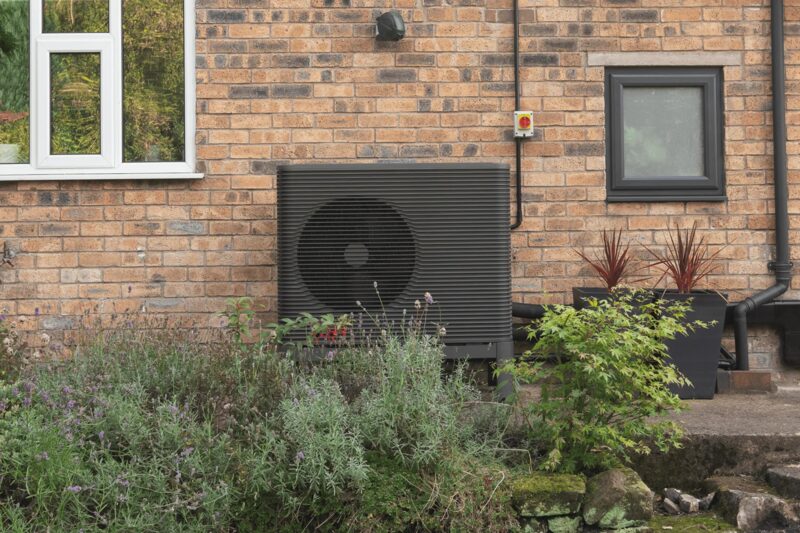
What counts as air conditioning for planning purposes in Scotland
Planning law in Scotland does not use "air conditioning" as a defined category. It regulates the equipment: an air source heat pump installed on a dwelling or within its curtilage, which is the wording of the permitted development class1. A reversible split system that heats in winter and cools in summer is, in planning terms, an air source heat pump. A cooling-only split system is not covered by the class as it stands.
The Scottish Government's 2025 consultation on permitted development rights set out the position directly: the rights "have been amended to allow for cooling and heating, but not solely for cooling purposes"3. The same consultation proposed permitting air source heat pumps installed under permitted development to be used for heating and cooling but not solely cooling, which would allow air-to-air heat pumps to benefit2. That is a proposal, not a settled change, and it matters because air-to-air units are the type most often sold as air conditioning.
Building standards sit alongside planning and use a different vocabulary again. The domestic technical handbook directs readers to the Domestic Building Services Compliance Guide for Scotland for guidance on the efficiency of mechanical ventilation and air conditioning systems9. The same guide sets the minimum performance of space heating and hot water systems, heating appliances and controls10. So a system can be acceptable under building standards and still need planning permission, or the reverse.
For a household, the practical reading is this: the label on the box is irrelevant. What matters is whether the unit provides a heating function, whether it meets the certification and siting conditions, and whether the property is one where the rights apply at all.
Permitted development: when no planning application is needed
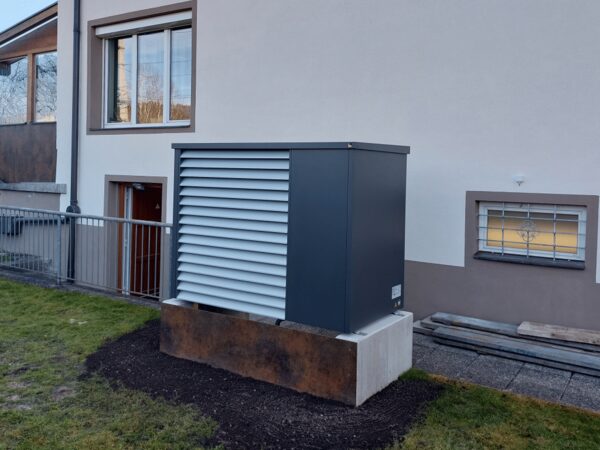
Permitted development rights are, in the Scottish Government's own definition, "a Scotland wide planning permission set out in legislation which removes the need to apply for planning permission"11. They are not a discretionary concession by the local authority. If a proposal falls within the criteria and thresholds, the authority has no application to determine.
The Scottish Government has stated the principle plainly: "Development falling within the criteria and thresholds established by the rights would not require planning permission but remain required to gain non-planning consents such as a building warrant"5. That sentence carries two points. The first is that planning permission is genuinely removed, not merely likely to be granted. The second is that removing the planning step does not remove anything else: building warrants, listed building consent and any lease or title conditions continue to apply.
There is also a financial consequence. Where the planning application step is removed, "there is no planning application fee to be paid"12. Scottish planning authorities estimated that they would lose around £163,000 per year in fee income associated with planning applications for solar panels under a comparable change13, which gives a sense of how many applications the rights remove from the system.
The rights are broad but not unlimited. The 1992 Order, as updated, provides for a range of buildings, technologies and other developments to proceed without planning permission4, and the Scottish Government has described the existing position as providing "fairly extensive PDR for domestic and non-domestic renewables technologies, such as solar panels, wind turbines and heat pumps"11. Air conditioning equipment that qualifies as an air source heat pump sits inside that description.
The conditions your installation must meet to qualify
The conditions are cumulative. All of the limitations and conditions that apply to the relevant class must be met in full; there is no partial compliance4.
| Condition | Requirement | Source |
|---|---|---|
| Certification | MCS Planning Standards or equivalent | 1 |
| Volume, dwellinghouse | Outdoor compressor unit including housing, no more than 1.5 cubic metres | 6 |
| Volume, block of flats | Outdoor compressor unit including housing, no more than 0.6 cubic metres | 6 |
| Siting | Protrusion from the external surface of the building of no more than 1 metre (proposed) | 3 |
| Prior notification | Notification to the planning authority on siting and design | 1 |
The first condition is certification. Any air source heat pump installed under the permitted development rights "must comply with the Microgeneration Certification Scheme (MCS) Planning Standards or equivalent"1. The MCS Planning Standards are the mechanism by which noise and siting performance is demonstrated without a case-by-case assessment, and the Scottish Government has proposed linking noise prediction to that same UK scheme7.
The second is volume. For a dwellinghouse, the outdoor compressor unit including any housing must not exceed 1.5 cubic metres6. For a block of flats the limit is 0.6 cubic metres6. These are the figures in the Scottish class; the equivalent English limit for the outdoor compressor housing is 0.6 cubic metres3, a difference worth noting for anyone comparing the two regimes.
The third is siting. Scottish proposals have examined a requirement that development not extending the floor area of a dwelling take place where it has "a protrusion from the external surface of the building of no more than 1 meter"3. Earlier consultation work looked at bringing air source heat pumps within the alterations to a dwelling house permitted within 1 metre of the external surface of the building7.
The fourth is the prior notification step. Domestic air source heat pumps in Scotland have been "subject to prior notification to the planning authority on siting and design"1. The Scottish Government consulted on removing that step, describing it as removing "the requirement for the step of asking the planning authority if prior approval of the equipment is needed"15. Until that change is made, the notification requirement stands.
Where permitted development falls short: when full permission is required
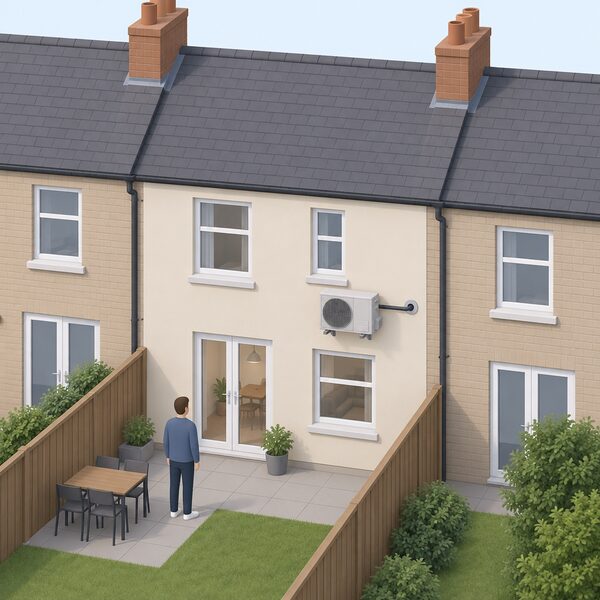
The rule is blunt: "Development which does not meet the criteria or thresholds within the legislation will not be considered to be permitted development and requires to gain planning permission"7. There is no middle category.
The most common reason a Scottish air conditioning proposal falls outside the rights is that the system is cooling-only. The rights apply where the system provides a heating function, including a unit that can both heat and cool; a cooling-only system requires a planning application16. A household that wants summer cooling and has no intention of using the unit for winter heating is therefore in application territory, even though the hardware may be identical to a reversible model.
The second reason is quantity and building type. Proposals that would result in more than one air source heat pump on flatted buildings, or on terraced or semi-detached properties, have been treated as needing a planning application assessed case by case, including cumulative noise impacts3. The Scottish Government's 2025 consultation proposed letting planning authorities "continue to be able to assess such proposals on a case-by-case basis"3. In Scotland there is already no boundary restriction of the kind that applies elsewhere3, so the constraint is about numbers and attachment rather than distance from a boundary.
The third is the property itself. Where a building is listed, listed building consent is required for any works to it, "including works that have planning permission by virtue of the GPDO"11. Permitted development and listed building consent are separate regimes, and the first does not displace the second.
Listed buildings, conservation areas and other restricted cases
Protected areas change the answer. Guidance on air conditioning is direct: "If your home is in a protected area such as a Conservation Area then permission will be required. If you live in a listed building then listed building consent will be required"16. The same principle appears in guidance on other external works: where a building is listed or in a conservation area, the local planning authority should be consulted17.
The reason listed buildings are treated separately is that listed building consent is a distinct consent, concerned with the effect of works on the special interest of the building rather than with land use. The Scottish Government has stated that listed building consent is required for any works to a listed building, including works that already have planning permission through the permitted development order11. A household in a listed building therefore needs consent even where the equipment would otherwise be permitted development.
Conservation areas are a planning matter rather than a heritage consent, but the effect is similar: the permitted development rights do not carry the proposal through, and an application is needed. The same applies to other designations that remove permitted development rights, and to flats and tenements where the installation touches common parts or the fabric of a shared building.
For flatted properties there is a further layer. More than one air source heat pump on a flatted building is treated as needing a planning application assessed case by case3. Where a flat is rented, the tenancy agreement and the landlord's consent sit alongside planning, and the private rented sector in Scotland is moving towards a minimum standard of EPC HRR band C for domestic properties, with exemptions relating to consent, negative impacts on the fabric or structure of the property, a cost cap and temporary exemptions19.
How to apply: the process step by step
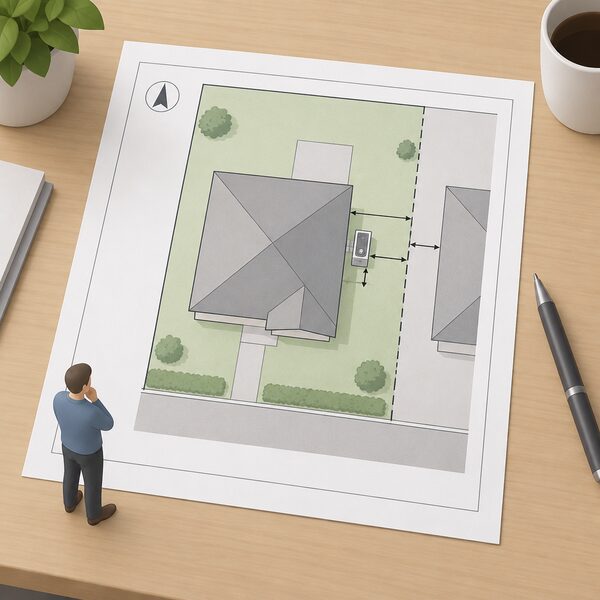
Where an application or a notification is needed, the process follows the local planning authority's own procedures. The steps below reflect the Scottish framework.
- Establish whether the proposal falls within permitted development. If the unit heats as well as cools, meets the MCS Planning Standards or equivalent, sits within the volume limit and is on a property where the rights apply, no application is needed1.
- Where prior notification applies, notify the planning authority, provide details of the proposal and pay the relevant fee4.
- Where the proposal falls outside the rights, submit a full planning application to the local planning authority for the area, with drawings showing the unit's position, its dimensions and how it relates to the building and any neighbouring property.
- Obtain any separate consents: a building warrant, listed building consent, or consent from a landlord or co-owners where the property is flatted or rented5.
- Install to building standards, using an installer working to the relevant certification. For grant-funded work in Scotland, installers must have or be working towards PAS 2030 certification and meet measure-specific standards such as MCS, Oftec or Gas Safe20.
The prior approval route has a defined clock. In the comparable Scottish classes, prior approval is treated as given on "the expiry of a period of 28 days following the date on which the application was received by the planning authority" without a decision7. That 28 day figure applies to prior approval determinations, not to full planning applications, which run to the authority's own timescales.
For context on volume, the Scottish Government estimated that if all Renewable Heat Incentive applications resulted in planning applications, that would be an application rate of approximately 804 per year3. That is the scale at which the rights matter: they keep a large number of small domestic installations out of the application system altogether.
Building standards and electrical requirements alongside planning
Planning permission and building standards are separate approvals, and satisfying one does not satisfy the other. The Scottish Government's position is explicit: development within the permitted development criteria "would not require planning permission but remain required to gain non-planning consents such as a building warrant"5.
On the building standards side, the domestic technical handbook deals with mechanical ventilation and air conditioning. It states that "Guidance on the efficiency of mechanical ventilation and air conditioning systems is given in the Domestic Building Services Compliance Guide for Scotland"9. That guide sets the minimum performance of space heating and hot water systems, heating appliances and controls10. The practical effect is that the efficiency and control performance of an installed system is a building standards matter, assessed against the compliance guide rather than against the planning class.
Certification runs through both regimes. The permitted development class requires compliance with MCS Planning Standards or equivalent1, and the Scottish Government has proposed linking noise prediction to the UK microgeneration certification scheme7. For work funded through Scottish schemes, installers must have or be working towards PAS 2030 certification and meet the other measure-specific standards set out in the contract, such as MCS, Oftec or Gas Safe20.
Electrical work is covered by the general building standards regime rather than by a separate planning condition. Guidance on air conditioning installation notes that "the installation of air conditioning must comply with building regulations" and advises contacting an installer who belongs to the Microgeneration Certification Scheme or a relevant Competent Person Scheme16. That is the route by which the electrical and refrigerant aspects of an installation are signed off.
For a household, the sequence matters. Planning consent, where needed, comes first; the building warrant and the installation follow. A system that meets the planning class but fails the building standards performance requirements is not a compliant installation, and the reverse is equally true.
Noise, condenser placement and neighbour considerations
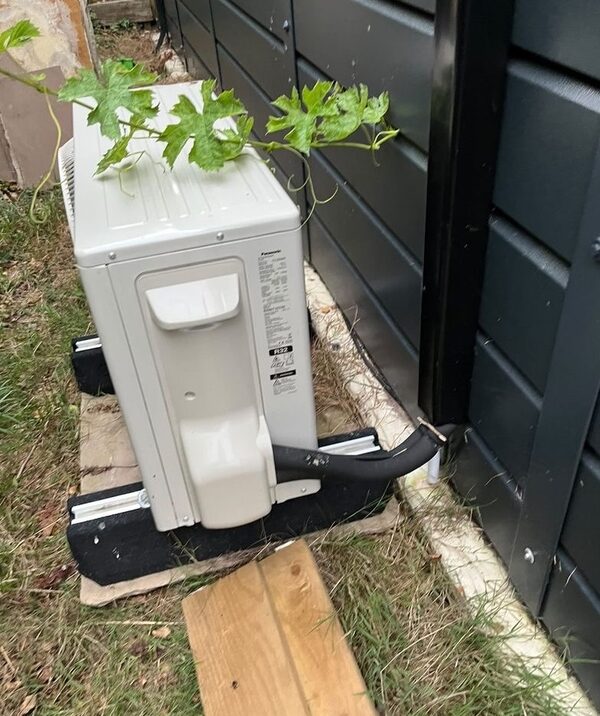
Noise is the reason the Scottish permitted development class carries the conditions it does. The prior notification requirement was applied "to ensure noise emissions could be suitably controlled in the absence of an agreed noise threshold and measurement methodology"14. The Scottish Government's proposed answer was to link noise prediction to the UK microgeneration certification scheme7, so that a certified unit is treated as meeting the noise condition without a site-specific assessment.
Permitted development does not remove the statutory nuisance regime. Noise concerns can be reported to the Environmental Health department of a council in Scotland, which can investigate to see whether the installation constitutes a statutory noise nuisance under the Environmental Protection Act 199014. The Scottish Government has described that as a safeguard that "is unaffected by the permitted development rights" and which "provides a safeguard against installations that meet the permitted development rights thresholds but following investigation are found to constitute a statutory noise nuisance"7.
That combination is worth understanding. A unit can be fully compliant with the permitted development conditions and still generate a complaint that leads to enforcement under the nuisance legislation. The planning class sets a threshold; it does not immunise the installation.
Placement follows from the same logic. The volume limit applies to the outdoor compressor unit including any housing6, and the siting conditions address how far the unit protrudes from the building3. Units sited close to a neighbour's window, a shared wall or a boundary are more likely to attract complaint, and on flatted or terraced properties the case-by-case assessment for multiple units explicitly takes cumulative noise impacts into account3.
Portable and single-hose units: what needs no permission at all
A portable air conditioner that sits inside a room and discharges through a window or a wall opening is not an air source heat pump installed on a dwelling or within its curtilage in the sense the permitted development class uses. The class covers "the installation, alteration or replacement of an air source heat pump on a dwelling or within the curtilage of a dwelling"1, which describes fixed external equipment rather than a freestanding appliance.
Nothing in the Scottish permitted development framework requires a planning application for a unit used wholly inside a dwelling. The planning system regulates development, and moving a portable appliance within a room is not development. Where a household fits a permanent wall sleeve or a fixed vent, that alteration may engage other rules, but the appliance itself does not.
The distinction matters for households in protected buildings. A portable unit does not require listed building consent in the way a fixed external installation does, because no works are carried out to the listed building. A fixed through-wall installation in a listed building would engage the listed building consent regime, which applies to any works to a listed building including works that have planning permission through the permitted development order11.
Portable units also avoid the volume and siting conditions entirely, since those apply to outdoor compressor units6. What they do not avoid is the building standards position on the electrical installation, and they do not deliver the efficiency of a fixed split system. For households in flats, tenements or listed buildings, or in a rental where consent for external works is unlikely, a portable unit is often the only route that requires no planning consent at all.
Costs, timescales and what happens if permission is refused

Where permitted development applies, there is no planning application fee to pay12. That is the direct financial effect of the rights, and it is the reason the Scottish Government has treated the extension of permitted development as a way of accelerating the rollout of low-carbon technologies21.
Where an application is needed, the cost is the authority's fee plus the cost of preparing drawings and any supporting noise or siting information. The Scottish Government has not published a fee schedule for domestic air conditioning applications in the material available, so the figure is set by the authority and quoted at the point of application. Installation costs themselves are installer-quoted.
On timescales, the 28 day period in the comparable Scottish classes governs prior approval determinations7. Full planning applications run to the authority's own determination timescales. For wider context on how long Scottish energy and buildings processes take, the Heat in Buildings Bill consultation noted that it had been 18 months since the Scottish Government initially consulted on the Bill22, and the Climate Change Committee has set out the statutory deadlines for laying draft carbon budgets and a Climate Change Plan23. Those are not planning timescales, but they indicate the pace at which the surrounding policy framework moves.
If permission is refused, the installation cannot proceed as proposed. The options are to amend the proposal to address the reason for refusal, or to appeal. Where an installation has been carried out without the required permission, the planning authority has enforcement powers, and the private rented sector regulations give a sense of the enforcement model used in Scotland: local authorities would have powers to serve a penalty notice for individual acts of non-compliance, which can include financial penalties, a publication penalty or both, subject to an appeals process19.
On VAT, the Value Added Tax (Installation of Energy-Saving Materials) Order 2022 introduced a temporary zero rate on the supply of installation of energy-saving materials in England and Wales and Scotland, running from 1 April 2022 to 31 March 2027, with Northern Ireland on a reduced rate instead8. Where the value of the installed materials exceeds 60 per cent of the cost of the total supply, only the labour element qualifies for the reduced rate, with the goods element standard rated15. The reduced rate also continues to apply to the whole supply where the customer is 60 or over, or in receipt of certain benefits, and the accommodation is their sole or main residence15.
Where the Scottish rules differ from England
Scottish Ministers have stated an aim of parity: "Scottish Ministers want to ensure that there is parity in permitted development rights between Scotland and England" for air source heat pumps and solar panels3. The same objective appears in earlier consultation material, which sought to ensure that those installing the technology in Scotland, and those manufacturing it, had similar conditions to England and Wales12.
Parity has not meant identical rules. The Scottish rights have carried a prior notification step on siting and design3, which the English class does not. The volume limits differ: 1.5 cubic metres for a dwellinghouse in Scotland6 against 0.6 cubic metres for the outdoor compressor housing in England3. And the Scottish Government's preferred approach in earlier consultation was to "adopt the principles of the provisions from England but apply them in a way that is consistent with existing approaches to permitted development rights in Scotland"15.
| Feature | Scotland | England |
|---|---|---|
| Volume limit, dwellinghouse | 1.5 cubic metres6 | 0.6 cubic metres for the outdoor compressor housing3 |
| Prior notification on siting and design | Applies1 | Does not apply3 |
| Boundary restriction | None3 | Applies3 |
| Heating function | Required for the class to apply2 | Class covers air source heat pumps6 |
The Scottish Government has also consulted on removing the prior approval step for domestic air source heat pumps, describing it as removing the requirement to ask the planning authority whether prior approval is needed15. The regulations would be implemented through an amendment to the Town and Country Planning (General Permitted Development) (Scotland) Order 19923, using secondary legislation approved by negative parliamentary procedure14.
For a household comparing the two nations, the practical differences are these: Scotland has a notification step that England does not, a larger volume allowance for a dwellinghouse, and a permitted development class that turns on whether the unit provides a heating function. The direction of travel in both is towards treating reversible heat pumps as ordinary domestic equipment rather than as development requiring consent.
Sources23 cited
- The Town and Country Planning (General Permitted Development) (Scotland) Amendment Order 2016, article 3, legislation.gov.uk, 2016
- Permitted development rights to support the provision of new homes: consultation, page 4, Scottish Government, 2025
- Permitted development rights to support the provision of new homes: consultation, Scottish Government, 2025
- Circular 1/2024: Householder permitted development rights, Scottish Government, 2024
- The Town and Country Planning (General Permitted Development) (Scotland) Amendment Order 2024, legislation.gov.uk, 2024
- Class G: Installation or alteration of air source heat pumps on domestic premises, legislation.gov.uk, 2015
- Permitted development rights for non-domestic solar panels and domestic air source heat pumps: consultation, Scottish Government, 2015
- The Value Added Tax (Installation of Energy-Saving Materials) Order 2022, legislation.gov.uk, 2022
- Building standards technical handbook 2022: domestic, 6.6 Mechanical ventilation and air conditioning, Scottish Government, 2022
- Building standards technical handbook 2020: domestic, 6.3 Heating system, Scottish Government, 2020
- Scottish Government review of permitted development rights: phase 3 consultation, Scottish Government, 2023
- Permitted development rights for non-domestic solar panels and domestic air source heat pumps, Scottish Government, 2015
- Permitted development rights for non-domestic solar panels and domestic air source heat pumps: consultation, page 1, Scottish Government, 2015
- Permitted development rights for non-domestic solar panels and domestic air source heat pumps: consultation, Scottish Government, 2015
- Permitted development rights for non-domestic solar panels and domestic air source heat pumps: consultation, Scottish Government, 2015
- Is permission needed for installing new roof tiles, Planning Portal, 2026
- Insulation: planning permission, Planning Portal, 2026
- Insulation, Planning Portal, 2026
- Consultation on draft Energy Efficiency (Domestic Private Rented Property) (Scotland) Regulations, Scottish Government, 2025
- Warmer Homes Scotland: first annual review, Scottish Government, 2016
- Permitted development rights (PDR), SNIPEF, 2025
- Delivering net zero for Scotland's buildings: consultation proposals, Scottish Government, 2023
- Scotland's carbon budgets, Climate Change Committee, 2025
 Planning Permission EnglandExplains when an external air conditioning or air-to-air heat pump unit in England needs planning permission, and how permitted development applies.
 Planning Permission NIHow Northern Ireland's planning rules apply to external air conditioning and air-to-air heat pump units, when consent is needed, and how the position differs from England, Scotland and Wales.
 Planning Permission in ScotlandDo you need planning permission for a heat pump in Scotland?
 Planning Permission WalesDo you need planning permission for an air conditioning unit outside your home in Wales?
 Home Energy Planning ScotlandDo you need planning permission for solar panels or a heat pump in Scotland?
 Planning Permission in EnglandDo you need planning permission for an air source heat pump?