

In this guide
Cooling has become a UK heating question because the two are now decided together. Air conditioning ownership nationally rose from three per cent of households in 2011 to around 23 per cent in 2023, and in London approximately 32 per cent of households report owning air conditioning, around three times higher than in several other UK regions1. At the same time, official projections put 90% of UK homes at risk of overheating under a 2C global warming scenario, and 92% of existing homes could overheat by mid-century2.
The reason the two subjects meet is that the equipment which cools a home is increasingly the equipment that heats it. Air source heat pumps can give both heating and cooling, and permitted development rights in England have been amended to allow for cooling and heating, but not solely for cooling purposes4. A household weighing up cooling is therefore also weighing up how it will heat the home once gas is phased out of new and replacement installations.
This page sets out what the published data says about ownership, overheating risk, gas dependence and the policy timetable, and what each means for a household's energy independence. It does not recommend a product, a system or an installer.
Why cooling is becoming a UK heating question
The starting point is that most UK heating runs on gas. Most heating in the UK is supplied by gas, and the UK is a net importer of natural gas, importing more than it exports, which leaves it exposed to global price volatility7. Heating UK buildings contributes to almost a quarter of all UK emissions8. Home energy consumption accounts for 22% of the UK's carbon emissions, and existing housing in the UK contributes around 27% of total carbon emissions9.
Cooling sits inside the same household budget. National polling found that 13% of respondents reported higher energy bills associated with efforts to cool homes, including the use of fans and air-conditioning1. That is a small share, but it is the first sign that summer comfort is showing up as a cost line rather than a lifestyle choice.
The two demands also compete for the same electricity supply. The Climate Change Committee has factored in a 50% increase in demand on electricity, to reflect the expected increase in transport, industry and buildings decarbonisation11. Over three-quarters of household energy demand is for space and hot water heating12. If heating moves onto electricity and cooling demand grows at the same time, the summer peak becomes a design question for the grid, not just for the household.
For a household, the practical consequence is that cooling and heating decisions are no longer separable. A system chosen for summer comfort may determine what is possible in winter, and the reverse. That is why the ownership figures and the overheating projections belong on the same page.

How much of the UK housing stock needs active cooling

No published figure states a share of the housing stock that needs active cooling. What exists is a set of overheating projections, and they are consistently high. Under a 2C global warming scenario, 90% of UK homes will overheat2. A separate projection states that hotter heatwaves could see 92% of existing homes overheat by mid-century, creating dangerous conditions for vulnerable people3.
Those two figures are close but not identical, and they measure different things: one is a scenario at a stated level of warming, the other a mid-century projection. Neither is a statement that 90% or 92% of homes require an air conditioning system. Overheating risk is a function of dwelling form, orientation, glazing, shading, ventilation and occupancy, and the Climate Change Committee commissioned Arup to appraise the current and future risks posed by summertime overheating to the UK housing stock at scale, including what factors influence risk, how homes can be adapted or upgraded to mitigate the impacts and how much that costs13.
The lived experience is already measurable. Survey evidence shows that the proportion of households reporting heat discomfort rose from 20 per cent in 2011 to around 80 per cent during the 2022 heatwave1. National polling in summer 2025 found that the majority, 68%, reported that they or someone in their household experienced at least one negative impact from overheating1.
The gap between risk and equipment is where most UK households currently sit. The projections describe a stock that performs badly in heat; the ownership figures describe a minority that has bought a mechanical answer. Between those two positions lie the passive measures, which are covered in passive cooling and night ventilation.
What rising heat intensity means for household priorities
The evidence on how households respond is thinner than the evidence on the risk itself. Fewer than half, 42%, understand that energy efficiency measures can help keep homes cool in summer1. That is a significant knowledge gap, because the same fabric measures that retain heat in winter also slow its entry in summer.
The Climate Change Committee's work on overheating is explicit that adaptation and upgrade options carry costs, and that the factors influencing risk vary by home13. In practice that means the household decision is not simply whether to buy a cooling appliance, but whether the dwelling itself can be made to perform better in heat first.
There is also a policy dimension. The government has consulted on reforming consumer protection for the home upgrade sector, including those involved in the installation of solar panels, insulation, batteries, and heat pumps, as well as consumers and groups representing consumer interests14. That consultation matters to cooling because the same installers and the same consumer risks apply.
"The work considers what factors influence risk, how homes can be adapted or upgraded to mitigate the impacts and how much that costs."
For a household, the priority order that the evidence supports is: understand the dwelling's risk, address fabric and shading where possible, and treat mechanical cooling as one option among several rather than the default. The pages on external shading and cooling by home type set out where the risk concentrates.
Who is affected: the household segments where cooling demand is emerging

Ownership is not evenly spread. London is the outlier, with approximately 32 per cent of households reporting air conditioning ownership, around three times higher than in several other UK regions1. The national figure of around 23 per cent in 2023 sits well below that, and the 2011 baseline of three per cent shows how recent the change is1.
The pattern points to urban households in flats and smaller dwellings, where night ventilation is harder, external shading may be restricted, and the urban heat island effect raises overnight temperatures. The pages on air conditioning in flats and which dwellings overheat most deal with those cases directly.
Scotland's housing stock differs in composition. Storage heaters are used by around 7% of the stock, and around 89% of homes and 49% of non-domestic premises are estimated to be using polluting heating at present15. That matters for cooling because a home on a storage heater has no wet central heating system to convert, and the options for adding reversible heating and cooling are different.
| Segment | What the evidence shows | Source |
|---|---|---|
| London households | Approximately 32 per cent report air conditioning ownership | 1 |
| UK households nationally | Around 23 per cent in 2023, up from three per cent in 2011 | 1 |
| Scottish dwellings | Around 7% of the stock uses storage heaters | 15 |
| Scottish homes | Around 89% estimated to be using polluting heating | 16 |
| Households reporting heat discomfort | Around 80 per cent during the 2022 heatwave | 1 |
The household segments where demand is emerging are therefore not defined by income alone. They are defined by dwelling type, location and the presence of people who are vulnerable to heat, which is covered in heatwaves and health at home.
Gas dependency and why heating changes are coming anyway
The UK has been strongly affected by the energy crisis due to its dependence on natural gas for heating, electricity generation and industry17. It is a net importer of natural gas, and one official document states that by 2025 the UK is expected to be importing 67% of its gas from outside the UK6. The Spring Statement of 2022 described the UK as a net energy importer with a high dependence on gas and oil18.
That dependence is the reason the heating transition is proceeding regardless of what any individual household decides about cooling. Over 85% of UK domestic properties have hydronic (water-based) central heating systems, which is the installed base that heat pumps and other low-carbon options are designed to retrofit19. The Climate Change Committee has called for an end to the fossil fuel age for a secure and prosperous future20.
For a household, the independence question has two halves. The first is the fuel: a home heated by gas is exposed to imported gas prices, and a home heated by electricity is exposed to electricity prices, which are themselves partly set by gas. The second is the equipment: a system that can both heat and cool reduces the number of separate appliances a home depends on, but it also concentrates dependence on one manufacturer, one installer and, where controls are app-based, one cloud service.
The cooling and energy independence page develops that trade-off in full.
The next ten years: what the heating transition asks of households
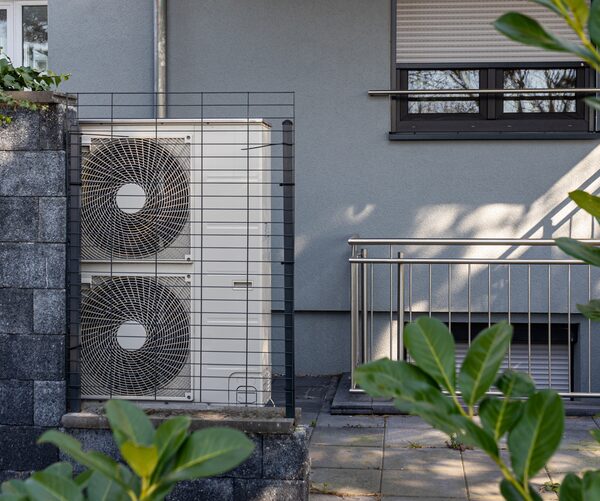
The policy direction is set out in dates. The stated aim is that all new and replacement home heating installations are low carbon, mainly heat pumps, by the middle of the next decade20. Approximately 10% of existing homes in the UK will need to be heated by a heat pump by 2030, compared to only approximately 1% at the time of the projection21. By 2040, 52% of existing homes in the UK will need to be heated using a heat pump, compared to around 1% in 202322.
Against those targets, the current legal position is permissive. There is currently no legal requirement for existing homes to be retrofitted or for low-carbon heating technologies to be installed in existing homes, with exceptions for privately rented homes and homes owned by local authorities and housing associations in some parts of the UK7. The Climate Change Committee has said the UK is off track for net zero21.
The readiness picture is more encouraging than the installation rate. This is despite 90% of UK homes having sufficient insulation and electrical capacity to operate a heat pump12. The English Housing Survey fact sheet examines the prevalence and preparedness of English homes for low carbon technologies such as heat pumps and EV charge points22.
| Target | Figure | Date | Source |
|---|---|---|---|
| Existing homes heated by heat pump | Approximately 10% | by 2030 | 21 |
| Existing homes heated by heat pump | 52% | 2040 | 22 |
| Existing homes heated by heat pump | Around 1% | 2023 | 22 |
| Homes with sufficient insulation and electrical capacity for a heat pump | 90% | 2025 | 12 |
| New and replacement heating installations to be low carbon | All | middle of the next decade | 20 |
Public familiarity is improving. The share of owner-occupiers saying they do not know enough about air source heat pumps fell from 39% in Winter 2021 to 21% in Summer 202523. That is the measure of how quickly the transition has moved from unfamiliar to mainstream in household awareness.
Cooling and heating together: what a system that does both means for independence
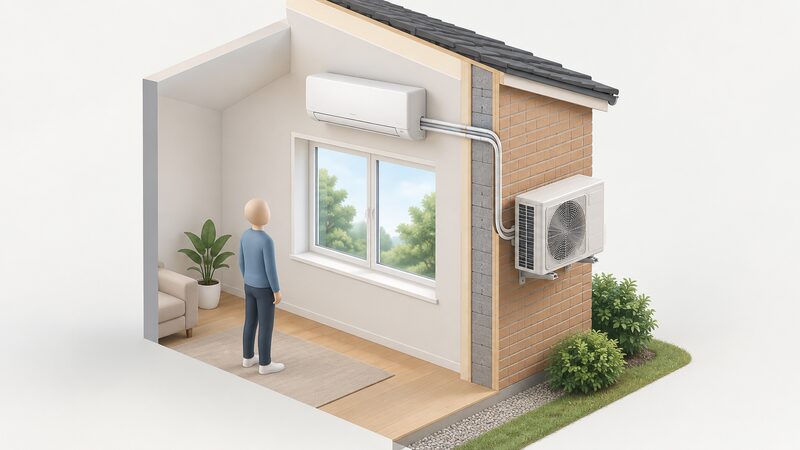
A reversible air source heat pump is the clearest example of the two functions converging. Air source heat pumps can give both heating and cooling, making them versatile24. In England, permitted development rights have been amended to allow for cooling and heating, but not solely for cooling purposes, which facilitates the rollout of air-to-air models5. Official guidance is equally clear that air source heat pumps are not used solely for cooling purposes4.
Scotland's building standards add a control requirement. If both heating and cooling are provided in the same space, the controls should prevent them operating simultaneously25. Fixed air conditioners should have a minimum energy efficiency classification of Class C in Schedule 3 of the labelling scheme adopted under the Energy Information (Household Air Conditioners) (No 2) Regulations25. Air-conditioning systems are also subject to inspection at intervals ranging from three years for poorly maintained and inefficient systems up to five years for those systems that are well maintained26.
"If both heating and cooling are provided in the same space, the controls should prevent them operating simultaneously."
For independence, a combined system has a clear logic: one outdoor unit, one refrigerant circuit, one set of controls, and one appliance to maintain instead of two. The dependence it creates is equally clear. The household relies on a single manufacturer for parts and warranty support, on a certified engineer for refrigerant work, and, where the controls are app-based, on a cloud service that may not outlive the hardware. The air conditioning and heat pumps page covers the equipment side, and air conditioning controls and Wi-Fi covers the control dependency.
Where AC fits in a low-carbon home
The policy framework for buildings decarbonisation runs over the next three decades27. Within that, cooling equipment is being drawn into the same regulatory net as heating. The Heat Market Mechanism consultation proposed a target for the minimum average energy efficiency or maximum average carbon dioxide emissions intensity of all new heating appliances sold and installed in the UK over a given period, adjusted over time19. Fixed air conditioners already face a minimum efficiency classification25.
Support schemes are beginning to treat cooling and heating as one fabric problem. The Warm Homes: Social Housing Fund Wave 3 allows homes at or above EPC band C to be eligible for the installation of low carbon heating measures, though the 10% cap of homes in an application applies28. The Great British Insulation Scheme requires that a household either owns its own home or has permission from its landlord, including social housing providers or management companies29. Rooftop solar for new builds is intended to save people money, and the government has stated that allowing for air source heat pumps that can be used for cooling as well as heating facilitates the rollout of air-to-air models5.
The independence case for a low-carbon home with cooling is that generation, heating and cooling can share one electricity supply, and where solar and battery storage are present, part of that supply is self-generated. The dependence that remains is the grid connection, the distribution network's capacity at times of peak summer demand, and the manufacturer's support for the equipment. The cooling with solar panels page sets out how generation and cooling interact, and the home cooling pillar covers the full range of options.
Sources30 cited
- Are London's homes ready for a heatwave? Call for Evidence, London Assembly, 2026
- Energy Innovation and Net Zero Analysis: Heat and Buildings, Department for Energy Security and Net Zero, 2025
- Progress in reducing emissions: 2026 report to Parliament, Climate Change Committee, 2026
- Planning permission: air source heat pump, Planning Portal, 2025
- Rooftop solar for new builds to save people money, Department for Energy Security and Net Zero, 2025
- Scottish Energy Strategy: future energy in Scotland, Scottish Government, 2025
- Research briefing: heat pumps and the gas grid, House of Commons Library, 2026
- Heat and Buildings Strategy, Department for Energy Security and Net Zero, 2021
- Home and business grants, schemes and advice, East Hertfordshire District Council, 2026
- Low income homeowners in Leeds can apply for free solar panels and insulation, Leeds City Council, 2021
- A reliable, secure and decarbonised power system by 2035, Climate Change Committee, 2023
- Heat pumps: a solution for UK homes, Environmental Audit Committee, 2025
- Addressing overheating risk in existing UK homes, Climate Change Committee, 2026
- Reforming consumer protection for home upgrade schemes, Department for Energy Security and Net Zero, 2026
- Scottish House Condition Survey 2023: key findings, Scottish Government, 2023
- Delivering net zero for Scotland's buildings, Scottish Government, 2023
- Climate policy that cuts costs: international policy comparison, Climate Change Committee, 2026
- Spring Statement 2022, HM Treasury, 2022
- Heat Market Mechanism consultation, Department for Business, Energy and Industrial Strategy, 2021
- End the fossil fuel age for a secure and prosperous future, Climate Change Committee, 2025
- UK off track for net zero, say country's climate advisors, Climate Change Committee, 2024
- English Housing Survey 2023 to 2024: low carbon technologies fact sheet, Department for Levelling Up, Housing and Communities, 2025
- DESNZ public attitudes tracker: heat and energy use in the home, summer 2025, Department for Energy Security and Net Zero, 2025
- Building Regulations Part L and F review: stage 2a, Welsh Government, 2020
- Building Standards Technical Handbook: Domestic (April 2026), Scottish Government, 2026
- Warm Homes: Social Housing Fund Wave 3 scheme guidance addendum, Department for Energy Security and Net Zero, 2026
- Next steps for UK heat policy, Climate Change Committee, 2019
- Written evidence on hydrogen heating, Baxi Heating UK Ltd, 2026
- Great British Insulation Scheme: homeowners and tenants, Ofgem, 2026
- Heat pumps, nidirect, 2025
 The Full Cooling and Air Conditioning GuideDo you really need air conditioning in a British summer, or would a fan and better shading do the job?
 Overheating and Hot WeatherIs your home getting uncomfortably hot in summer, and is there anything you can do about it?
 The Full Statistics GuideHow many homes in the UK have solar panels, heat pumps or batteries?
 Planning Permission EnglandExplains when an external air conditioning or air-to-air heat pump unit in England needs planning permission, and how permitted development applies.
 CIBSE Weather DataIf a new home is being checked for overheating, which weather is that based on?
 Air Conditioning CostPublished UK equipment prices and the parts of an installed price for portable, single split, multi-split and whole-house air conditioning.