

In this answer
Short answer
Around 32 per cent of London households report owning air conditioning, according to evidence submitted to the London Assembly's Planning and Regeneration Committee in June 20261. That is roughly one home in three, and it is around three times higher than in several other UK regions1. Nationally, the picture is very different: it is estimated that 3 per cent of UK homes currently have air conditioning2.
The gap between the capital and the rest of the country is the single most important fact about cooling ownership in the UK. London is not a slightly warmer version of the national average; it is a distinct market with its own drivers, its own housing stock and its own pattern of overheating. Understanding why the figure sits where it does matters for any household trying to work out what cooling it needs, what it will cost to run, and what it means for energy independence.
This page sets out the headline figure, how London compares with the rest of the UK, why ownership in the capital runs about three times higher, the UK-wide picture, what projections suggest about future uptake, and what all of it means for a household's energy independence.
The headline figure: around 32 per cent of London households
The 32 per cent figure comes from evidence collated by the London Assembly's Planning and Regeneration Committee for its inquiry into whether London's homes are ready for a heatwave1. It is a self-reported ownership rate: households were asked whether they own air conditioning, not whether a fixed system has been professionally installed. That distinction matters, because the figure will include portable units as well as split systems, and it tells you what people have in their homes rather than what has been fitted to a wall.
The same evidence found that in summer 2025, 36 per cent of London residents reported difficulty keeping their homes cool, compared with 34 per cent nationally1. In 2025, the hottest year on record, between 85 and 87 per cent of residents reported experiencing indoor overheating1. Ownership of cooling equipment and experience of overheating are therefore not the same thing: a substantial share of London households report overheating even though roughly a third own some form of air conditioning.
The cost of cooling is also visible in the same evidence. Over half of London residents, 56 per cent, reported that hot weather had cost their household money, and 18 per cent reported noticeably higher energy bills as a result of trying to keep their homes cool1. For a household weighing up a unit, that is the practical context: cooling already shows up on bills for a significant minority of Londoners.
"approximately 32 per cent of households report owning air conditioning, around three times higher than in several other "

How London compares with the rest of the UK
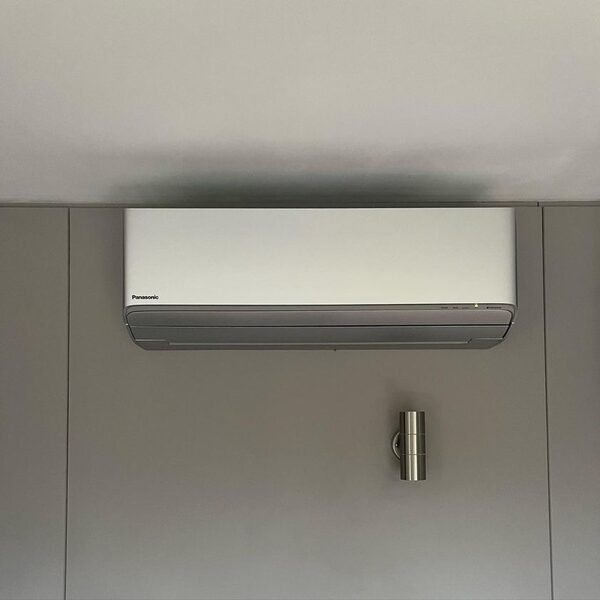
London's approximately 32 per cent sits against a UK-wide estimate of about 3 per cent2. A 2026 estimate puts household penetration in England at around 4 per cent, and fewer than 5 per cent across the UK3. The documents give slightly different national figures, and they are not reconciled: the 3 per cent estimate and the 4 per cent England figure come from different analyses with different definitions. What they agree on is that national ownership is in low single digits, an order of magnitude below London.
The comparison with other countries is instructive for scale. France accounts for 25 per cent of homes with air conditioning in one international comparison, China around 60 per cent, and Germany only around 3 per cent2. The German figure is close to the UK national estimate, which suggests that the UK's low ownership is a northern European pattern rather than a British peculiarity. London, at 32 per cent, is the exception within that pattern.
| Area | Households with air conditioning |
|---|---|
| London | approximately 32 per cent1 |
| England | around 4 per cent3 |
| UK | about 3 per cent2 |
| Germany | around 3 per cent2 |
| France | 25 per cent2 |
| China | around 60 per cent2 |
The regional comparison within the UK is less well documented. The London evidence states that the capital's rate is around three times higher than in several other regions but does not name them with figures1. What can be said with confidence is that no other UK region is identified in the available evidence as approaching London's rate.
Why ownership in the capital runs about three times higher
The most direct explanation is overheating itself. The prevalence of overheating in Greater London dwellings is at least two times higher than in some other regions, according to the same official consultation evidence1. Cooling equipment follows the problem: where homes overheat more often and more severely, more households buy something to deal with it.
Housing stock and tenure reinforce the pattern. London has around 2 million rented homes, and prepayment meters are more common in rented housing1. Private renters in England were less likely than owner occupiers to switch on an air conditioner to cool down, at 3.7 per cent against 8.7 per cent4. That suggests ownership is concentrated among owner occupiers, who have both the incentive and the ability to install equipment. Owner occupation has shifted too: the proportion of outright owners in England has increased to 35 per cent in 2023-245.
London's built environment adds further pressure. District heat networks are concentrated in the capital, with 30 per cent of UK heat network homes in London6. Scenarios in the Greater London Authority's 1.5C Compatible Climate Action Plan envisage 100,000 homes or more on district heating in London by 20257. Heat networks and dense flatted development are both associated with overheating risk, which in turn drives cooling demand.
Energy efficiency in London's stock is also comparatively poor in places. London has the lowest percentage of energy-efficient semi-detached houses, with less than one in five, 17.74 per cent, rated EPC C or above, compared with more than 43 per cent in the South West8. Nearly half, 48 per cent, of the capital's homes were rated EPC A to C in 20239. A less efficient, more urban, more rented housing stock overheats more and cools less passively.
UK-wide picture: only around 3 per cent of homes have air conditioning

The national figure is the anchor for everything else on this page. It is estimated that 3 per cent of UK homes currently have air conditioning2. England sits at around 4 per cent3, and fewer than 5 per cent across the UK3. These are low single digits, and they place the UK alongside Germany rather than France or China2.
That low base is consistent with how the UK heats and cools its homes generally. Around 85 per cent of homes rely on natural gas for heating10, and only about 5 per cent of homes currently have low carbon heating11. Heat pumps are used by around 2 to 3 per cent of UK households12, and less than 3 per cent of homes in the UK are connected to a heat network13. The UK housing stock is, in broad terms, a gas-heated stock with very little mechanical cooling and very little low carbon heating.
Insulation levels tell a similar story of partial retrofit. In Great Britain, 26.1 million homes have a loft, and of these 67 per cent, 17.5 million, have loft insulation with more than 125mm thickness14. A separate estimate found 33 per cent of homes with lofts have less than 125mm of loft insulation, 8.5 million properties8. Fabric measures that reduce both heating demand and summer heat gain are therefore present in most but not all homes.
For a household outside London, the practical implication is that air conditioning remains unusual. That does not make it unavailable or unsuitable, but it does mean the installed base, the installer network and the second-hand market are all thinner than in the capital. The UK climate and cooling demand page sets out how that picture may change.
Projections: how much higher London uptake could go
The evidence points to rising concern rather than a settled forecast. In London, 45 per cent of residents say they are very or fairly concerned about their homes overheating over the next five years, compared with 38 per cent nationally1. Concern at that level is a leading indicator of purchase intent, though it is not a projection of ownership.
The drivers of growth are identified in the same body of evidence. Increased working from home and rising summer temperatures may be behind the rise in UK household air conditioning ownership15. Both trends push in the same direction: more daytime occupancy of homes, and more days hot enough to make cooling desirable.
There is also a reach problem that limits how quickly behaviour can change. Around 25 per cent of the London population is not effectively reached by heat risk communication, with digitally excluded, older and lower-income groups disproportionately affected1. In London, approximately one quarter of residents, around 2.2 to 2.3 million people, are not effectively reached by heat risk communication1. Any projection of uptake has to account for a quarter of the capital's population that official messaging does not reliably reach.
On the heating side, the direction of travel is clearer. The percentage of UK homes with low carbon heating systems will need to increase from 9 per cent today to 39 per cent in the next decade, before reaching 100 per cent by 205016. That is a requirement, not a forecast, but it indicates the scale of change expected in how homes are serviced. Cooling sits alongside that transition rather than inside it.
What the numbers mean for household energy independence
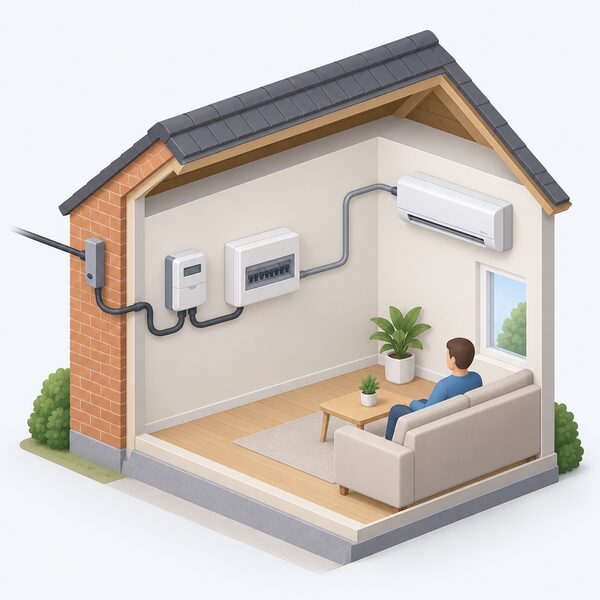
Air conditioning adds an electricity load. It does not reduce a household's dependence on the grid or on a supplier; it increases it, at least in the short term. That is the honest reading of the figures, and it sits alongside the wider picture: homes use 35 per cent of the UK's energy and emit 20 per cent of its carbon dioxide emissions17. Home energy consumption accounts for 22 per cent of the UK's carbon emissions18. Heating homes accounts for 18 per cent of UK carbon emissions19.
The dependence is not only electrical. Around 85 per cent of homes rely on natural gas for heating10, and 26.6 per cent of domestic properties in Inner London are off the gas grid20. A household that adds cooling while remaining on gas heating has added a second energy dependence rather than reduced the first. The cooling and energy independence page develops that trade-off.
There is a countervailing consideration. Cooling equipment that runs in reverse as a heat pump can displace some gas heating, and the UK already has a low base of low carbon heating at about 5 per cent of homes11. But the evidence does not show London's 32 per cent ownership translating into heating substitution at scale. What it shows is a capital where a third of households have bought cooling, where 18 per cent report noticeably higher bills from keeping cool1, and where the underlying housing stock remains largely gas-heated and only partly insulated.
For a household, the practical questions are therefore about load, running cost and fabric before equipment. Reducing heat gain through shading, ventilation and insulation lowers the cooling load that any unit has to meet, and the passive cooling and home cooling pages cover those measures. Where a unit is the answer, the types of air conditioning and running costs pages set out the options and what they draw.
Sources20 cited
- Planning and Regeneration Committee Call for Evidence: Are London's homes ready for a heatwave?, London Assembly, June 2026
- Eight facts about air conditioning amid an overheated global debate, Carbon Brief, 22 October 2025
- The cost of keeping cool: four million homes now use air conditioning, Uswitch, 2026
- How well do homes in England cope with extreme weather, Nesta, 9 July 2026
- English Housing Survey 2023 to 2024: profile of households and dwellings, Ministry of Housing, Communities and Local Government, 2023-24
- District heat networks, Nesta, 3 February 2025
- Existing and future technologies for retrofitting the UK housing stock, CREDS, 2025
- Energy saving statistics, Uswitch, 16 July 2025
- Green home statistics, Uswitch, 2023
- The role of gas heating in homes, Energy UK, 15 April 2025
- Smart energy supply chain: giving consumers access to clean power, BEAMA, June 2025
- Beyond affordability: why heat pumps feel like a gamble, Which?, 2 July 2026
- Heat and buildings, House of Commons Environmental Audit Committee, 9 May 2025
- Energy in buildings 2025: heat and buildings, Department for Energy Security and Net Zero, June 2025
- Condensation nation: two thirds of households struggle with damp and mould, Uswitch, 30 April 2026
- What the UK needs from the Warm Homes Plan, Energy Saving Trust, 17 April 2025
- Retrofit your home, TrustMark, 20 September 2026
- Home and business grants, schemes and advice, East Herts Council, 17 September 2026
- Hydrogen boilers: what you need to know, Which?, 17 September 2026
- Fuel poverty statistics, House of Commons Library, 2024
 UK Cooling DemandPublished data on air conditioning ownership and home overheating, with projections for summer temperatures in each UK nation, and what rising cooling demand means for summer electricity use.
 The Full Cooling and Air Conditioning GuideDo you really need air conditioning in a British summer, or would a fan and better shading do the job?
 Air Conditioning BrandsWhich air conditioning brands can you actually buy in the UK, and who makes them?
 Air Conditioning CostPublished UK equipment prices and the parts of an installed price for portable, single split, multi-split and whole-house air conditioning.
 Overheating and Hot WeatherIs your home getting uncomfortably hot in summer, and is there anything you can do about it?
 Housing Stock Data for EnglandHow energy efficient are English homes, and how many have insulation or low carbon heating?