
In this answer
Short answer
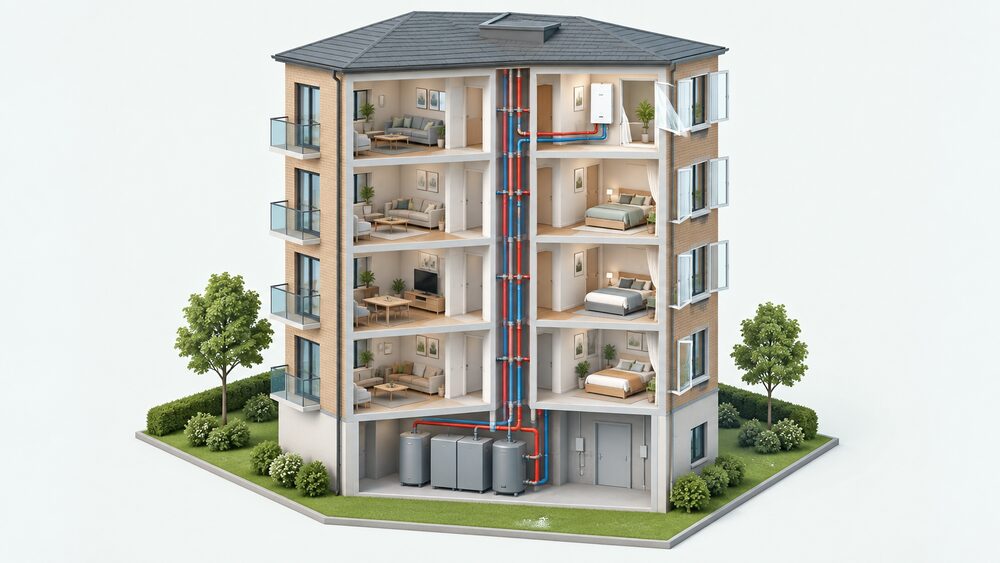
Heat networks do contribute to overheating in flats, and the mechanism is straightforward: heat is pumped into the home from a central energy centre, supplying heating and possibly hot water, and the pipework serving the building stays charged with hot water whatever the season1. A communal heat network supplies several properties within one building, for example 80 flats in a high-rise block, so the distribution pipework runs through the building rather than stopping at a single front door2.
The scale of the problem is documented. There are around 14,000 heat networks in the UK, with the highest concentration in London, where nearly half (46%) of some stock is served by them, and Government estimates suggest 65% of networks have heat losses above 200W per dwelling and 45% above 400W3. Separately, 55% of UK homes are already overheating during relatively cool summers4.
What follows is what the rules cover, what the research on London homes found, and where the limits of a householder's options lie.
Why flats on heat networks overheat
The first driver is the network itself. Heat is produced centrally and moved through underground pipes carrying hot water, so a dwelling receives heat whether or not it has called for any6. Distribution losses are not incidental: Government estimates put 65% of networks above 200W of loss per dwelling and 45% above 400W3. In a flat, those losses arrive inside the thermal envelope rather than being shed to the outside, because the risers and laterals run through the building.
The second driver is the building's own heat retention. Homes built since June 2022 and aligning with London Plan guidance for homes to be dual aspect are much better equipped to cope with current overheating risks, which implies that the stock built before that is not3. A single-aspect flat with limited opening windows has few routes for heat to leave once it is in the structure.
The third is regulatory direction. Zoning will be used to require heat network installation in new buildings as the first option for heat provision, and in Scotland heat network zones are areas particularly suitable for heat network development, intended to attract investment from developers7. More flats will therefore be on networks, not fewer, which makes the overheating question a growing one rather than a legacy one.
There is also a supply-side factor that has nothing to do with the network's design. Hot conditions can cause underground cables and substations to overheat, which may lead to interruptions, so a heat network flat that relies on a fan or a portable unit in a heatwave is relying on a grid that is itself under strain9.
Heat networks: how heat gets into the flat all year round

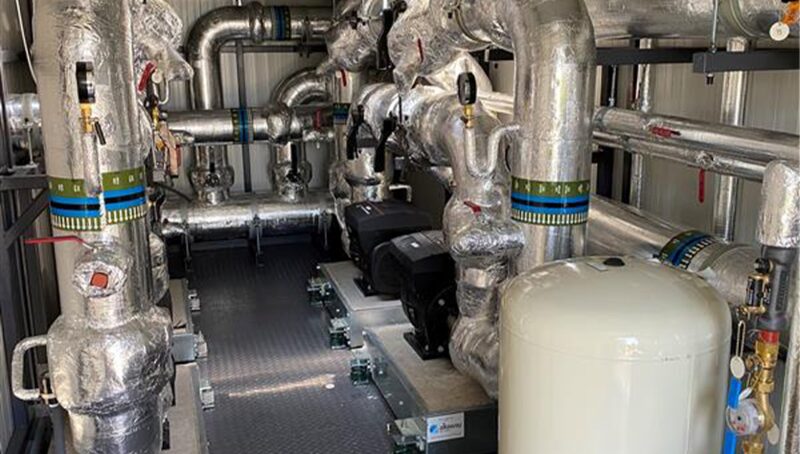
A heat network is a system that provides heat and hot water to several homes, from a central energy source such as a plant room or energy centre2. There are two types: district heating and communal heating1. A communal network supplies several properties within one building, for example 80 flats in a high-rise block2. Heat is pumped into the home, supplying heating and possibly hot water1.
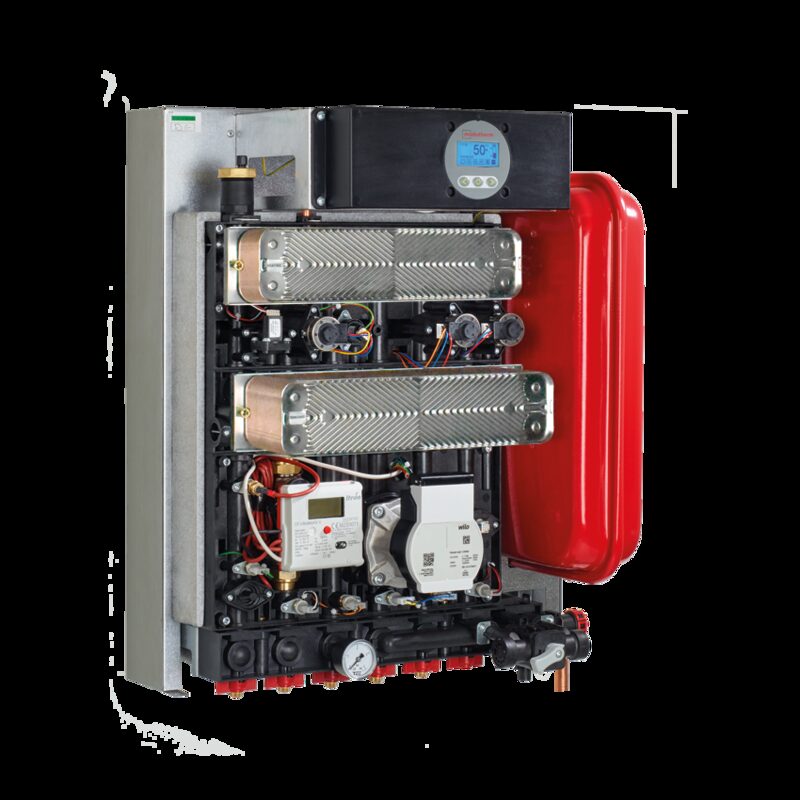
The practical consequence for a flat dweller is that the point of control sits at the Heat Interface Unit rather than at a boiler. Heat network operators should ensure that consumers are proactively and regularly informed about how to interact with key parts of the network infrastructure, such as Heat Interface Units, at regular intervals or during key events like tenancy changes or maintenance visits10. Where that briefing has not happened, a resident may not know which control does what, and a unit left in a heating position will keep delivering heat.
Two constraints follow. First, if you are on a heat network, you cannot switch your supplier11. Second, you usually cannot disconnect your home from the heat network, for reasons including contract or lease terms, no gas supply, effects on other homes, or cost1. The dependence is structural: the household depends on the network operator for the temperature of the water arriving, and on the building's own management for the condition of the pipework and controls.
Part O of the Building Regulations: what it does and does not cover
Part O of the Building Regulations was introduced in 2022 to address the risk of overheating in new homes3. It sets mandatory requirements designed to prevent homes from becoming excessively hot, and it applies to new residential buildings in England and Wales13. It appears in the Building Regulations as the overheating part15.
What it does not do is reach backwards. A flat completed before 2022 is outside Part O, and the London Assembly's evidence gathering treats that gap as the central problem: the standard was introduced in 2022 but the briefing finds its approach insufficient for London's extreme heat resilience3. The Climate Change Committee's work on existing homes considers what factors influence risk, how homes can be adapted or upgraded to mitigate the impacts and how much that would cost, and recommends further research to understand when overheating occurs in existing homes, including ongoing monitoring of temperatures in the housing stock and the number of homes currently adapted6.
There is a second regulatory gap that matters more to heat network residents than Part O. Households that get their heat delivered through a heat network are not covered by the energy regulator Ofgem; gas supply to a network is regulated as a commercial supply but heat supply to homes is not15. Part O governs how a new building is designed. It does not govern how the network serving it is run, priced or maintained.
What the research shows: UCL, CIH and UEL findings on London homes
The London Assembly Planning and Regeneration Committee opened its Call for Evidence on 6 March 2026, asking whether London's homes are ready for a heatwave3. The submissions set out the evidence base.
Research published in May 2023 highlighted overheating issues in homes created through permitted development in London3. In April 2026, CIH and UEL published a strategy briefing recommending a dual-track approach: strengthened heat risk communication in the short term, and building adaptation and retrofit in the long term3. In May 2026, Citizens Advice submitted a response setting out three priorities, including integrating overheating measures into fuel poverty and retrofit programmes and improving heat network efficiency through HNTAS3.
The national picture is starker than the London one in one respect. The Climate Change Committee projects that hotter heatwaves could see 92% of existing homes overheat by mid-century, creating dangerous conditions for vulnerable people16. The Committee has also assessed the risks to health, wellbeing and productivity from overheating in buildings, and commissioned Arup to appraise the current and future risks posed by summertime overheating to the UK housing stock at scale5.
On the cost side, high heat network pricing has been attributed to high input energy costs and, in some cases, poor heat network efficiency, and those increases were worsened by unfair and opaque billing practices17. A flat that is too hot and also expensive to run is the combination the evidence describes, not two separate problems.
Ventilation and window design: the limits of cooling by opening a window

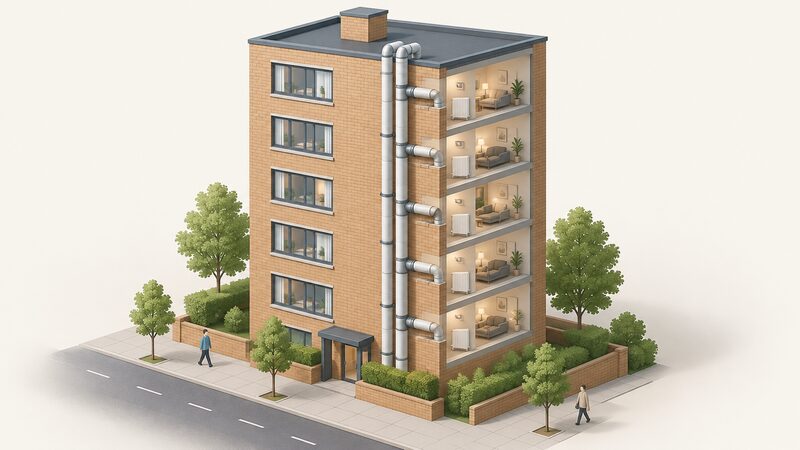
Opening a window is the first thing a resident tries, and it has real limits in a heat network flat. Approved Document L treats parts of a building which are not heated, for example garages, carports and outbuildings, as exempt, and requires that certain roof constructions be ventilated, but it does not set a minimum window aperture for cooling a dwelling12. There is no single figure in the building rules for how wide a window must open to ventilate a room.
What the rules do address is the equipment a resident might add. Class G permitted development rights allow an air source heat pump on, or within the curtilage of, a block of flats only where the outdoor compressor unit, including any housing, does not exceed 0.6 cubic metres, and more than one such unit is not permitted on a dwellinghouse which is not detached, or on a block of flats19. Those are the same constraints that bear on any outdoor cooling equipment on a flat.
Scotland is moving on a different track. Under the draft Buildings (Heating and Energy Performance) and Heat Networks (Scotland) Bill, heat network zone regulations may prohibit the use of direct emission heating systems in buildings within a heat network zone, and may require that such systems are not used in buildings situated within a heat network zone21. A zone co-ordinator may also be able to set a limit on emissions of greenhouse gases resulting from district heat networks within a heat network zone22. For a Scottish flat inside a zone, the direction of travel is restriction on individual heating plant, which makes the building's own ventilation and shading the main levers.
"The roof will need to be ventilated"
What a householder can do about an overheating flat
The first step is to establish what the Heat Interface Unit is doing. Operators are expected to explain how residents interact with it, at regular intervals or during key events such as tenancy changes or maintenance visits10. Where a radiator is hot at the top and cold at the bottom, the likely cause is sludge or debris in the system, which can be flushed out by a professional23. That is a building-side issue, not a resident-side one, and it belongs with the operator.
The second step is the complaint route. Customers who believe they have been unfairly treated by their heat network provider complain to their provider in the first instance24. The party responsible for handling complaints is the Energy Ombudsman, but before contacting the Ombudsman the consumer first notifies the heat supplier and tries to resolve the issue10. In the first instance the heat network supplier is contacted and asked to fix the situation25. The Ombudsman expects sufficient evidence to support the case, including the date the complaint was raised with the supplier26.
On cost, the reduced VAT treatment applies to certain products supplied by an installer and to the cost of all work to install those products in the home, in Great Britain27. It is not a general reduction in the VAT charged on the electricity a fan or portable cooling unit uses, so running costs remain a function of the unit's power draw and the tariff.
For the flat itself, the options that do not require the network's cooperation are the passive ones: shading, keeping solar gain out during the day, and using the coolest hours for ventilation. The options that do require it are the ones that touch the Heat Interface Unit, the riser pipework and the building's controls. The dependence that remains is on the network operator for the heat arriving, on the building's management for the pipework, and on the grid for any powered cooling.
Sources27 cited
- If your home is on a heat network, Citizens Advice, 2026-09-17
- Heat networks billing, Lease Advice, 2025-09-12
- Are London's homes ready for a heatwave? Call for Evidence, London Assembly, 2026-06
- Is air conditioning worth it in the UK?, Uswitch, 2026-07-14
- Risks to health, wellbeing and productivity from overheating in buildings, Climate Change Committee, 2026-09-19
- Addressing overheating risk in existing UK homes, Climate Change Committee, 2026-09-19
- Heat networks and zoning, House of Commons Library, 2026-09-20
- Heat networks policy, Scottish Government, 2026-09-17
- Be summer ready, Electricity North West, 2026-09-19
- Heat networks consumer protection draft guidance, Ofgem, 2025-09-05
- Switch your home energy supplier, Ofgem, 2026
- Approved Document L Volume 1: Dwellings, Ministry of Housing, Communities and Local Government, 2026-09-17
- Heatwaves, air con and other things, BESA, 2026-07-03
- Passivhaus and Building Regulations, Passivhaus Trust, 2026-09-20
- Introduction to the Building Regulations, BSRIA, 2026-09-17
- Progress in reducing emissions: 2026 report to Parliament, Climate Change Committee, 2026-06-24
- Citizens Advice response to Ofgem's heat networks regulation: fair pricing, Citizens Advice, 2026-09-17
- Building regulations: roof and conversion projects, Welsh Government, 2026-09-17
- Future Homes and Buildings Standards consultation, Ministry of Housing, Communities and Local Government, 2026-09-17
- Class G permitted development rights for air source heat pumps, legislation.gov.uk, 2026-09-17
- Draft Buildings (Heating and Energy Performance) and Heat Networks (Scotland) Bill: explanatory notes, Scottish Government, 2025-11-18
- Draft Buildings (Heating and Energy Performance) and Heat Networks (Scotland) Bill, Scottish Government, 2025-11-18
- How to bleed a radiator, Smart Energy GB, 2026-08-17
- Heat networks and consumer protection, House of Commons Library, 2026-09-17
- Heat networks affected by the Energy Prices Act 2022, Energy Ombudsman, 2026-09-20
- Raise a dispute: Metropolitan Infrastructure Limited, Energy Ombudsman, 2026-09-19
- VAT on energy-saving products, HM Revenue and Customs, 2026-09-20
 Overheating and Hot WeatherIs your home getting uncomfortably hot in summer, and is there anything you can do about it?
 High-Rise Flats and SafetyWho signs off new insulation, cladding or heating in a high-rise flat?
 UK Cooling DemandPublished data on air conditioning ownership and home overheating, with projections for summer temperatures in each UK nation, and what rising cooling demand means for summer electricity use.
 Heat Battery Trials and ResultsDo heat batteries actually work in real UK homes, and what did the trials find?
 Choosing Heating by Home TypeWhat heating can you actually have in a flat, a park home, a listed building or a new build?
 Future Weather and Climate DataHow hot will British summers get, and will your home cope?