
In this guide
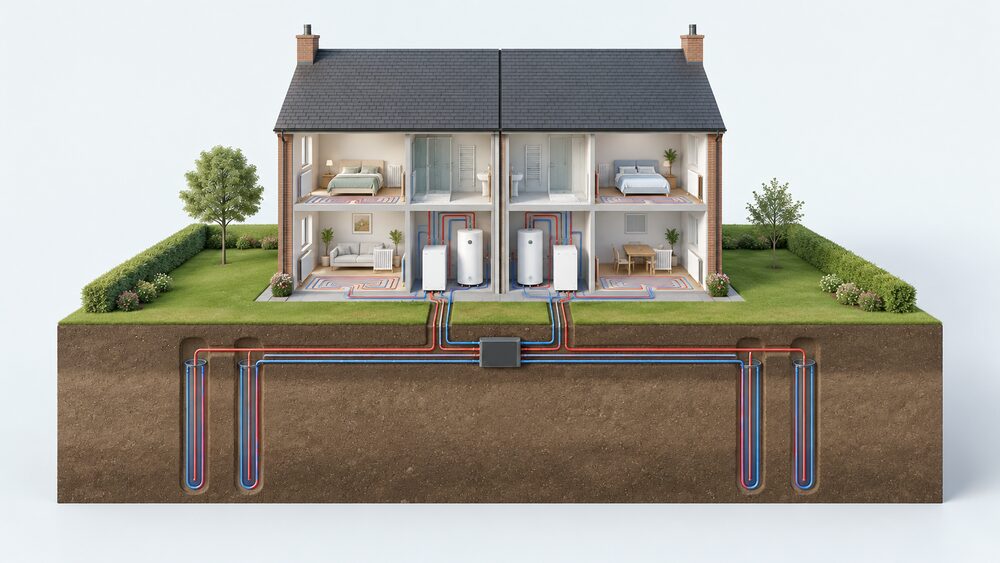
A shared ground loop array is one underground network of pipes serving many homes, with a separate heat pump inside each dwelling. The ground does the collecting; each household does its own heating. That single distinction separates a shared ground loop from a heat network, where heat arrives at the door as a bought commodity and the household has no heat pump of its own.
The model is eligible for the Boiler Upgrade Scheme. Ground source heat pumps on a shared ground loop are a named eligible technology, and the grant is £7,500 per property1. The condition that catches people out is capacity: the combined output of all the heat pumps on the shared loop cannot exceed 300 kWth3. Above that, the array is a different kind of project with different funding.
For a household, the practical consequences are unusual and mostly favourable. There is no outdoor unit, because the heat comes from a borehole rather than from the air. There is no heat bill from a network operator, because the household buys its own electricity and keeps its own supplier relationship4. What remains shared is the ground itself, and with it the maintenance, the access arrangements and the long-term ownership of infrastructure that is expected to last far longer than the heat pump attached to it.
What a shared ground loop array is: one ground network, many heat pumps
The defining feature is that the ground array is communal and the heat pump is not. A single set of boreholes, or a single horizontal trench field, collects low-grade heat from the soil and rock and delivers it through a circulating fluid to a manifold. From that manifold, a pipe runs to each dwelling, where an individual ground source heat pump raises the temperature to what the heating system needs.
Under the Boiler Upgrade Scheme, this arrangement is treated as one system for capacity purposes. The scheme rules state that the combined capacity cannot exceed 300 kWth1. That figure is the practical boundary of the model as the grant defines it: a terrace of homes on a single loop sits well inside it, while a larger estate may need to be split into separate arrays or funded through a different route. The median capacity of a ground source installation supported under the scheme in England and Wales was 10.5 kW6, which gives a sense of the individual unit size the loop is designed around.
Under ECO4, the same arrangement appears from a different angle. A ground source heat pump may also be comprised of a shared ground loop, considered as a district heating and cooling variant measure type8. That classification matters because it determines which delivery rules apply and whether the measure counts as an innovation measure in a given tenure. For social housing at SAP band D, a district heating connection using shared ground loops needs to be an innovation measure; for all other tenure types, it does not9.
The distinction between the array and the heat pump is not administrative tidiness. It is what determines who owns what, who pays for what, and what happens when something fails. The array is a buried asset with a working life measured in decades. The heat pump is a machine with a working life measured in years, and it is the household's own.
| Element | Who owns it | Who maintains it | Typical life |
|---|---|---|---|
| Boreholes and ground pipework | The array owner or operator | The array owner or operator | Buried infrastructure, decades |
| Manifold and communal pipework | The array owner or operator | The array owner or operator | Buried infrastructure, decades |
| Heat pump inside the dwelling | The household or the dwelling owner | The household or the dwelling owner | A machine, years |
| Electricity supply contract | The household, where it pays the supplier directly | The household | Ongoing |
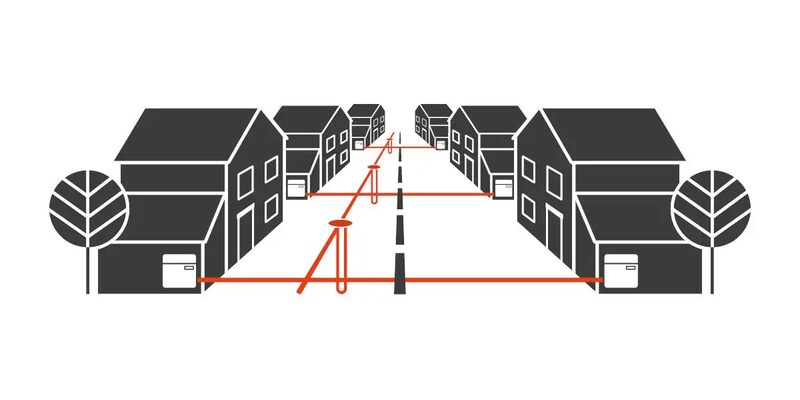
How the system works: boreholes, brine and individual heat pumps in each home
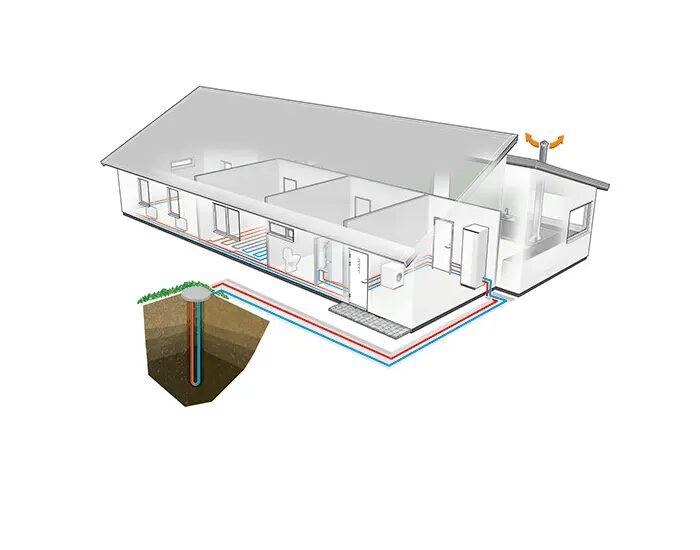
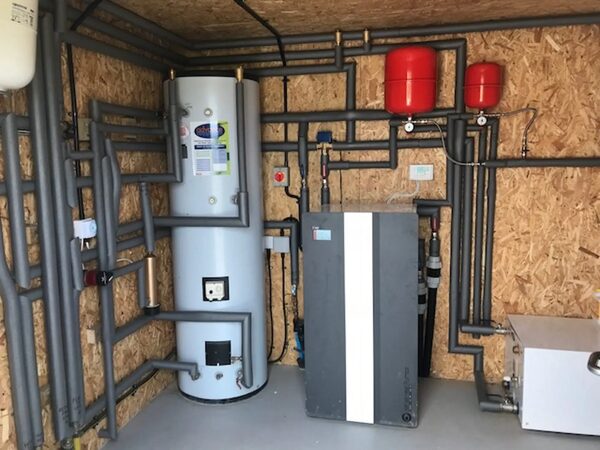
Ground source heat pumps transfer energy from the natural heat stored in the earth to heat the home and domestic hot water8. The mechanism is a closed circuit. Lengths of pipe are buried in the ground, either in a borehole or a horizontal trench, and the pipe is usually a closed circuit filled with a mixture of water and antifreeze7. That mixture, often called brine, absorbs heat from the surrounding ground as it circulates. The heat pump then lifts that low-grade heat to a temperature useful for radiators, underfloor heating or a hot water cylinder.
In a shared array, the circuit is longer and the fluid is pumped further. Instead of one property's loop returning to one heat pump, the loop runs from the boreholes to a manifold and then branches to each dwelling. Each heat pump extracts what it needs. The ground is replenished by solar gain and by heat conducted from surrounding rock, which is why the array is sized to the total extraction across all the homes it serves rather than to any one of them.
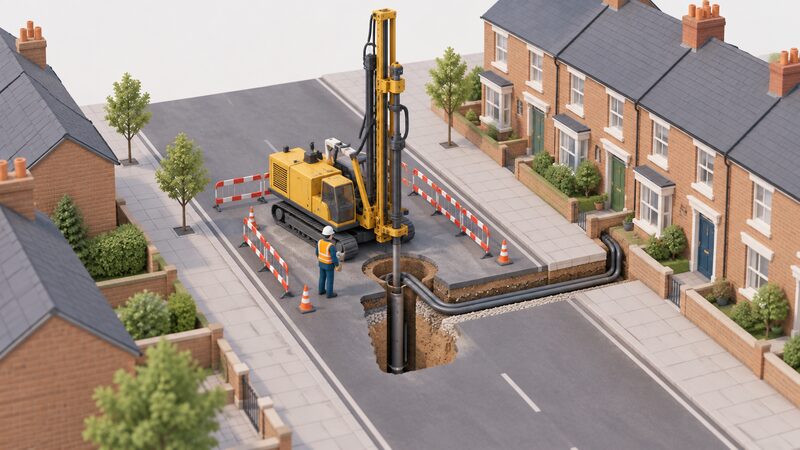
Depth is the variable that surprises people. A borehole is only about 20cm wide, but somewhere between 75 and 200 metres deep5. Where land allows, horizontal trenches are the cheaper option: for a newbuild three-bedroom house, two trenches of 30 to 40 metres in length are typical5. Shared arrays in dense streets use vertical boreholes because there is no open ground to trench.
The heat pump inside the dwelling is a conventional ground source unit. It provides space heating and, in some cases, pre-heating of domestic hot water7. Energy Saving Trust notes that a ground source heat pump is also called a ground-to-water heat pump, which describes exactly what it does: heat from the ground outside is transferred to a wet heating system inside5.
Shared loops, heat networks and individual ground arrays: which is which
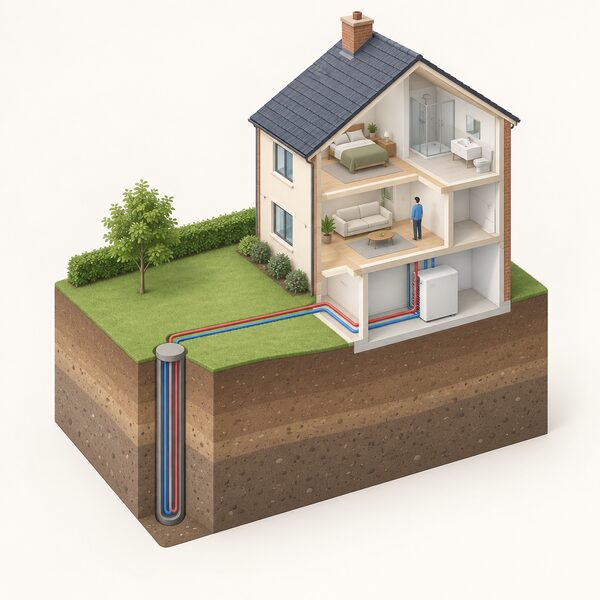
Three arrangements are often confused, and the differences are not cosmetic.
An individual ground array serves one property. The borehole or trench, the pipework and the heat pump all belong to the same household, and the household carries the whole cost and the whole benefit. This is the arrangement described in most domestic ground source guidance.
A shared ground loop serves several properties from one ground array, but each property has its own heat pump and buys its own electricity. There is no heat sold between parties. The household's relationship with an energy supplier is unchanged.
A heat network serves several properties from a central heat source. Heat is generated in one place and sold to the dwellings through insulated pipes. The household buys heat, not electricity for a heat pump, and the tariff is set by the network operator.
| Feature | Individual ground array | Shared ground loop | Heat network |
|---|---|---|---|
| Ground array | One property | Several properties | Not applicable |
| Heat pump | One per property | One per dwelling | Central plant |
| What the household buys | Electricity | Electricity | Heat |
| Supplier choice | Household's own | Household's own | Set by the operator |
| Grant route | Boiler Upgrade Scheme | Boiler Upgrade Scheme | Not the Boiler Upgrade Scheme |
The regulatory treatment reflects the difference. Under the Future Homes and Buildings Standards, communal heat network systems, where multiple dwellings or units within a single building are served from a central heat source in that building, cannot use the sleeving route to compliance10. A shared ground loop is not that, because the heat source is not central: it is distributed, one heat pump per home.
The funding rules draw the line in the same place from the other direction. District heating connection does not include a connection to a district heating system that uses a shared ground loop8. That exclusion is what allows a shared ground loop to be treated as a heat pump installation rather than as a heat network connection, and it is why the Boiler Upgrade Scheme grant applies.
For a householder, the test is simple. If the home has its own heat pump and its own electricity meter, it is on a shared ground loop. If heat arrives through a pipe and is metered as heat, it is on a heat network. The two feel similar in the street and are entirely different in the paperwork.
Where shared ground loops fit: flats, dense estates and street-by-street schemes
The model suits buildings where individual ground arrays are impossible. A flat has no garden to drill in. A mid-terrace house has no side return. A dense estate has no spare land between properties. A shared array solves all three by putting the boreholes where they can be drilled, often under a road, a car park or a communal green, and running pipes to each dwelling.
Flats are the clearest case, and also the most complicated. Permitted development rights for many common projects apply to houses, not to flats, maisonettes or other buildings11. Householder planning consent does not apply to applications affecting flats, more than one house or changes of use; for those, a full planning permission request is necessary14. South Oxfordshire District Council puts it plainly: flats do not have the same permitted development rights as other properties, so the planning team should be consulted about any proposed works15.
That does not block a shared ground loop, but it changes the route. The array itself is buried infrastructure, and the installation of a ground source heat pump on domestic premises is usually considered permitted development, not needing a planning application16. In a listed building or conservation area, the council should be contacted to check local requirements16. For a block of flats, the works are likely to need consent as a project affecting more than one dwelling, and the common areas have to be adequate in size and layout, which is a standard applied to blocks of flats in the Decent Homes Standard consultation17.
Dense estates and street-by-street schemes are the other natural fit. The economics improve with the number of connections, because the cost of the boreholes and the manifold is spread across more homes. The funding rules give a sense of the scale at which this becomes a fundable project: Warm Homes: Social Housing Fund Wave 3 Challenge Fund applications must include a minimum of 100 eligible social housing properties at EPC band D to G, except for small social housing landlords18. Mixed tenure blocks and terraces can be treated in their entirety as long as there are at least 30% social homes in the block or terrace18.
What changes for the householder: no outdoor unit, no central billing, your own supplier and tariff
The household experience of a shared ground loop differs from both a gas boiler and a heat network in three specific ways.
- No outdoor unit. There is no fan, no compressor housing on the wall and no noise at the boundary. The heat pump is indoors, connected to the ground loop. For flats and terraces where siting an air source unit is difficult, this removes the problem entirely. It also removes the permitted development question about air source unit placement, which restricts detached dwellings to two units and all other dwellings or flats to one19.
- No central billing. The household buys electricity, not heat. Ofgem guidance is clear that if you pay a supplier directly for the electricity or gas you use at home, you can choose to switch to a different supplier or tariff at any time4. That right applies in rented properties too, where the tenant pays the bills: if you have to pay your energy bills, you can choose to switch your supplier or tariff at any time4.
- Your own tariff, including time-of-use. Because the household controls its own electricity purchase, it can use a time-of-use tariff to run the heat pump when electricity is cheaper. That option does not exist on a heat network, where the heat tariff is set by the operator.
The alternative homes guidance draws the boundary from the other side. Where residents have their own contract with an energy supplier, they may be able to switch their business energy supplier; where residents pay the landlord or site owner by meter readings or estimates, the position on choosing a supplier is different20. The determining question is who holds the supply contract.
Costs and grants: £7,500 towards a heat pump on a shared ground loop
The Boiler Upgrade Scheme provides £7,500 towards a ground source heat pump, including water source heat pumps and those on shared ground loops2. The same figure appears in the scheme statistics: £7,500 towards a ground source heat pump, including water source heat pumps and those on shared ground loops6. Ofgem's installer guidance lists the ground source heat pump grant value at £7,500 from 21 July 2026, with a voucher validity of six months3.
The capacity condition is the one that shapes projects. The combined capacity of all heat pumps on the shared loop cannot exceed 300 kWth1. Ofgem's installer guidance states the same limit: 300 kWth total for shared ground loop systems3.
Take-up has been very small. Of the grants paid to date, 29, or 0.05%, were for shared ground loop ground source heat pumps, as reported to August 20255. In the quarter from May to July 2025, two shared ground loop ground source heat pump grants were paid5. Cumulative Boiler Upgrade Scheme figures for ground source heat pumps in England and Wales show 2,388 voucher applications received, 2,024 vouchers issued and 1,567 redemptions paid from May 2022 to July 20264.
Cost data for ground source installations is published at scheme level rather than for shared loops specifically. The nominal median cost of a ground source heat pump installation in 2026 Q2, April to June, was £27,232 including the grant value, in England and Wales4. The lower quartile reported cost was £18,136 and the upper quartile £42,1104. The median capacity of installation was 10.5 kW4. These are individual installation figures and should be read as such: a shared loop spreads the ground array cost across dwellings, and no published per-dwelling price exists for that arrangement. The cost of the heat pump itself ranges between £4,450 and £7,365, with little data available on the additional cost of installation5.
Running costs, efficiency and bills: savings of up to 72% for social housing residents
Efficiency is where the ground loop earns its place. Because soil and rock temperatures are stable through the year, a ground source heat pump works against a steadier source temperature than an air source unit, which is why ground source systems are associated with higher seasonal performance. No COP range is published for shared ground loops specifically, and no figure should be assumed for a particular installation. What is documented is the outcome: networked ground source heat pumps cut resident bills by up to 72% for social housing residents5.
What is documented is a modelled outcome from a retrofit programme rather than a measured bill. At Cables Wynd House, modelling coupled with electrification of the heating system has shown significant carbon emission reductions between 67-85%21. That is a carbon figure, not a bill figure, and it comes from an official council programme document for a high rise retrofit.
The funding rules also indicate how the technology is expected to perform. Warm Homes: Social Housing Fund Wave 3 expects heat pumps and low carbon heat networks optimised for operation with a low flow temperature, below 55°C, and then in priority order: shared ground loops or ground source heat pumps, air to air heat pumps once eligible, heat batteries once eligible, high retention electric storage heaters in electrically heated flats and small dwellings only, or solid biomass18. Shared ground loops sit at the top of that priority order, above every other measure listed.
For the household, the running cost question is about electricity price and heat pump efficiency together. The household pays for electricity at its own tariff, and the heat pump converts that electricity into heat at a ratio set by the ground temperature and the flow temperature of the heating system. A lower flow temperature improves the ratio, which is why the funding guidance specifies below 55°C. Fabric improvements, larger radiators or underfloor heating, and weather compensation controls all push in the same direction.
The independence point is straightforward. A household on a shared ground loop is not exposed to gas prices, not exposed to a heat network tariff, and not dependent on a fuel delivered by tanker. It is exposed to electricity prices, and to the performance of the heat pump it owns.
Heat the Streets: the Cornwall retrofit that proved the model
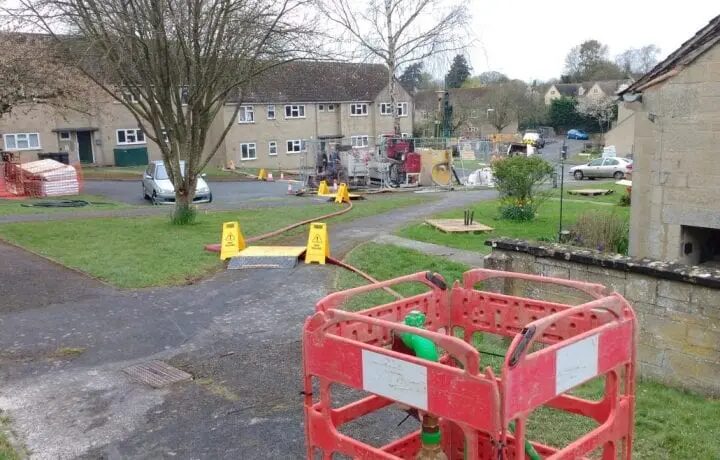
The Heat the Streets project in Cornwall is the UK retrofit that demonstrated the shared ground loop model at street scale, drilling boreholes under roads and pavements and connecting existing homes to a communal ground array with individual heat pumps in each property. It showed that the approach could be applied to a terrace of existing dwellings rather than only to new build, which is the harder case because the ground is already occupied by services, roads and gardens.
The evidence base for the model comes from a different but comparable project. The High Rise Retrofit and Upgrade Programme Phase 1 in Edinburgh covers proposals for the upgrade and retrofit of 10 high rise blocks, at Craigmillar and Peffermill Court, Cables Wynd and Linksview House, and six Moredun high rise blocks21. The programme document records that modelling coupled with electrification of the heating system has shown significant carbon emission reductions between 67-85%21.
That is the shape of the case for shared loops in retrofit: high rise and dense housing where individual ground arrays are impossible, where the building fabric can be improved at the same time, and where the heating system can be electrified as part of a wider upgrade. The carbon reduction figure is a modelled outcome for that programme, not a guarantee for any other building.
Installation, permits and the 100-year ground infrastructure
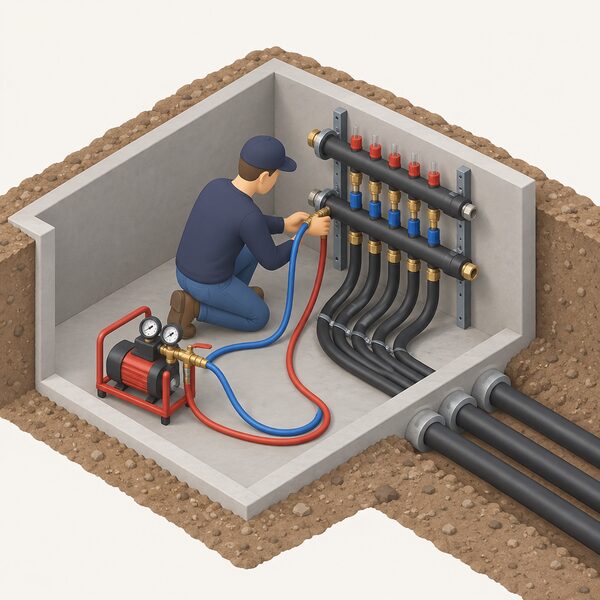
The ground array is the long-lived part of the system. Boreholes and pipework are buried infrastructure, and the standards applied to them reflect that. Ground arrays, including header pipes and manifolds, should be flushed as one system to remove all debris and purged to remove all air22. A pressure test in accordance with BS EN 805, section 11.3.3.4, should be conducted on the closed-loop installation22. Commissioning information provided to the dwelling owner should include details of the fluids used and their commissioned concentrations22.
Those requirements matter more on a shared loop than on a single-property array, because a fault in the communal pipework affects every dwelling connected to it. Flushing and pressure testing the array as one system, before the individual heat pumps are commissioned, is the sequence the guidance describes.
On planning, the position for domestic ground source heat pumps is permissive. The installation of a ground source heat pump or a water source heat pump on domestic premises is usually considered to be permitted development, not needing an application for planning permission16. In a listed building or a conservation area, the council should be contacted to check on local requirements16. For flats and multi-dwelling buildings, the permitted development position is narrower: the rights applying to many common projects for houses do not apply to flats, maisonettes or other buildings11, and householder planning consent does not cover applications affecting flats, more than one house or changes of use14.
The ground loop must be new, except for the ground loop associated with the second or subsequent ground source heat pump in an existing shared ground loop system23. That rule allows additional dwellings to be connected to an array that already exists, which is what makes a phased street-by-street rollout possible.
Limits and caveats: where a shared ground loop is not the answer
A shared ground loop is not a universal solution, and the conditions under which it fails are worth stating as plainly as the benefits.
- It needs ground. Boreholes require space to drill and access for the rig. A dense urban site with no accessible land, no road to close and no communal area may not be drillable at the cost the project can bear. The array has to be sized to the total heat extraction of every dwelling connected to it, so the ground area scales with the number of homes.
- It needs a critical mass of dwellings. The economics depend on spreading the array cost. A single property gains nothing from the shared arrangement, and a pair of semi-detached houses gains little. The funding rules point to 100 or more eligible social housing properties for a Challenge Fund application, with mixed tenure blocks and terraces treated in their entirety where at least 30% are social homes18.
- It needs the capacity to stay under 300 kWth for Boiler Upgrade Scheme eligibility1. A larger scheme has to be structured differently, whether as separate arrays or through another funding route.
- It needs consent where flats are involved. Permitted development rights for many common projects do not apply to flats, maisonettes or other buildings11, and householder planning consent does not cover applications affecting flats, more than one house or changes of use14. A block of flats is a full planning application, not a permitted development notification.
- It leaves the household dependent on electricity. The ground is free, but the heat pump is not. The household's running cost is an electricity bill, and its exposure is to electricity prices rather than gas prices. That is a different dependence, not the absence of one.
- It leaves the household dependent on the array operator. The heat pump belongs to the household, but the ground loop does not. Whoever owns and maintains the array controls the infrastructure the heat pump depends on. The terms of that arrangement, including access rights and maintenance charges, are set by the project rather than by the household.
- It is not a heat network, and should not be sold as one. District heating connection does not include a connection to a district heating system that uses a shared ground loop8, and communal heat network systems served from a central heat source in a building cannot use the sleeving route to compliance10. A shared ground loop is a distributed heat pump installation with a communal ground array, and the household's rights and bills follow from that.
Sources23 cited
- Boiler Upgrade Scheme: information for installers, Ofgem, 2026-09-17
- Apply for the Boiler Upgrade Scheme: what you can get, GOV.UK
- Boiler Upgrade Scheme guidance for installers v5, Ofgem, 2026-04-28
- Boiler Upgrade Scheme statistics, July 2026, Department for Energy Security and Net Zero, 2026-08-27
- Boiler Upgrade Scheme quarterly report, issue 13, Ofgem, 2025-08-29
- Ground source heat pumps, Energy Saving Trust, 2026-07-16
- Home energy generation: heat pumps, Planning Portal, 2026-09-17
- ECO4 new measures and products guidance v3.0, Ofgem, 2026-03-26
- Summary of updates to ECO4 delivery guidance and measures table, Ofgem, 2025-06-26
- Future Homes and Buildings Standards consultation response, Ministry of Housing, Communities and Local Government, 2026-03
- Permitted development rights, Planning Portal, 2026-09-17
- Planning permission: fuel tanks, Welsh Government, 2026-09-17
- Permitted development rights in Wales, Planning Portal, 2026
- Householder planning consent, Planning Portal, 2026-09-17
- Do you need planning permission for retrofitting, South Oxfordshire District Council, 2025-08-15
- Heat pumps, Planning Portal, 2026-09-17
- Current Decent Homes Standard summary table, Northern Ireland Department for Communities, 2025-08-05
- Warm Homes: Social Housing Fund wave 3 scheme guidance addendum, Department for Energy Security and Net Zero, 2026-06
- Air source heat pumps, Bracknell Forest Council, 2025-10-17
- Alternative homes energy guidance, Ofgem, 2026
- High rise retrofit and upgrade programme phase 1, City of Edinburgh Council, 2026-04-20
- Approved Document L volume 1 consultation version, Welsh Government, 2026-09-17
- Boiler Upgrade Scheme guidance for installers v2.1, Ofgem, 2023-05-18
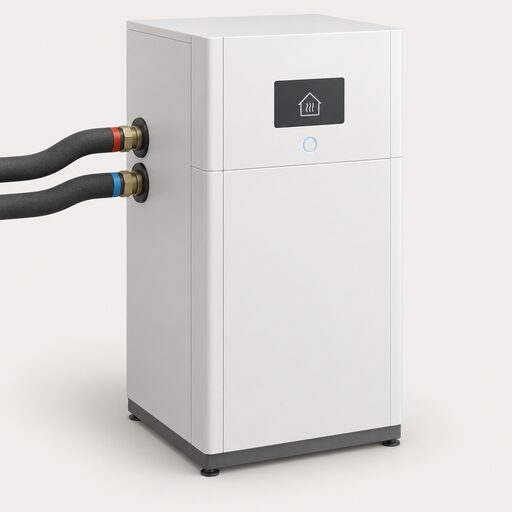 Ground Source Heat PumpsA ground source heat pump takes warmth from the ground to heat your home and water.
 Ground Loops and BoreholesHow horizontal trenches, slinky coils and vertical boreholes work, the land or drilling access each needs, how ground conditions affect collector length, and what the Boiler Upgrade Scheme pays.
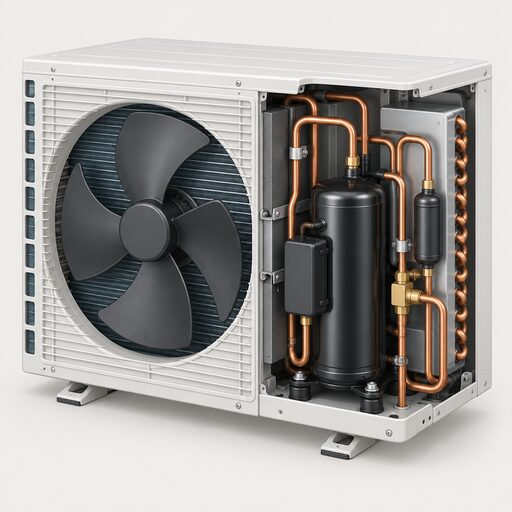 Air Source Heat PumpsHow an air source heat pump takes heat from outdoor air, the difference between air-to-air and air-to-water systems, typical efficiency, the £7,500 Boiler Upgrade Scheme grant, noise and planning limits, and what ownership means for a household's energy independence.
 Hybrid Heat PumpsHow hybrid systems pair a heat pump with a gas, oil or LPG boiler, what decides which appliance runs, what they cost, how much gas they displace, and why the Boiler Upgrade Scheme will not fund them.
 Water Source Heat PumpsYour home sits near a river, lake or the sea.
 Ground Source Heat Pump CostWhat a ground source heat pump costs in the UK, splitting groundworks and drilling from the heat pump and internal works, and how the £7,500 Boiler Upgrade Scheme grant and the £9,000 off-gas-grid uplift change the figure.