

In this guide
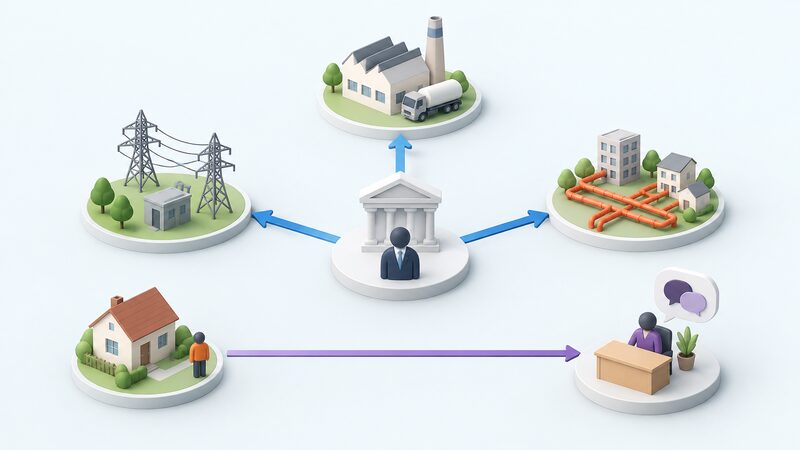
Ofgem is Great Britain's independent energy regulator1. It performs the day-to-day functions of the Gas and Electricity Markets Authority (GEMA), the statutory body in whose name formal decisions are taken2. In practice that means Ofgem writes and enforces the licence conditions that gas and electricity suppliers and network companies must meet, sets the price controls that determine what networks may recover from bills, sets the default tariff cap every quarter, and administers 12 schemes on behalf of the UK government and the devolved administrations3.
What Ofgem does not do matters just as much to a household. It does not directly get involved with complaints about energy suppliers or network operators, and that now includes heat network suppliers and operators, and it does not investigate individual disputes4. It does not set scheme policy or legislation, and it does not certify installers, products or installations5. Its role in relation to fraud is limited to progressing counter-fraud investigations where allegations have been made, with neither a legislative role nor the ability to detect fraud across the whole system6. A household that wants a decision on its own bill needs the supplier's complaints process and then the Energy Ombudsman, not the regulator.
The remit has been widening. Since 27 January 2026 Ofgem's formal role as regulator of heat networks has been live, with the initial set of rules in place7, and a government review of Ofgem in 2026 introduced a new set of three equal principal objectives covering existing and future consumers, net zero and growth, alongside powers for Ofgem to ban energy bosses' bonuses if they break the rules8.
Three principal objectives: consumers, net zero and growth
Ofgem's long-standing statutory duty is to protect the interests of existing and future consumers, including consumers' interests in the net zero 2050 target and five-year carbon budgets, and in the security of supply of gas and electricity1. The 2026 government review of Ofgem restated this as three equal principal objectives, focusing on the interests of existing and future consumers, net zero and growth8. The significance of equality between the objectives is that consumer interest no longer automatically outranks the other two in a contested decision: investment that raises bills now but supports decarbonisation or network capacity can be justified on its own footing.
The consumer strand is currently expressed most concretely in Ofgem's debt strategy. That strategy has four components: resetting debt through a proposed Debt Relief Scheme, reforming how suppliers manage debt by increasing Debt Standards, helping to prevent debt from occurring by looking at billing and access to credit, and energy affordability support12. Government has said that backing Ofgem's proposed debt strategy will cut consumers' energy bills by reducing the cost of paying for energy debt13. Ofgem's own update lists the immediate priorities as ensuring accurate bills and direct debits, reducing the occurrence of shock bills, and ensuring customers who want a smart meter can receive one quickly14.
The net zero and growth strands show up in the price controls and in network reform. Ofgem's price controls have introduced requirements for distribution and transmission companies to submit climate resilience strategies as part of their business plans, and Ofgem has work in train on agreed approaches to measuring and valuing resilience15. On flexibility, Ofgem is due to set out immediate priority steps for adapting its regulatory frameworks for clean flexibility innovation by the end of 2026, to consult by the end of 2026 on implementing the consumer outcome related to informed decision making for the electricity supply licence, to report by autumn 2026 on its review into distribution system operators' use of flexibility in the ED2 price control, to finalise decisions on the first window of the long duration electricity storage cap and floor by autumn 2026, and to publish regulatory instructions and guidance following the regime award and licence decisions by the first quarter of 202716.
For a household aiming at independence, these are the decisions that determine whether exporting, storing and shifting electricity is rewarded or merely tolerated. They sit with the regulator, not with the householder, and they are made through consultations rather than at the point of sale.
Who Ofgem is and is not: legal status and relationship with government

The legal body is GEMA; Ofgem is the office that carries out its day-to-day functions, and it is GEMA that is described as the statutory body responsible for administering schemes such as the Domestic Renewable Heat Incentive in Great Britain2. Independence is the defining feature in government's own description of it1, and the Energy Ombudsman describes Ofgem's contribution to the market in terms of providing independent dispute resolution arrangements and helping to build trust in the market17.
Independence is not the same as autonomy over policy. On the Energy Company Obligation, Ofgem is the appointed administrator but the Department for Energy Security and Net Zero sets the overall policy for the scheme18. The same division runs through the grant schemes: Ofgem states plainly that it is not responsible for setting scheme policy or legislation, nor for certifying installers, products or installations5. Where the rules come from, in other words, is DESNZ and Parliament; where they are applied is Ofgem.
Geography limits the remit too. Ofgem regulates Great Britain. Northern Ireland has its own regulator, and gas and electricity there are overseen by the Utility Regulator. Within Great Britain, devolved policy in Scotland and Wales shapes building standards and heat network delivery while the licensing of suppliers and networks remains reserved and with Ofgem.
Ofgem's own procedural posture is deliberately open-textured in places. On deemed contracts it said it intends to adopt a case-by-case assessment of all relevant circumstances rather than a fixed rule [46 note: see standing charges section]. In the heat networks consumer protection decision it declined to set prescriptive, minimum standards for how the Standards of Conduct should be achieved, wanting to keep a flexible, principles-based framework, and it did not set prescriptive rules for how information should be shared, to ensure a regime appropriate for a diverse sector19.
What Ofgem covers: suppliers, network operators and, since 2026, heat networks
Ofgem monitors energy suppliers and network operators closely to make sure they meet the rules set out in licences, regulations and law, provide good customer service, and reply quickly to customers who contact them20. That monitoring is the everyday work of the regulator: licence conditions, performance reporting, and the codes that govern the industry.
Heat networks were, until recently, the conspicuous gap. Households that got their heat delivered through a heat network were not covered by Ofgem: the gas supply to a network was regulated as a commercial supply, but the heat supply to homes was not21. The Energy Act 2023 named Ofgem as the regulator for heat networks in England, Scotland and Wales19, and Ofgem began regulating them from January 202622. On 27 January 2026 the formal role began with the initial set of rules in place7, and from that date all heat networks are regulated by Ofgem and must register23. Government presented the change as Ofgem being able to act on unfair price hikes and poor service24.
| Sector | Ofgem's position |
|---|---|
| Licensed gas and electricity suppliers | Monitored against licences, regulations and law20 |
| Electricity and gas network operators | Monitored, and subject to price controls including climate resilience strategy requirements20 |
| Heat networks (England, Scotland, Wales) | Regulated from 27 January 2026; registration required7 |
| Individual consumer disputes | Not investigated by Ofgem4 |
Ofgem has signalled a graduated start for heat networks, saying it wants to support operators and suppliers to comply over time, including with guidance and a fair and pragmatic compliance approach25. It has not amended the statutory definitions of operator and supplier, which are published in line with the Heat Networks Market Frameworks Regulations19. It also declined for now to impose prescriptive targets or key performance indicators for authorised persons' resolution of complaints, though it may explore complaint resolution requirements through future consultations on the guaranteed standards of performance for heat networks, and it has amended the authorisation condition so an enquiry service must be capable of taking enquiries at any time while not requiring responses outside usual working hours19. DESNZ has said it is working with Ofgem to ensure that, as regulation matures, heat network customers receive similar levels of protection to customers on other types of heating26. The detail is set out on the heat network regulation page.
The price cap: quarterly since summer 2022
The default tariff cap was introduced on 1 January 201910. It limits what a supplier may charge on a default or standard variable tariff, expressed as a maximum unit rate and standing charge rather than a maximum bill. In summer 2022 Ofgem moved from setting the cap every six months to every quarter, in response to high and volatile wholesale prices10. Current parliamentary briefings describe Ofgem as revising the cap each quarter27 and as reviewing and setting the price cap every three months based on the cost of wholesale energy28.
Older guidance from January 2022 still describes the cap as reviewed twice a year29. The two accounts reflect the change of practice in 2022 rather than a live disagreement, and the quarterly figure is the current one.
Because the cap tracks wholesale costs, the decisions that move it are largely outside the regulator's control. What Ofgem controls is the methodology, the allowances, and the enforcement of compliance with the cap: it has said it will be closely monitoring supplier compliance and will continue to take firm action against suppliers who fall short of their requirements30. The mechanics are covered in more detail on the energy price cap page.
For a household pursuing independence, the cap's limits are instructive. It applies to default tariffs from licensed suppliers. It does not cap fixed deals, and it does not cap heat delivered by a heat network, which is regulated separately under the new heat network regime. Reducing exposure to the cap means reducing metered consumption, not appealing to the regulator.
Enforcement: monitoring, investigations, penalties and bonus bans

If Ofgem thinks a supplier or network operator has not met certain rules, it will start an investigation31. Its formal enforcement powers, as it describes them, include opening investigations, making orders and imposing penalties in response to non-compliance and suspected non-compliance3.
Ofgem does not investigate every failing. Its published approach is to pursue enforcement action in line with its Enforcement Guidelines where there is serious harm that requires a strong deterrent signal, a consistent pattern of poor conduct, or where companies refuse to cooperate12. After a review of how suppliers support customers in vulnerable situations, it stated that where there are serious ongoing concerns with suppliers it will consider what further action may be necessary in line with its Enforcement Guidelines32. On prepayment meter installations, following the 2023 code of practice, it confirmed that it was already investigating suspected poor practice in this area, including through a market-wide review33. Those protections are set out on the prepayment and vulnerable customer rules page.
The 2026 review added a personal dimension to enforcement: Ofgem now has powers to ban energy bosses' bonuses if they break the rules9. That is a deterrent aimed at company leadership rather than at the balance sheet.
Enforcement extends into the schemes. On the Feed-in Tariffs scheme, Ofgem states that it takes compliance with scheme rules extremely seriously and investigates matters where there are concerns with supplier performance or generator compliance, taking action where necessary34. It has an ongoing duty as FIT scheme administrator to monitor compliance with the FIT Orders by operators of installations, including on occasion through an audit programme [37, see scheme section]. Audit volumes are published: in Scheme Year 11 of the Domestic RHI a total of 1,199 audits were conducted, made up of 621 desk audits and 578 site audits, and the recovery rate for incorrect payments rose from 85.3% in Scheme Year 10 to 89.8% in Scheme Year 112.
What enforcement is not is redress for an individual. A penalty against a supplier does not settle a household's bill, and Ofgem's fraud role is limited to progressing counter-fraud investigations where allegations have been made, without a legislative role or the ability to detect fraud across the whole system6.
Where the regulator stops: complaints, disputes and individual cases
Ofgem is explicit that it does not directly get involved with complaints about energy suppliers or network operators, including heat network suppliers and operators, and does not investigate individual disputes4. The same position is restated in the heat networks decision: generally, Ofgem does not intervene in individual disputes between consumers and energy businesses, including heat suppliers and operators19. This is not new; guidance from 2014 already said Ofgem does not have a direct role in dealing with individual disputes between customers and energy companies35.
The route that does exist runs through the company and then the ombudsman. The Energy Ombudsman is approved by Ofgem to handle service disputes in the energy sector23. It does not cover everything: it does not deal with disputes on commercial decisions made by companies about whether to provide a product or service, nor with liquid petroleum gas36.
- Step 1: Complain to the supplier or network operator and use its complaints procedure31.
- Step 2: If unresolved, refer the case to the Energy Ombudsman, which Ofgem has approved for energy service disputes23.
- Step 3: Ofgem's interest is in patterns: repeated failures inform monitoring and, where the thresholds are met, investigation3.
The energy complaints and redress page sets out the sequence and the time limits.
Schemes Ofgem administers: ECO, GBIS, FIT, RHI, Warm Home Discount and more

Ofgem administers 12 schemes on behalf of the UK government and the devolved administrations3. Administration means running the machinery: guidance, assessing eligibility, audits and payments3.
| Scheme | Ofgem's role |
|---|---|
| Energy Company Obligation (ECO4) | Setting targets for each obligated supplier, ensuring compliance and monitoring progress; DESNZ sets policy18 |
| Great British Insulation Scheme | Scheme administrator, alongside ECO437 |
| Feed-in Tariffs | Administration split with FIT Licensees, who handle day-to-day administration38 |
| Domestic Renewable Heat Incentive | Processing applications, making payments, reporting on the scheme39 |
| Warm Home Discount | Administering the industry initiatives and facilitating supplier compliance40 |
| Boiler Upgrade Scheme | Guidance, eligibility assessment, audits and payments; not policy or certification5 |
On ECO, Ofgem's role as administrator involves setting targets for each obligated energy supplier, ensuring compliance, and monitoring progress towards those targets18. Its wider obligation-scheme duties include calculating energy suppliers' obligations and tracking performance against them, processing notifications, auditing suppliers, counter fraud, and reporting to the Secretary of State41. It consults from time to time on how it administers aspects of the ECO scheme [see consultations].
On Feed-in Tariffs, Ofgem's administered functions include running the Central FIT Register and the Renewable Electricity Register, publishing reports and data, processing ROO-FIT applications, managing fuelling and sustainability requirements for anaerobic digestion installations, running the levelisation process, and ensuring suppliers comply with the scheme requirements42. Earlier supplier guidance lists responsibilities as granting ROO-FIT preliminary and full accreditation, registering community energy and school installations, managing the Central FIT Register, administering deployment caps and degression, and managing levelisation43. Ofgem describes itself as fulfilling multiple functions as scheme administrator, including overseeing the accreditation process, and conducting annual audit programmes to ensure suppliers and generators comply34.
On the Domestic RHI, Ofgem compiles and publishes public statistics and reports as part of its administration duties44. Its statistical audits are randomly selected to provide a representative view of the scheme population at a 90% confidence level2.
For insulation delivered through local authority routes, Ofgem sends suppliers an annual sample of measures notified during the year, and where it identifies that local authorities have not carried out adequate due diligence checks it includes this in the report45. It also commissioned a randomised sample of audits of solid wall insulation installed under ECO4 and the Great British Insulation Scheme, the results of which were published as official statistics46. For the proposed Debt Relief Scheme, Ofgem's delivery guidance states that where it is not satisfied with an aspect of a claim it will adjust or reject specific items rather than rejecting the whole claim, and may revise or reject a claim entirely where evidence is insufficient47.
For a household, the practical consequence is that grant money flows through Ofgem but eligibility and installer quality do not rest with it. Certification sits with MCS and the installer schemes and consumer codes.
When a supplier fails: Supplier of Last Resort
When an energy supplier ceases trading, Ofgem appoints another supplier to provide the customers' energy supply, to prevent a drop in service23. Government has described the effect from the household's side: the independent energy regulator will automatically switch you onto a new supplier so there will be no interruption to your supply of energy48.
This is the clearest example of the regulator acting as a backstop rather than a service provider. Nothing is required of the household at the moment of failure: the supply is not cut off, the meter keeps working, and the appointment is made by Ofgem. What the household loses is its tariff, since the new supplier's terms replace the failed supplier's deal, and there is a period of uncertainty around account balances while the transfer is processed. The mechanics of licensing and the Supplier of Last Resort process are set out on the supplier licensing and supplier failure page.
The independence lens here is uncomfortable but plain. Continuity of supply is guaranteed by a regulatory process, not by the market, and it depends entirely on there being another licensed supplier willing to take the customers on. A home with its own generation and storage reduces the consequences of a failure but does not step outside the arrangement while it remains connected and metered.
Standing charges, back billing and deemed contracts

Standing charges are a live area of regulatory work rather than a settled one. The Energy Ombudsman's response to Ofgem's Forward Work Programme 2025/6 consultation supported Ofgem's plans to look at how it regulates pricing, including reforms to standing charges and steps on debt and affordability49. That places standing charges inside the cap methodology debate rather than in enforcement.
Back billing is settled and enforceable. Ofgem's rules mean a household does not have to pay for energy used more than 12 months ago where it has not had an accurate bill or statement of account, or where a Direct Debit was set too low50.
"Our back billing rules mean you do not have to pay for energy you used more than 12 months ago if:"
Deemed contracts, the terms applied when someone takes a supply without agreeing a contract, are governed by a rule that the terms should not be "unduly onerous"51. Suppliers can ensure contracts are not unduly onerous by making sure the profit derived from deemed rate customers is not significantly higher than the profit derived from contracted customers51. Ofgem's stated approach to applying that test is a case-by-case assessment of all relevant circumstances rather than a fixed formula.
Because Ofgem does not adjudicate individual cases, these protections are enforced in two ways: through the supplier applying the rule, and through the Energy Ombudsman when it does not. That division is the single most useful thing for a household to understand about the regulator.
Contacting Ofgem and what it will ask for
Ofgem publishes scheme contact routes rather than a general consumer helpline. For the Boiler Upgrade Scheme it lists the telephone number 0330 053 2006 and the email address BUS.Enquiry@ofgem.gov.uk11.
Ofgem does contact households in connection with the schemes it administers. Under the Boiler Upgrade Scheme it verifies the identity of the individual confirming consent, and for properties owned by an organisation it verifies the authority of that individual via Companies House52. Scheme audits include site audits as well as desk audits: 578 of the 1,199 audits in Domestic RHI Scheme Year 11 were site audits2. Contact of that kind arises from an application or an audit sample, not from an unsolicited offer, and Ofgem cannot confirm eligibility before a full application is submitted by an installer11.
Sources52 cited
- Electricity distribution networks study: government response, GOV.UK, 2025-07-07
- Domestic RHI Annual Report, Scheme Year 11, Ofgem, 2025-07
- Supplier Performance Report, July to December 2023, Ofgem, 2024-08
- Complain about your energy supplier, Ofgem, 2026
- Boiler Upgrade Scheme, Ofgem, 2026
- Public Accounts Committee report, UK Parliament, 2026-01-23
- Heat Networks Delivery Plan review report 2026, Scottish Government, 2026
- Ofgem Review 2026: final report, GOV.UK, 2026-04-22
- Ofgem transformed to strengthen protections for energy consumers, GOV.UK, 2026
- Energy price cap methodology: backwardation deadband decision, Ofgem, 2025-11-21
- Boiler Upgrade Scheme guidance for property owners, Ofgem, 2026-03-25
- Consumer Vulnerability Strategy, final, Ofgem, 2025-04-15
- Millions more families to get £150 off energy bills this winter, GOV.UK, 2025-06-19
- Debt strategy update: supporting reduction of energy debt, Ofgem, 2025-11-06
- Well-adapted energy system monitoring framework, Climate Change Committee, 2026
- Clean Flexibility Roadmap: July 2026 update, GOV.UK, 2026-07
- One million consumers helped as service marks 20 years, Energy Ombudsman, 2026-07-07
- ECO: homeowners and tenants, Ofgem, 2026
- Heat networks regulation: consumer protection guidance decision, Ofgem, 2026-01-13
- Complain about your energy supplier or network operator, Ofgem, 2026
- Heat networks regulation briefing, House of Commons Library, 2026
- Heat networks briefing, UK Parliament, 2026-02-26
- Energy Ombudsman FAQs, Energy Ombudsman, 2026
- Heat network customers to be shielded from unfair price hikes, GOV.UK, 2026-01-26
- Heat networks: policy, guidance and resources, Ofgem, 2026
- Reforming consumer protection for home upgrade schemes, GOV.UK, 2026-06-17
- Energy prices briefing, House of Commons Library, 2026
- Electricity prices in Great Britain, House of Lords Library, 2026-06
- Domestic energy prices briefing, House of Commons Library, 2022-01
- Summary of changes to the energy price cap, 1 April to 30 June 2025, Ofgem, 2025-02-25
- Complain about your energy supplier or network operator, Ofgem, 2026
- Ofgem completes review of how suppliers support customers in vulnerable situations, Ofgem, 2022-11-22
- Energy suppliers sign new code of practice on involuntary prepayment installations, Ofgem, 2023-04-18
- Feed-in Tariffs Annual Report, Scheme Year 13, Ofgem, 2023-12
- How to complain: consumer leaflet, Ofgem, 2014-08
- How we can help: energy suppliers, Energy Ombudsman, 2026
- Decision on administration of mid-scheme changes to ECO4 and GBIS, Ofgem, 2025-06-26
- Feed-in Tariffs scheme administration, Ofgem, 2026
- Domestic RHI Essential Guide, Ofgem, 2024-06
- Warm Home Discount, Ofgem, 2026
- Energy Company Obligation, Ofgem, 2026
- Feed-in Tariffs, Ofgem, 2026
- FIT guidance for licensed electricity suppliers, Ofgem, 2021-08
- Domestic RHI: contacts, guidance and resources, Ofgem, 2026
- Great British Insulation Scheme: local authorities, Ofgem, 2026
- Solid wall insulation installed under ECO4 and GBIS: statistical audit results, GOV.UK, 2025-10-13
- Debt Relief Scheme delivery guidance, Ofgem, 2025-11
- Your top 5 questions on energy prices answered, GOV.UK, 2021-09-24
- Ofgem Forward Work Programme 2025/6 consultation response, Energy Ombudsman, 2025-02-07
- What to do if you get a back bill, Ofgem, 2026
- Deemed contracts and rates, Energy Ombudsman, 2026
- Boiler Upgrade Scheme letter of authorisation, Ofgem, 2026
 Financial Resilience RulesYour supplier going bust raises two questions: who takes over and what happens to your credit balance?
 Tariff Rules and ProtectionsOfgem decides which energy tariffs suppliers can offer you, so it's worth knowing what they must provide.
 Energy Complaints and RedressMaps the routes a householder has when an energy supplier, network operator, broker or heat network gets something wrong, which body handles which dispute, and what the Energy Ombudsman can and cannot do.
 Heat Network RegulationYour home is heated by a shared network instead of your own boiler.
 Switching and Supplier MarketWhat is the Ofgem price cap and does it limit what you actually pay?
 Customer Service RatingsWhich energy suppliers answer the phone quickly and deal with complaints properly?