

In this guide
Scotland's New Build Heat Standard (NBHS) is a requirement set out in law that new buildings install climate-friendly heating systems instead of oil and gas boilers1. It comes into force from 1 April 2024, and the trigger is the building warrant: all new buildings applying for a building warrant from April 2024 need to install clean heating systems, and the same applies to some conversions2. The standard is technology agnostic, allowing developers flexibility in the choice of technology used3.
The practical effect is narrow and firm. Fossil fuel gas and oil boilers cannot be used as a mains heating system in new-build homes and buildings, and the prohibition extends to heating and cooling systems within the curtilage of any new building that produce more than a negligible level of greenhouse gas emissions at the point of combustion1. The standard covers space heating, cooling and hot water only; other heat or hot water processes are out of scope3.
For a household, the consequence is that a new Scottish home is built without a gas or oil boiler as its main heat source, so it does not depend on the gas grid or on delivered fuel for warmth. What remains is electricity, a supplier, the network, and the manufacturer or installer behind whatever system is fitted. That is the shape of the independence the standard delivers: partial, and worth stating plainly.

What the standard requires, and what it does not
The NBHS prohibits the use of heating and cooling systems, located within the curtilage of any new building, which produce more than a negligible level of greenhouse gas emissions at the point of combustion3. Where there is an installed heating system contained within the curtilage of a new building, it must be a zero direct emissions heating (ZDEH) system, meaning one which produces negligible direct greenhouse gas emissions at the point of use7. That definition includes heat networks, bioenergy and peat7.
The scope is deliberately bounded. The standard extends only to the provision of space heating, cooling and hot water; any other processes which use or generate heat or hot water are out of scope3. It applies to any installed heating system within the curtilage of the building, both the main system and any other fixed heating system3. It is introduced through building regulations, using the Scottish Government's fully devolved building regulations, by prohibiting the installation of the relevant systems3.
Two exemptions matter to householders:
- Emergency back-up heating. The standard does not apply to any emergency back-up heating system installed solely for use in the event of failure of the normal heating or hot water service system3.
- Conversions. It applies to the conversion of existing buildings where the conversion involves a change in occupation or use of the part of the building in which an existing direct emission heating system is located, and where it is reasonably practicable to do so3.
"The NBHS only extends to the provision of space heating, cooling and hot water."
The technology neutrality is not a loophole. It means the regulations do not name heat pumps, heat networks or any other single answer; they set an emissions test at the point of use and leave the choice to the developer3. A household buying a new build therefore cannot assume a particular system from the standard alone, only that the main system is not a direct emission one.
The dates, the building warrant transition and the 2025 amendment

The regulations were laid in the Scottish Parliament in the week commencing 5 June 2023, prior to taking effect from 1 April 20244. The standard applies to all new buildings, both domestic and non-domestic, constructed under a building warrant applied for on or after that date4. The Scottish Ministers had committed to ensuring that from 2024, all new homes are required to use renewable or low carbon heating8.
The transition is by application date, not completion. A building warrant applied for before 1 April 2024 sits outside the standard even if the building is finished later, which is why the warrant date is the figure to check on any new development.
| Date | What changed |
|---|---|
| Week commencing 5 June 2023 | Regulations laid in the Scottish Parliament4 |
| 1 April 2024 | Standard takes effect for buildings under a warrant applied for on or after this date4 |
| May 2024 | Review of the standard confirmed to Parliament2 |
| 19 September 2024 | Minister for Climate Action writes to local authorities to temporarily relax the standard for bioenergy and peat heating pending the review2 |
| 1 January 2025 | Amendment permits bioenergy and peat main heating systems, and any type of secondary heating, in new buildings5 |
The bioenergy and peat position has moved twice. Under the original regulations, which came into force in April 2024, wood burning stoves were only permitted in new homes and buildings for emergency heating5. Ministers then introduced a temporary direction in September 2024 which reverted the regulations to the pre-April 2024 situation for bioenergy and peat systems in new homes only, pending the review5. An amendment to regulations made on 1 January 2025 permits the installation of bioenergy and peat main heating systems, and any type of secondary heating, in new buildings5. Mains gas and oil boilers remain prohibited as a main heating system5.
The review itself was confirmed to Parliament in May 2024. The Minister for Climate Action wrote on 19 September 2024 to local authorities to temporarily relax the standard in relation to the use of bioenergy and peat heating pending the review, with regulatory amendments to be introduced by the end of the year2. The January 2025 amendment is the outcome of that sequence.
What drives the standard: the Heat in Buildings Strategy
The NBHS is the new-build edge of a much larger programme. The Heat in Buildings Strategy, published in October 2021, sets out the Scottish Government's programme for reducing greenhouse gas emissions from Scotland's homes, workplaces and community buildings, and for removing poor energy performance as a driver of fuel poverty6. It encompasses an update to the 2018 Energy Efficient Scotland Route Map and the 2015 Heat Policy Statement6.
The strategy's headline targets are the reason the new-build rule exists. It aims to decarbonise over 1 million homes and the equivalent of 50,000 non-domestic buildings by 20309. Emissions from heat in buildings will have to fall by 68% by 2030 as compared to 20206. At least 50% of the building stock is to use zero emission heating systems by 203010. On energy efficiency, a large majority of homes should reach at least the equivalent of an EPC Band C by 2030, with all homes meeting at least this standard by 20336.
The purpose of the NBHS is stated directly: to make sure that any new buildings are future-proofed by using clean heating systems which will not require future retrofit2. That is the logic of regulating at construction rather than conversion. A building fitted with a direct emission system at build would need to be revisited later; a building fitted with a zero direct emissions system does not.
The scale of the wider task is set out in the strategy's own cost estimates. The total investment required to transform Scotland's homes and buildings is likely to be in excess of £33 billion11. Against that, the Scottish Government has committed £1.8 billion to 2026 to support delivery of the strategy2. The strategy also records that the biggest challenge remains in existing buildings, and that supply chain readiness, a clear regulatory framework, public engagement and a plan for tenements and rural areas are all needed12.
How the standard differs across the UK nations
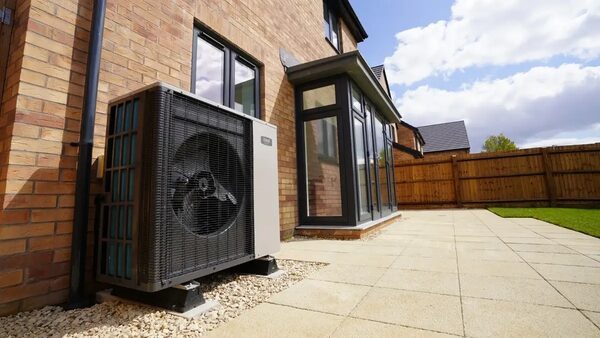
The NBHS is Scotland's alone, and it is implemented using the Scottish Government's fully devolved building regulations7. That is the constitutional reason it can prohibit a technology outright while other parts of the UK regulate carbon instead. Building regulation is devolved, so the four nations set their own energy standards for new homes, and the Scottish route has been to ban direct emission heating at the point of installation rather than to set a carbon target the developer meets by other means.
| Nation | Route for new-build heating |
|---|---|
| Scotland | New Build Heat Standard: mains gas and oil boilers prohibited as main heating under a warrant applied for on or after 1 April 20245 |
| England and Wales | Future Homes Standard: carbon and fabric requirements rather than a technology prohibition |
| Northern Ireland | Its own building regulations and technical booklets |
The practical differences a household meets are these. In Scotland, a new building under a warrant applied for on or after 1 April 2024 cannot have mains gas or oil as its main heating system5. In England and Wales, the equivalent route is the Future Homes Standard, which sets carbon and fabric requirements for new homes rather than prohibiting a heating technology by name. Northern Ireland has its own building regulations and technical booklets. The Future Homes Standard and the Scottish building standards and building warrant system are the pages that carry those regimes in detail.
Scotland has also gone further on the existing stock. The Scottish Government consulted on proposals for the NBHS in 2021 and again in 2022, and the consultation record describes the standard as paving the way for the introduction of similar requirements in existing buildings from 2025 onwards5. The Heat in Buildings Strategy sets the end point: all homes will have to use zero direct emissions heating systems by 204513. A separate consultation proposes that building owners replace polluting heating systems with clean ones by 2045.
The direction of travel is therefore consistent across the UK even where the mechanism differs. What is distinctive about Scotland is the combination of an outright prohibition on direct emission heating in new buildings from 2024, a stated intention to extend similar requirements to existing buildings, and a 2045 backstop for the whole stock13.
What it means for a household's energy independence
The standard removes one dependency and leaves others in place, and it is worth being exact about which is which.
What it removes is the gas connection as the default heat source in a new home. A new Scottish home cannot be built with mains gas or oil as its main heating system5, so the household is not exposed to the gas grid for warmth or to delivered fuel prices for a boiler. The Scottish Government's own framing is that new homes are required to install clean heating6, and that the standard future-proofs buildings so they will not require future retrofit2.
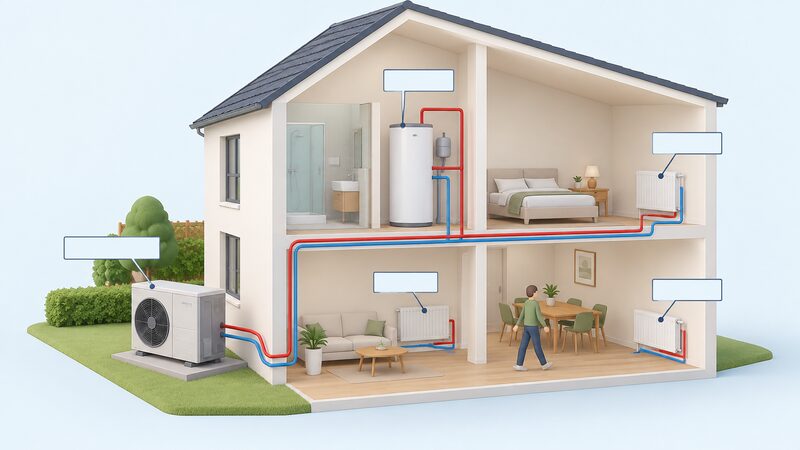
What remains is electricity. A heat pump or a heat network connection still depends on the electricity network and on a supplier, and a heat network depends on the operator of that network. The Heat Networks (Scotland) Bill creates a new licensing system to drive up standards across the sector and improve consumer confidence6, which is a recognition that network dependence needs its own consumer protections. A household on a heat pump also depends on the manufacturer for parts and on a qualified installer for servicing.
There is a timing point that bears on independence. The Heat Pump Sector Deal Expert Advisory Group noted that while regulation is proposed from 2024, it could take several years before all new build properties are reached10. The number of heat pumps installed in new build homes had increased over the four years to 2021 as tighter emissions standards introduced in the 2015 building regulations exerted an effect10. The standard accelerates a trend that was already visible in the new-build segment.
For the household, the honest summary is that the NBHS makes a new Scottish home independent of the gas grid for heat, and no more than that. It does not make the home self-sufficient, it does not remove the electricity bill, and it does not remove the need for a servicing supply chain. The regulation and energy independence page sets out how far building rules of this kind can take a household, and where the remaining dependencies sit.
The rules in practice: warrants, conversions and technical guidance
The standard is enforced through the building warrant and completion certificate process rather than by a separate regulator. The administrator named in the consultation record is the Heat in Buildings Regulations Unit4, and enquiries go to 2024heatstandard@gov.scot1. The legal basis is building regulations3, and the standard is a requirement set out in law2.
The technical guidance sits in the building standards Technical Handbooks, which the Scottish Government stated it intended to update later in 20234. The two editions a developer or agent checks for the energy sections are:
- April 2024 domestic handbook. First published on 22 December 2023 and last updated on 30 September 2024 as Version 1.114.
- January 2025 domestic handbook. First published on 22 November 2024 and last updated on 14 July 202515.
On conversions, the handbook position is that the building as converted shall meet the requirements of the standard as is reasonably practicable, and in no case be worse than before the conversion16. The guidance applies to new systems and to the replacement, in whole or in part, of existing systems, and it addresses improvement work to existing systems as a consequence of replacing components16. That is the mechanism by which a conversion or a system replacement can bring a building into the standard's reach.
The consultation that shaped the rules drew 112 responses, 91 from businesses and other organisations and 21 from individuals, and the majority, 62%, of respondents supported proposals introducing the New Build Heat Standard4. The analysis was carried out independently by The Lines Between, and three two-hour online workshops were held on equality and consumers, island communities, and non-domestic buildings4. The consultation opened on 28 July 2022 and closed on 20 October 20224.
Where the standard sits in the wider Scottish programme

The NBHS is one instrument in a programme that runs well beyond new build. The Heat in Buildings Strategy was reviewed, and the review concluded that the strategy should be varied to bring it up to date with latest developments, with the varied strategy to be published in 202417. The Scottish Government recorded in its 2023 progress report that it had developed regulations for new buildings, and that the biggest challenge remains in existing buildings12.
The funding picture is set out across several documents. The strategy commits at least £1.8 billion for heat and energy efficiency projects over the current parliamentary session11, and the 2023 progress report records £170 million of capital investment through Delivery Schemes supporting the heat transition in homes and buildings12. The strategy also describes the need for heating installations to scale up to provide at least 124,000 systems installed between 2021 and 20266, with installation numbers needing to double every year from the baseline to at least 64,000 installations in 2025 and to reach a peak of over 200,000 new systems per annum in the late 2020s10.
The employment estimate is part of the case. Research suggests the additional jobs supported in 2030 will exceed those displaced by an estimated 16,400 as a result of investment in zero emissions heat jobs9. The strategy also commits to a fabric first approach, and recognises that it will be important to understand the need for passive measures such as ventilation and shading during building fabric efficiency improvements6.
For a household in a new build, the practical reading is that the standard is the first step of a longer transition rather than the whole of it. The new-build rule is settled and in force; the existing-build rules are still being consulted on and legislated for, with a 2045 backstop for all homes13. The energy and buildings policy in Scotland page covers the devolved settlement behind these powers, and the regulation and policy pillar carries the wider programme.
Sources17 cited
- New Build Heat Standard factsheet, Scottish Government
- The Heat in Buildings Programme, Scottish Government
- New Build Heat Standard consultation Part II, Scottish Government
- New Build Heat Standard Part Two consultation, Scottish Government
- Wood burning stoves to be permitted in new homes, Scottish Government
- Heat in Buildings Strategy: Fairer Scotland duty assessment summary, Scottish Government
- NBHS 2024 Island Communities Impact Assessment, Scottish Government
- Building Scotland Amendment Regulations 2022: Section 6 Energy, Scottish Government
- Heat in Buildings Strategy: Child rights and wellbeing impact assessment, Scottish Government
- Heat Pump Sector Deal Expert Advisory Group, Scottish Government
- Heat in Buildings Strategy: Business regulatory impact assessment, Scottish Government
- Heat in Buildings progress report 2023: conclusion, Scottish Government
- Tenements short life working group: final report, Scottish Government
- Building standards technical handbook April 2024: domestic, Scottish Government
- Building standards technical handbook January 2025: domestic, Scottish Government
- Building standards technical handbook 2022: domestic, insulation of pipes, ducts and vessels, Scottish Government
- Heat in Buildings progress report 2023: context and purpose, Scottish Government
 Future Homes StandardWill your new build still have a gas boiler, and when do the new rules actually start?
 Overheating StandardsScotland and Northern Ireland handle overheating in new homes differently from England and Wales.
 Scottish Building StandardsBuilding or extending in Scotland means meeting Scottish rules on insulation, glazing and ventilation.
 Climate TargetsScotland aims to stop adding greenhouse gases by 2045, five years before the rest of the UK.
 Planning Permission in ScotlandDo you need planning permission for a heat pump in Scotland?
 Building RegulationsReplacing a boiler or heating system usually needs building regulations approval, and the rules differ across England, Scotland, Wales and Northern Ireland.