

In this guide
Scotland does not use the building control and building notice system found in England. It uses a building warrant, granted in advance by the local authority acting as verifier, followed by a completion certificate that the owner or client must submit at the end of the job. The legal framework is the Building (Scotland) Act 2003, which gives Scottish Ministers the power to make building regulations and focuses on the health and safety of buildings, the conservation of fuel and power within buildings, and sustainable development1. A warrant is granted subject to the condition that the work is carried out as described in the warrant, including the related plans and specifications, and in accordance with the building regulations3.
For a household, the practical questions are three: does this job need a warrant, which edition of the technical handbook applies, and what does the handbook actually require of the heating system, the insulation and the services. The answer to the second is mechanical. The regulations, standards and supporting guidance in the technical handbooks apply based on the date a building warrant application is submitted, or, for work that does not require a warrant, the date that work is commenced1. The January 2025 domestic handbook, for instance, applies to a warrant submitted on or after 1 January 20254.
The handbooks themselves are guidance, not the law. They are issued by Scottish Ministers under section 4(2) of the Building (Scotland) Act 2003 and explain the intent of each functional standard as well as how to achieve the requirements set in the Building (Scotland) Regulations 20042. Following the guidance in full should be accepted by the verifier as indicating that the building regulations have been met, but other routes to compliance exist2.
Work that needs a warrant: from rewires to heating replacements
The building regulations always apply where construction occurs, unless exempted by regulation 3, and construction includes alterations and extensions as well as entirely new buildings2. That single sentence does most of the work in deciding whether a household project is in scope. Replacing a heating system, forming a new opening, adding insulation to an existing structure or altering services are alterations to an existing building, not merely maintenance.
Scottish Government guidance on householder permitted development rights is explicit that a building warrant may also be required before work starts, and specifically that a warrant from the local authority may be required for microgeneration-related developments10. Planning permission and building warrant are separate consents: even where planning permission is not required, a building warrant may still be needed12. Households often assume that permitted development for a heat pump, a solar array or a micro wind turbine removes the need for any further approval. It does not.
Exemption is also narrower than it looks. Where exempt work requires that an alteration is made to an existing building to maintain the level of compliance with building regulations, a building warrant may be required for that alteration13. A small item of plant that is itself exempt can therefore pull the surrounding work into the warrant system.
Typical domestic energy work that householders ask about includes:
- Replacement heating appliances, controls and associated pipework
- New or altered electrical installations, including rewires
- Insulation upgrades to walls, roofs and floors as part of alteration work
- Microgeneration such as solar, heat pumps and free-standing micro wind turbines
- Conversions that change the occupation or use of a building
Grant-funded work carries its own conditions on top. Projects delivered under Scottish Government programmes including Warmer Homes Scotland must comply with all relevant building regulations, retrofit standards and guarantee requirements14. Because the verifier's decision is site-specific, the local authority building standards service is the body that confirms what a particular project requires. Related consents are covered on permitted development rights and on the narrower question of heating controls, radiators and pipework in Scotland.
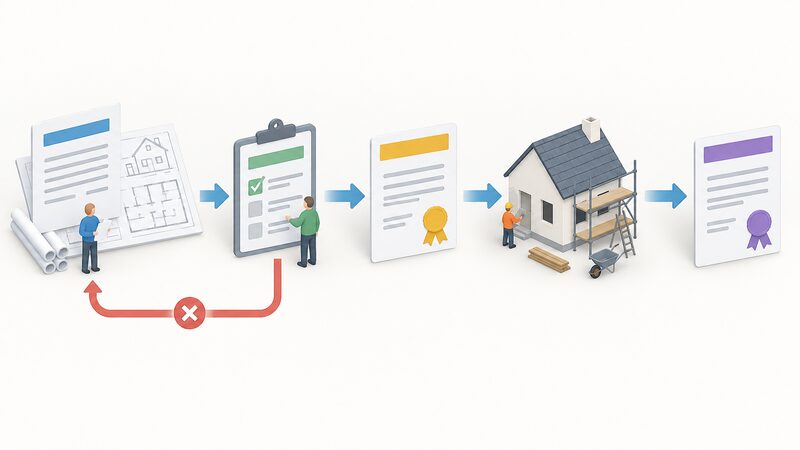
How the system works: application, verification and completion
The process is front-loaded. The warrant is applied for and granted before work begins, and it is granted subject to the condition that the work is carried out as described in the warrant, including the plans and specifications, and in accordance with building regulations3. That is a materially different discipline from a system where approval can be sought as work proceeds: a change on site to what was described in the warrant is a change to the thing that was approved.
Applications, completion certificates and other related forms associated with the end to end process of the building standards system can be completed and submitted through the eBuildingStandards portal1. The Building Standards Procedural Handbook, third edition, published by the Local Government and Housing Directorate, provides clarification on the procedures underpinning the Scottish building standards system as set out in the Building (Procedure) (Scotland) Regulations 2004 and the Building (Scotland) Act 2003, and contains a revised table of fees applicable to all building warrant applications9.
Turnaround is a matter of local authority performance rather than statutory entitlement. In the context of external wall insulation applications, Local Authority Building Standards Scotland described a target of 2 weeks to assess the building warrant submission15. That is an assessment target, not a guarantee of grant.
- The applicant submits the warrant application with plans and specifications to the verifier.
- The verifier assesses the submission against the building regulations and the applicable handbook edition.
- The warrant is granted, subject to the condition that work matches what was described3.
- Work is carried out.
- On completion, the owner or client must certify that the works have been constructed in accordance with the building warrant and the building regulations2.
Where approval is not given, the work should be changed so that it meets the standards16. Separate guidance, the building standards enforcement handbook, provides clarification on the enforcement powers available to local authorities as set out in the Building (Scotland) Act 20035.
A change proposed in December 2024 would add a further document at application stage: a requirement for developers to provide an "energy and environmental design statement" with building warrant applications, describing how the design and construction comply with mandatory standards 3.13, 3.14, 3.28, 6.1 to 6.7, 6.10, 7.1 and 7.2 of the Building (Scotland) Regulations 200417.
The technical handbooks and which edition applies

There are two volumes, one for domestic buildings and one for non-domestic buildings7. Each provides guidance on achieving the standards set in the Building (Scotland) Regulations 200418. From the 2013 edition onwards the handbooks are published electronically and are available free on the Scottish Government Building Standards Division website6. The 2022 domestic handbook carries ISBN 978-1-78544-328-2 and the 2022 non-domestic volume ISBN 978-1-78544-329-919.
Editions are dated to warrant submissions, and the table below sets out the published application dates.
| Domestic handbook edition | Applies to a building warrant submitted | Also applies to warrant-free work commenced |
|---|---|---|
| 2019 | on or after 1 October 201921 | from that date21 |
| 2020 | on or after 1 March 202122 | from that date22 |
| 2022 | on or after 1 June 202223 | from that date23 |
| April 2024 | from 1 April 2024 to 31 December 202418 | within that period18 |
| January 2025 | on or after 1 January 20254 | from that date4 |
The January 2025 domestic handbook was first published on 22 November 2024 and last updated on 14 July 20254. The April 2024 edition was first published on 22 December 2023, with a version 1.1 update on 30 September 202418. The 2022 edition was published on 1 June 202223, and the 2020 edition on 2 December 202022.
The April 2026 domestic handbook, version 1.0 dated 9 March 2026, was an initial issue in support of the revision of Regulation 8, Standard 2.15, and supporting guidance within Sections 0, 2, 3 and 42. Any reference to the Building Regulations in that document is to the Building (Scotland) Regulations 2004 as amended, and the document applies to Scotland only2. The 2004 Regulations apply to all buildings and works where an application for warrant is made on or after 1 May 2005, and to Crown buildings where an application is made on or after 1 May 20098.
The eight sections of the domestic handbook, from Structure to Sustainability
Each handbook has eight sections6. The domestic volume runs Section 1 Structure, Section 2 Fire, Section 3 Environment, Section 4 Safety, Section 5 Noise, Section 6 Energy and Section 7 Sustainability2, preceded by Section 0 General and followed by defined terms and a list of standards and other publications19.
| Section | Subject | Relevance to household energy work |
|---|---|---|
| 0 | General | Application, exempted buildings, services and fittings13 |
| 1 | Structure | Safety of people in or around new and existing buildings2 |
| 2 | Fire | Revised at Standard 2.15 in the April 2026 edition2 |
| 3 | Environment | Includes 3.13 Heating19 |
| 4 | Safety | Revised guidance in the April 2026 edition2 |
| 5 | Noise | Sound insulation between dwellings |
| 6 | Energy | Carbon dioxide emissions, fabric, services, EPCs, metering19 |
| 7 | Sustainability | Sustainability labelling of new dwellings6 |
Households doing energy work most often meet Sections 3, 6 and 7. Section 3 carries the heating guidance at 3.1319. Section 6 carries the energy standards. The energy and environmental design statement proposal would draw on 3.13, 3.14, 3.28, 6.1 to 6.7, 6.10, 7.1 and 7.2 together, which is a fair indication of how tightly these sections interlock in a new dwelling17.
Section 6 Energy: what the handbook covers for heating and emissions
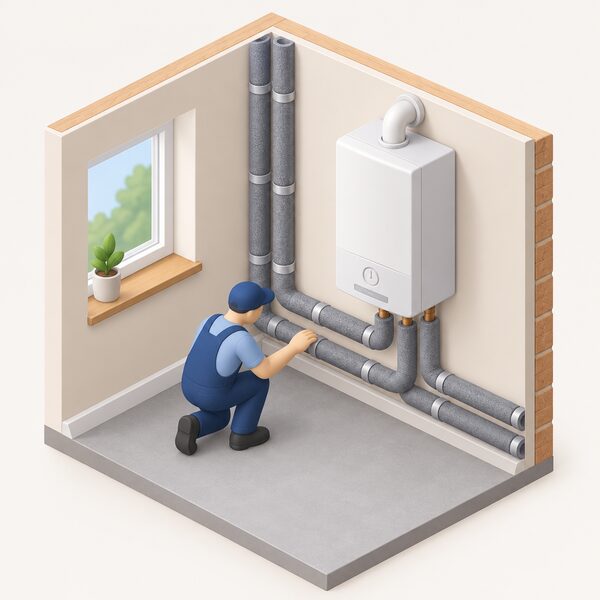
Section 6 is headed Energy, economy and heat retention2. Within it sit guidance on carbon dioxide emissions, the building insulation envelope, the heating system, insulation of pipes, ducts and vessels, artificial and display lighting, mechanical ventilation and air conditioning, commissioning of building services, written information, energy performance certificates and metering, with annexes covering compensating U-values, compensatory heat loss and high-efficiency alternative systems19.
Since the 2022 edition, guidance given in support of Standards 6.3 to 6.6 refers directly to information contained within the Domestic Building Services Compliance Guide for Scotland23. That guide sets out compliance with the energy efficiency requirements under standards 6.3 to 6.7 of the building regulations, and applies to work subject to a building warrant submitted on or after 1 December 202224. Non-domestic work is served by the equivalent Non-domestic Building Services Compliance Guide for Scotland, which sets the minimum performance of space heating and hot water systems, heating appliances and controls, replicates guidance published elsewhere in the UK, and applies to new systems, replacement in whole or in part, and improvement work to existing systems20.
The 2022 amendment to Section 6 was substantial. It introduced a new energy target for the construction of new buildings, revised the minimum energy performance standards set for both building fabric and fixed building services, made consequential changes to ventilation standards in response to fabric improvements including an increase in the level of airtightness testing prior to completion, and introduced the need for overheating risk assessment and mitigation measures25. The Building (Scotland) Amendment Regulations 2022 applied to all building warrants applied for on or after 1 December 202226. Twenty-five responses to the consultation, which ran from 26 July 2021 to 26 November 2021, included comments relevant to remote, rural or island communities, a matter engaged by the duty in section 7 of the Islands (Scotland) Act 201825.
There is an approved alternative route to demonstrating Section 6 compliance: the Certification of Design (Section 6, Energy) for Domestic Buildings scheme has been approved by Scottish Ministers to confirm compliance with Section 623. That parallels the idea behind competent person schemes elsewhere in the UK, though the Scottish mechanism is certification of design and construction within the warrant system rather than self-certification outside it.
For new buildings, Annex 6.C requires a statement on how high-efficiency alternative systems were considered in arriving at the solution within a building warrant submission22. That is a documentation duty about low-carbon options, not a mandate to install any particular one.
The handbook's legal status: guidance, not the law itself
This distinction matters more in Scotland than householders expect, because the handbook reads like a rulebook. It is not one. The Technical Handbook is issued by Scottish Ministers through the Building Standards Division, and the 2022 domestic edition states its effect plainly.
"Failure to comply with the Technical Handbook does not render a person liable to civil or criminal procedures"
The same document adds that proof of compliance with the guidance may be relied on in any proceedings as tending to negative liability for an alleged contravention of the building regulations6. In other words, the handbook is a defence, not an offence. What binds is the Building (Scotland) Regulations 2004 and the conditions attached to the warrant under section 13 of the 2003 Act3.
The corollary is that alternative solutions are permitted. If the guidance is followed in full then this should be accepted by the verifier as indicating that the building regulations have been met2. Where it is not followed in full, the applicant must satisfy the verifier by other means. The point is made in the same terms in the related Accredited Construction Details (Scotland), which states that the guidance is not prescriptive and other methods of meeting the functional standards will exist27.
Scotland is not unusual in this. The Northern Ireland technical booklets operate on the same principle, and comparison with building regulations in England and in Wales shows the same guidance-versus-regulation split under different procedural machinery. What is distinctively Scottish is the prior warrant and the closing completion certificate, which put the verifier's decision at both ends of the job.
Conversions and replacement systems in existing homes
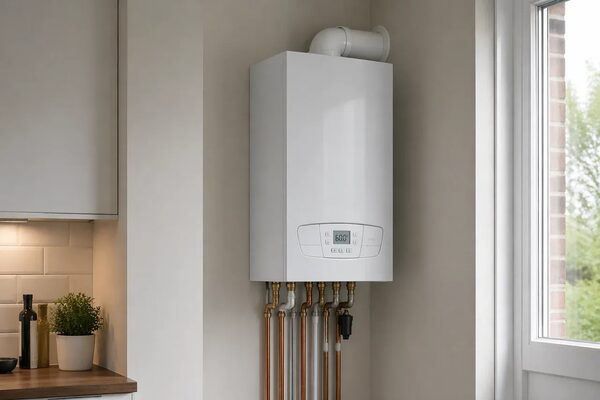
Most household energy independence work happens in existing buildings, so the rules for alterations and conversions matter more than the new-build standards. A warrant must be obtained before making a change of occupation or use listed in schedule 2, and such changes are defined as conversions2. The warrant for a conversion will only be granted if the standards set out in regulation 12 are achieved2.
Regulation 12 does not demand new-build performance from an old building. For the heating system standard, the rule is that the building as converted shall meet the requirements of this standard in so far as is reasonably practicable, and in no case be worse than before the conversion20. The same formulation is used for the insulation of pipes, ducts and vessels28. Not every standard carries that qualifier: for some, the requirement is stated flatly as the building as converted shall meet the requirement of this standard29.
Replacement systems are caught by the compliance guide rather than by the conversion rules. The Domestic Building Services Compliance Guide for Scotland applies to new systems and replacement, in whole or in part, of existing systems, and also addresses improvement work to existing systems as a consequence of replacing components28. A partial replacement, a new boiler onto old pipework, or a heat pump onto existing emitters, is therefore not outside the standard: swapping one component can trigger improvement obligations on what remains.
The equivalent principle in the non-domestic handbook is stated as a consequential improvement: where work to an existing building subject to a building warrant includes new fixed building services, or alters or extends the capacity of existing services, the opportunity should be taken to review and improve the performance of fixed building systems20.
The New Build Heat Standard reaches into existing stock at the margins. It applies to the conversion of existing buildings where the conversion involves a change in occupation or use of the part of the building in which an existing direct emission heating system is located, and where it is reasonably practicable to do so30. The standard itself is covered on the page for Scotland's New Build Heat Standard.
Where Scottish standards are heading: EPC reform and zero-emission heat
Two strands of change bear on warrants. The first is new-build heat. The Heat in Buildings Strategy set out a requirement for all new buildings, for which a building warrant is applied for from 2024, to use zero emissions heating31. Put the other way, the standard bans direct emission heating in new buildings subject to a building warrant application from April 202426. New buildings applying for a building warrant in Scotland which are not served by a heat network must meet their space heating and hot water needs accordingly26. Because the trigger is the warrant application date, the warrant system is the delivery mechanism for heat decarbonisation in new build.
The second strand is energy performance certification. The Energy Performance of Buildings (Scotland) Regulations 2025 were made under sections 1 and 49(1) of the UK Withdrawal from the European Union (Continuity) (Scotland) Act 2021 and sections 250 and 331(2) of the Energy Act 202332. Regulation 1 and regulations 2, 11, 12 and 36 commenced on 1 January 202633. The regulations were originally stated to come into force on 31 October 2026 as the principal vehicle to deliver EPC reform34. That date has moved: regulations introducing new-style EPC certificates, validity periods and rating systems in Scotland are now to be amended so that they take effect from 30 April 202835. The stated purpose of the delay is to ensure there is sufficient time for those involved in the EPC assessment industry, and for the wider property market, to prepare for the new regulations and deal with their effects and impacts36.
The earlier reform programme had intended to introduce revised regulations in 2025 to bring reformed EPCs into effect in 2026, pending confirmation from the UK Government that the Home Energy Model would become available in the second half of 2026, and aimed to align with the revised requirements for EPCs under the recast EU Energy Performance of Buildings Directive, including an independent onsite audit and inspection to verify EPC accuracy37. The Scottish Government intends to carry out an onsite audit and inspection of a small sample of properties to help verify accuracy, and the regulations will also ensure new ratings for non-domestic buildings34. Buildings owned, occupied or used by the naval, military or air forces of the Crown, the Security Service, the Secret Intelligence Service, GCHQ or the Royal Family, and buildings used as a prison or young offenders institution, are excluded32. Further detail sits on EPC regulations and reform.
Beyond building standards, a draft Buildings (Heating and Energy Performance) and Heat Networks (Scotland) Bill, consisting of 18 sections and 2 schedules, was published on 18 November 202540. It includes a regulation-making power to set a Minimum Energy Performance Standard for owner-occupied and non-domestic buildings that use direct emission heating systems42. Its regulation-making powers may make different provision for different purposes or areas, zone regulations can impose different requirements in relation to different types of building, and regulations may modify any enactment, including the Bill once enacted40. If passed it would be cited as the Buildings (Heating and Energy Performance) and Heat Networks (Scotland) Act 202740. A separate review is considering a Scottish equivalent to the Passivhaus standard, with the energy and environmental design statement as one proposed mechanism17.
What the warrant system means for household energy independence

The warrant system does not stop a household generating, storing or heating with what it chooses, but it decides the terms. Work on the building fabric, the heating system and fixed services is checked by the local authority before it happens and certified by the owner after it finishes2. That is a dependence on a public body, with its own assessment timetable and its own fee schedule, which rose again from 1 April 20269.
Against that, the system gives a household something that matters for self-reliance: a documented, verifiable record that the fabric and the services meet a published standard, and a set of minimum performance requirements for pipe insulation, heating controls and commissioning that determine how much of a home's generated or purchased energy is actually retained19. The direction of travel, zero emissions heating tied to warrant application dates in new build, reformed EPCs from 30 April 2028, and a possible minimum standard for owner-occupied homes with direct emission heating, points to the warrant and the certificate becoming the main points at which national heat policy touches an individual Scottish home31. Devolved responsibility for this area is set out on energy and buildings policy in Scotland, within the wider regulation and policy guide.
Sources42 cited
- Building standards policy, Scottish Government, 2026-09-17
- Building Standards Technical Handbook, Domestic, April 2026, Scottish Government, 2026-03
- Building (Scotland) Act 2003, section 13, legislation.gov.uk
- Building standards technical handbook January 2025: domestic, Scottish Government, 2025-07-14
- Monitoring and improving building regulations, Scottish Government, 2026-09-17
- Technical Handbook 2022 domestic: application and legal status, Scottish Government, 2022
- Building standards 2017: domestic, Scottish Government, 2017-03-01
- Domestic Technical Handbook, December 2022, Scottish Government, 2022-12
- Building standards procedural handbook, third edition, version 1.9, Scottish Government, 2026-03-25
- Guidance on householder permitted development rights, updated 2021, Scottish Government, 2021-04-01
- Householder permitted development rights: guidance, microgeneration, Scottish Government, 2021-04-01
- Permitted development rights, Dumfries and Galloway Council, 2026-09-17
- Technical Handbook 2020 domestic: exempted buildings, services, fittings and equipment, Scottish Government, 2020-12-02
- Heat in buildings: quality assurance statement, Scottish Government, 2022-06-07
- Information released, EIR 202400408737 annex, Scottish Government, 2024-08
- Electric vehicle charging: building regulations, Planning Portal, 2026-09-17
- Update on the review to introduce a Scottish equivalent to the Passivhaus standard, Scottish Government Building Standards blog, 2024-12-12
- Building standards technical handbook April 2024: domestic, Scottish Government, 2023-12-22
- Building standards technical handbook 2022: domestic, Scottish Government, 2022-06-01
- Technical handbook 2022 non-domestic: heating system, Scottish Government, 2022-06-01
- Building standards technical handbook 2019: domestic, Scottish Government, 2019-10-01
- Building standards technical handbook 2020: domestic, Scottish Government, 2020-12-02
- Technical handbook 2022 domestic: Section 6 Energy introduction, Scottish Government, 2022-06-01
- Domestic Building Services Compliance Guide for Scotland, 2022 Edition, Scottish Government, 2022-06
- Building (Scotland) Amendment Regulations 2022: Section 6 Energy, island communities impact assessment, Scottish Government, 2022-08-16
- New Build Heat Standard consultation, part 2, Scottish Government, 2022-07
- Accredited Construction Details (Scotland) 2007, Scottish Government, 2020-02-11
- Technical handbook 2022 domestic: insulation of pipes, ducts and vessels, Scottish Government, 2022-06-01
- Technical handbook 2022 domestic: water efficiency, Scottish Government, 2022-06-01
- New Build Heat Standard, part two consultation, Scottish Government, 2026-09-20
- Heat in Buildings Strategy summary, Scottish Government, 2021-10
- The Energy Performance of Buildings (Scotland) Regulations 2025, legislation.gov.uk, 2025
- The Energy Performance of Buildings (Scotland) Regulations 2025, PDF, legislation.gov.uk, 2025
- Energy Performance of Buildings (Scotland) Regulations 2025 update and government response, Scottish Government, 2025-10
- Energy Performance Certificate reform updates, Scottish Government, 2026-08-24
- Business regulatory impact assessment, EPB Scotland Amendment Regulations 2026, Scottish Government, 2026-08-24
- EPC reform consultation, government response, Scottish Government, 2025-01
- Environmental Audit Committee report on energy efficiency of existing homes, UK Parliament
- Consultation on draft Energy Efficiency (Domestic Private Rented Property) (Scotland) Regulations, Scottish Government, 2025-06
- Draft Buildings (Heating and Energy Performance) and Heat Networks (Scotland) Bill explanatory notes, Scottish Government, 2025-11-18
- Heat in Buildings Bill consultation analysis report and response, Scottish Parliament, 2026-01-29
- Decarbonising heating in homes and buildings, Scottish Government, 2026-09-17
 Using an Installer in ScotlandYou live in Scotland and want solar panels or a heat pump fitted.
 Scottish Building StandardsBuilding or extending in Scotland means meeting Scottish rules on insulation, glazing and ventilation.
 Planning Permission ScotlandMost solar panels on Scottish homes go ahead without planning permission, but flats, conservation areas and listed buildings change that.
 Planning Permission in ScotlandDo you need planning permission for a home battery in Scotland?
 Building Regulations EnglandAdding a heat pump, solar panels or an extension usually needs building regulations approval, and it is separate from planning permission.
 Home Energy Planning ScotlandDo you need planning permission for solar panels or a heat pump in Scotland?