

In this answer
Short answer
Scotland has a binding alarm standard that applies to homes themselves, not only to new building work. Smoke and heat alarms must be installed and maintained in accordance with British Standard BS 5839-6, and the Tolerable Standard, the legal minimum for housing in Scotland, has included an element covering smoke, heat and carbon monoxide alarms since 20221.
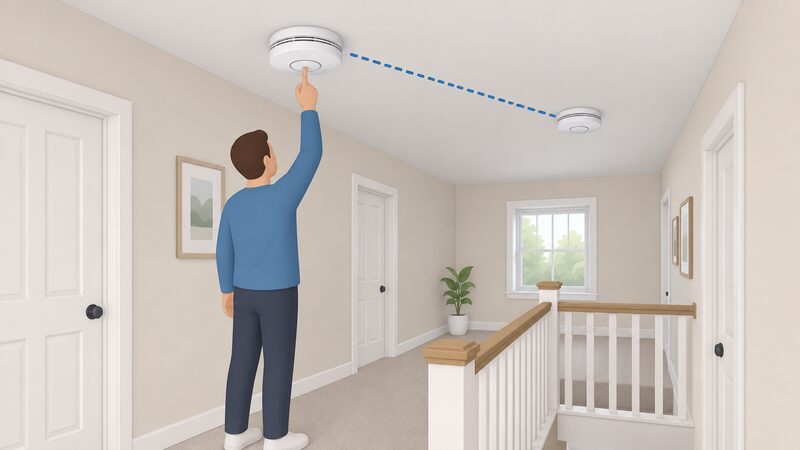
The practical shape of the rule is one alarm per floor at minimum, with a heat alarm rather than a smoke alarm in the kitchen, and carbon monoxide detection wherever a fixed combustion appliance or flue is present. Interlinking is required for the smoke alarms connected to the electrical supply in private rented housing, so that one alarm sounding sets off the others3.
What follows is the standard itself, where each alarm belongs, which products satisfy it, and who sets and enforces it. The same rules apply to owners and tenants, which is unusual: most housing standards in the UK are tenure-specific.
The legal requirement: every home to have interlinked alarms
The Scottish standard is not a new-build rule that stops at the front door. The Tolerable Standard was amended by the Housing (Scotland) Act 1987 (Tolerable Standard) (Extension of Criteria) Order 2019, and from 2022 it includes a new element covering smoke, heat and carbon monoxide alarms7. The standards for provision in private rented housing were extended to all tenures from February 2022, so the same expectation reaches owner-occupiers and social tenants8.
Interlinking is the part householders ask about most. Official guidance for private rented housing requires a smoke alarm, in proper working order, to be present on every storey of a dwelling, connected to the electrical supply and inter-linked with all other smoke alarms connected to the electrical supply4. Interlinking means a single sounding alarm triggers the rest, which matters where a fire starts in a closed room or a stairwell and the occupant is asleep elsewhere.
Carbon monoxide is treated differently. The Tolerable Standard does not require carbon monoxide detectors to be interlinked, or to be interlinked with fire alarms2. A CO alarm can therefore stand alone, and the guidance is explicit that the Tolerable Standard is a minimum standard, and does not preclude additional carbon monoxide detectors2.
For a household, the independence question is narrow but real. Alarms are self-contained devices that need no supplier, no network connection and no subscription. The dependence that remains is on the battery or the mains circuit, and on the occupant testing the unit. A mains-powered interlinked system depends on the dwelling's electrical supply, so a power interruption affects it unless the units carry battery backup.
Which alarms meet the standard: smoke, heat and carbon monoxide
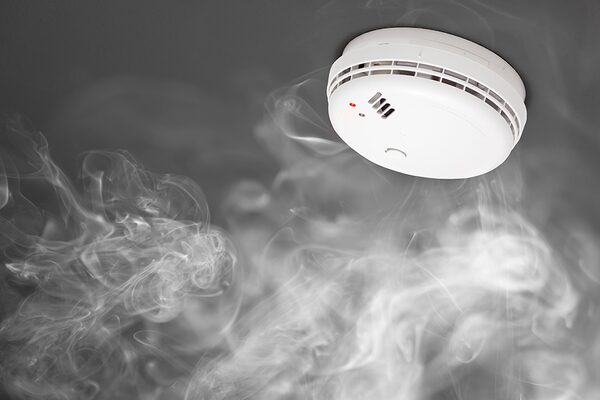
Three device types carry the Scottish requirement, and each has its own standard.
Smoke and heat alarms must be installed and maintained in accordance with British Standard BS 5839-61. That is the code of practice for fire detection in dwellings, and it governs both the device and how it is sited.
Carbon monoxide alarms are specified separately. Official guidance states that before purchasing a CO alarm, it should comply with British Standard EN 50291 and carry a British or European approval mark, such as a Kitemark6. Guidance for private rented property in Scotland describes a carbon monoxide alarm to BS EN 50291, powered by a battery designed to operate for the working life of the alarm, positioned in a suitable location10. Welsh building guidance gives the same standard as BS EN 50291:2001 for CO alarms11.
Installation requirements for CO alarms are set out in independent guidance: the alarm must be permanently installed, be either mains or battery powered, and should incorporate a self-test and audible alert if the battery or detector cell develops a fault, fixed in the same room where the appliance is fitted12.
"The alarm must be permanently installed, be either mains or battery powered, and should incorporate a self-test and audible alert if the battery or detector cell develops a fault"
Solid fuel installations carry their own condition. All log burner and multifuel stove installations must have a working carbon monoxide (CO) alarm appropriately placed in the room13. The current scope of carbon monoxide alarm requirements in building terms covers solid fuel heating, and a consultation has proposed requiring carbon monoxide alarms upon the installation of a fixed heating appliance of any fuel type in any home14.
| Alarm type | Standard or marking | Where it applies |
|---|---|---|
| Smoke and heat alarms | BS 5839-61 | All dwellings in Scotland |
| Heat alarms only | BS 5839-6:20193 | Kitchens |
| Carbon monoxide alarms | BS EN 50291, with British or European approval mark such as a Kitemark6 | Rooms with a fixed combustion appliance or flue |
| Carbon monoxide alarms (private rented) | BS EN 50291, battery designed to last the working life of the alarm10 | Private rented dwellings |
| Carbon monoxide alarms (Welsh building guidance) | BS EN 50291:200111 | Wales, for comparison |
Where each alarm must be placed in the home
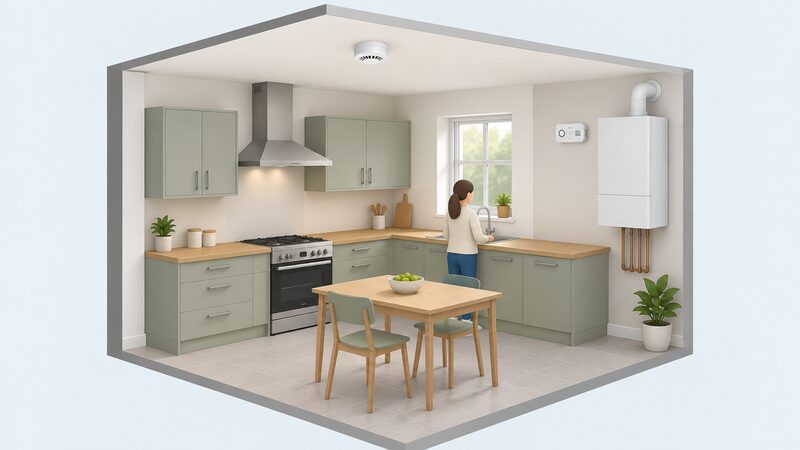
Placement is where the standard becomes concrete. Official scheme rules for funded energy efficiency work describe the layout in full: one smoke alarm in the living room or the room you use most; one smoke alarm in every hallway or landing; and one heat alarm in the kitchen3. The same rules state that British Standard (BS 5839-6:2019) states that only heat alarms should be installed in kitchens3. A heat alarm responds to temperature rather than smoke, which avoids nuisance triggering from cooking.
Independent guidance puts the floor-level minimum plainly: ensure there is at least one smoke or heat alarm per floor in your property5. Electrical Safety First makes the same point in its safety advice, that homes should be fitted with working smoke alarms on every floor15.
Carbon monoxide detection follows the appliance, not the room count. The Tolerable Standard requires CO detectors to be fitted in all rooms where there is a fixed combustion appliance or a flue, excluding an appliance used solely for cooking2. Official guidance for private rented housing mirrors this: a carbon monoxide alarm must be present in any room which has a gas, oil or solid fuel burning appliance installed4.
For houses in multiple occupation, detection of carbon monoxide is covered in section 4.5 of the Scottish Government guidance for local authorities on licensing of HMOs, with physical standards set by the licensing local authority16. That means an HMO may face a stricter local specification than a single dwelling.
Who sets and enforces the building standards: the Scottish Government's role
The Scottish Government creates the building standards regulations and technical guidance, oversees the building approval process, and strengthens the building standards system in Scotland17. The Building (Scotland) Act 2003 is the primary legislation under which Scotland's building standards system operates, and the stated purpose of the system is to ensure buildings are safe, efficient and sustainable17.
Enforcement is shared. The parties responsible for operation of the Energy Performance of Buildings (Scotland) Regulations 2008 system are the 32 Scottish local authorities and the Scottish Government18. For the private rented sector, local authorities will carry out enforcement and compliance duties under the draft energy efficiency regulations19. Housing standards, including the alarm elements of the Tolerable Standard, sit with local authority housing enforcement.
There is a route to vary the rules for a particular building. A person may apply to Scottish Ministers for a direction to either relax or dispense with a provision of the building regulations relating to building standards for any particular building or description of building20. That is a formal application, not a general exemption.
Section 2 (Fire) of the building standards is under review, with a call for evidence launched as part of the Scottish building regulations fire safety review17. Any change to the fire section would run through the same process: consultation, then regulations laid before the Scottish Parliament.
Combi, system or regular: which fits which home
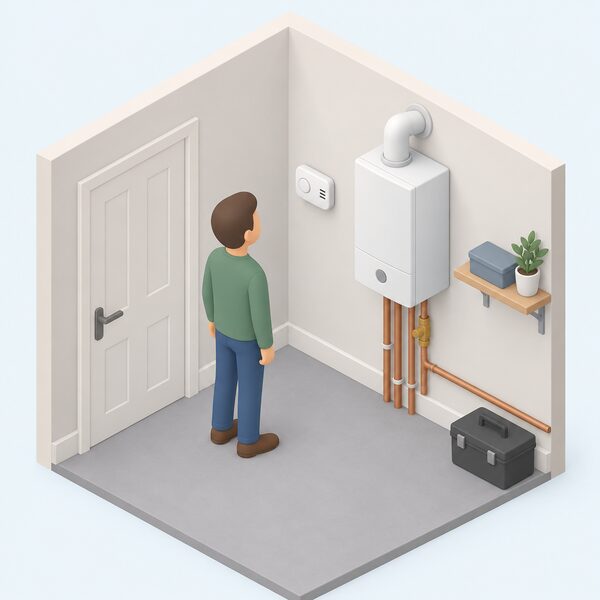
The alarm standard does not depend on the heating system, but the carbon monoxide requirement does, because it follows the presence of a fixed combustion appliance or flue2. A home with a gas boiler, an oil boiler, a solid fuel stove or an open fire carries the CO detector requirement in the room where that appliance sits. A home with no combustion appliance and no flue does not, under the Tolerable Standard, though additional detectors are permitted2.
That distinction matters as Scottish homes change. The Scottish Government has proposed a new Heat in Buildings Bill to require homeowners in Scotland to meet a minimum energy efficiency standard by 203323, and has stated that its commitment to decarbonising heat in buildings by 2045 remains firm24. New homes are already required to install clean heating25. As combustion appliances come out, the CO detector requirement in those rooms falls away with them, while the smoke and heat alarm requirement stays.
For a household, the practical position is that the alarm standard is a floor, not a ceiling. The Tolerable Standard is a minimum standard, and does not preclude additional carbon monoxide detectors2. Adding detection beyond the minimum is permitted; falling below it is not.
How to check an alarm meets the standard
Checking is a matter of reading the product and its packaging. Official guidance states that before purchasing a CO alarm, it should comply with British Standard EN 50291 and carry a British or European approval mark, such as a Kitemark6. For smoke and heat alarms, the reference point is BS 5839-6, the standard against which installation and maintenance are judged1.
A few conditions sit alongside the marking. The CO alarm must be permanently installed, be either mains or battery powered, and should incorporate a self-test and audible alert if the battery or detector cell develops a fault12. In private rented housing, the smoke alarm must be connected to the electrical supply and inter-linked with all other smoke alarms connected to the electrical supply4.
Where a household wants the wider regulatory picture, the Scottish building standards and the building warrant system sets out how approval works, and product markings and standards explains what UKCA, CE and Kitemark marks represent. For the devolved policy context, energy and buildings policy in Scotland covers where Scottish powers begin and end, and the UK home energy regulation and policy guide is the starting point for the rest.
Sources25 cited
- The Smoke and Heat Alarms etc. (Scotland) Regulations 2024, Legislation.gov.uk, 2024-05-30
- Tolerable Standard guidance: satisfactory fire and carbon monoxide detection, Scottish Government, 2023-06-20
- Area Based Schemes and Warmer Homes Scotland: alarm requirements, Scottish Government, 2024-08
- Fitness for human habitation guidance for landlords, Welsh Government, 2022-01-13
- Dehumidifiers: safety advice, Electrical Safety First, 2026-09-19
- Gas safety in the home: frequently asked questions for owner occupiers, Health and Safety Executive, 2026
- Scottish House Condition Survey 2024: key findings, Scottish Government, 2026-02
- Regulations to modify the repairing standard: summary, Scottish Government, 2022-02-01
- Gas safety: frequently asked questions, Health and Safety Executive, 2026
- Carbon monoxide alarms in private rented properties: guidance, Scottish Government, 2015-11
- Building regulations guidance Part J: heat producing appliances, Welsh Government, 2025-01
- Consumer FAQs, HETAS, 2026-04-01
- Log burner rules, HETAS, 2026
- Domestic smoke and carbon monoxide alarms, CIBSE, 2026-09-17
- Comment on reports of off-peak energy pricing, Electrical Safety First, 2026-09-19
- Stove guidance for householders, Building Control Northern Ireland, 2015-11
- Building standards, Scottish Government, 2026-09-17
- Energy Performance of Buildings (Scotland) Regulations 2008, Legislation.gov.uk, 2026-09-17
- Consultation on draft Energy Efficiency (Domestic Private Rented Property) (Scotland) Regulations, Scottish Government, 2025-06-06
- Monitoring and improving building regulations, Scottish Government, 2026-09-17
- Part P of the Building Regulations, Electrical Safety First, 2026-09-17
- Wiring a shed: a guide for homeowners, NICEIC, 2026-09-17
- Heat in Buildings Bill: research briefing, House of Commons Library, 2026-09-17
- Heat in Buildings Bill consultation analysis and response, Scottish Parliament, 2026-01-29
- Heat in Buildings plans, Scottish Government, 2026-09-17
 Alarm Rules in Rented HomesHow many smoke and carbon monoxide alarms a rented home must have, where they must be sited, and how the rules differ across England, Scotland, Wales and Northern Ireland, including the standards alarms must meet and who tests them.
 Scottish Building StandardsBuilding or extending in Scotland means meeting Scottish rules on insulation, glazing and ventilation.
 Test Smoke and Heat AlarmsHow often alarms should be tested, what the different beeps mean and when a unit has reached the end of its life.
 Overheating StandardsScotland and Northern Ireland handle overheating in new homes differently from England and Wales.
 New Build Heat StandardScotland's New Build Heat Standard means gas and oil boilers are no longer allowed in new homes from April.
 Energy Policy in ScotlandWho decides how your home in Scotland is heated and improved?