
In this guide
Heat networks have a regulator for the first time. Ofgem's formal role as regulator of heat networks began on 27 January 2026, with the initial set of rules in place1. The Energy Act 2023 named Ofgem as the regulator for heat networks in England, Scotland and Wales, and the Heat Networks (Market Framework) (Great Britain) Regulations 2025 brought the first tranche of provisions into force on that date2. Until then, households that got their heat through a network were not covered by the energy regulator at all: gas supply to a network was regulated as a commercial supply, but heat supply to homes was not4.
The practical effect for a connected household is a set of consumer standards covering fair pricing, transparent billing, reliable supply and customer service, backed by an independent dispute route through the Energy Ombudsman. That route has been open since 1 April 2025, when new legislation required all heat network suppliers to be signed up to the Ombudsman to remain compliant5. Complaints still go to the supplier first, and the supplier has eight weeks to resolve them before escalation2.
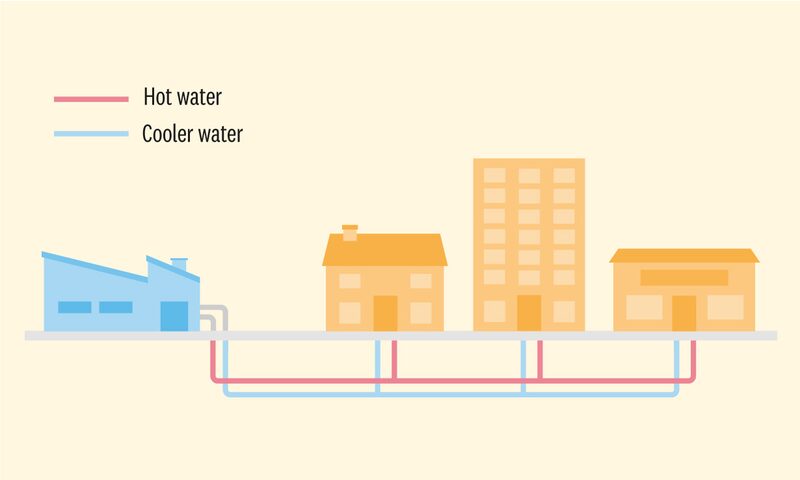
What regulation does not change is the underlying dependence. A heat network household buys heat from a single operator, usually has no choice of supplier, and cannot switch to a different source without changing the building's system. Regulation gives a route to challenge prices and service; it does not create competition. This page sets out who regulates what, what the standards require, how zoning will extend networks, and how to escalate a complaint.
What the new heat network rules mean for households
The regime that began in January 2026 is a market framework rather than a price cap. The Heat Networks (Market Framework) (Great Britain) Regulations 2025 commenced a series of provisions on 27 January 2026, covering the authorisation of heat network operators and the powers that sit behind them3. Ofgem's own description of its role is that its formal position as regulator of heat networks began on that date, with the initial set of rules in place1.
For a household already connected, three things change in principle. First, the operator is now a regulated entity with conditions attached to its authorisation, rather than a landlord or management company acting outside energy regulation. Second, the consumer standards described below become enforceable expectations rather than voluntary good practice. Third, there is a named regulator to which systemic problems can be reported, alongside the individual dispute route through the Ombudsman.
The limits are worth stating as plainly as the benefits. Regulation of consumer protection, including pricing, transparency and quality of service, is reserved: the UK Parliament retains the power to make these laws, even though heat networks themselves are devolved in Wales and both consumer protection and regulation are devolved in Northern Ireland4. That means the consumer standards apply across Great Britain through a single framework, while the devolved administrations control how networks are planned and supported in their own territories.
A connected household remains dependent on the network operator for heat, on the building's shared plant for supply, and on whatever fuel the network runs on. Regulation addresses conduct and redress. It does not give a household the ability to buy heat elsewhere, and it does not by itself decarbonise the heat delivered.
Ofgem becomes the sector regulator for heat networks
Ofgem is named as the regulator for heat networks in England, Scotland and Wales, which is to say Great Britain2. The Energy Act 2023 gave it that role, and the Scottish Government records that Ofgem's formal role as regulator of heat networks began on 27 January 2026, with the initial set of rules in place1. The Commons Library confirms the same division: Ofgem would regulate in England, Scotland and Wales, while the Utilities Regulator would regulate in Northern Ireland9.
The Northern Ireland position is the clearest example of how the four nations differ. In Northern Ireland both consumer protection and the regulation of heat networks are devolved to the Northern Ireland Assembly, so the Great Britain framework does not extend there4. In Wales, heat networks and schemes to facilitate or incentivise them are devolved, but regulation of heat networks is reserved to the UK Parliament4. Scotland has its own delivery plan for heat networks and its own review reporting in 2026, while sitting inside the Ofgem regulatory framework for the market rules10.
Ofgem's consumer protection guidance sets out the topics the rules cover: Standards of Conduct, quality of service, billing and transparency, back-billing, heat supply contracts, protections for vulnerable consumers, and security of supply3. A separate Ofgem consultation on fair pricing protections sits alongside that guidance, and describes the Energy Act 2023 as naming Ofgem the regulator for heat networks in Great Britain11.
For a household, the significance is that there is now a single regulator with published expectations, rather than a patchwork of landlord obligations and voluntary codes. The dependence that remains is structural: a regulated monopoly is still a monopoly. Ofgem can set and enforce standards of conduct and service; it does not introduce supplier choice into a building served by one network.
The four consumer standards: fair pricing, transparent billing, reliable supply and customer service
The consumer protections group into four areas a household would recognise: what you are charged, how it is explained, whether heat keeps coming, and how the operator handles you when something goes wrong.
On pricing, Ofgem has consulted on fair pricing protections, and the consumer protection guidance covers Standards of Conduct and quality of service11. On billing, the draft guidance is specific. Bills and billing information for heating, cooling or hot water on metered heat networks must be accurate and based on actual consumption12. The minimum information a bill must carry is a long list: current charges, consumption information, a comparison with the same period in the previous year, terms of supply, contact details for the relevant consumer advice body, supplier and billing agent contact details, complaints contact, emergencies contact, energy saving information, support mechanisms, the authorised person's identification number, and Energy Ombudsman details12.
Suppliers must also tell consumers how to contact the relevant consumer advice organisation, which is Citizens Advice or Consumer Scotland depending on where the household is13. That signposting matters because advice bodies are the first stop for a household that does not know whether a charge is legitimate.
On reliable supply, security of supply is one of the topics the guidance covers, alongside protections for vulnerable consumers3. On customer service, the Standards of Conduct and quality of service provisions set the expectation for how operators deal with the households they serve3.
"Bills and billing information provided to the relevant consumer by the authorised person for the consumption of heating,"
The comparison with domestic heating oil contracts is instructive. Government guidance on heating oil suppliers states the requirement that the terms and conditions in their contracts with consumers must be fair and transparent14. Heat network regulation goes further, because it adds consumption-based billing accuracy, a prescribed minimum content for bills, and an independent dispute route.
What this means for independence is mixed. Accurate consumption billing lets a household see and manage its own use, which is real. But the price itself is set by the operator within the regulatory framework, and the household cannot take its custom elsewhere. Transparency is not the same as choice.
What counts as a heat network: the two-premises rule and heat meters
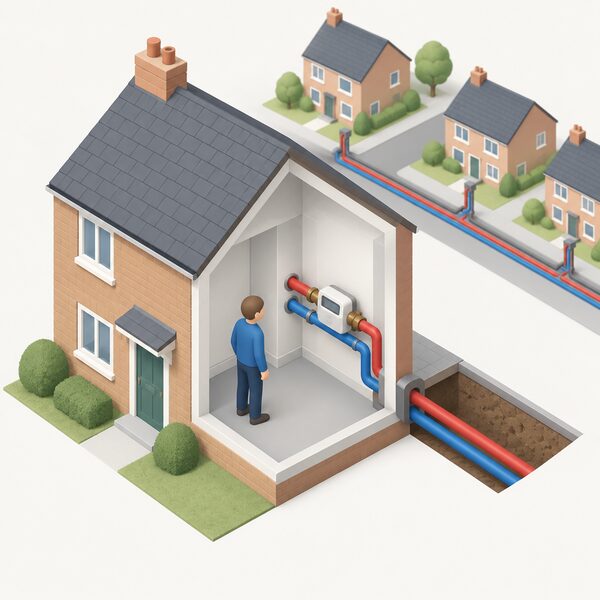
The scale of the sector explains why regulation took so long to arrive. There are 14,000 heat networks in Great Britain, serving around 500,000 customers4. Unlike gas and electricity, heat networks did not have an official regulator in Great Britain before this regime4.
For the purposes of support schemes, the definition of a district heating connection is precise. A connection must encompass at least two domestic premises in separate buildings, or three domestic premises situated in a single building15. That two-or-three premises threshold is the practical test that separates a genuine network from a shared system within one dwelling.
Heat meters are the other defining feature. Where a district heating connection is installed under ECO, a heat meter for each household is required15. Metering is what makes consumption-based billing possible, and it is why the billing standards can require actual consumption rather than an apportioned share of a communal bill.
| Feature | Requirement | Source |
|---|---|---|
| Minimum premises, separate buildings | At least two domestic premises | 15 |
| Minimum premises, single building | Three domestic premises | 15 |
| Metering on new ECO connections | A heat meter for each household | 15 |
| Billing basis on metered networks | Accurate and based on actual consumption | 12 |
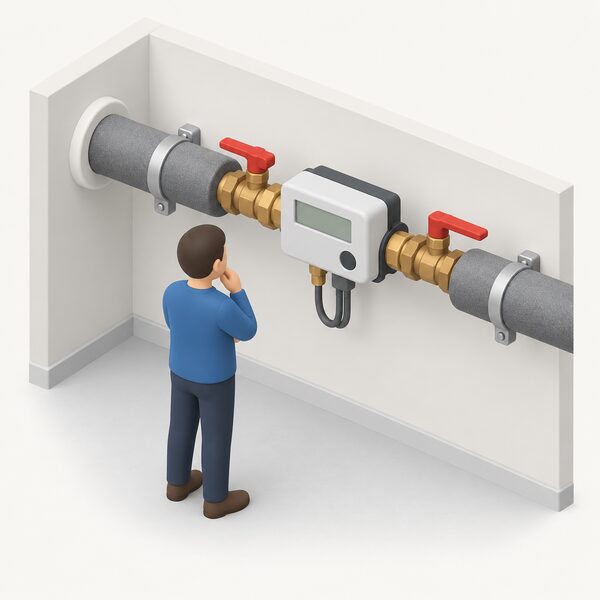
The dependence here is physical as well as commercial. A household on a heat network receives heat through pipework it does not own, from plant it does not control, and cannot disconnect without altering the building's system. A heat meter gives visibility of consumption; it does not give a route to an alternative supply.
Heat network zoning and the 20% target
Zoning is the mechanism by which government intends to grow the sector deliberately rather than piecemeal. The target for England is for heat networks to provide 7% (27 TWh) of heat to consumers by 2035, and the expectation is that a fifth of all heat will come from heat networks in 20508. The Commons Library records an earlier milestone: designate the first heat network zone by 20259.
The delivery plan sets out what happens next. At least 10 of the largest English towns and cities will be supported to establish their heat network zones soon after heat network zoning regulations go live later in 20268. Zoning works by identifying areas where a network is the most cost-effective low carbon option, so that development is coordinated rather than duplicated.
For a household, zoning has two implications. If you live in a designated zone, a network connection may become the expected route for your heating, particularly in dense urban areas and new development. If you are already on a network, zoning signals that the sector is being formalised and expanded, which strengthens the case for the regulatory framework but also confirms that the network is intended to be the long-term supply route for that area.
The independence question is sharpest here. A heat network can run on a range of heat sources, including waste heat and low carbon generation, which can reduce reliance on imported gas at the system level. At the household level, however, connection to a zoned network means dependence on that network's operator and its chosen heat source for the foreseeable future. Zoning is a system-level decarbonisation tool, not a household-level independence tool.
The Energy Ombudsman: free dispute resolution for heat network consumers

The Energy Ombudsman provides the independent escalation route for consumer complaints, and it is free to consumers16. From 1 April 2025 it can help consumers and small businesses resolve heat network disputes16. The legal basis is that new legislation requires all heat network suppliers to be signed up to the Energy Ombudsman to remain compliant5.
The service is described consistently as free and independent dispute resolution for heat network consumers18. It is approved by Ofgem to handle service disputes in the energy sector, and it is funded by the suppliers signed up to the scheme, who pay a fee for each case reviewed regardless of the outcome17. That funding model is worth knowing: the Ombudsman is not paid by the consumer and not paid according to who wins.
The Ombudsman works with DESNZ, Ofgem, Citizens Advice and Consumer Scotland as consumer advocacy, advice and redress come into operation before heat network regulation does20. It handles disputes across energy suppliers, energy brokers, network operators, Green Deal providers and heat network suppliers16. For network operators specifically, it can consider disputes where there is a loss of service or a problem with a connection or repair21.
Named heat network suppliers appear on the Ombudsman's dispute pages, including Metropolitan Infrastructure Limited, Kelham Company Ltd Works RTM, Cynon Taf Community Housing, Greenhill Housing Association, Theodore Stevenage Limited, ESP Heat Ltd, London Square (Spitalfields) Management Company Ltd, Sheffield City Council, Sanctuary Housing Association and Theodore Bracknell Limited18. The presence of councils and housing associations on that list reflects how much of the sector is operated by landlords rather than specialist energy companies.
How to escalate a complaint: the 8-week rule, deadlock letters and evidence
The route to the Ombudsman has a fixed sequence, and skipping a step means the case comes back.
- Raise the issue with the heat network supplier and ask them to fix it31.
- Allow the supplier eight weeks to resolve the complaint, or accept a deadlock letter if one is issued sooner2.
- Check that the supplier name matches the company name written on the account holder's bill before starting a case27.
- Gather evidence, including the date the complaint was first raised22.
- Escalate to the Energy Ombudsman, uploading evidence within the window allowed17.
Ofgem confirmed in its January 2026 decision that the period after which a complaint can be escalated to the Energy Ombudsman remains eight weeks for heat networks2. The Ombudsman's own eligibility wording is consistent across its supplier pages: the complainant must have received a deadlock letter or waited eight weeks without resolution22. A deadlock letter allows a consumer to come to the Ombudsman sooner than eight weeks21.
There is a deadline on the other side too. After a deadlock letter, the dispute must be escalated within 12 months of receiving the letter17. Once a resolution is accepted, the supplier is obliged to implement it within 28 days17. Consumers have up to 14 days to upload evidence to support a case17.
The Ombudsman's process is to ask for information and evidence, review evidence from both parties, inform the consumer of the decision within six weeks, and give the energy company a set of actions to resolve the problem33. In practice, most disputes are resolved within six weeks of receiving evidence from both parties7.
For a household, this is the clearest independence gain in the whole regime: a free, independent route to a binding outcome on an operator the household cannot leave. It is also bounded. The Ombudsman resolves individual disputes; it does not set prices, and it cannot force an operator to change how it runs its business.
Heat network support under ECO4: when a connection qualifies
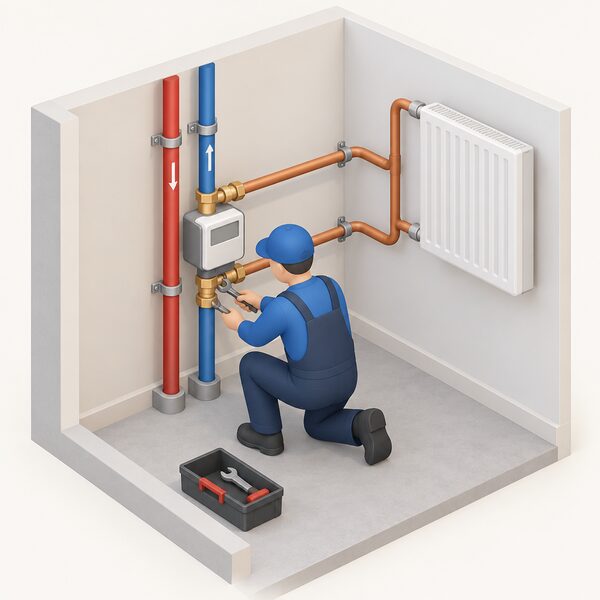
ECO4 support for a heat network connection runs through the district heating connection measure, and the conditions are specific. Suppliers may apply for a district heating connection measure to be approved as an alternative methodology where SAP does not provide an appropriate calculation method15. The installation requires a heat meter for each household15.
Eligibility for ECO4 more broadly runs through defined routes: the Help to Heat Group, Social Housing, LA Flex, Supplier Flex and In-fill34. A data link exists with the Department of Work and Pensions so that Help to Heat Group eligibility can be verified through a data matching exercise34.
| ECO4 element | Detail | Source |
|---|---|---|
| Eligibility routes | Help to Heat Group, Social Housing, LA Flex, Supplier Flex, In-fill | 34 |
| Verification | DWP data matching for Help to Heat Group | 34 |
| District heating connection | Alternative methodology where SAP is not appropriate | 15 |
| Metering condition | Heat meter for each household | 15 |
The connection between support and regulation matters for a household weighing up a network. ECO4 funding can help with the cost of a connection and the metering that makes consumption billing possible, and the regulatory framework then governs how that connection is billed and serviced. Support reduces the upfront cost; regulation governs the ongoing relationship. Neither removes the dependence on the network itself.
Where regulation ends and dependence remains
The regime that began on 27 January 2026 gives heat network households something they did not have before: a named regulator, published consumer standards, prescribed billing content, and a free independent dispute route with awards of up to £10,000 for domestic disputes1. For a household on one of the 14,000 networks in Great Britain, that is a material change in standing4.
The dependence that remains is not a regulatory failure; it is the nature of the technology. A heat network is a local monopoly. The household cannot switch supplier, cannot choose the fuel the network runs on, and cannot easily leave the network without changing the building's heating system. Regulation can make that monopoly behave better, price more transparently and answer for its service. It cannot make it competitive.
Zoning will extend the model deliberately, with at least 10 of the largest English towns and cities establishing zones soon after regulations go live later in 2026, and a target of 7% (27 TWh) of heat to consumers in England by 20358. Households in those zones should expect a network connection to be the planned route for their heating. The regulatory framework is what makes that expansion defensible for consumers; the Ombudsman route is what makes it enforceable case by case.
For related rules on how energy regulation works more broadly, see Ofgem: what the energy regulator does and energy complaints and redress. The devolved positions are set out in energy and buildings policy in Scotland, energy and buildings policy in Wales and the Utility Regulator in Northern Ireland. The wider framework sits under UK home energy regulation and policy.
Sources34 cited
- The Heat Networks (Market Framework) (Great Britain) Regulations 2025, legislation.gov.uk, 2026-01-27
- Heat networks regulation: consumer protection guidance (decision), Ofgem, 2026-01-13
- Heat networks regulation: consumer protection, Ofgem, 2026-01-13
- Heat networks in Great Britain, House of Commons Library, 2026-09-17
- Heat network disputes, Energy Ombudsman, 2025-04-01
- What to expect, Energy Ombudsman, 2026-09-19
- We may be able to help resolve your energy dispute, Energy Ombudsman, 2026-09-20
- Carbon Budget and Growth Delivery Plan: heat and buildings factsheet, GOV.UK, 2026
- Part 7 heat networks regulation, House of Commons Library, 2026-09-20
- Heat networks delivery plan review report 2026, Scottish Government, 2026
- Heat networks regulation: fair pricing protections, Ofgem, 2025-04-30
- Heat network consumer protections draft guidance, Ofgem, 2025-09-05
- Heat network consumer protections draft guidance, Ofgem, 2025-09-05
- Heating oil suppliers: using fair terms and conditions, GOV.UK, 2026-09-10
- ECO4 New Measures and Products Guidance v3.0, Ofgem, 2026-03-26
- How we can help, Energy Ombudsman, 2026-09-19
- FAQs, Energy Ombudsman, 2026-09-19
- Metropolitan Infrastructure Limited, Energy Ombudsman, 2026-09-19
- Kelham Company Ltd Works RTM, Energy Ombudsman, 2026-09-19
- Review of Ofgem call for evidence, Energy Ombudsman, 2025-02-28
- Network operators, Energy Ombudsman, 2026-09-20
- Greenhill Housing Association, Energy Ombudsman, 2026-09-19
- Theodore Stevenage Limited, Energy Ombudsman, 2026-09-19
- ESP Heat Ltd, Energy Ombudsman, 2026-09-19
- London Square (Spitalfields) Management Company Ltd, Energy Ombudsman, 2026-09-19
- Sheffield City Council, Energy Ombudsman, 2026-09-19
- Sanctuary Housing Association, Energy Ombudsman, 2026-09-19
- Theodore Bracknell Limited, Energy Ombudsman, 2026-09-19
- Raise a dispute, Energy Ombudsman, 2026-09-19
- Heat networks affected by the Energy Prices Act 2022, Energy Ombudsman, 2026-09-20
- Creating a case with the Energy Ombudsman, Energy Ombudsman, 2026-09-20
- Complain about your energy supplier or network operator, Ofgem, 2026
- ECO4 Eligibility Requirements Form v1.0, Ofgem, 2022-10
- Heat networks policy, Scottish Government, 2026-01-27
 OfgemOfgem sets the rules energy suppliers and network companies must follow, including the price cap on standard tariffs.
 Energy Complaints and RedressMaps the routes a householder has when an energy supplier, network operator, broker or heat network gets something wrong, which body handles which dispute, and what the Energy Ombudsman can and cannot do.
 Heat Network SuppliersWho supplies the heating in your home if it runs on a communal or district system?
 Controls in Rented HomesCan you change the heating controls in a rented home, and who pays if they break?
 Ofgem Consumer ArchetypesWhich kind of household are you, and does it change what you pay for energy?
 Utility Regulator NIWho sets your energy prices in Northern Ireland and who can you complain to?