In this guide
Four different organisations carry the title of energy consumer body in the UK, and which one a household deals with depends on where it lives. In England and Wales it is Citizens Advice, whose free consumer service is reached on 0808 223 1133, with 0808 223 1144 for a Welsh-speaking adviser1. In Scotland, day to day advice comes from Energyadvice.scot, run by Advice Direct Scotland, on 0808 196 8660, while Consumer Scotland holds the statutory advocacy role1. In Northern Ireland, the Consumer Council gives free advice, runs an energy price comparison tool and can investigate complaints about natural gas and electricity, alongside NI Energy Advice on 0800 111 44554.
None of these bodies is the adjudicator. A complaint about a supplier goes to the supplier first, and if the household is unhappy with the response it can ask the Energy Ombudsman to investigate6. The consumer bodies sit either side of that: they explain rights and the supplier's complaints process before a complaint is made, and in the Citizens Advice Extra Help Unit they take over a case entirely where the consumer is vulnerable or at risk of disconnection7.
The division is not tidy. Citizens Advice is the official advocate for heat network consumers in England and Wales8, Consumer Scotland is named alongside Citizens Advice Scotland for Scotland3, and Northern Ireland sits outside the Great Britain framework altogether with its own regulator, suppliers and comparison tables. A household that contacts the wrong body will usually be redirected, but knowing the route saves time in the cases where time matters most.
Who the energy consumer bodies are and what each one does
The bodies split into three functions that are easy to confuse. The first is individual advice and casework: a person with a bill they cannot pay or a supplier that will not answer. The second is statutory advocacy: representing the collective interest of consumers in policy and regulation, without taking individual cases. The third is charitable support: organisations such as National Energy Action working on fuel poverty and warmth.
Ofgem's own guidance sets out the map for heat network consumers, and it is the clearest statement of who covers whom:
"Citizens Advice for consumers in England and Wales • Consumer Scotland for consumers in Scotland • the Citizens Advice Extra Help Unit for consumers in vulnerable circumstances, by referral"
For Scotland the fuller list adds Citizens Advice Scotland alongside Consumer Scotland, together with any related, qualifying consumer advice bodies3. The structure has changed over time: Consumer Futures previously held the position of statutory representative for energy consumers across Great Britain, postal services across the United Kingdom, and water consumers in Scotland15. Scotland has since built its own machinery, including an independent Energy Consumers Commission created to engage in high level energy decision making and to make use of the unique insights of grassroots energy organisations16, which has taken a role monitoring and advocating for consumers on energy issues17.
The case for these bodies rests on how little most households know about their own supply. Research found by the European Commission that only 36% of UK consumers had a reasonable level of awareness of their electricity consumption18. Ofgem and Citizens Advice jointly commission the Energy Consumer Satisfaction Survey, a survey of domestic energy consumers in England, Scotland and Wales19, which is one of the few ways a household's experience is fed back into regulation at all.
For a household pursuing energy independence, the point is blunt: these bodies are the only route to challenge a supplier without paying for one. They do not reduce dependence on the grid or on a supplier. They make that dependence contestable.
Citizens Advice: the consumer advocate for England and Wales
Citizens Advice runs a free consumer service for people in England or Wales who have problems with their energy bills or supply20. It is also named in Ofgem's guidance as the relevant consumer advice body for England and Wales, covering heat network consumers alongside any related, qualifying consumer advice bodies3, and the UK government describes it as the official advocate for heat network consumers in England and Wales8.
The service covers information and support on struggling to pay bills, problems with an energy supplier or supply, saving energy at home, and getting a better energy deal9. It gives free and impartial help and advice21. The helpline number is 0808 223 11331, with a textphone route of 18001 followed by the helpline number and an online webchat22.
Citizens Advice also has a formal place in the dispute machinery. Under the electricity and gas licensing rules, a dispute may be referred to the Gas and Electricity Markets Authority by any party or, with the agreement of any party, by Citizens Advice, Citizens Advice Scotland or Consumer Scotland23. That is a narrow power and it is exercised rarely, but it means the advocate is not confined to advice.
What Citizens Advice does not do is decide a case against a supplier. Where a consumer is stuck and meets the vulnerability criteria, the consumer service refers on to the Extra Help Unit; where the consumer is not, the route is the Energy Ombudsman. The page on complaining about an energy supplier sets out that process in full.
Advice Direct Scotland runs the national energy advice line

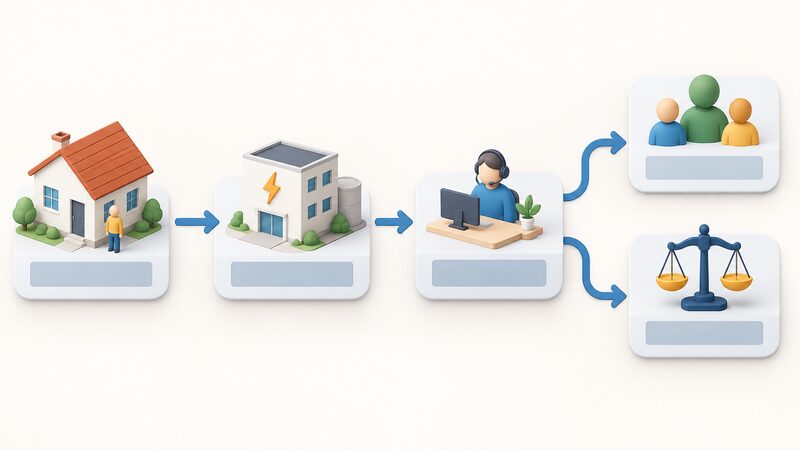
Advice Direct Scotland is Scotland's national advice service, offering free, practical, and impartial advice on a wide range of issues including energy, debt and consumer rights24. Its energy arm is Energyadvice.scot, a free service for Scottish citizens who have questions about their energy supplier, who want to understand their supplier's complaints process, or who have problems with their energy bills20.
The contact route is 0808 196 8660 or the online webchat22. Scottish households on heat networks are directed to the same webchat and number26. Ofgem's guidance for households that cannot afford their bills carries the same number for Scotland9.
Scotland has a second, separate service for efficiency and generation rather than billing. Home Energy Scotland gives free impartial advice on energy efficiency and renewable energy27, and the Scottish Government describes it as a free independent advice and referral scheme28. The split matters in practice: a dispute about a bill goes to Energyadvice.scot, a question about insulation, a heat pump or a grant goes to Home Energy Scotland. Further detail on the Scottish landscape, including restricted meters, sits on energy suppliers in Scotland.
The fuel poverty framing behind all of this is set out in the Scottish Government's strategic approach, which is also where Consumer Scotland's creation is recorded10.
Consumer Scotland: statutory advocacy, not casework
The Consumer Scotland Act 2020 established Consumer Scotland as a non-ministerial body10. Ofgem names it as the relevant consumer advice body for consumers in Scotland14, and Scottish Government guidance on heat networks states that Consumer Scotland, Advice Direct Scotland and the Citizens Advice Extra Help Unit will advocate for Scottish consumers and escalate key issues26.
The distinction to hold onto is between advocacy and advice. Consumer Scotland's function is to represent the collective interest and escalate systemic problems, not to take a phone call about a disputed bill. A household with an individual complaint is routed to Energyadvice.scot or, if the criteria are met, to the Extra Help Unit. Consumer Scotland does, however, hold the same referral power as Citizens Advice: a dispute may be referred to the Gas and Electricity Markets Authority by Consumer Scotland with the agreement of any party23.
Scotland's advocacy structures are layered. The consumer voice is described as well represented on the Scottish Energy Advisory Board through the Energy Consumers Commission16, itself established as an independent body to engage in high level energy decision making and to make use of the unique insights of grassroots energy organisations16. The Commission has established a key role monitoring and advocating for consumers on energy issues17.
For an independence-minded household, the practical consequence is that Scotland has more advocacy than the rest of Great Britain, but the same underlying dependence: Ofgem still regulates supply, and the Energy Ombudsman still decides individual disputes.
Consumer Council for Northern Ireland: complaints, tariffs and price comparison

Northern Ireland runs a separate energy market and a separate consumer body. The Consumer Council gives free advice and can investigate complaints about natural gas and electricity4, which is a broader remit than any of the Great Britain advice bodies hold: it investigates rather than only advising. Northern Ireland guidance on overdue utility bills names the Consumer Council for Northern Ireland as the contact for problems dealing with a fuel supplier29.
The Council also offers an energy price comparison tool covering electricity and gas tariffs for all suppliers in Northern Ireland4. That tool matters more in Northern Ireland than an equivalent would in Great Britain, because there is no Ofgem price cap in the Northern Ireland market and tariff changes are announced supplier by supplier. Tariff changes scheduled for October 2026 include Share Energy from 1 October 2026 and Firmus Energy in Greater Belfast from 8 October 2026, both flagged through the Council's comparison tables.
Alongside it, NI Energy Advice offers independent and impartial energy advice to domestic householders in Northern Ireland, plus referrals to energy grants and other sources of help30. Both the Consumer Council NI and Northern Ireland Energy Advice give free, independent and impartial energy advice to all domestic householders in Northern Ireland32. NI Energy Advice is contactable on 0800 111 4455, open 9am to 5pm Monday to Friday5. Northern Ireland guidance on generating your own electricity also directs homeowners to seek independent advice on solar panels, heat pumps, and other energy efficiency measures from organisations of this kind33.
Northern Ireland suppliers are separately expected to refer customers struggling to pay bills to organisations like Advice NI, which offer free, independent debt advice4. Our fuller profile sits at the Consumer Council for Northern Ireland, and the market itself at energy suppliers in Northern Ireland.
National Energy Action: the fuel poverty charity
National Energy Action is a charity rather than a statutory body, and it works on fuel poverty across England, Wales and Northern Ireland7. It provides free advice about energy bills and keeping warm and safe at home, and can also help with benefits advice and income maximisation34. Income maximisation is the part householders tend not to expect: a cold home is often a benefits problem before it is an energy problem.
Its published fuel poverty estimates are widely cited and they differ between documents. The House of Commons Library records National Energy Action's estimate of 4.5 million households in fuel poverty in the UK in October 202513. A separate account attributes to National Energy Action an estimate of over six million households in fuel poverty35. The two figures are not reconciled in the documents and they are not directly comparable; the 4.5 million figure is the more recent and carries a stated date.
Local variants of the same model exist and are worth knowing about because they are often quicker to reach than a national line: Act on Energy serves West Midlands residents free of charge37, and Community Energy Plus operates in Cornwall38. These are regional and their coverage is limited to their own areas. Supplier-run funds are covered on energy supplier hardship funds and charitable trusts.
The Extra Help Unit: the escalation for vulnerable consumers

The Citizens Advice Extra Help Unit supports vulnerable consumers by raising complaints with energy suppliers on their behalf, particularly where there is a risk of disconnection or complex personal circumstances7. It works by referral only, for consumers in vulnerable circumstances14.
The consumer service sets out four referral triggers. A caller may be referred to the Extra Help Unit if they:
- need support with a difficult or urgent complaint;
- cannot deal with their energy supplier on their own due to personal circumstances;
- are considered vulnerable; or
- are at risk of being disconnected from an energy supply20.
The difference between the Extra Help Unit and the ordinary advice line is that the Unit acts as the consumer's representative with the supplier rather than coaching the consumer to act for themselves. It covers all of Great Britain: it is named for Scotland alongside Consumer Scotland and Advice Direct Scotland26, and in the England and Wales route through the Citizens Advice consumer service2.
There is no self-referral route described in the guidance. The path runs through the consumer service in England and Wales, or through the Scottish advice bodies. A household that believes it qualifies makes the case to whichever advice line covers its nation. What suppliers themselves must do is set out on what suppliers must do for vulnerable customers and on supplier conduct on prepayment meters and customer debt.
Complaining about a supplier: the order of the steps
The sequence is fixed and the advice bodies sit within it rather than around it. The supplier is contacted first, for problems relating to late, incorrect, or missing bills, back billing, being overcharged, a faulty meter, poor customer service, and refusing to refund credit from an account2. The Energy Ombudsman is explicit about the order:
"Speak to your energy supplier first to raise a complaint, and if they can't help, we'll aim to fairly and impartially resolve your dispute"
- Complain to the supplier. Households have a right to complain to their supplier and a right to a resolution6.
- Use the advice body for the nation. Citizens Advice in England and Wales, Energyadvice.scot in Scotland, the Consumer Council in Northern Ireland: to understand the supplier's complaints process and what the rules require.
- Escalate to the Energy Ombudsman if unhappy with the way the supplier has handled the complaint39.
The Ombudsman's eligibility conditions are that the supplier must be the correct one to raise the dispute against, the consumer must have already complained to the supplier, and must have sufficient evidence including the date the complaint was raised12. A deadlock letter or a wait of eight weeks is the usual threshold11. The Ombudsman is approved by Ofgem to deal with consumer complaints about energy bills, mis-selling, problems with energy supply and problems with switching supplier [2 2]. Heat network consumers follow the same pattern, notifying the heat supplier first, with the heat supplier given eight weeks to resolve the complaint3.
| Issue | First contact | Escalation |
|---|---|---|
| Bills, meters, customer service | The supplier2 | Energy Ombudsman39 |
| Prepayment meter fitted without permission | The supplier41 | Energy Ombudsman41 |
| Heat network complaint | The heat supplier, 8 weeks to resolve3 | Energy Ombudsman3 |
| Vulnerable consumer, risk of disconnection | Consumer service for the nation | Extra Help Unit, by referral7 |
| Misuse of personal data by a scheme administrator | Information Commissioner, 0303 123 111342 | n/a |
More detail on the decision stage is on the Energy Ombudsman, and on what happens if a supplier stops trading at supplier of last resort, where the same split applies: Citizens Advice for households in England and Wales, Advice Direct Scotland for those in Scotland21.
Which body fits which nation and which problem
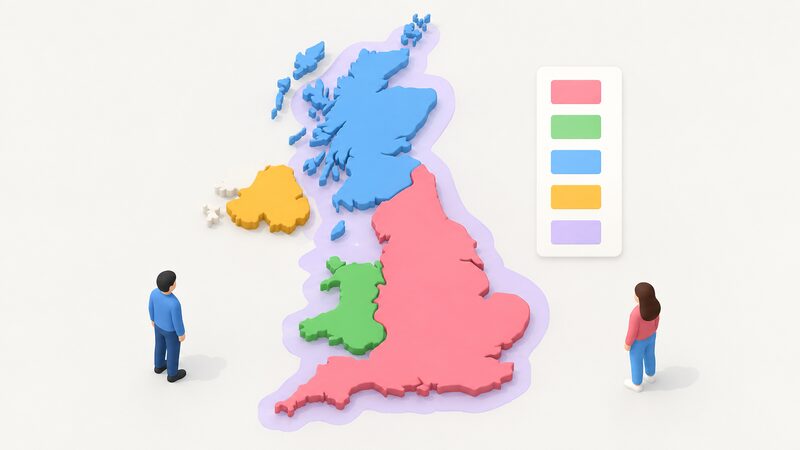
The choice is made on two axes: where the household is, and whether the problem is an individual dispute, a question of efficiency and grants, or a matter of policy.
| Nation | Individual energy advice and complaints | Statutory advocate | Efficiency, renewables and grants |
|---|---|---|---|
| England | Citizens Advice consumer service, 0808 223 11331 | Citizens Advice14 | National Energy Action7 |
| Wales | Citizens Advice, 0808 223 1133, Welsh 0808 223 11442 | Citizens Advice14 | National Energy Action7 |
| Scotland | Energyadvice.scot, 0808 196 866025 | Consumer Scotland, with Citizens Advice Scotland3 | Home Energy Scotland27 |
| Northern Ireland | Consumer Council NI, investigates gas and electricity complaints4 | Consumer Council NI29 | NI Energy Advice, 0800 111 44555 |
| GB, vulnerable circumstances | Extra Help Unit, by referral14 |
Two further distinctions are easy to miss. First, energy efficiency advice and billing advice are separate services in Scotland and in Northern Ireland but blended under Citizens Advice in England and Wales. Second, the Consumer Council for Northern Ireland investigates complaints itself, where the Great Britain bodies advise and then hand off to the Ombudsman.
Policy-level work is a different channel again. The Each Home Counts review, an independent review of consumer advice and protection, was commissioned by the UK Government in October 201543, and the case has been made for a UK Government public engagement campaign focused on reducing energy demand, aimed at both businesses and households44. Household-level advice does not substitute for that.
What these bodies change, and what they do not
The advice bodies make a supplier answerable. They do not make a household independent of one. Even a home with generation and storage remains connected, billed and subject to a supplier's conduct, and the consumer bodies are the mechanism for holding that relationship to the rules. Their leverage is procedural: the right to complain, the right to a resolution, the right to ask the Ombudsman to investigate6.
The limits are real. None of the advice bodies sets prices. The energy price cap protects consumers from the rapid changes observed in the wholesale energy market in the short term45, and it is set by Ofgem, not by any consumer body; in Northern Ireland there is no equivalent cap at all, which is why the Consumer Council's comparison tool carries more weight there. None of them can compel a supplier to act: the Extra Help Unit represents, the Ombudsman decides. And the statutory advocates, Consumer Scotland above all, work at the level of markets and policy, where an individual household will not see the result for years.
Structural change to the market has come from elsewhere. As of September 2016, 14% of domestic consumers received their electricity from suppliers other than the six large energy suppliers18, a shift driven by entrants rather than advocacy; the history is on challenger and small energy suppliers. What the consumer bodies add is a floor under the individual household when that market goes wrong, and, in the Extra Help Unit, a route for the households least able to fight their own case.
Sources45 cited
- Complain about your energy supplier, Ofgem, 2026
- Complain about your energy supplier or network operator, Ofgem, 2026
- Heat networks regulation: consumer protection guidance decision, Ofgem, 2026-01-13
- Advice if you're struggling to pay your energy bills, nidirect, 2026-09-17
- NISEP list of schemes 2026-27, Utility Regulator Northern Ireland, 2026-04
- Understanding your rights, Energy Ombudsman, 2026-09-20
- Worried about your energy bills, Energy Ombudsman, 2026-03-24
- Heat network customers to be shielded from unfair price hikes, GOV.UK, 2026-01-26
- Getting help if you can't afford your energy bills, Ofgem, 2026-09-17
- Tackling fuel poverty in Scotland: a strategic approach, Scottish Government, 2021-12-23
- Facilitated complaints resolution, Energy Ombudsman, 2026-09-20
- Raise a dispute: JM Energy Services Ltd, Energy Ombudsman, 2026-09-19
- Fuel poverty briefing CBP-8730, House of Commons Library, 2025-10
- Heat networks consumer protections: draft guidance, Ofgem, 2025-09-05
- Consumer Futures written evidence, Green Deal watching brief, UK Parliament, 2014-02
- Scotland's energy strategy position statement, Scottish Government, 2021-03-16
- Consumer Scotland draft workplan: energy consultation, Scottish Government, 2022-02-02
- Future insights series: consumer engagement, Ofgem, 2017-03
- Customers' satisfaction with their supplier: supplier level findings, Ofgem, 2025-05-13
- Complain about your energy supplier or network operator: detail, Ofgem, 2026
- Help with household costs, Isle of Anglesey County Council, 2026-09-20
- Energy terms explained, Ofgem, 2026
- The Electricity and Gas (Standards of Performance) Regulations 2015, legislation.gov.uk, 2022-01-13
- Fund opens for Scots to claim £300 heating oil support, Advice Direct Scotland, 2026-04-01
- Get help with your home or business energy bills, Ofgem, 2026
- Heat networks policy, Scottish Government, 2026-09-17
- Domestic RHI: who to contact, Ofgem, 2026-09-17
- Heat in buildings progress report 2025, Scottish Government, 2025-10-02
- Overdue utility bills, nidirect, 2026-09-17
- Biomass, nidirect, 2026-09-17
- Energy saving grants in your area, nidirect, 2026-09-17
- Low carbon heating, nidirect, 2026-09-17
- Support to generate your own electricity, nidirect, 2025-09-22
- Getting help with your energy bills, Birmingham City Council, 2026-06-24
- Helping to tackle fuel poverty through smart data, Smart DCC, 2025
- Smart meters: your rights and expectations, GOV.UK, 2025-08-08
- Mayor's plan to improve living standards and cut energy bills, West Midlands Combined Authority, 2025-01-30
- Winter wellbeing, Cornwall Council, 2026-06-30
- Understand your electricity and gas bills, Ofgem, 2026
- How your electricity or gas bill is calculated, Ofgem, 2026
- Installing a prepayment meter without your permission, Ofgem, 2026
- Administration of the Boiler Upgrade Scheme consultation, Ofgem, 2021-12
- Energy Efficient Scotland route map, Scottish Government, 2015-10
- Climate policy that cuts costs: international policy comparison, Climate Change Committee, 2026-09-19
- Spring Statement 2022, HM Treasury, 2022-03
 The Full Rules and Regulation GuideConfused about who actually decides what you pay for gas and electricity, or why rules differ in Scotland and Wales?
 The Full Scotland, Wales and Northern Ireland GuideWhy a householder in Glasgow, Cardiff or Belfast faces different schemes, standards, targets and markets from one in England.
 Suppliers in ScotlandWho do you contact in Scotland when something goes wrong with your supplier, whether that is British Gas, ScottishPower, SSE or another big name?
 Utility Regulator NIWho sets your energy prices in Northern Ireland and who can you complain to?
 Who to Call for Energy HelpA single reference to the right contact for each situation: gas escapes, power cuts, water leaks, meter faults, billing disputes, scams and free advice.
 Devolved vs Reserved PowersWho decides what you pay for gas and electricity, and who decides how your home is insulated or improved?