

In this guide
The answer turns on one question: whose name is on the supply account. If you pay a supplier directly for the electricity or gas you use at home, you can choose to switch to a different supplier or tariff at any time1. That right does not depend on owning the property, and it applies to prepayment customers as much as to those on credit meters2. If the landlord pays the supplier, the position reverses: the landlord chooses the supplier, and a tenant cannot switch supplier or tariff themselves2.
Rented homes also carry a second layer that owner-occupied homes do not. The meter itself may form part of the tenancy agreement, so a change of meter or payment method is a conversation with the landlord even where the supply contract is the tenant's3. And where a landlord buys energy and passes the cost on, the household is a customer of the landlord, not of an energy company, which changes both the price protection available and the route for complaint.
This page sets out who holds the contract, what a tenant can change alone, how prepayment meters work in rentals, what they cost against the price cap, and how disputes over installation, debt and billing are escalated.
Who pays the bills decides who chooses the supplier
The supply contract sits with whoever pays the energy company. Ofgem's guidance is unambiguous: if you pay a supplier directly for the electricity or gas you use at home, you can choose to switch to a different supplier or tariff at any time1. Citizens Advice frames the same rule for tenants, stating that you can switch energy supplier or tariff if you pay your energy supplier directly for your gas or electricity, and that this includes a prepayment meter2. Which? reaches the same conclusion from the consumer side: if you rent your home and pay your energy company directly for your gas and electricity, then you can choose your energy supplier according to consumer protection law4.
Where the landlord pays, the tenant has no supply contract to move. Citizens Advice states that you cannot switch energy supplier or tariff yourself if your landlord pays the energy supplier for you, and that while the landlord might agree to switch, they do not have to2. Which? puts the choice plainly: if your landlord pays the energy company themselves, they will choose the energy supplier4.
There is a third arrangement that catches households in blocks of flats and converted buildings. Where a resident is supplied under the landlord's own business contract, Ofgem's guidance for alternative homes notes that residents may not have the right to choose their own energy supplier or switch suppliers themselves7. That is a different legal position from a domestic tenancy, and it is worth establishing which one applies before assuming a switch is possible.
The practical test is the bill. A bill or statement in your own name, from an energy company, means the account is yours and the switching right is yours. A bill from a landlord, a managing agent or a heat network operator means the supply contract sits elsewhere.
When the landlord pays: what you can and cannot change
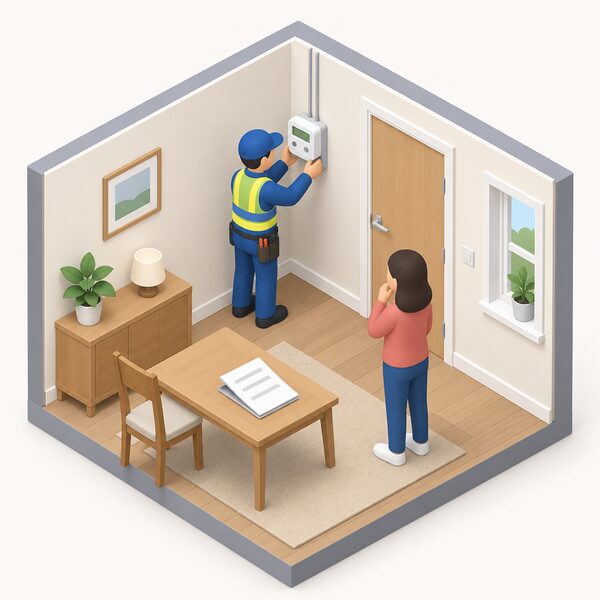
A landlord-held supply is not a dead end, but the levers are different. The tenant can ask the landlord to change supplier or tariff, and the landlord may agree, but there is no obligation to do so2. The energy is bought under the landlord's contract, at whatever rate that contract carries, and the tenant's protection comes from the tenancy and from consumer law on resale rather than from the switching regime.
The meter is a separate matter from the supply contract, and it is the point where tenancy agreements most often bite. Smart DCC's guidance for households notes that renters should discuss any changes with the landlord, as each meter may form part of the tenancy agreement3. That applies to a smart meter installation as much as to a change of payment method. Private renters can choose a smart meter if the energy bills are in their name or they prepay for energy, after checking the tenancy agreement and letting the landlord know9.
Where a landlord or managing agent supplies energy to tenants and bills them for it, the household is buying a service rather than a tariff. The Energy Ombudsman can consider disputes involving heat network suppliers alongside energy suppliers, brokers and network operators, and it can require a supplier to put things right where a mistake has been made or a customer has been treated unfairly10. The Ombudsman has also considered whether it was appropriate for a supplier to place a customer on a deemed rate contract, or whether supplier error or omission left the customer on high deemed contract prices for longer than necessary12.
For a household, the independence question here is stark. A tenant on a landlord-held supply cannot shop for a cheaper unit rate, cannot fix a price, and cannot move to a green tariff of their own choosing. The only route to supplier choice is to have the account put in their own name, which requires the landlord's agreement and a meter registered to the property.
Prepayment meters: how they work and why they are common in rentals
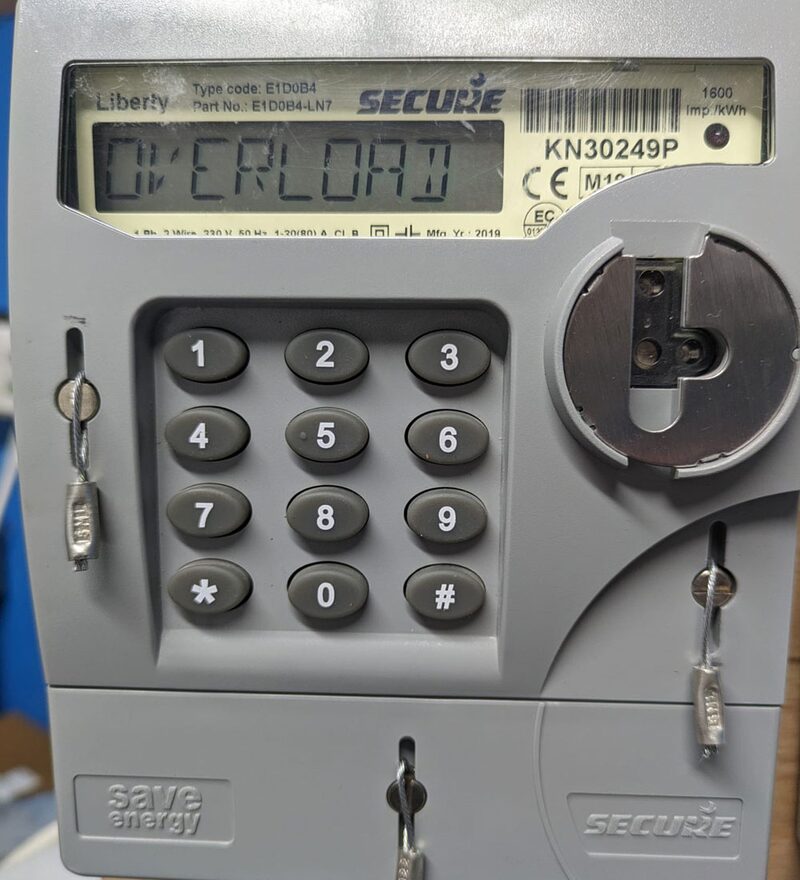
A prepayment meter lets a household pay for electricity or gas in advance rather than after it has been used13. Credit is loaded onto the meter, and the meter releases energy until the credit runs down. On traditional meters that means a key or card taken to a shop; on smart meters it can be done remotely.
Prepayment is common in the private rented sector for two reasons. First, it removes the credit risk for the supplier, which matters where a tenancy is short and a household has no payment history at the address. Second, it is the standard tool for recovering an existing debt: suppliers often recommend a prepayment meter for customers already in fuel debt, set up to repay a specific amount each week based on affordability14.
Being on prepayment does not remove the switching right. Which? states that being on a prepayment meter does not prevent customers from switching tariff or supplier, and that tenants responsible for paying bills have the right to switch provider14. Ofgem's own guidance confirms that a prepayment customer can switch supplier or tariff, including with a prepayment meter2.
Two features of prepayment shape the household's position more than the tariff itself. The first is the standing charge, a fixed daily amount payable no matter how much energy is used, deducted automatically along with any unpaid standing charge or fuel debt when credit is added14. The second is that payments cannot be spread evenly across the year, so prepayment customers pay much more in winter than in summer14. A household on a fixed income feels both.
What prepayment costs: tariffs, standing charges and the price cap
Prepayment is a payment method, not a single tariff, and the price cap treats it as its own category. Ofgem states that the level of the cap varies by where you live, payment method (Direct Debit, standard credit or prepayment meter), fuel type and meter type15. The cap is reviewed and set every 3 months6. If a household does not fix an energy deal, it typically pays a provider's default, variable rate, which is determined by the energy price cap and changes every three months4.
The published cap levels show how much regional variation sits inside a single national headline. For gas, the benchmark maximum charges for prepayment customers in the quarter from 1 July to 30 September 2026 were £99.53 standing charge and £745.22 annual bill at 9,500 kWh in the South East, and £99.16 standing charge and £761.19 annual bill at 9,500 kWh in the Southern region16. For electricity, the prepayment levels for London in the quarter from 1 October to 31 December 2025 were £160.10 at nil consumption and £893.64 at 3,100 kWh on a single-rate meter, with £159.00 and £1,112.34 for a multi-register meter at 4,200 kWh; the Southern region stood at £155.12 and £912.80 single-rate, and £155.67 and £1,138.05 multi-register17.
| Cap element, prepayment | Region | Figure | Period |
|---|---|---|---|
| Gas standing charge | South East | £99.53 | 1 Jul to 30 Sep 202616 |
| Gas annual bill at 9,500 kWh | South East | £745.22 | 1 Jul to 30 Sep 202616 |
| Gas standing charge | Southern | £99.16 | 1 Jul to 30 Sep 202616 |
| Gas annual bill at 9,500 kWh | Southern | £761.19 | 1 Jul to 30 Sep 202616 |
| Electricity, nil consumption | London | £160.10 | 1 Oct to 31 Dec 202517 |
| Electricity at 3,100 kWh, single-rate | London | £893.64 | 1 Oct to 31 Dec 202517 |
| Electricity at 4,200 kWh, multi-register | London | £1,112.34 | 1 Oct to 31 Dec 202517 |
| Electricity at 3,100 kWh, single-rate | Southern | £912.80 | 1 Oct to 31 Dec 202517 |
Two things follow for a renter. The first is that the payment method itself moves the cap level, so a prepayment household is not paying the same capped amount as a Direct Debit household in the same street. The second is that the region matters as much as the method, which is why a national figure quoted in a comparison cannot be applied to a specific tenancy.
The tariff menu available to any household, prepayment included, covers standard variable, renewable, electric vehicle, fixed price and prepayment pay-as-you-go tariffs18. A tenant who holds the account can choose among them; a tenant whose landlord holds the account cannot.
Emergency credit, self-disconnection and debt on the meter
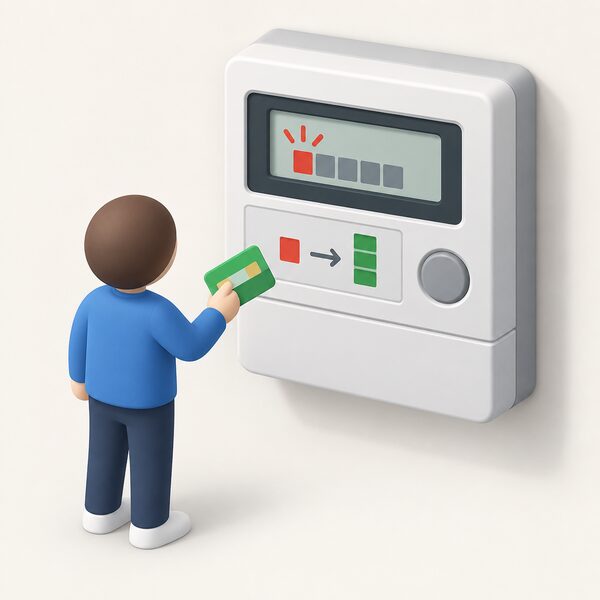
Emergency credit is the buffer between running out and going dark. The amount is set by the supplier, which must offer a reasonable amount, and it must be paid back when the customer next tops up, with an affordable payment plan agreed with the supplier19. Heat network suppliers are obliged to offer a reasonable amount of Emergency Credit and Friendly Hours Credit to any consumer using a prepayment meter, unless it is technically infeasible20.
Self-disconnection is the term for running out entirely and stopping top-up. It is not a neutral event for the account: the standing charge and any fuel debt still apply even when the meter has no credit14. A household that cannot top up therefore falls further behind rather than standing still.
Debt recovery is built into the meter. Suppliers often recommend a prepayment meter for customers already in fuel debt, set up to repay a specific amount each week based on affordability14. That structure is why prepayment is so often found in rentals where a previous balance exists.
The debt also governs what happens next. Tenants who owe money to their energy supplier cannot change back to paying by credit until the debt is paid2. Switching supplier is a different question from changing payment method, and the rules diverge: a prepayment customer can switch where the debt is under £500 for each meter, repaying the new supplier instead1. On a credit meter the restriction is tighter, with households that have owed money for more than 28 days unable to switch supplier until they have repaid what they owe21.
Moving to a credit meter: eligibility and landlord permission
Moving off prepayment is possible, and the conditions are financial rather than legal. Tenants who do not owe money to their energy supplier can move to paying by credit2. Where a balance is outstanding, the move waits until it is cleared2.
The mechanics vary by supplier. Some fuel suppliers will install a new meter free of charge, although in most cases a household needs to pass a credit check or pay a refundable deposit, and private tenants who are the bill payer have the right to change payment method14. Switching from an existing gas or electricity prepay meter to a smart credit meter is described as straightforward for customers who meet the conditions3.
The landlord's interest is in the meter, not the payment method. Renters should discuss any changes with the landlord, as each meter may form part of the tenancy agreement3. A smart meter installation is the same conversation: private renters can choose a smart meter if the energy bills are in their name or they prepay for energy, after checking the tenancy agreement and letting the landlord know9. Smart meters can be applied for by renters, prepay customers, and where the meter sits outside the property, such as in a communal meter box in a block of flats3.
For a household, the move from prepayment to credit is the single largest change available without moving house. It converts a pay-in-advance supply into a billed account, which opens the standard tariff market and removes the winter-heavy payment pattern. It does not change who owns the meter, and it does not remove the landlord's say over the physical installation.
When a prepayment meter is not safe or practical
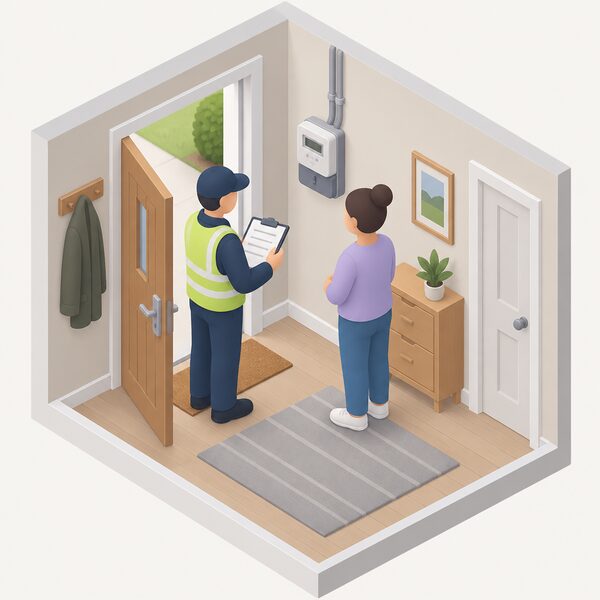
There are households for which a prepayment meter must not be installed at all. Ofgem's guidance states that a supplier must not install one if there are any vulnerable people in the household, including terminal illness or severe health condition, dependence on a continuous energy supply for medical equipment, everyone aged 75 or over with no support, a child under 2, no one able to top up due to a physical or mental health condition, or temporary circumstances such as pregnancy or bereavement5.
Before any installation without permission, the supplier must visit the home to understand the circumstances and check whether a prepayment meter is safe and suitable for the household5. That visit is the point at which the prohibited categories are meant to be identified.
Where a supplier switches an existing supply meter to prepayment mode without the consumer's consent, it must ensure the consumer receives prepayment meter credit, unless that is technically infeasible or otherwise outside the supplier's control20. That requirement sits alongside the £30 credit rule for installations and remote switches5.
The safety categories are not advisory. A household that falls into one of them has grounds to challenge an installation, and the supplier's own pre-installation visit is the evidence trail. For a tenant, the practical step is to make the circumstances known to the supplier in writing before any visit, and to keep the tenancy agreement to hand, since the meter may be the landlord's property even where the supply is the tenant's.
If you are moved onto a prepayment meter: your rights and protections
A supplier can install a prepayment meter without permission only in defined circumstances: where the household is building up an energy debt and other ways of recovering that debt have not worked5. The methods available are a warrant to enter the property and install a meter, or a remote switch of an existing smart meter into prepayment mode5.
The process carries notice obligations. Before installation the supplier should explain why it made the decision, tell the household when it plans to install the meter, explain what will happen during the installation, and tell the household how to contact it if circumstances have changed or the decision is thought to be wrong22. The supplier must also visit the home to check safety and suitability5.
Two financial protections attach to the installation itself. The supplier must give £30 credit once it has installed the meter or remotely switched an existing meter to prepayment mode5. And where a smart meter is switched remotely without consent, the consumer must receive prepayment meter credit unless that is technically infeasible20.
Compensation is a separate matter from the credit. A household may be able to claim compensation if it was forced to have a prepayment meter between 1 January 2022 and 21 January 2023 and the supplier did not follow the rules properly5. Ofgem's market compliance review on installations to collect debt without household permission covered at least 40,000 customers15.
Complaining and escalating: the Energy Ombudsman

The route to the Energy Ombudsman runs through the supplier first. A complaint must be raised with the supplier in the first instance, and the Ombudsman is free to use if the issue is not resolved after eight weeks or a deadlock letter is received24. The Ombudsman can also be contacted where a reported problem is not fixed within 8 weeks, where the household and the energy company cannot agree on how to fix the problem, where a deadlock letter is received, or where the household is not happy with the decision received25.
The Ombudsman is an independent service, separate to Ofgem, for problems with an energy supplier, an energy broker, a network operator or a heat network supplier11. Its scope covers energy suppliers, energy brokers, network operators, green deal providers and heat network suppliers26. Where a mistake has been made or a customer has been treated unfairly, it can require the supplier to put things right10.
The remedies available are practical as well as financial. The Ombudsman can tell suppliers to take practical action, such as crediting or cancelling an account or changing a tariff, to make an apology, or to offer a financial award, or a combination of these, and it may make recommendations to prevent the issue happening again27. For prepayment disputes specifically, the Ombudsman can consider whether it was appropriate for a supplier to place a customer on a deemed rate contract, or whether supplier error or omission left the customer on high deemed contract prices for longer than necessary12.
A case needs evidence. Useful details include the energy supplier's name, the name of the account holder, the account number and the date the complaint was first raised with the supplier28. The Ombudsman expects an unresolved dispute that has already been complained about to the supplier, with sufficient evidence including the complaint date and a supplier name matching the account holder's bill29.
For a tenant, the escalation route matters most where the landlord holds the supply. A dispute about a heat network or a landlord-supplied energy service can go to the Ombudsman where the supplier is in scope11, but a dispute about the tenancy itself is a different matter. The dividing line is whether the problem is with an energy supply or with the letting.
Sources29 cited
- Switch your home energy supplier, Ofgem, 2026
- Switching energy supplier if you're a tenant, Citizens Advice, 2026-09-17
- How to get a smart meter, Smart DCC, 2026
- How to switch energy supplier, Which?, 2026-05-15
- Check if energy suppliers can install prepayment meters without household permission, Ofgem, 2026
- Energy price cap, Ofgem, 2026-09-17
- If you live in a home on a business energy contract, Ofgem, 2026
- Tenants' energy rights explained, Ofgem, 2013-09-12
- Smart meters, Energy Ombudsman, 2026
- We may be able to help resolve your energy dispute, Energy Ombudsman, 2026-03-24
- Understanding your rights, Energy Ombudsman, 2026-09-20
- Deemed contracts and rates, Energy Ombudsman, 2026-09-20
- Get help with your prepayment meter, Ofgem, 2026
- Prepayment meters, Centre for Sustainable Energy, 2025-08
- Compensation for installing prepayment meters without permission, Ofgem, 2025-05-28
- Energy price cap levels, 1 July to 30 September 2026, Ofgem, 2026
- Energy price cap levels, 1 October to 31 December 2025, Ofgem, 2025
- Problems with services: energy tariffs, Isle of Anglesey County Council, 2025-10
- Prepayment meters consumer guidance, Ofgem, 2026
- Heat networks consumer protection guidance, Ofgem, 2025-09-05
- Tackling fuel poverty in Scotland, Scottish Government, 2021-12-23
- Installing a prepayment meter without your permission, Ofgem, 2026
- Installing a prepayment meter without your permission, Ofgem, 2026
- Creating a case with the Energy Ombudsman, Energy Ombudsman, 2026-09-20
- Complain about your energy supplier or network operator, Ofgem, 2026
- Worried about your energy bills, Energy Ombudsman, 2026-09-20
- What to expect, Energy Ombudsman, 2026-09-19
- Edmunds House Management Company Ltd, Energy Ombudsman, 2026-09-19
- What happens if your energy supplier goes out of business, Ofgem, 2026
 Where to Start If You RentRenting means you can switch supplier or get a smart meter yourself, but insulation, glazing and heating need your landlord's agreement.
 Controls in Rented HomesCan you change the heating controls in a rented home, and who pays if they break?
 Renting and Home EnergyThe position of a tenant in a privately rented home: which measures need no permission, which are fixtures the landlord controls, and what the law says about heating, insulation, certificates and bills across the four UK nations.
 Energy in Social HousingWhat must your landlord do if your home is cold, damp or mouldy?
 Monitoring in Flats and RentalsCan you get a smart meter in a rented flat, and who decides?
 Who Owns Your Home Energy DataYour smart meter records how much gas and electricity you use, and that information belongs to you, not your supplier.