

On this page
Scotland's Heat in Buildings Bill is the legislation intended to end the use of polluting heating systems across the country, but it has not reached the Scottish Parliament. On 18 November 2025 the Scottish Government confirmed it "will not introduce a Heat in Buildings Bill during this Parliamentary session", and instead published a draft Bill as a statement of intent1. The stakes are large: heat is responsible for approximately half of Scotland's energy use2, and emissions from buildings, primarily from heating, currently account for 15% of Scotland's greenhouse gas emissions3.
The draft Bill, called the Buildings (Heating and Energy Performance) and Heat Networks (Scotland) Bill, would set a legal target that by the end of 2045, as far as reasonably practicable, no direct emission heating system is used in any building in Scotland4. Along the way it proposes minimum energy efficiency standards, with private landlords meeting them by the end of 2028, owner occupiers by the end of 2033, and all homes and businesses moving to clean heating by the end of 20455.
For a household thinking about energy independence, the pause matters. Nothing in the draft Bill is law yet, and nothing in it compels anyone to act today. But the direction is fixed across every Scottish Government document on the subject, and the deadlines, if the Bill eventually passes, would shape decisions about boilers, insulation and heat pumps for the next two decades.
Why the Bill exists: heat is half of Scotland's energy use
The case for legislating on heat rests on its sheer scale. The consultation on the Bill states plainly: "Today, heat is responsible for approximately half of Scotland's energy use"2. The draft Climate Change Plan published in November 2025 puts the emissions side of that picture at 15% of Scotland's greenhouse gas emissions, primarily from heating3. Earlier documents gave slightly different framings: the 2021 consultation on the Heat in Buildings Strategy said heat in buildings accounts for approximately a fifth of Scotland's GHG emissions2, and a 2026 impact assessment put the figure at around 19% of Scotland's total emissions from heating systems in the building stock6. The differences reflect different scopes and dates, but the order of magnitude is consistent: heating buildings is one of the largest single sources of Scotland's emissions.
The strategy also has a social purpose. The Heat in Buildings Strategy, published on 7 October 2021, sets out short term actions and a long term vision for warmer, more efficient homes7. Around 30% of the average household's heating bills are spent on heating water for sanitary, health or hygiene purposes, so the fabric and system of a home affect running costs continuously, not only in winter8. Reducing demand through insulation and cleaner heating is presented by the Scottish Government as both a climate and a fuel poverty measure.
For households, this is the context in which every grant, loan and standard operates. Scotland's home energy grants exist in part because the Government expects the building stock to change, and the Bill is the legal instrument meant to drive that change.
A draft Bill exists, but it will not be introduced this session

The Bill has had a long gestation. The Programme for Government for 2024/25 included a Heat in Buildings Bill, but as fuel poverty reporting noted in April 2025, "this has still not been introduced"9. The consultation ran from 28 November 2023, with responses invited by 8 March 20242. It received over 1,600 responses and included 28 questions seeking stakeholders' views on the proposals10.
On 18 November 2025 the Cabinet Secretary wrote to the Scottish Parliament's committee with the outcome: the Government "will not introduce a Heat in Buildings Bill during this Parliamentary session". Instead, a draft Bill was published the same day, described as "a clear statement of intent to introduce it as early as possible in the next Parliament (subject to the outcome of the 2026 Scottish Parliament election)"1. The Government's response to the Green Heat Finance Taskforce confirms it intends to bring the legislation forward as early as possible in the next parliamentary session, subject also to clarity on the UK Government position11.
The draft Bill itself, if passed, would take the short title the Buildings (Heating and Energy Performance) and Heat Networks (Scotland) Act 20274. That name signals its two halves: heating and energy performance rules for existing buildings, and the framework for heat networks.
What the draft Bill would do
The draft Bill sets the headline target in legislation: "by the end of the year 2045, as far as reasonably practicable, no direct emission heating system is used in any building" in Scotland4. It also gives Scottish Ministers power to set, by regulations, minimum energy performance standards for buildings in which direct emission heating systems are used4.
The consultation that shaped it proposed a Heat in Buildings Standard with several triggers, each applying to a different household situation12:
- After a property purchase: at the end of a grace period following completion of a purchase, buyers would need to end their use of polluting heating systems within a fixed period.
- In a Heat Network Zone: following notice from a local authority that a building owner is required to end their use of polluting heating.
- Private landlords: by the end of 2028.
- Owner occupiers: by the end of 2033.
The consultation also proposed that Scottish Ministers should have powers to extend these requirements in future, subject to Parliamentary approval and further consultation12. A related scoping consultation on a Heat, Energy Efficiency and Technical Suitability Assessment describes the same architecture: powers to set minimum energy efficiency standards for owner occupier and non-domestic properties, and requirements for large non-domestic premises, including powers to require public sector buildings to connect to district heating when available13.
Minimum energy efficiency standards: who must act, and by when
The deadlines differ by tenure, and the differences are deliberate. Private landlords would need to meet the minimum energy efficiency standard by the end of 2028; owner occupiers by the end of 2033; and all homes and businesses would have to move to a clean heating system by the end of 20455. The consultation set out the same sequence: private landlords by the end of 2028, owner occupiers by the end of 203312.
| Household | Requirement | Deadline |
|---|---|---|
| Private landlords | Meet minimum energy efficiency standard | End of 20285 |
| Owner occupiers | Meet minimum energy efficiency standard | End of 20335 |
| All homes and businesses | Move to a clean heating system | End of 20455 |
| Buyers of homes and buildings before 2045 | Move to clean heating within a set period after sale | Set period after purchase5 |
For social housing, the Committee on Climate Change has recommended that the Scottish Government complete the review of the Energy Efficiency Standard for Social Housing, assessing progress to date and aligning it with the 2040 target for low-carbon heat in homes14. The New Build Heat Standard already applies to new buildings: warrant applications made from April 2024 must be built with a low-carbon heating system15.
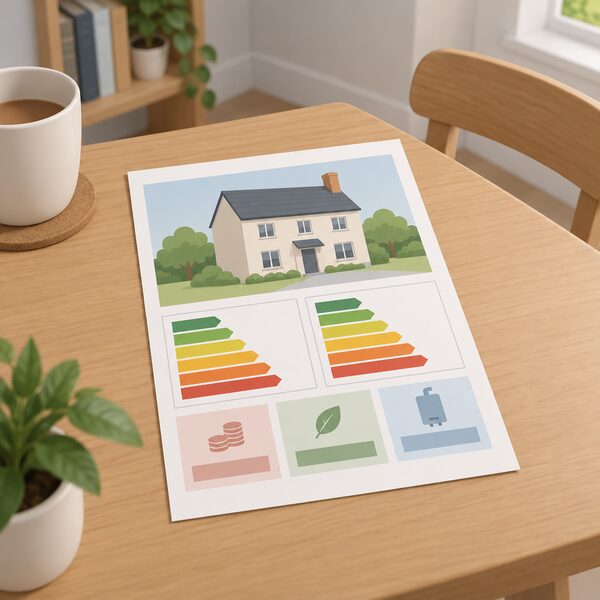
What the standard will actually require of an individual home is not yet fixed. The reformed Energy Performance Certificate will carry new ratings for domestic buildings: a Heat Retention Rating, a Heating System Rating and an Energy Cost Rating, alongside carbon dioxide emissions and the type of heating system used16. These are the metrics against which a home's compliance would likely be judged once regulations are made.
Abandoned point-of-sale proposals, and what remains
One of the most contested ideas in the consultation has been dropped. The Committee on Climate Change, in its advice on Scotland's carbon budgets published in May 2025, stated: "It is therefore disappointing that the proposals for regulations to upgrade properties at the point of sale have been ab"andoned14. The consultation had proposed requiring those purchasing a home or business premises to end their use of polluting heating systems within a fixed period following completion of the sale12, and the consultation analysis repeated this as a pathway to 204510. The requirement on buyers appears in the draft Bill's framework, but the abandoned point-of-sale upgrade regulations mean the burden on buyers may be lighter than first proposed.
What remains is the fabric-first approach. The Heat in Buildings progress report for 2023 noted that "now the biggest challenge remains in existing buildings"17, since regulations for new buildings have already been developed. The Energy Performance of Buildings (Scotland) Regulations 2025 remain a draft item of legislation4, and the Government has not proposed changes to the Section 63 assessment process, Improvement Plans, or Display Energy Certificates ahead of its response to the Heat in Buildings Bill consultation16.
For a household, the practical reading is this: the point of sale is no longer certain to be the moment the Government forces an upgrade, but the 2028 and 2033 deadlines for landlords and owner occupiers remain the operative proposals.
Heat network zones, licensing and new-build connections
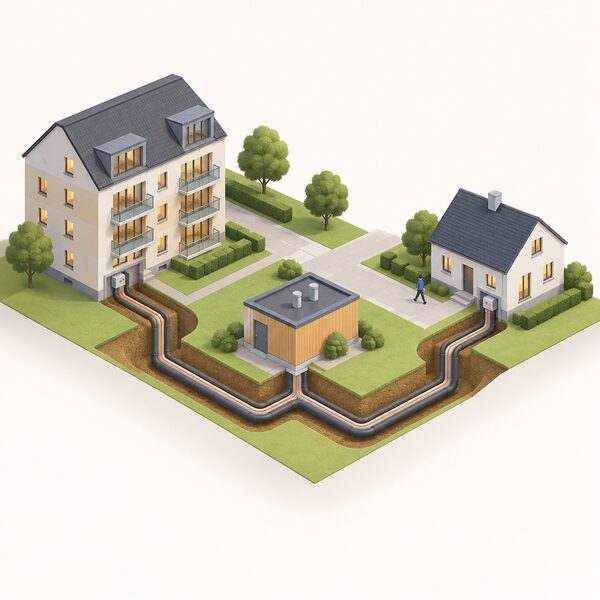
The second half of the draft Bill concerns heat networks, which the Heat Networks (Scotland) Act 2021 defines as a district heating network or communal heating system distributing thermal energy from one or more sources to more than one building, or to one building comprising more than one building unit18. That Act introduced powers to regulate the heat networks market in Scotland for the first time19, and the Scottish Parliament passed legislation requiring all local authorities to produce a draft Local Heat and Energy Efficiency Strategy, with prospective Heat Network Zones designated in line with the Act20. Edinburgh's delivery plan, for example, identifies such zones21.
The scale is currently modest: around 33,000 buildings are connected to heat networks in Scotland12, against a statutory ambition of 6 TWh of output by 203020. The draft Bill would add:
- New powers to require buildings within heat network zones to connect or decarbonise, building on what the Government reports as strong stakeholder support10.
- A voluntary Scottish installation and maintenance licence for heat networks, giving developers a mark of quality10.
- A requirement to identify Heat Network Zones across Scotland, including a new requirement on the public sector to assess the suitability of its own estate to connect2.
For new buildings, the New Build Heat Standard applies to all new buildings, domestic and non-domestic, constructed under a building warrant, and is introduced through building regulations22. The Scottish Government had committed that, from 2024, new buildings must use zero emissions heat7.
A heat network connection changes a household's dependence rather than removing it: instead of a gas supplier, the dependence is on a network operator and its heat source. The draft Bill's licensing and consenting rules, which support only renewable and low carbon heat networks2, are meant to make that dependence reliable.
How the Bill fits with Scotland's 2045 decarbonisation targets
The Bill is the legal backbone of a target that already exists in policy: the Scottish Government is committed to decarbonising heat in buildings by 20451, described as decarbonising heating systems in all buildings where "reasonable and practicable to do so"15. The consultation on the Bill proposed reconfirming that the use of polluting heating systems will be prohibited after 204512, and the Heat in Buildings Strategy consultation frames the whole programme as "ensuring a transition to zero emissions by 2045"23.
The Committee on Climate Change's advice on Scotland's carbon budgets, published in May 2025, recommended four carbon budgets of 57%, 69%, 80% and 94% below 1990 levels14. Its February 2026 assessment found that Scotland's plan means immediate climate targets are now within reach, with credible plans in place for 91% of the emissions reduction needed for the First Carbon Budget (2026 to 2030)24. The same assessment noted that the upcoming Heat in Buildings Strategy and Delivery Plan should be published as soon as possible, and that it should include minimum energy efficiency standards for privately rented homes24.
The 2026 impact assessment for the private rented sector regulations describes the Bill as introducing "a target to decarbonise heating systems in Scotland's buildings by 2045"6. So the 2028 and 2033 deadlines are staging posts on a 2045 journey that is fixed in policy and would become fixed in law.
Tracking the timetable: what has been published and when

The paper trail is long, and it shows a programme that has repeatedly slipped while its end date has held.
| Date | Publication or event |
|---|---|
| 7 October 2021 | Heat in Buildings Strategy published7 |
| 2021 | Heat Networks (Scotland) Act passed; local authorities required to produce Local Heat and Energy Efficiency Strategies20 |
| 28 November 2023 | Consultation on the Heat in Buildings Bill opens, 28 questions12 |
| 8 March 2024 | Consultation response deadline2 |
| 27 October 2023 | Heat in Buildings progress report, fulfilling the requirement under the Climate Change (Scotland) Act 2009 to report annually25 |
| 6 November 2025 | Draft Climate Change Plan 2026 to 2040 published3 |
| 18 November 2025 | Draft Bill published; introduction deferred to the next session1 |
| By end of 2026 | New Heat in Buildings Strategy and Delivery Plan due11 |
The progress report notes that the Strategy, published in 2021, sets out the Scottish Government's programme, and that the report fulfils the requirement under the Climate Change (Scotland) Act 2009 to report annually on progress25. The next milestone households should watch is the new Heat in Buildings Strategy and Delivery Plan, due by the end of 202611, followed by the Bill's introduction in the next parliamentary session.
Support while the Bill waits
Legislation is one track; household support is the other. In 2025 the Scottish Government's heat in building programmes are supporting over 20,000 households to save up to £500 on their energy bills26. Community-level support is also growing, with new funding for communities to develop ideas on transforming heat in Scotland's homes and buildings27, and around one fifth of Scotland's carbon emissions coming from heating homes and buildings keeps the pressure on delivery27.
For households weighing a heat pump or insulation now, the Boiler Upgrade Scheme and the Home Energy Scotland grant and loan operate today, regardless of when the Bill reaches Parliament. The Bill, when it comes, would set the floor; the grants set the pace.
Sources27 sources
- Heat in Buildings Bill update from the Cabinet Secretary, Scottish Parliament, 18 November 2025
- Changing the way we heat our homes and buildings: consultation on proposals for a Heat in Buildings Bill, Scottish Government
- Scotland's Climate Change Plan 2026 to 2040, Scottish Government, 6 November 2025
- Draft Buildings (Heating and Energy Performance) and Heat Networks (Scotland) Bill, Scottish Government, 18 November 2025
- The Heat in Buildings Programme, Scottish Government
- Energy Efficiency (Domestic Private Rented Property) (Scotland) Regulations 2026: partial Business and Regulatory Impact Assessment, Scottish Government, 6 June 2025
- Update to the Renewable Heat Target: action plan 2021, Scottish Government, 27 October 2021
- 3.27 Water efficiency, Building standards technical handbook 2022: domestic, Scottish Government, 2022
- Tackling fuel poverty in Scotland: periodic report 2021 to 2024, engagement responses, Scottish Government, 2025-04-22
- Proposals for a Heat in Buildings Bill: consultation analysis, Scottish Government, 29 January 2026
- Scottish Government response to the Green Heat Finance Taskforce, Scottish Government, 17 December 2025
- Delivering net zero for Scotland's buildings: consultation on proposals for a Heat in Buildings Bill, Scottish Government, 28 November 2023
- Scoping consultation on a Heat, Energy Efficiency and Technical Suitability Assessment: partial BRIA, Scottish Government
- Scotland's carbon budgets, Climate Change Committee, 21 May 2025
- Progress in reducing emissions in Scotland 2025, Climate Change Committee
- Energy Performance of Buildings (Scotland) Regulations 2025: Children's Rights and Wellbeing Impact Assessment, Scottish Government, 10 October 2025
- Heat in Buildings: progress report 2023, conclusion, Scottish Government, 27 October 2023
- Domestic Building Services Compliance Guide 2022, Scottish Government, June 2022
- Heat networks, Scottish Government, 17 September 2026
- Heat in Buildings Strategy 2022 update: progress, Scottish Government, 31 October 2022
- Edinburgh Local Heat and Energy Efficiency Strategy delivery plan, City of Edinburgh Council, 2023
- New Build Heat Standard part two consultation, Scottish Government, 20 September 2026
- Heat in Buildings Strategy consultation, Scottish Government, 17 September 2026
- Scotland's plan means immediate climate targets are now within reach, Climate Change Committee, 25 February 2026
- Heat in Buildings: progress report 2023, context and purpose, Scottish Government, 27 October 2023
- Helping households to manage their bills, Scottish Government, 3 November 2025
- New support for communities to develop ideas on transforming heat in Scotland's homes and buildings, Local Energy Scotland, 20 September 2026