In this guide
The Great British Insulation Scheme, formerly known as ECO+, was a government energy-efficiency obligation placed on medium and large energy companies to deliver measures that reduce energy usage in the least energy-efficient homes in Great Britain1. It ran from 25 July 2023 to 31 March 2026 and closed on that date2. Unlike ECO4's whole house approach, it mostly delivered single insulation measures, one per home, so that as many households as possible could be reached quickly1.
Its defining feature was the general eligibility group: households did not have to be on benefits. A property with an Energy Performance Certificate rating of D to G, in council tax bands A to D in England or A to E in Scotland and Wales, could qualify4. A separate low-income group covered homeowners and tenants receiving one of a list of qualifying benefits, and could also receive certain heating controls as a secondary measure4.
GBIS was estimated to be a £1 billion obligation on energy suppliers, with the previous government forecasting that 300,000 households would benefit by 20265. Actual delivery fell well short of that: 126,000 measures were installed up to the end of December 20257. The scheme is administered by Ofgem, which sets supplier targets and monitors progress but does not administer guarantees for the work5.
The scheme in one paragraph: a single-measure, supplier-funded insulation obligation
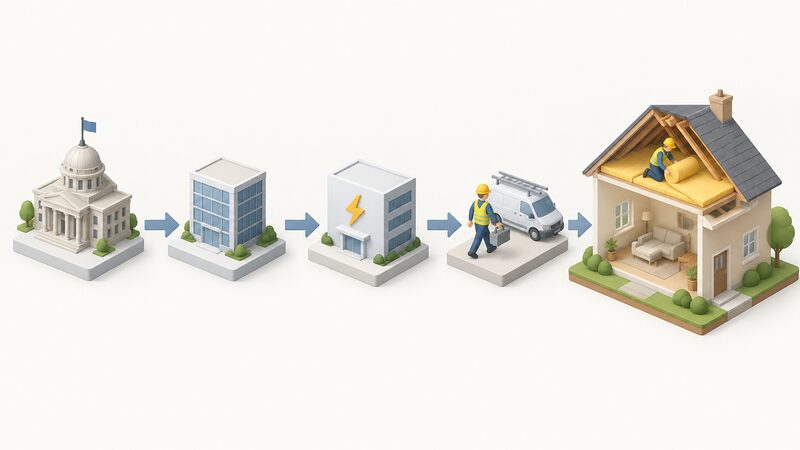
GBIS worked by placing an obligation on medium and large energy companies to deliver measures that result in reduced energy usage1. It complemented ECO4 rather than replacing it, and was designed to deliver improvements to the least energy-efficient homes in Great Britain, to tackle fuel poverty, reduce energy bills and reduce carbon emissions1. Where ECO4 requires a package of works assessed against a whole-house standard, GBIS was predominantly a single measure scheme with extra measures being eligible under certain conditions10. The focus was solely on the delivery of insulation and heating control measures11. Ofgem describes the approach as the rapid installation of value-for-money insulation measures and, in some cases, heating controls8. Compliance was measured on an annual basis, rather than across the scheme as a whole10. For a side-by-side treatment of the two obligations, see Great British Insulation Scheme vs ECO4, and for the wider framework, the Energy Company Obligation.
Delivery figures: 126,000 measures against a 300,000-household target
There were 126,000 measures installed under the scheme up to the end of December 20257. Of those, 38 per cent were cavity wall insulation, 28 per cent loft insulation, 25 per cent heating controls and 4 per cent solid wall insulation7. Heating controls accounting for a quarter of delivery is notable in a scheme described as an insulation scheme: controls were permitted only as a secondary measure alongside an eligible insulation measure in owner-occupied low-income homes4.
| Measure type | Share of GBIS measures to end December 2025 |
|---|---|
| Cavity wall insulation | 38%7 |
| Loft insulation | 28%7 |
| Heating controls | 25%7 |
| Solid wall insulation | 4%7 |
Against the forecast that 300,000 households would benefit by 2026, delivery of 126,000 measures represents a substantial shortfall, and because a single household can receive an insulation measure plus a heating control, the number of households reached is lower than the number of measures6. The scheme was expected to cost £1 billion7.
Statistics were published monthly, covering measures installed and households upgraded, analysed by measure type and geographical region, and applying to England, Scotland and Wales12. Data in each monthly release were two months in arrears, and the figures are provisional and subject to future revisions12. Final figures up to the end of the scheme were published in the May 2026 publication14. Ofgem also publishes monthly reports showing supplier progress towards targets and the number and types of measures installed, and has stated an intention to add GBIS to its supplier performance reporting15.
Eligibility: two groups, and four routes into the scheme
Eligibility ran through four routes: General Eligibility, Low-income and Social Housing, In-fill, and LA Flex17. In practice households encountered two groups.
The general group covered households whose property had an EPC rating of D to G and sat within council tax bands A to D in England or A to E in Scotland and Wales4. This was the widest eligibility test used by any recent supplier-funded scheme, and it is what distinguished GBIS from ECO4.
The low-income group covered homeowners or tenants receiving at least one of: Child Benefit, Pension Guarantee Credit, Income-related Employment and Support Allowance, Income-based Jobseeker's Allowance, Income Support, Universal Credit, Housing Benefit, or Pension Credit Savings Credit4. Related detail sits on which benefits qualify you for energy grants and GBIS eligibility.
Beyond the group test, several conditions applied:
- The property had to require energy-efficiency upgrades such as cavity wall insulation, decided through a retrofit assessment4.
- The applicant had to own the home or have permission from the landlord, including social housing providers or management companies4. Homeowners, landlords and tenants were all within scope18.
- There was no minimum requirement for a property's Standard Assessment Procedure rating to be increased through the measure, unlike ECO4's scoring rules8.
- Local authorities referring eligible households had their own set of requirements under separate Ofgem guidance19.
Measures funded, and what a household might have paid
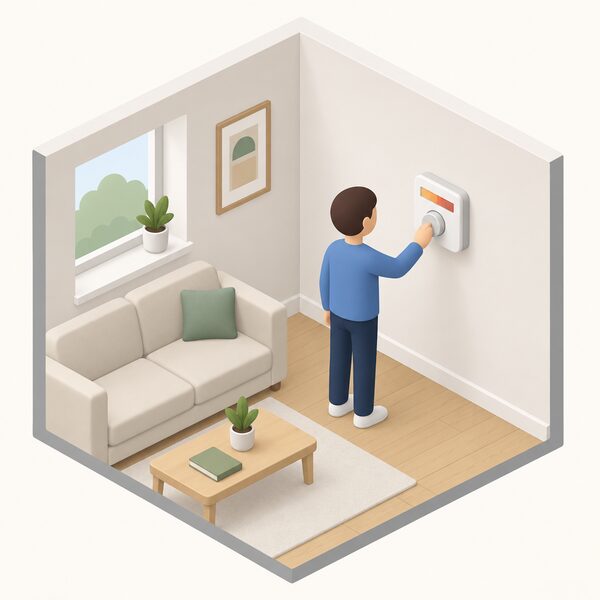
Both the general and low-income groups were eligible for cavity wall insulation including party wall, loft insulation, solid wall insulation, pitched roof, flat roof, under-floor, solid floor, park home and room-in-roof insulation4. Where an eligible insulation measure was installed in owner-occupied premises in the low-income group, certain heating controls such as room thermostats were also allowed as a secondary measure4.
Funding was not uniform. The cost of measures could be partially or fully subsidised, depending on the proposed measure and any property issues20. Higher-cost measures, such as solid wall insulation, were more likely to need a contribution from the household4. That, together with the cost position of solid wall work generally, helps explain why solid wall insulation was only 4 per cent of measures delivered while cavity wall was 38 per cent7.
Funding for measures delivered under the scheme could not be blended with funding from other government schemes or grants, including the Warm Home Discount, Home Upgrade Grant, Boiler Upgrade Scheme, Social Housing Decarbonisation Fund and ECO410. Non-scheme measures had to be installed before or after all scheme measures4. This matters for anyone who combined works: see can ECO4 measures be funded with other government grants and the wider grants and schemes guide.
Separate incentives supported innovative measures that could provide further energy efficiency improvements or offer additional benefits, but only obligated suppliers could apply under the innovation routes; a manufacturer with a new product had to work with an obligated supplier, which liaised with Ofgem and submitted the application9. Award of the innovation uplift was capped at 10 per cent of a supplier's low-income group obligation, and the 5 per cent applicant uplift did not apply under GBIS21. Measures approved under the ECO4 DLM route were not eligible for delivery under GBIS, while ECO4 approved innovation measures could be delivered where GBIS measure type and eligibility requirements were met21.
Standards, installers and who stands behind the work
All measures available under the scheme had to be delivered according to PAS2030/2035 standards, and all installers had to be a TrustMark-registered business with a registration number4. The delivery guidance required work to be carried out in accordance with relevant provisions of PAS 2030:2019, PAS2035:2019, building regulations and any other applicable regulations10. Where a party wall measure was involved, the installer had to obtain the necessary consent from all properties adjacent to the wall before the measure was carried out10.
Ofgem's position on redress is explicit and important for anyone holding a GBIS installation:
"Ofgem does not administer appropriate guarantees or financial protection for measures installed on the Great British Insulation Scheme"
The current list of appropriate guarantees is held on the TrustMark website8. Ofgem sets targets for obligated suppliers, ensures compliance and monitors progress, but has no oversight of contractual arrangements, and says its ability to help resolve a complaint is limited4. Complaints about an installation follow Ofgem's energy company obligation complaints process15. Suspected fraud can be reported through Ofgem's counter fraud route15. There are quality issues with some solid wall insulation fitted through the scheme3. Related reading: do ECO4 installations need a TrustMark registered installer and energy grant scams.
How the nations differ
The scheme applied to England, Scotland and Wales13. Northern Ireland was outside it, and households there rely on separate provision; see home energy grants in Northern Ireland.
| Nation | Position under GBIS |
|---|---|
| England | General group council tax bands A to D, EPC D to G4 |
| Scotland | General group council tax bands A to E, EPC D to G4 |
| Wales | General group council tax bands A to E, EPC D to G4 |
| Northern Ireland | Not covered; scheme applied to England, Scotland and Wales13 |
Building control requirements also vary. In Wales, the guidance is that where a solid wall is upgraded by the installation of insulation it must meet the minimum energy efficiency values set out in the Approved Documents, and where such an upgrade is not technically or functionally feasible the element should be upgraded to the best standard which can be achieved within a simple payback of no greater than 15 years24. Scottish households also have access to separate support: Home Energy Scotland offers loft, cavity and underfloor insulation funding of £500 per improvement as a loan alongside a £1,500 grant per improvement25. That support sits outside GBIS and is covered in home energy grants in Scotland and home energy grants in Wales.
The measures themselves: what cavity, loft and solid wall work involve
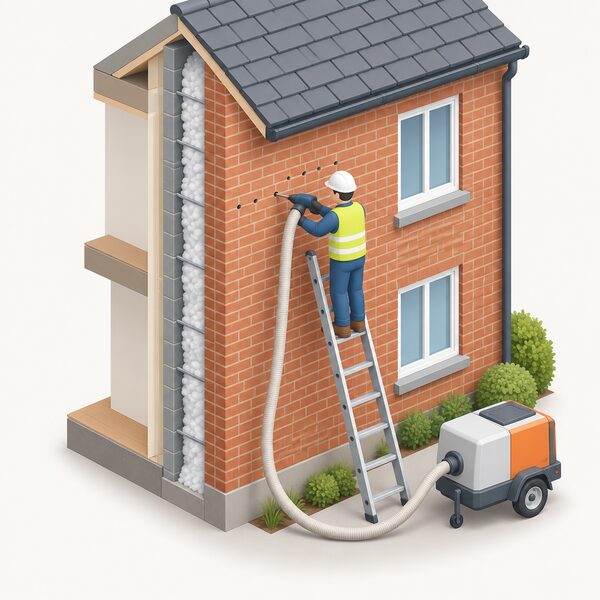
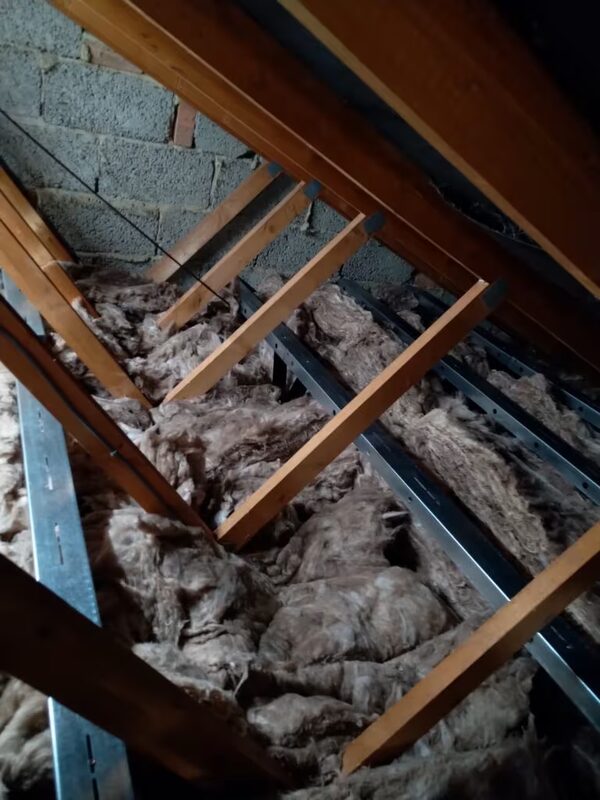
Cavity wall insulation dominated delivery, and the reason is practical. The insulation is blown into the cavity from the outside and disruption to the householder is minimal, in a process that can take just a couple of hours for a typical three-bedroom house26. Cavities that are not insulated can add up to 25 per cent onto a heating bill26. Ofgem's measure definitions distinguish cavity wall insulation by thermal conductivity, at 0.027, 0.033 or 0.040, alongside partial fill and party wall cavity variants, with a U-value target of 0.55 W/m2K; the main materials used are mineral wool (glass or rock wool), EPS bead (polystyrene bead) and PU foam (polyurethane foam)21. A partial fill measure applies where at least 50 per cent of the cavity walls are originally insulated prior to retrospective insulation21. Insulation should go at least 150mm below the damp proof course level27.
Solid walls lose even more heat than cavity walls, and the options are a decorative, weatherproof insulating treatment on the outside of the walls or ready made insulation boards internally28. External insulation thickness needs to be between 50 and 100mm; internal insulation/plaster board laminates are typically up to 90mm in total28. Internal types include ready made insulation/plaster board laminates, wooden battens in-filled with insulation, or flexible linings28. External work is usually installed where there are severe heating problems, or where the exterior requires other repair work providing the opportunity of adding insulation28. Solid wall insulation can be expensive, so the ideal time to do it is when the walls need some other corrective work26. Beyond bills, it helps create a more even temperature in the home, helps prevent condensation on walls and ceilings, and can reduce heat building up inside during summer hot spells28. For planning purposes, the installation of solid wall insulation constitutes an improvement rather than an enlargement or extension to the house29.
Published cost and saving estimates vary and are not official scheme figures. Independent guidance puts cavity wall insulation for a semi-detached house at around £2,700 to install with savings of £240 a year, while another independent estimate for 2026 gives average costs of £1,800 for a mid-terrace rising to £4,600 for a detached house, with annual savings of £200 for a semi-detached gas-heated dwelling and a payback of around 9 to 12 years depending on property type30. A trade body puts savings at up to £610 a year with a maximum of 5 years to repay, and states the measure lasts the lifetime of the property if the property is maintained; these figures are considerably higher than the independent estimates and the two sets are not reconciled32. Disruption for cavity wall work is rated low31. Reputable cavity wall insulation is said to come with a 25-year guarantee, either backed by the Cavity Insulation Guarantee Agency or an equivalent independent insurance-backed scheme31. Householders considering cavity fill are advised in Welsh government guidance to get advice from a qualified retrofit assessor before going further33.
Applying after closure, and what remains

The application process has ended. The service to check eligibility for free or cheaper home insulation has closed, and installations had to be complete by 31 March 2026, when the scheme ended3. Local authority guidance confirms the scheme closed on Tuesday 31 March 2026, with applications having been made online via the GOV.UK portal, or through a participating home energy supplier16. Government guidance to suppliers refers to the ending of funding for both ECO4 and GBIS34.
Where an application was already in train, the route was to contact the energy supplier applied to3. If eligible, the energy supplier arranged an assessment of the property; the household found out after the assessment whether any contribution was needed towards the installation, and could decide not to go ahead if they did not agree with the assessment or the costs3. A helpline operated on 0800 098 7950, Monday to Friday 8am to 6pm and Saturday 9am to 12pm35. Ofgem's scheme enquiries address is GBIS.enquiry@ofgem.gov.uk, and contact details of obligated suppliers are published by Ofgem15.
Households still looking for insulation funding should look to the successor and parallel schemes rather than GBIS: the Warm Homes: Local Grant, ECO4 and VAT relief on energy-saving materials. A comparison of the closed scheme against its successor is at Warm Homes: Local Grant vs Great British Insulation Scheme, and closed schemes generally at closed home energy grants.
What GBIS did, and did not do, for household energy independence
Insulation is the one household measure that reduces demand rather than shifting where energy comes from, and that makes it the foundation of any move towards self-sufficiency. A home with an insulated cavity needs less gas or electricity for the same comfort, permanently and without a control system, an app or a tariff to manage. Cavity wall insulation is stated to last the lifetime of the property if the property is maintained, which is a longer horizon than any heating appliance32. Where uninsulated cavities add up to 25 per cent to a heating bill, closing that gap reduces exposure to every future price movement26.
The limits are real, and they are structural. GBIS was a single measure scheme: one insulation measure per home, with no minimum requirement for the property's SAP rating to improve4. A home with an uninsulated loft, uninsulated walls and a poor floor could only have one of those treated. That leaves most of the fabric untouched and the household still substantially dependent on the grid and on a gas supplier. Delivery of 126,000 measures against a 300,000-household forecast means most eligible homes were never reached6. And the scheme was itself supplier-funded: it was estimated to add £5 to a typical annual dual fuel bill in 2023/24 and £17 in each of the following two years, so the cost of the measures sat on everyone's bills, including those who received nothing7.
Dependence also persisted in the delivery chain. Whether work happened at all rested on an energy company's commercial decision about which retrofit projects to fund4. Redress rests with the installer's TrustMark guarantee rather than with Ofgem, which does not administer guarantees or financial protection and says its ability to resolve complaints is limited4. With reported quality issues on some solid wall insulation fitted through the scheme, the guarantee chain is the only protection a household holds3. Now that the scheme has closed, the fabric measure installed remains an asset; the funding route behind it does not. Further discussion sits on grants, schemes and household energy independence.
Sources35 cited
- Great British Insulation Scheme, Ofgem, 2026-09-17
- ECO4 delivery guidance version 3.2, Ofgem, 2025-12-08
- Apply for support from the Great British Insulation Scheme, GOV.UK, 2026-09-17
- GBIS guidance for homeowners and tenants, Ofgem, 2026-09-17
- ECO4 and GBIS mid-scheme changes: final stage impact assessment, GOV.UK, 2025-04-07
- Select Committee report on retrofit and energy efficiency, UK Parliament, 2026
- Research briefing: Great British Insulation Scheme, House of Commons Library, 2026-09-17
- GBIS information for the supply chain, Ofgem, 2026-09-17
- GBIS information for energy suppliers, Ofgem, 2026-09-17
- Great British Insulation Scheme delivery guidance v1.0, Ofgem, 2023-08-31
- Great British Insulation Scheme government response, DESNZ, 2023-03
- Great British Insulation Scheme release, November 2025, GOV.UK, 2025-11-20
- Great British Insulation Scheme release, September 2025, GOV.UK, 2025-09-18
- Great British Insulation Scheme statistics collection, GOV.UK, 2023-11-30
- GBIS contacts, guidance and resources, Ofgem, 2026-09-17
- Supplier performance report, July to December 2023, Ofgem, 2026-09-17
- ECO4 and GBIS eligibility and pre-installation declaration, Ofgem, 2026-09-17
- What is the Great British Insulation Scheme, Energy Saving Trust, 2026-06-18
- GBIS and ECO4 local authority administration guidance, Ofgem, 2025-04-03
- Energy company obligation schemes for homeowners, Elmhurst Energy, 2026-09-20
- ECO4 new measures and products guidance v3.0, Ofgem, 2026-03-26
- Building regulations for cavity wall insulation, Planning Portal, 2026
- Building regulations: cavity wall insulation, Welsh Government, 2026-09-17
- Building regulations: solid wall insulation, Welsh Government, 2026-09-17
- Grants and loans, Home Energy Scotland, 2026-09-17
- Insulation, nidirect, 2026-09-02
- Thermal resistance of external walls, Planning Portal, 2026
- Solid wall insulation, Planning Portal, 2026
- Permitted development rights for householders: technical guidance, GOV.UK, 2026-09-17
- Great British Insulation Scheme guide, Uswitch, 2026-04-14
- Wall insulation types, Uswitch, 2026-09-04
- Cavity wall insulation, Insulation Assurance Authority, 2026-09-20
- Five top tips from Which? to cut your energy bills, Welsh Government, 2026-03-18
- Domestic energy tariff reductions 2026: guidance for energy suppliers, GOV.UK, 2026-03-18
- ECO4 scheme information, West Lindsey District Council, 2025-07
 Grants and Energy IndependenceCan you get a grant for solar panels or a battery?
 Insulation Savings and PaybackHow much can you really save by adding insulation, and does it depend on your home, your heating and how you use it?
 Home Ventilation SystemsWhy do modern insulated homes need extra ventilation, and what happens if they do not get it?
 The Full Cooling and Air Conditioning GuideDo you really need air conditioning in a British summer, or would a fan and better shading do the job?
 The Full Grants and Schemes GuideWhich grants can you actually get right now, and how do you apply for them?
 Insulation and Glazing CostsTypical installed costs for cavity wall, solid wall, loft and roof insulation, draught-proofing and replacement glazing, by measure and home size, with the savings, VAT position and funding schemes that shape the final bill.