

In this answer
Short answer
ECO4 funding cannot be blended with other government grants. Ofgem's delivery guidance is explicit: "Funding for measures delivered under ECO4 cannot be blended with other government schemes or grants." The same rule appears in the Great British Insulation Scheme rules, and it extends to named schemes including the Warm Home Discount, the Boiler Upgrade Scheme, the Social Housing Decarbonisation Fund and the Home Upgrade Grant1.
The rule bites on the measure, not the household. A home can receive ECO4 work and separately funded work, but the two cannot pay for the same installation, and the non-ECO4 work has to be sequenced around the ECO4 project. Ofgem states that any measures outside ECO4 delivered to the same property must be installed either before the ECO4 retrofit project starts or after the entire project is complete and all measures are installed3.
Timing matters because ECO4 is closing. The scheme runs until 31 December 2026 following a nine-month extension, and all project notifications are subject to an overall scheme deadline of 31 March 20274. Households weighing a second grant against an ECO4 project are working inside a narrowing window.
The short answer: no blending, on any measure
The prohibition is stated in the same terms across the guidance. A supplier cannot partially or wholly fund a measure with funding from other government schemes or grants, which closes off both topping up another scheme's contribution and accepting a top-up from it1. The rule is repeated in the Great British Insulation Scheme rules, where funding for measures delivered under the scheme cannot be blended with funding from other government schemes or grants6.
The named schemes are worth setting out, because households often assume a heat pump grant and an insulation grant can be stacked on one job. Ofgem lists the exclusions as including but not limited to the Warm Home Discount, the Boiler Upgrade Scheme, the Social Housing Decarbonisation Fund and the Home Upgrade Grant3. For the Warm Home Discount the wording is even tighter: ECO and Warm Home Discount funding cannot be combined for any measures1.
Two specific pairings are spelled out. Funding from ECO4 and the Social Housing Decarbonisation Fund cannot be blended for the same measure or be included within an ECO4 project, and the same wording applies to the Boiler Upgrade Scheme1. For the Home Upgrade Grant, funding cannot be blended within the ECO4 package of measures1.
The practical effect is that a household cannot assemble a single installation from two public funding streams. It can hold two separate projects, funded separately, at the same address, provided the sequencing rule is met. The Energy Company Obligation page sets out how supplier funding works in the round, and the ECO4 page covers the scheme itself.
What counts as another government scheme or grant

The category is wider than the four named schemes. The guidance describes the prohibition as covering other government schemes or grants generally, with the named list given as examples rather than a closed set3. ECO4 itself is described by councils as one of the UK Government-backed schemes regulated by Ofgem, which is the frame the rule sits in7.
There is a definitional wrinkle worth knowing. West Lindsey Council states that ECO4 is not a grant scheme, because it is the energy provider's decision which retrofit projects it chooses to fund8. That distinction matters for how the rule reads: ECO4 money is supplier obligation funding, and the prohibition is on blending it with grant funding from public bodies. The legislation behind the scheme supports that reading, requiring that a qualifying action is not funded by a grant made by a public authority or any person distributing funds on behalf of a public authority9.
The Social Housing Decarbonisation Fund guidance takes a slightly different angle, and it is the clearest statement of the principle underneath the ECO4 rule: applicants may use funding from other government schemes, such as the Energy Company Obligation, to support works on the same home, but funding from multiple government schemes cannot fund the same individual measure twice10. That is the same rule seen from the other side. The measure is the unit that cannot be double-funded, not the property.
For households, the useful test is whether the money comes from a public scheme at all. A grant from a council, a devolved administration or a national scheme falls inside the category. Private finance, a household's own savings or a loan do not.
Why the rule exists and who it applies to
The rule exists to stop public money paying twice for one installation. If a boiler or a loft insulation job could draw on ECO4 and a second government scheme, the same measure would be counted against two budgets and two sets of carbon savings, and the household would receive more public support than the scheme intended. The Social Housing Decarbonisation Fund wording, that multiple government schemes cannot fund the same individual measure twice, is the plainest expression of the purpose10.
The obligation falls on suppliers. The guidance is addressed to them: a supplier cannot partially or wholly fund a measure with funding from other government schemes or grants1. That is why the rule is not something a household applies for an exemption from. It is a condition on how the supplier accounts for the measure, and it is enforced through the evidence and eligibility checks that accompany each notification.
Those checks are not trivial. Measures may be notified before the project but will not be able to pass eligibility checks until the associated project has already done so, and measures may be rejected11. Any measures where fraudulent or electronically duplicated signatures are detected will be rejected13. The Great British Insulation Scheme and ECO4 forms are used to collect and provide evidence of measure eligibility, so the funding source for each measure is documented rather than assumed14.
For a household, the consequence is that the funding route for each measure should be settled before work starts. A measure that has already been installed under one scheme cannot later be re-presented under another.
"A supplier cannot partially or wholly fund a measure with funding from other government schemes or grants."
Does the blending rule apply to local authority funding?

It applies to the funding, not to who administers it. ECO4 Flex is the route through which local authorities, and the Scottish and Welsh governments, refer households into the scheme, and it is voluntary for all of them3. Flex exists to use councils' localised and communal knowledge to target consumers who may benefit from the scheme but who may not be captured within its standard eligibility criteria15.
That referral role is not the same as co-funding. A council identifying a household as eligible under Flex is directing it into ECO4, not adding a second public grant to the same measure. Where a council runs its own separate scheme, the two remain separate funding streams, and the same measure cannot be funded twice by government schemes10.
The vulnerable household route shows how councils use Flex in practice. Essex County Council, for example, describes households being identified by the council as a vulnerable household which is not eligible under any other scheme16. Ceredigion notes that councils can voluntarily participate in ECO4 Flex to identify eligible households that are not in receipt of a means tested benefit17. Neither is a funding blend.
The position is the same across Great Britain, since ECO4 Flex operates in England, Scotland and Wales through the same Ofgem rules. Northern Ireland sits outside the Energy Company Obligation entirely, so the blending question does not arise there in the same form. The ECO4 Flex page covers the referral route in detail, and council energy grants covers separately administered local schemes.
What households can do instead of stacking grants
The alternative to stacking is sequencing, and the guidance sets it out directly: any measures outside ECO4 delivered to the same property must be installed either before the ECO4 retrofit project starts or after the entire project is complete and all measures are installed3. That allows a household to use a different scheme for different work, as long as the two projects do not overlap.
The sequencing rule has a practical edge. In-fill measures cannot be transferred until all the in-fill and primary measures are approved, and once verified they can only be transferred as a group18. A project that is part-delivered while a second funding application is live is exposed to that constraint.
For households that do not qualify through the standard route, the options are the eligibility routes rather than additional funding. ECO4 Flex is one. Free and impartial energy advice is another: councils direct residents to speak to an organisation that can offer free and impartial energy and bill saving support and assess whether they might be eligible for funding16. The ECO4 eligibility page sets out the benefit and property conditions, and which benefits qualify covers the means-tested routes.
Where a household wants a heat pump rather than insulation, the Boiler Upgrade Scheme is a separate scheme with its own rules, and it cannot be blended with ECO4 for the same measure1. The comparison page on Boiler Upgrade Scheme vs ECO4 sets out how the two differ.

ECO4 deadlines and what they mean for timing
ECO4 closes to new applicants on 31 December 2026, following a nine-month extension4. All project notifications are subject to an overall scheme deadline of 31 March 2027, and installation extensions cannot allow installation dates beyond 31 December 20265. The scheme must be completed in full no later than 31 December 20261.
The deadlines are layered, and the layers matter for anyone planning a second project around an ECO4 installation.
| Deadline | What it governs |
|---|---|
| 31 December 2026 | ECO4 closes to new applicants; measures must be completed in full1 |
| 31 March 2027 | Overall scheme deadline for all project notifications5 |
| Six months | Deadline for projects containing a district heating connection, instead of the standard three months2 |
The district heating point is a longer window rather than a shorter one: projects containing a district heating connection have a six-month deadline instead of the standard three months2.
For a household, the timing consequence is that a second grant application running alongside an ECO4 project has to fit inside these dates. A measure installed under ECO4 cannot be re-funded later, and a non-ECO4 measure has to be complete before the project starts or after it finishes. The Great British Insulation Scheme is also ending, with funding for both ECO4 and the scheme closing19.
Where the rule leaves a household's energy independence
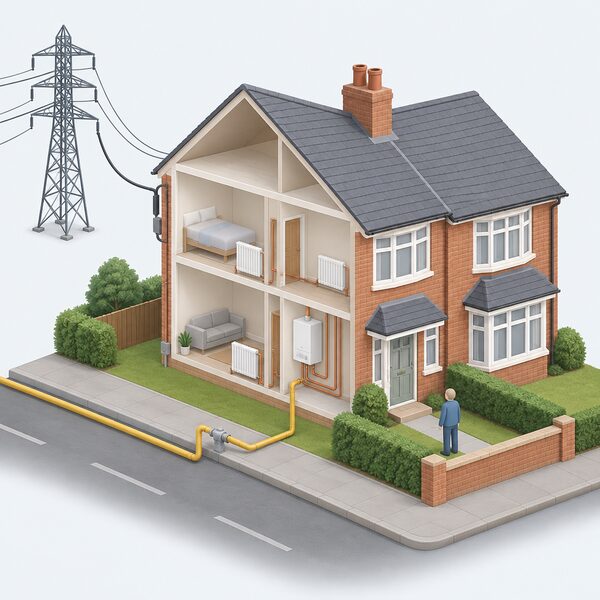
The blending rule is a constraint on public funding, not on what a home can achieve. A property that receives a full ECO4 package still depends on the grid for electricity and, in most cases, on gas for heating, and it still depends on a supplier to deliver the measures in the first place. ECO4 is supplier obligation funding, and the supplier decides which projects to fund8.
What the rule does is prevent a household from assembling a single installation out of two public budgets. It does not prevent a household from doing work in stages, using different schemes for different measures, provided the sequencing condition is met3. That is the realistic route to a deeper retrofit: one funded project at a time, each measure accounted for once.
The dependence that remains is structural. The scheme closes on 31 December 2026, and the support that follows it is a matter for future schemes rather than this one4. Households that want to act inside ECO4 are working to a fixed calendar, and the funding source for each measure has to be settled before the work begins.
Sources19 cited
- ECO4 delivery guidance version 4.0, Ofgem, 2026
- ECO4 delivery guidance v3.2, Ofgem, 2025
- Energy Company Obligation: homeowners and tenants, Ofgem, 2026
- Energy Company Obligation (ECO), Ofgem, 2026
- ECO4 guidance: supplier administration guidance, Ofgem, 2025
- ECO4 and GBIS eligibility and pre-installation declaration, Ofgem, 2026
- Financial help for energy efficiency and low carbon heating, City of Edinburgh Council
- ECO4 scheme, West Lindsey District Council, 2025
- The Electricity and Gas (Energy Company Obligation) Order 2023, legislation.gov.uk, 2023
- Summary: SHDF Wave 3 draft guidance, National Insulation Association, 2024
- ECO4 summary updates document, Ofgem, 2022
- ECO4 Eligibility Requirements Form v1.0, Ofgem, 2022
- ECO4 Scoring Consultation Part 2, Ofgem, 2021
- Great British Insulation Scheme: supply chain, Ofgem, 2026
- ECO4 LA Flex audit report, Ofgem, 2025
- Energy Company Obligation (ECO4), Essex County Council, 2026
- ECO4 Flex and GBIS Flex information document, Ceredigion County Council, 2025
- Domestic Energy Tariff Reductions 2026: guidance for energy suppliers, GOV.UK, 2026
- Great British Insulation Scheme, Ofgem, 2026
 Grants and Energy IndependenceCan you get a grant for solar panels or a battery?
 Why Energy Grants DifferWhere you live in the UK changes which home energy grants you can get.
 ECO4 and GBIS Install FailuresYour home may have insulation fitted under ECO4 or GBIS that was not done properly.
 The Full Heat Pumps GuideWill a heat pump keep my house warm in winter, and what does one cost to buy and run?
 Insulation a Heat Pump NeedsWill a heat pump still work if your home is not well insulated, and would you need to add loft, wall or floor insulation first?
 The Full Grants and Schemes GuideWhich grants can you actually get right now, and how do you apply for them?