

In this answer
Short answer
Scotland's renewable heating target is a provisional figure of at least 22% of heat from renewable sources by 2030, set out in the Heat in Buildings Strategy1. It replaced an earlier target of 11% of non-electrical heat demand from renewable sources by 20202. The 22% figure is a share of heat, not a count of installations, and it sits inside a wider legal framework rather than standing alone.
The binding dates come from climate law. The Climate Change (Emissions Reduction Targets) (Scotland) Act 2019 set legally binding targets for net zero greenhouse gas emissions by 2045, with interim reductions of 75% by 2030 and 90% by 20403. On heating specifically, the Scottish Government states a target to decarbonise heating systems by 2045, so far as reasonably practicable4, and the draft Buildings (Heating and Energy Performance) and Heat Networks (Scotland) Bill carries a heat decarbonisation target to replace direct emission heating systems in all Scottish buildings, as far as reasonably practicable, by 20455.
The nearer deadline is 2030. The Scottish Government's target for heat decarbonisation is a million homes and the equivalent of 50,000 non-domestic properties by 20306, and over one million households are expected to need a low-carbon heating system by 20307. For a household, the practical reading is that the direction of travel is set, the 2030 milestone is a delivery target rather than a legal duty on any individual home, and the 2045 date is the one written into draft legislation.
What the 22% target actually measures
The renewable heat target is expressed as a proportion of heat, which makes it different from a target for installations or for capacity. The Heat in Buildings Strategy set out a provisional target for renewable heat of at least 22% by 20301. The word provisional matters: it is a strategy figure, not a statutory duty, and it is the successor to the 11% target for renewable heat that applied to 20202.
That earlier target was narrower in scope. It measured 11% of non-electrical heat demand from renewable sources by 20202, which excluded electricity used for heating. The 22% figure is not described in the same terms, so the two are not directly comparable, and the documents do not set out a single consistent series across the change.
The legal duty behind the reporting is older than either figure. Section 61 of the Climate Change (Scotland) Act 2009 requires preparation and publication of a plan for the promotion of renewable heat, including a renewable heat target, reviewed at least every two years8. That is why a renewable heat target exists as a standing obligation rather than a one-off announcement, and why the number can be revised without new primary legislation.
Scotland's wider energy strategy adds a broader 2030 target: the equivalent of 50% of the energy for Scotland's heat, transport and electricity consumption to be supplied from renewable sources by 20309. That covers heat alongside transport and electricity, so it is not a renewable heat target on its own, but it frames the same decade.
For a household, the target's shape matters more than its exact value. A share-of-heat target is met by a combination of measures across the whole stock, including heat networks, heat pumps, biomass and, in the strategy's terms, the decarbonisation of the electricity that heats homes. No single home's choice determines whether the target is met, and no single technology is named as the only route.
Who the target applies to
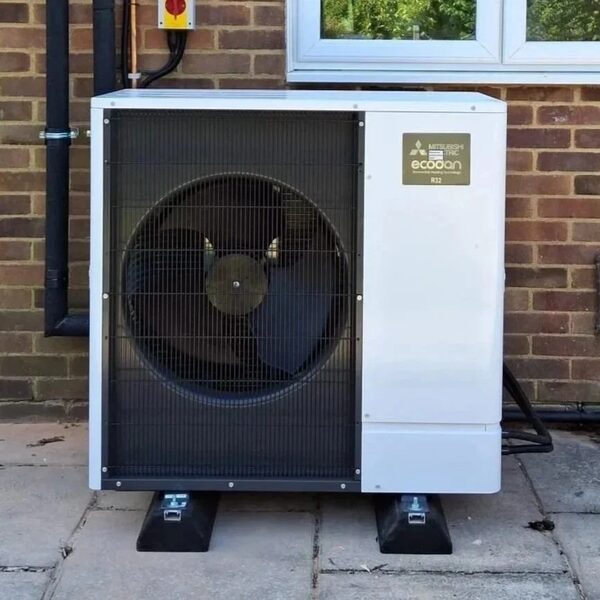
The 2045 heat decarbonisation target is framed for buildings, not for a subset of tenures. The draft Bill sets a target to replace direct emission heating systems in all Scottish buildings, as far as reasonably practicable, by 20455, and the Scottish Government's own statement of the target uses the same all-buildings framing4. That covers owner occupiers, private rented homes and social housing.
The 2030 delivery target is expressed in numbers of properties: a million homes and the equivalent of 50,000 non-domestic properties6. Over one million households are expected to need a low-carbon heating system by 20307, which is the same milestone described from the household side.
Support is narrower than the target. The Home Energy Scotland Grant and Loan Scheme provides grants and loans to all domestic owner-occupiers in Scotland to install clean heat and energy efficiency measures10. That is a defined eligibility group, and it does not by itself extend to tenants or to landlords, whose obligations sit in separate regulation.
The older UK-wide scheme had a different footprint. The Domestic Renewable Heat Incentive covered customers across England, Scotland and Wales who install eligible renewable heating technologies in their homes11, and its territorial extent is given as England, Scotland and Wales12. Northern Ireland sat outside it, which is one reason Scottish support now runs through a devolved scheme rather than a shared one. The split of that scheme's later installations shows how small Scotland's share was: figures for installations are 85.87% in England, 7.52% in Scotland, and 6.53% in Wales13.
Conditions, exceptions and the "reasonably practicable" limit
The phrase that does most work in the 2045 target is "as far as reasonably practicable". The draft Bill's target is to replace direct emission heating systems in all Scottish buildings, as far as reasonably practicable, by 20455, and the Scottish Government's statement of its heat decarbonisation target uses the same qualifier4. That wording leaves room for buildings where replacement is not feasible, and it means the target is not a blanket prohibition with a fixed date for every property.
The emissions targets that sit above it are firmer. The Act set legally binding targets for net zero greenhouse gas emissions by 2045, with interim targets of 75% reduction by 2030 and 90% by 20403. The Committee on Climate Change records the same structure: amendments to the Act in 2019 introduced interim emissions targets to reduce emissions by 75% on 1990 levels by 2030 and a net zero target year of 204514.
Heat networks carry their own conditions. From 2023, only renewable and low or zero emissions heat networks were to be consented15, and the Heat Networks (Scotland) Act 2021 set a target of 6 terawatt hours of heat by 203016. The Scottish Government describes the 2027 and 2030 heat network targets as 3% and 8% respectively of current heat demand17. Those are supply-side conditions on network operators rather than duties on individual homes.
There is also a buildings emissions target that bears on the same stock: the Scottish Government aims to reduce emissions from buildings by 68% by 2030 against a 2020 baseline7. That is a reduction target rather than an installation target, and it is met through a combination of fabric improvement, heating replacement and grid decarbonisation.
"by the end of the year 2045, as far as reasonably practicable, no direct emission heating system is used in any building"
How the target is delivered
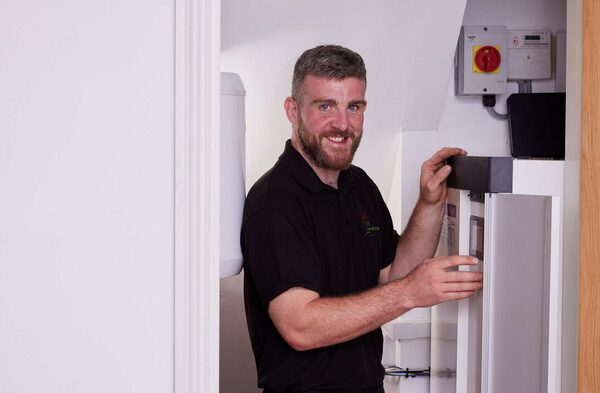
Delivery runs through three routes: regulation, funding and heat networks. On regulation, the draft Bill would place the 2045 heat decarbonisation target in statute5, and the Scottish Government has published its intention to decarbonise heating systems by 2045 so far as reasonably practicable4. Building standards work sits alongside that, with proposed changes to energy standards consulted on separately16.
On funding, the Home Energy Scotland Grant and Loan Scheme is the main domestic route, offering grants and loans to all domestic owner-occupiers in Scotland for clean heat and energy efficiency measures10. The Scottish Government's response to the Green Heat Finance Taskforce set out the 2045 target as the frame for that finance4.
On heat networks, the Heat Networks (Scotland) Act 2021 set a target of 6 terawatt hours of heat by 203016, with the 2027 and 2030 milestones described as 3% and 8% of current heat demand17. Consenting from 2023 was restricted to renewable and low or zero emissions networks15.
The scale of the task is visible in the wider numbers. Scotland has committed to reaching net zero by 204518, and the Scottish Government describes its climate change targets as reaching net zero five years before the UK targets19. The Committee on Climate Change has published its own assessment of progress in reducing emissions in Scotland20, which is the independent check on whether delivery matches the targets.
For a household, the delivery routes determine what is available rather than what is required. Grant funding is the practical lever, heat networks matter only where a network exists or is planned, and the 2045 target sets the direction for replacement decisions taken over the next two decades.
Where the target sits against fuel poverty
The heating targets sit alongside a separate set of statutory goals on affordability. Scotland's fuel poverty targets are that in 2040 no more than 5% of households are fuel poor, no more than 1% are in extreme fuel poverty, and the fuel poverty gap is no more than £250 in 2015 prices21. Those are defined in section 3 of the Fuel Poverty (Targets, Definition and Strategy) (Scotland) Act22.
The definition is specific: fuel costs more than 10% of adjusted net income after housing costs, and the remaining income must be insufficient to maintain an acceptable standard of living, at least 90% of the UK Minimum Income Standard22. That means a household can be fuel poor on any heating fuel, including a low-carbon one.
The two agendas interact. The Scottish Government's fuel poverty scenario modelling for the October to December 2026 price cap period estimates around 820,000 fuel poor households, 32%, and around 440,000 in extreme fuel poverty, 17%, each up around 20,000 households on the previous quarter23. Scottish House Condition Survey local authority tables for 2022 to 2024 show fuel poverty rates ranging from 22% in Stirling to 51% in Orkney Islands against a Scotland average of 31%22.
That matters for how the renewable heat target is read. A target for the share of heat from renewable sources is met by changing systems; a fuel poverty target is met by changing what those systems cost to run. The documents set both, and neither is expressed as a condition of the other.
Sources23 cited
- Delivering Net Zero for Scotland's Buildings: Heat in Buildings Bill consultation, Scottish Government, 2023-11-28
- Update to the Renewable Heat Target and Action, Scottish Government, 2020
- Heat in Buildings Strategy: Achieving Net Zero Emissions in Scotland's Buildings, Scottish Government, 2021-10
- Scottish Government Response to the Green Heat Finance Taskforce, Scottish Government, 2025-12-17
- Draft Buildings (Heating and Energy Performance) and Heat Networks (Scotland) Bill, Scottish Government, 2025-11-18
- Heat in Buildings Strategy: Quality Assurance Policy Statement, Scottish Government, 2022-06
- Heat in Buildings: Scotland's National Public Energy Agency consultation, Scottish Government, 2021-11-30
- Changing the Way Heat is Supplied to Homes and Buildings: BRIA, Scottish Government, 2023-11-28
- Scottish Energy Strategy: Future Energy Scotland, Scottish Government, 2021-02-26
- Heat in Buildings Progress Report 2024, Scottish Government, 2024-10-10
- Domestic Renewable Heat Incentive Quarterly Report Issue 32, Ofgem, 2022-05-31
- Domestic RHI Essential Guide, Ofgem, 2022-03
- Feed-in Tariffs Quarterly Report Issue 64, Ofgem, 2026-06-29
- Scotland's Carbon Budgets, Climate Change Committee, 2025-05-21
- Draft Heat in Buildings Strategy consultation, Scottish Government, 2021-02
- Scottish Building Regulations: Proposed Changes to Energy Standards, Scottish Government, 2021-07-23
- Heat Networks Delivery Plan, Scottish Government, 2022-03
- Scotland's Climate Change Plan 2026-2040, Scottish Government, 2025-11-06
- Scotland's Climate Change Policy, Scottish Government, 2026-09-17
- Progress in Reducing Emissions in Scotland 2025, Climate Change Committee, 2026-02-25
- Heat in Buildings Strategy: Strategic Environmental Assessment, Scottish Government, 2021-02-26
- Scottish House Condition Survey Local Authority Tables 2022-2024: Fuel Poverty, Scottish Government, 2026-05-26
- Fuel Poverty Scenario Modelling Based on Ofgem Energy Price Caps to October to December 2026, Scottish Government, 2026-09-02
 Climate TargetsScotland aims to stop adding greenhouse gases by 2045, five years before the rest of the UK.
 Wales Renewable Energy TargetsWales aims for renewable sources to meet the equivalent of 70% of its electricity consumption by 2030 and 100% by 2035, with at least 1.5 GW locally owned by 2035.
 Energy Policy in ScotlandWho decides how your home in Scotland is heated and improved?
 New Build Heat StandardScotland's New Build Heat Standard means gas and oil boilers are no longer allowed in new homes from April.
 Home Energy Planning ScotlandDo you need planning permission for solar panels or a heat pump in Scotland?
 Home HeatingMost Scottish homes are heated by mains gas, so what happens to the rest?