

In this answer
Short answer
In 2025, the hottest year on record, 85 per cent of residents reported experiencing indoor overheating, with 86 per cent reported specifically in London1. That is the single most direct answer to how many London homes overheat: on the capital's own evidence, the overwhelming majority of households experienced it, and the figure sits at the top of a national range rather than apart from it.
The count is not a survey of thermometers. It is residents reporting what their homes felt like, gathered through the London Assembly's Planning and Regeneration Committee call for evidence on whether London's homes are ready for a heatwave1. The prevalence of overheating in Greater London dwellings is at least two times higher than in some other regions, and London has set its own overheating policy since 2008, prior to the introduction of Part O1.
The headline figure: 86 per cent of London residents report indoor overheating
The 86 per cent figure comes from polling carried out in 2025, the hottest year on record, when between 85 and 87 per cent of residents reported experiencing indoor overheating1. Nationally the same polling put the figure at 85 per cent, so London runs a single percentage point above the UK as a whole on self-reported experience1. Where London separates sharply is in concern and in the concentration of the problem: 45 per cent of London residents say they are very or fairly concerned about their homes overheating over the next five years, compared with 38 per cent nationally1.
The problem is not confined to housing. Evidence indicates that 93 per cent of schools in London report overheating as a significant issue1. That matters for households because it shows the condition is structural across the capital's building stock, not a quirk of a few poorly oriented flats.
Reported overheating is remarkably even across dwelling types in London: flats 88 per cent, detached houses 88 per cent, semi-detached 88 per cent, terraces 87 per cent and bungalows 85 per cent1. The spread is five percentage points from top to bottom, which undercuts the assumption that this is a flats-only problem. A household in a detached London house is about as likely to report overheating as one in a flat.
"In 2025, the hottest year on record, between 85 per cent and 87 per cent of residents reported experiencing indoor overheating, with 86 per cent reported specifically in London"

How the 4.5 million overheating homes figure is counted
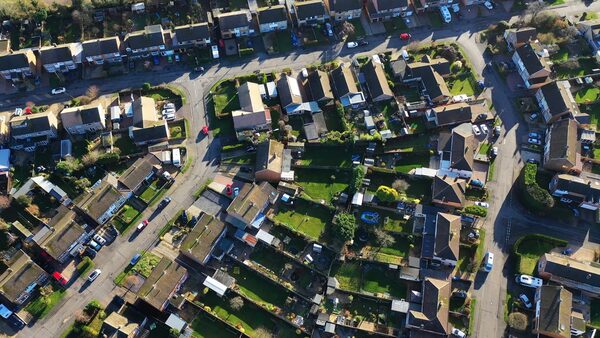
The 4.5 million figure is a national count, not a London one, and it comes from the Climate Change Committee: around 4.5 million homes overheat, even in cool summers4. A separate estimate puts 4.6 million homes in the UK as currently affected by overheating5. The two are close enough to be describing the same phenomenon with slightly different methods, and both are counts of homes rather than of people or of days.
The counting has moved on since. Occupied dwellings in England reporting overheating rose from an estimated 1.7 million to 3 million dwellings between 2019 and 20246. That is the most recent official count of its kind, and the 4.5 million and 4.6 million figures predate it.
Counting is difficult because there is no single instrument reading. The Climate Change Committee's work on the risks to housing from overheating uses data from the English House Survey to assess the profile of English dwellings at risk7. Around 122,000 dwellings are at risk owing to a variety of factors7. That is a much smaller number than the millions above, and the difference is one of definition: risk assessed from dwelling characteristics is narrower than residents reporting discomfort.
Why London overheats more than the rest of the UK
Overheating was modelled to be more prevalent in certain parts of the country such as the south of England and London8. The London Assembly's evidence puts a figure on the gap: the prevalence of overheating in Greater London dwellings is at least two times higher than in some other regions1. London has also had its own overheating policy since 2008, prior to the introduction of Part O, which means the capital has been assessing and designing for the problem for longer than the rest of the country1.
Air conditioning ownership is part of the picture. Approximately 32 per cent of London households report owning air conditioning, around three times higher than in several other UK regions1. That is a marker of both affluence and of how acute the discomfort has become: households do not buy cooling equipment in regions where the problem is mild.
There is also a communication gap. In London, approximately one quarter of residents, around 2.2 to 2.3 million people, are not effectively reached by heat risk communication1. A household that does not receive the warning cannot act on it, and that sits alongside the 44 per cent of Brits who feel they lack the basic control needed to stop their homes overheating9.
What counts as overheating in a home

The statutory reference point is Part O of the Building Regulations, which governs overheating in new homes. A high proportion of existing homes fail to meet the new overheating standard for new homes10. The Climate Change Committee's earlier assessment was blunter: the majority of existing UK homes are estimated to fail the current standard used in the buildings regulations to limit overheating in new build homes8.
The projections show how far the stock is from compliance. Under a warming scenario, 90 per cent of UK homes will overheat, and in a hotter scenario all UK homes will overheat3. Hotter heatwaves could see 92 per cent of existing homes overheat, creating dangerous conditions for vulnerable people11.
The historical trend is steep. Reports of overheating rose from 18 per cent of households in 2011 to 80 per cent in 202212. Another series puts the proportion of UK homes experiencing overheating as soaring from 18 per cent in 2011 to 80 per cent today13. Survey evidence shows the proportion of households reporting heat discomfort rose from 20 per cent in 2011 to around 80 per cent during the 2022 heatwave1.
| Measure | Figure | Period | Source |
|---|---|---|---|
| UK homes overheating, normal summer conditions | 20 per cent | 2026 | 14 |
| UK homes overheating, relatively cool summers | 55 per cent | 2026 | 2 |
| UK homes overheating | 80 per cent | 2022 | 12 |
| UK homes at risk of overheating | Half | 2025 | 3 |
| UK homes overheating, warming scenario | 90 per cent | 2025 projection | 3 |
| UK homes overheating, hotter scenario | All | 2025 projection | 3 |
The definitional spread explains why the numbers differ so widely. A count of homes at risk from dwelling characteristics, a count of residents reporting discomfort, and a count of homes failing a modelling standard are three different measurements. The 20 per cent figure for normal summer conditions and the 80 per cent figure for 2022 are not in conflict; they measure different things in different years12.
Why London flats overheat more than houses
Dwelling type does shape risk, though the London polling shows it is a weaker factor than expected. There is a greater overheating risk in certain types of dwellings, such as flats and mid-terraced houses, as well as rooms that face south or west15. Orientation and floor level matter as much as building form.
The English Housing Survey breakdown of the 3 million overheating dwellings in England gives the construction picture: 2 million are constructed with cavity masonry walls, 667,000 have solid masonry walls, and 309,000 dwellings have other less common wall types6. Wall construction affects how much heat a dwelling retains overnight, which is when overheating becomes a health problem rather than a comfort one.
The new-build pipeline compounds it. There is now a high likelihood that more than 300,000 homes due to be built each year across the UK will have the risk of overheating locked in16. A household buying a new home is not automatically buying a cool one.
Is overheating only a problem in heatwaves?
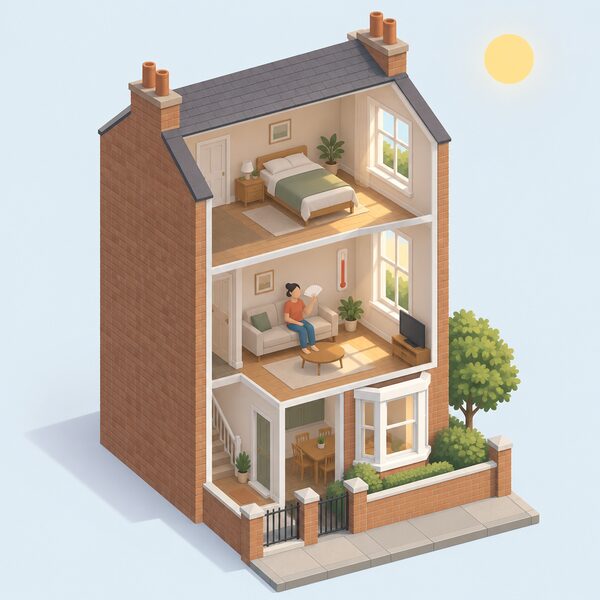
No, and the evidence is consistent on this. Around 20 per cent of homes in England already overheat in normal summer conditions17. Around 20 per cent overheat even in cool summers18. The Climate Change Committee's 2019 finding was that around 4.5 million homes overheat, even in cool summers4. The qualifier "even in cool summers" appears repeatedly because it is the point: this is not a heatwave phenomenon.
The 2022 heatwave pushed reporting to around 80 per cent of households1. That is a heatwave figure, and it sits far above the baseline. The distinction matters for a household deciding whether to act: a home that is uncomfortable in an ordinary July is a different case from one that becomes unbearable only in an exceptional August.
There is a compounding factor that receives less attention. About 395,000 homes experienced both getting uncomfortably hot and an inability to keep warm in the winter6. That is the same dwelling failing at both ends of the year, and it is the hardest case to remedy because the fabric is doing neither job well.
What overheating means for energy independence
Overheating is where a household's independence is most obviously incomplete. A home that overheats in summer and cannot be kept warm in winter is dependent on bought energy at both ends of the year, and the 395,000 homes in that position are the clearest illustration6. Cooling adds a summer load on top of a winter one.
The cost shows up directly. In 2025, 18 per cent of London residents reported noticeably higher energy bills as a result of trying to keep their homes cool, and 56 per cent reported that hot weather had cost their household money1. Cooling is not free, and it arrives in the season when a household may already be carrying higher standing charges.
The control gap is the deeper issue. New research by Citizens Advice finds nearly half (44%) of Brits feel they lack the basic control needed to stop their homes overheating9. A household that cannot control its indoor temperature is dependent on whatever the building fabric, the orientation and the weather decide, and on any cooling equipment it can afford to run.
"New research by Citizens Advice finds nearly half (44%) of Brits feel they lack the basic control needed to stop their homes overheating"
The routes to more control are the subject of the rest of this lane. Passive measures come first in most guidance: passive cooling covers shading, ventilation and the building-level changes that reduce heat gain without adding a running cost, and external shading, shutters and awnings and night ventilation are the two most direct applications. Where mechanical cooling is needed, air conditioning in flats sets out the lease and consent constraints that apply to the dwelling type most associated with the problem, and cooling and energy independence looks at what running costs and supply arrangements mean for a household's exposure. The wider context sits in the home cooling pillar.
Sources18 cited
- Planning and Regeneration Committee: Are London's homes ready for a heatwave?, London Assembly, June 2026
- Is air conditioning worth it in the UK?, Uswitch, 14 July 2026
- Energy in buildings: heat and buildings, Department for Energy Security and Net Zero, 2025
- UK homes unfit for the challenges of climate change, CCC says, Climate Change Committee, 21 February 2019
- Electrification of heat, BEAMA, October 2021
- How well do homes in England cope with extreme weather, Nesta, 9 July 2026
- The risks to housing from overheating, Climate Change Committee, 27 November 2017
- Deepening our understanding of summertime overheating in homes, Climate Change Committee, 4 October 2022
- Nearly half of Brits feel they lack basic control to stop homes overheating, Citizens Advice, 6 August 2026
- Addressing overheating risk in existing UK homes (Arup), Climate Change Committee, 19 September 2026
- Progress in reducing emissions: 2026 report to Parliament, Climate Change Committee, 2026
- Overheating in UK homes: why summer comfort can no longer be ignored, Elmhurst Energy, 16 June 2026
- Fuel poverty doesn't end in winter, it's a summer crisis too, National Energy Action, 31 August 2025
- How can we adapt our buildings to climate change, UK Green Building Council, 24 June 2026
- Considering summertime overheating in highly insulated homes, Welsh Government, January 2024
- We don't live in a cold country anymore, BESA, 1 July 2021
- Hidden problem: overheating, Climate Change Committee, 8 August 2017
- UK homes shockingly unprepared for climate change, says CCC, Carbon Brief, 21 February 2019
 Overheating and Hot WeatherIs your home getting uncomfortably hot in summer, and is there anything you can do about it?
 UK Cooling DemandPublished data on air conditioning ownership and home overheating, with projections for summer temperatures in each UK nation, and what rising cooling demand means for summer electricity use.
 How a Home Loses HeatWhere does most heat actually escape from a UK home, and does it change with the age or type of house?
 Overheating and Solar GainWhy do well-insulated homes get too hot in summer, and which windows cause the worst solar gain?
 Heatwaves and HealthWhich homes get dangerously hot in a heatwave, and which rooms?
 Which Homes Suit a Heat PumpMost UK homes can have a heat pump fitted, so the real question is whether yours makes it easy or expensive.