In this guide
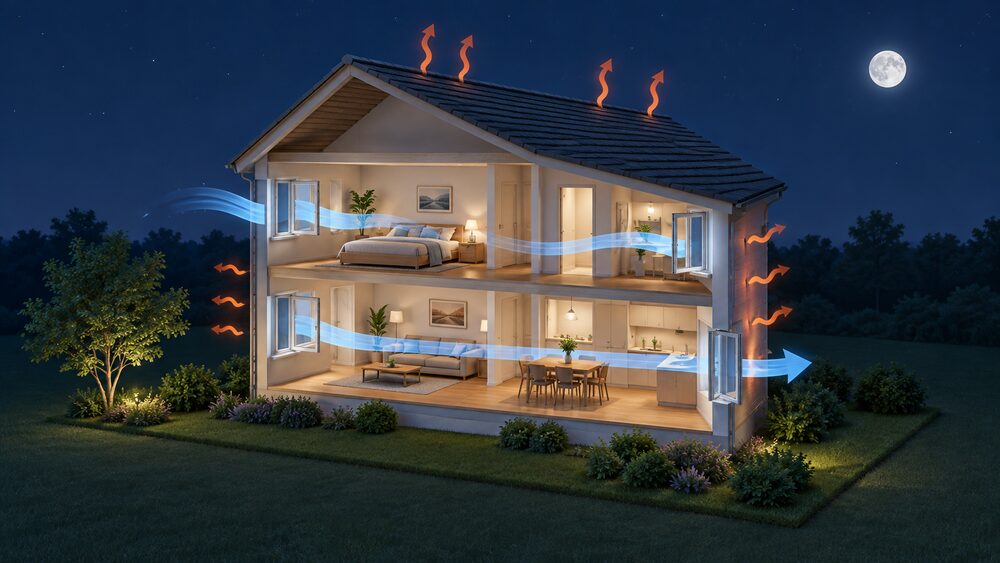
Night ventilation is the practice of flushing a home with cooler outdoor air after dark, and purge cooling is the high-rate version of it: opening windows or doors wide to shift a large volume of air in a short time. The two are the same physical mechanism at different rates. Typical background ventilation in UK dwellings is approximately 0.5 air changes per hour, while purge ventilation is considered to be at least 4 ach1. Approved Document F sets the purge requirement at a minimum of four air changes per hour per room directly to outside2.
The cooling that can be delivered scales with that rate. At 0.5 ach the modelled cooling capacity at night is 300 W; at 4 ach it is 2400 W1. That is the whole case for night ventilation in one comparison: the same building, the same night air, roughly eight times the cooling when the air change rate is raised from background to purge.
What night ventilation does for a household's energy independence is real but partial. It cools without a compressor, without refrigerant, without an outdoor unit and without adding to summer electricity demand. What it cannot do is guarantee a temperature difference: it depends on the outdoor air being cooler than the indoor air, on the home having openings that can be used safely, and on the household accepting open windows or investing in mechanical ventilation. Where those conditions fail, the fallback is a powered system, and the dependence returns.
What night ventilation and purge cooling are
Ventilation is not the same thing as air infiltration. Ventilation is deliberate air movement; infiltration is the unplanned movement of air through gaps in the building fabric, which is what most people call draughts5. Night ventilation is deliberate ventilation timed to the hours when outdoor air is coolest. Purge ventilation is deliberate ventilation at a high rate for a short period.
The distinction matters because the two are governed differently. Purge ventilation removes high concentrations of pollutants and water vapour, is used intermittently and is required only occasionally, for example to remove fumes from painting, and it can be delivered simply by opening windows or doors6. It is not a continuous service and it is not designed as a cooling system, but in summer the same wide opening that clears fumes also clears heat.
Approved Document F Volume 1, in its consultation version, describes the requirement in terms of rooms: purge ventilation should be capable of extracting a minimum of four air changes per hour per room directly to outside2. The phrase "directly to outside" is the operative one. Air moved between rooms, or through a corridor, does not satisfy it. A single-aspect flat with one opening wall can still meet the rate if that opening is large enough, but it has no cross ventilation to help.
The Building Engineering Services Association frames purge ventilation as one of the ventilation duties a home has, alongside background ventilation and the extraction of moisture and pollutants from wet rooms6. Background ventilation is the low, continuous rate that keeps air fresh; purge is the high, occasional rate that clears a load. Night cooling sits between them, using the background or purge opening at a time of day chosen for temperature rather than for air quality.
| Ventilation duty | Typical rate | When it runs | What it is for |
|---|---|---|---|
| Background | approximately 0.5 ach1 | continuously | fresh air, moisture control |
| Night cooling | between the two, set by the opening | after dark, while outdoor air is cooler | discharging stored heat |
| Purge | at least 4 ach1, minimum four air changes per hour per room directly to outside2 | intermittently, for short periods | pollutants, water vapour, fumes |

Why night air can cool a home that stays hot by day
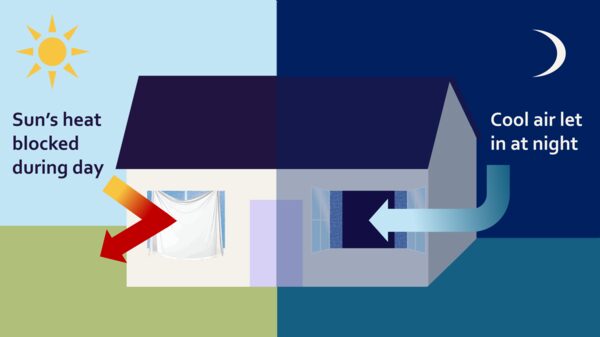
A home that stays hot into the evening is holding heat in its structure. Walls, floors and internal partitions absorb heat through the day and release it after the sun has gone, which is why the indoor temperature often peaks in the late evening rather than at midday. Night ventilation works on that stored heat: cool outdoor air passing over warm surfaces takes heat away by convection, and the building fabric is discharged overnight rather than carrying the load into the next day.
The fabric itself affects how much heat there is to remove. Solid wall insulation helps create a more even temperature in a home, helps prevent condensation on walls and ceilings, and can reduce the amount of heat building up inside during summer hot spells7. Loft insulation keeps a home cool by reducing the amount of heat entering through the roof8. Neither is a cooling system, but both reduce the heat load that night ventilation then has to clear.
Thermal mass is the other half of the mechanism, and it is why the air change rate matters so much. A heavy building can absorb a large quantity of heat, but it can only release it to air that is actually moving past it. At 0.5 ach the modelled cooling capacity is 300 W; at 4 ach it is 2400 W1. The building has not changed between those two figures. Only the rate at which cool air is supplied has changed.
There is a limit to how far this can be pushed. Doubling the ventilation rate to 1 ach would be very unusual for a typical mechanical system, so the high rates that deliver real night cooling come from openings rather than from mechanical ventilation running at its normal duty1. That is the practical reason night ventilation is a window-and-door strategy first, and a mechanical strategy second.
When night ventilation works: climate and UK conditions
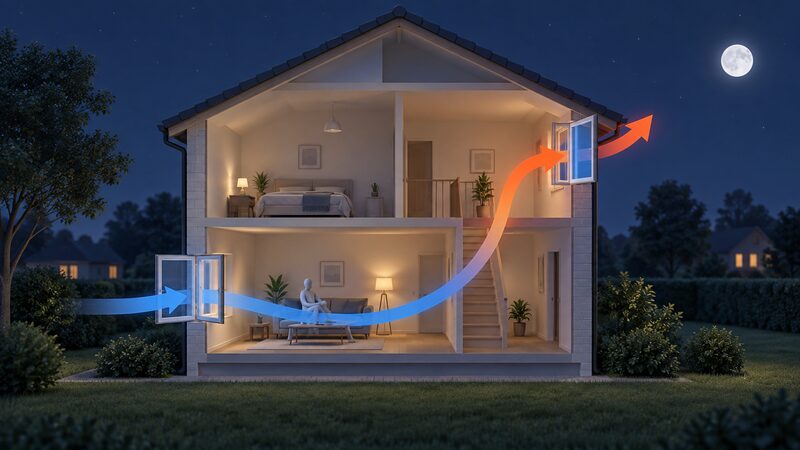
The controlling condition is a temperature difference. The recommended practice is to open windows and doors only when it is colder outside than it is inside, to close them when the temperature rises, and to open windows on opposite sides of the house where possible8. That last point is cross ventilation: an inlet and an outlet on different faces of the building, so that air is driven through rather than merely admitted.
In the UK the difference is usually available at night for much of the summer, which is why the measure has traction here despite a temperate climate. Evidence from the UK government's Warm Homes Plan, cited in a London Assembly call for evidence, shows that combining external shading with night-time ventilation can eliminate overheating risk in some homes, reducing indoor temperatures by 11 to 18°C3. That figure is a modelled outcome for some homes rather than a universal expectation, and it reflects shading and ventilation together rather than ventilation alone.
The regulatory framework increasingly assumes night ventilation is available. The Building Research Establishment's overheating guidance lists the provision of appropriate means for purge ventilation at night as a remedial action for single-aspect dwellings, for highly insulated and relatively airtight dwellings, and for dwellings with inadequate or inappropriate ventilation provision1. In other words, the three dwelling types most prone to overheating are the three for which night purge is the prescribed remedy.
Approved Document O's guidance goes further and treats mechanical night cooling as compatible with a natural ventilation strategy: a home can still be considered predominantly naturally ventilated where mechanical ventilation is provided for cooling at night9. That matters for compliance and for how a home is classified, and it means a fan-assisted night purge does not turn a naturally ventilated dwelling into a mechanically ventilated one.
Security, noise and pollution: the limits of open windows
Open windows are the cheapest night ventilation and the most compromised. Three constraints apply, and they are not solved by opening wider.
- Security. Approved Document F is explicit: windows locked on the night latch do not provide a sufficiently secure means of background ventilation10. A night-latched window is therefore not an accepted continuous ventilation route, which is why the same document treats trickle ventilators as the secure alternative. Trickle ventilators allow constant ventilation while a window is closed and locked, and their installation footprint does not enable intrusion into a property11.
- Noise. Trickle ventilators provide ventilation without the need to open windows, reducing noise levels as a consequence, and acoustic options are available in noisier locations11. Where glazing is being replaced anyway, double or triple glazing can reduce the passage of sound, and glass sealed units with enhanced acoustic options are available to reduce noise further12. A rooflight can also serve a room for both rapid and background venting, which moves the opening away from a noisy frontage13.
- Pollution and air quality. Air filtration is commonly built into MVHR systems to prevent pollen and other particles from entering the home6. A window cannot filter what it admits. For a home on a busy road, the trade is between free cooling and filtered air, and the two are not available from the same opening.
Automated vs manual: trickle vents, window controls and fans
The manual version of night ventilation is a household routine: open at dusk, close at dawn, and open on opposite sides where the layout allows. The automated version replaces the routine with hardware, and the hardware divides into background ventilators, mechanical extract, and full heat recovery systems.
Trickle vents are the simplest element. They sit at the top of windows and can be adjusted by cords, rods or by hand, and they provide effective background ventilation, contributing to a healthy living environment by enabling unobtrusive and controllable whole-room ventilation11. They can still operate at night and while the household is away on holiday, which is precisely the property that makes them useful for night cooling when nobody is awake to open a window11. Their limitation is rate: they deliver background ventilation, not purge.
Where a home needs more than background, decentralised mechanical extract ventilation uses extractor-like fans that run continuously, providing constant low levels of ventilation which increase when the system senses high humidity; these are more effective at regulating indoor air quality than basic extractor fans and cheaper than centralised mechanical ventilation5. They are not a night cooling device, but they keep air moving when windows are shut.
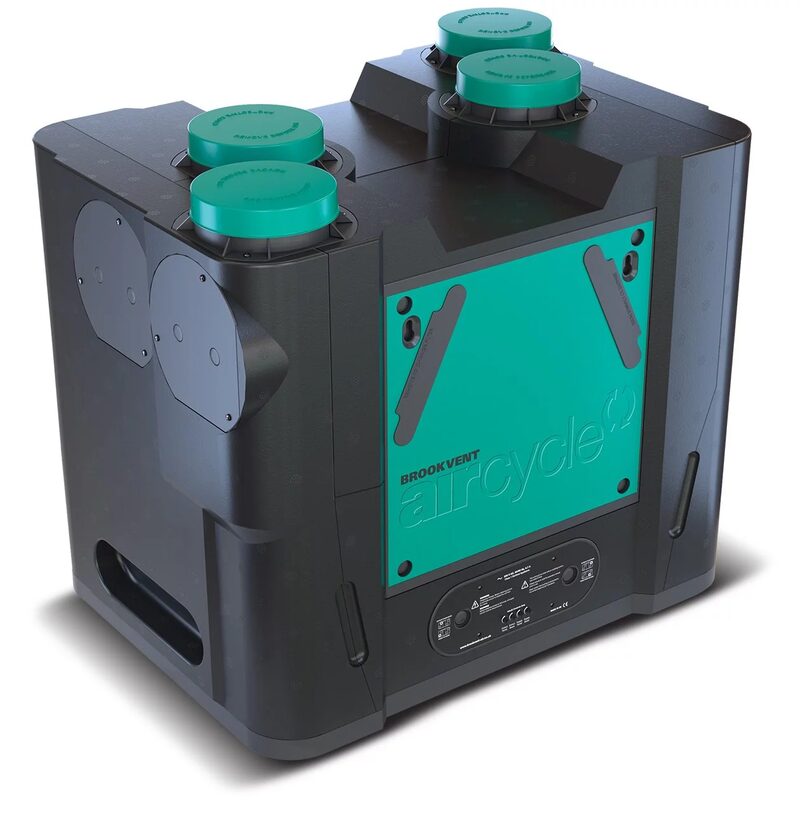
Full mechanical ventilation with heat recovery is the most capable option and the most expensive. It draws air out of warm, moist rooms such as kitchens and bathrooms, transfers heat from the exhaust air to incoming fresh filtered air in a heat exchanger, and blows pre-warmed fresh air into habitable rooms such as living rooms and bedrooms15. That heat transfer is a winter benefit and a summer obstacle, which is what summer bypass exists to address: the incoming air is routed around the heat exchanger so that cool night air is not pre-warmed before it reaches the room.
| Option | What it delivers | What it costs | Night cooling role |
|---|---|---|---|
| Trickle vents | background ventilation, window shut and locked11 | fitted with the window; installer-quoted | keeps air moving overnight without an open window |
| Decentralised mechanical extract | constant low ventilation, boosted by humidity sensing5 | from £600 per fan16 | air movement with windows shut |
| MVHR with summer bypass | heat recovery in winter, bypassed intake in summer15 | from around £3,000, potentially over £10,00016 | brings cool night air in without pre-warming it |
How much cooling night ventilation can deliver
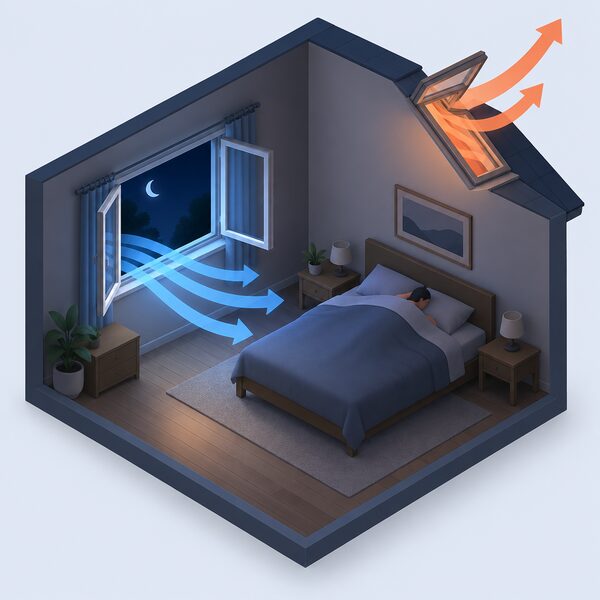
The headline figures come from the same modelling that sets the ventilation rates. At 0.5 ach, the cooling capacity at night is 300 W. At 4 ach, the cooling capacity is 2400 W1. Both are modelled capacities rather than measured outputs in a specific home, and the difference between them is the difference between a trickle vent and a wide-open window.
For scale, a split air conditioning outdoor unit in the Daikin Multi+ range is listed with a cooling capacity of 5.2 to 9.0 kW17. That is 5,200 to 9,000 W, so a full purge at 4 ach delivers roughly a quarter to a half of what a small multi-split provides, and a background rate of 0.5 ach delivers a small fraction of it. Night ventilation is not a substitute for a powered system in a heavily overheating room; it is a way of removing the day's accumulated heat so that the powered system has less to do, or is not needed at all.
The rate achieved in practice depends on the openings. A single window in a single-aspect room gives an inlet and no proper outlet, so the air change rate is well below what a cross-ventilated room achieves. Two openings on opposite faces, or a window and a rooflight, allow the stack and wind effects to work together. This is why the overheating guidance treats single-aspect dwellings as a category needing specific remedial provision rather than assuming they can ventilate adequately by default1.
The cooling is also time-limited. Night ventilation discharges stored heat; it does not create a reservoir of cold. Once the outdoor temperature rises above the indoor temperature in the morning, further ventilation adds heat rather than removing it, which is why the recommended practice is to close windows when the temperature rises8. A home that is ventilated all day in a heatwave is being warmed, not cooled.
Combining night cooling with shading and thermal mass
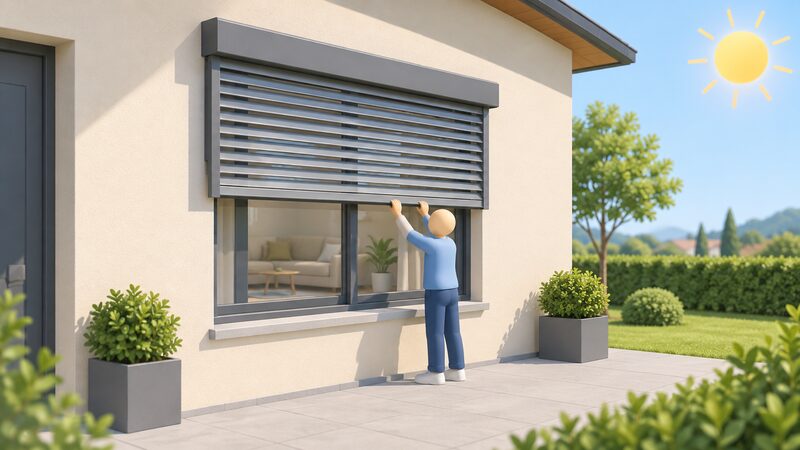
Night ventilation performs best as one part of a set of measures, and the evidence for the combination is stronger than the evidence for any single measure. The Warm Homes Plan evidence cited by the London Assembly credits external shading combined with night-time ventilation with eliminating overheating risk in some homes and reducing indoor temperatures by 11 to 18°C3. Shading keeps the heat out during the day; ventilation removes what got in.
Thermal mass is what makes the night purge worth doing. A lightweight building with little mass has little heat to discharge, so the cooling effect is small and short-lived. A heavy building holds more heat but releases it slowly, which is why the air change rate has to be high enough to strip that heat overnight. The 300 W and 2400 W figures are the same building at two rates, and they show how much of the outcome is controlled by the opening rather than by the structure1.
Other fabric measures reduce the load that night ventilation has to clear. Solid wall insulation helps create a more even temperature and can reduce the amount of heat building up inside during summer hot spells7. Loft insulation keeps a home cool by reducing heat entering through the roof8. Conservatories behave differently: they act as a buffer, and the guidance is that they should be closed off at night and on cold days so that the buffer works as intended rather than leaking heat back into the house18. Natural ventilation in a conservatory, through trickle ventilators, top opening windows or roof vents, is far more economical and environmentally friendly than air conditioning19.
Costs, running costs and maintenance
Night ventilation by opening windows has no purchase cost and no running cost. The costs arise when the openings are not adequate, or when the household cannot use them.
Trickle vents are fitted as part of a window, and their cost is not published separately; window prices are installer-quoted. Mechanical ventilation is priced. For decentralised MVHR systems, prices start from £600 per fan, and for MVHR systems they start from around £3,000 but could cost well over £10,00016. Those are supply figures before installation, and the range is wide because ducted whole-house systems require routing through the fabric.
The running cost of mechanical ventilation is not published as a standalone figure, but the heating benefit is: MVHR reduces household heating costs by 10 to 30%16. That is a winter return on a summer-capable system, and it is the main financial argument for the ducted option. A summer bypass adds cooling capability to a system bought largely for its heat recovery.
For comparison, the powered alternatives carry running costs that night ventilation avoids entirely.
| Measure | Power draw | Running cost |
|---|---|---|
| Small desk fan | 20W | 0.5p per hour4 |
| Large fan | 75W | 1.9p per hour4 |
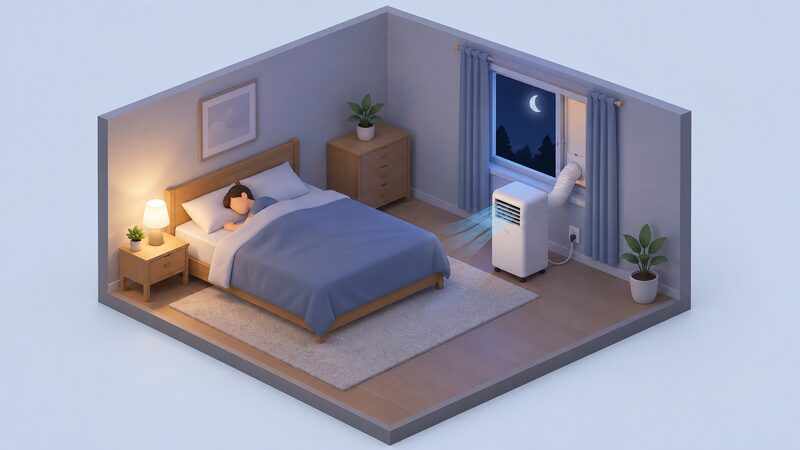
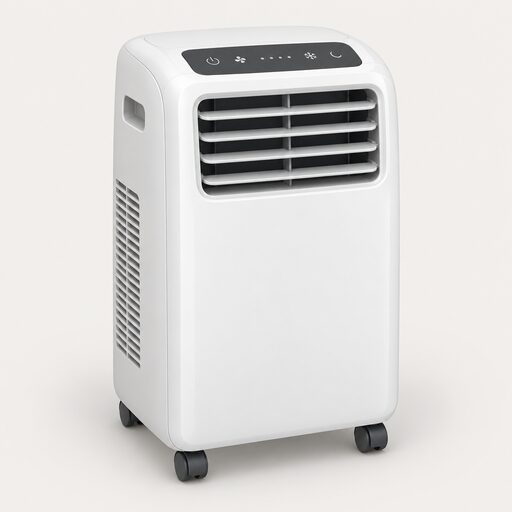
| Portable air conditioner | 1,000 to 1,500W | around 26 to 39p per hour4 |
Those figures are based on a 25.7p/kWh electricity price4. Fans move air around to create a cooling sensation on the skin and do not lower the temperature of a room, so they are a comfort measure rather than a cooling one4.
Maintenance on the passive route is minimal: trickle vents need occasional cleaning, and windows need to remain operable. Mechanical systems need filter changes and, for combined systems, inspection. The energy performance regulations bring combined air conditioning and ventilation systems, and combined heating and ventilation systems, within the inspection regime20.
Night ventilation compared with air conditioning
The comparison is not close on running cost, and it is not close on capability either. Fans are far cheaper to run than air conditioning, and air conditioning increases electricity use and can add significantly to summer energy bills8. Natural ventilation also carries lower embodied carbon than mechanical ventilation systems16. On both counts, night ventilation is the cheaper and lower-impact option.
The demand figures show what is at stake.
| Cooling scenario | Added electricity demand |
|---|---|
| Living room to 24°C, daytime | 150 to 460 kWh22 |
| Living room to 21°C, daytime | 230 to 540 kWh22 |
| Living room to 21°C by day and master bedroom to 21°C overnight | 260 to 580 kWh22 |
| Whole house to 21°C by day and all bedrooms to 18°C overnight | 950 to 2,090 kWh22 |
| The same whole-house setpoints, temperatures 2°C above the 2026 average monthly figures | 1,450 to 2,820 kWh22 |
Night ventilation reduces the hours the compressor runs, and therefore reduces those totals, without eliminating the need in a home that cannot achieve a useful air change rate.
Where air conditioning wins is certainty. A split system delivers its rated capacity regardless of the outdoor temperature difference, and a Daikin outdoor unit in the Multi+ range includes a night quiet mode setting to reduce sound pressure during the night, which addresses the noise objection that open windows cannot17. A mechanical system can also filter the incoming air, which windows cannot16.
The honest position is that the two are complements. Night ventilation removes stored heat at low or zero running cost and works whenever the outdoor air is cooler. Air conditioning provides cooling on demand when it is not. A household that can achieve a good night purge needs less installed capacity; a household that cannot, because of security, noise, pollution or a single-aspect layout, is dependent on a powered system and on the electricity supply that feeds it.
Sources22 cited
- Overheating Guidance v3, BRE
- Building Regulations Part L and F Review Stage 2A, Approved Document F, Welsh Government, 2020
- Are London's homes ready for a heatwave? Call for Evidence, London Assembly, 2026
- Summer energy tips, National Energy Action, 2026
- Ventilation, Centre for Sustainable Energy, 2025
- BESA Focus Areas: Ventilation, Building Engineering Services Association, 2026
- Solid wall insulation, Planning Portal, 2026
- Make your home more comfortable in warmer weather, Plymouth Energy Community, 2026
- Approved Document O: Overheating frequently asked questions, GOV.UK, 2022
- Approved Document F Volume 1: Dwellings frequently asked questions, GOV.UK, 2022
- Ventilation and trickle vents, Glass and Glazing Federation, 2026
- When to repair or replace your windows, Glass and Glazing Federation, 2023
- Building regulations: rooflights, Planning Portal, 2026
- Guide to the conversion of traditional buildings, Scottish Government, 2026
- Ventilation systems, nidirect, 2026
- Mechanical ventilation with heat recovery, Centre for Sustainable Energy, 2026
- Daikin 4 Port Multi air conditioner, Quiet Mark, 2026
- Planning permission: greener homes, conservatories, Welsh Government, 2026
- Conservatories and energy efficiency, Glass and Glazing Federation, 2023
- Changes to the energy performance of buildings regulations, CIBSE, 2026
- How to reduce heat loss from sash windows, Historic Environment Scotland, 2026
- Summer fuel poverty and the new price cap, Centre for Sustainable Energy, 2026
 The Full Cooling and Air Conditioning GuideDo you really need air conditioning in a British summer, or would a fan and better shading do the job?
 Warm Air Heating SystemsWarm air heating works by pushing heated air through vents in your floors or walls.
 UK Cooling DemandPublished data on air conditioning ownership and home overheating, with projections for summer temperatures in each UK nation, and what rising cooling demand means for summer electricity use.
 Evaporative Air CoolersHow evaporative coolers lower air temperature by evaporating water, why humidity limits the cooling they give in the UK, and what to know about water tanks, running power, prices and hygiene.
 Electric FansHow electric fans cool people rather than rooms, what the main UK fan types (desk, pedestal, tower, ceiling and bladeless) draw in watts and cost per hour, where they fall short in a heatwave, how to use them safely, and how they fit alongside night ventilation and shading.
 Air Conditioning and HumidityExplains how air conditioners remove moisture as they cool, what dry or dehumidify mode does and how extraction rates are stated.