
In this guide
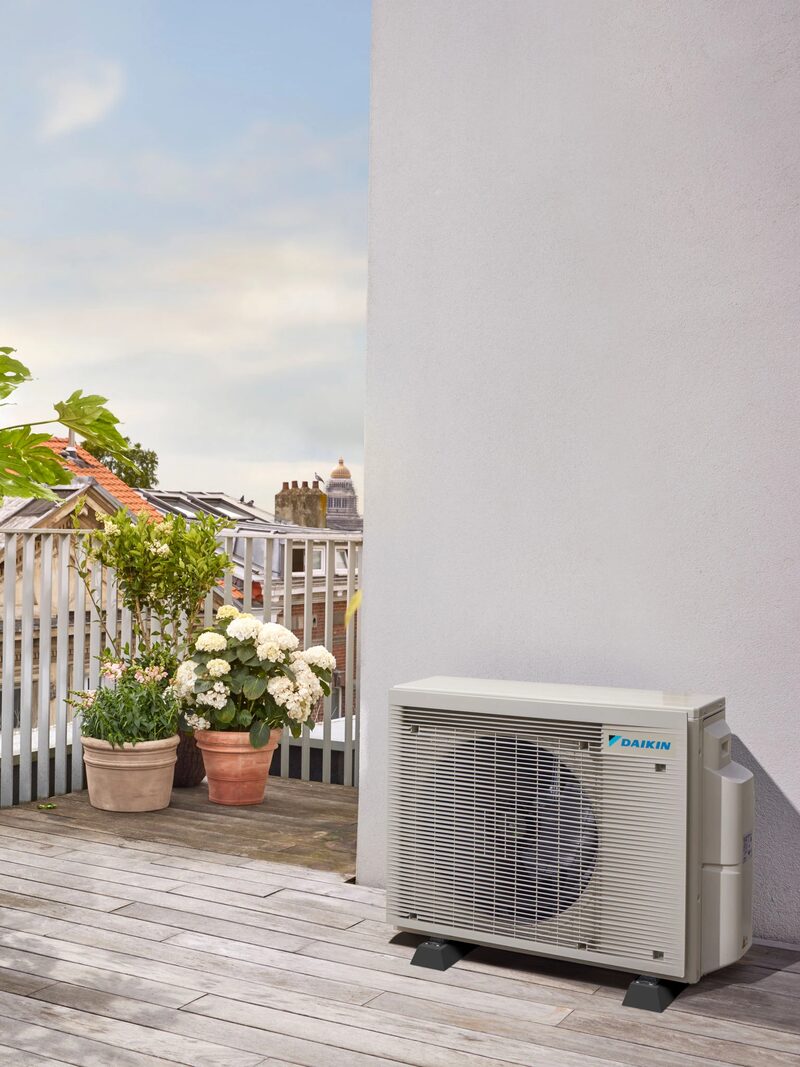
Daikin is one of the largest air conditioning manufacturers in the world and one of the four brands that dominate UK air source heat pump sales, alongside Mitsubishi Electric, Vaillant and Samsung. The company specialises in air-to-air, air-to-water and hybrid heat pumps, and its air conditioners are marketed in the UK under the name air-to-air heat pumps because they cool in summer and heat in winter from the same indoor unit1.
The range is built around seasonal efficiency rather than peak output. Daikin offers units rated up to A+++ for heating and cooling, on a scale that runs from A+++ at the top to D at the bottom, and the Sensira wall unit reaches up to A++ in cooling1. Daikin states that its products comply with the Ecodesign for Energy-Related Products regulations because they are designed for seasonal efficiency, and that seasonal efficiency is a rating system all manufacturers must use for heating and cooling products3.
For a household, the appeal is a single outdoor unit serving up to five indoor units, with one unit keeping both installation and maintenance costs lower4. The dependence is the same as any split system: the home stays on the electricity grid, the refrigerant circuit needs an F-Gas certified engineer for anything beyond routine work, and the warranty runs through an installer registration rather than the householder alone.
What Daikin sells for UK homes: heating, cooling, hot water and air quality
Daikin's UK residential offer divides into three families. Air-to-air heat pumps, which the company also calls air conditioners, provide cooling and heating from wall-mounted, floor-standing or concealed ceiling indoor units1. Air-to-water heat pumps feed a wet heating system, and hybrid heat pumps combine a heat pump with a gas boiler9. The company states that its air conditioners can be connected to a hot water tank to provide hot water, though that is an option rather than a standard configuration8.
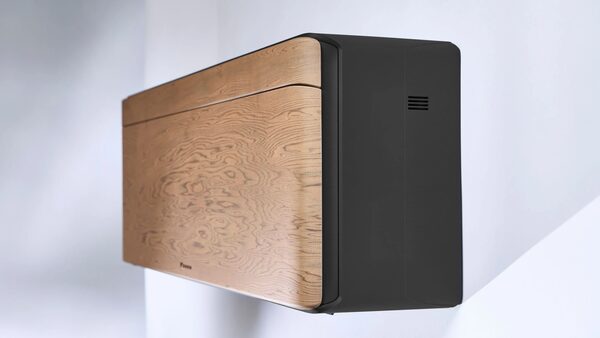
Air quality is part of the pitch. Some Daikin units carry a Flash Streamer and filters including a titanium apatite deodorising filter or a silver allergen removal filter, and Daikin states that an air-to-air heat pump can relieve the symptoms of allergies7. Across the air conditioning range, the filter options are odour filters with titanium apatite, silver-based allergen filters and flash streamers11. The Stylish set adds an enhanced airflow system intended to distribute temperature evenly across a room2.
The practical point for a household is that Daikin sells a system rather than an appliance. A single split cools one room. A multi-split connects up to five indoor units to one outdoor unit, which Daikin says keeps both installation and maintenance costs lower than separate systems4. The trade-off is that all the connected rooms share one outdoor unit's capacity and one refrigerant circuit, so a fault affects every room at once.

A range built around seasonal efficiency
Daikin was an early mover on seasonal efficiency, the rating approach that measures performance across a year rather than at a single test point. The company describes seasonal efficiency as a new way of measuring the true energy efficiency of heating and cooling technology over an entire year, and states that it demands a new rating system which must be used by all manufacturers3. Its own seasonal efficiency page frames the shift as a Daikin innovation12.
The metrics a household will see are SEER for cooling and SCOP for heating, both measuring year-round energy usage based on a typical day-to-day environment8. Seasonal efficiency measures the true energy efficiency of heating and cooling devices during a period of one year12. That is a more useful number than a peak efficiency figure because it reflects part-load running, which is how a domestic system spends most of its life.
The published ratings vary by range. Daikin Split units reach up to A+++ seasonal efficiency, helped by features such as an intelligent eye and weekly timers12. The Sky Air range reaches up to A++ in both cooling and heating12. The Sensira wall unit reaches up to A++ in cooling2. Daikin's commercial VRV technology is designed for high seasonal efficiency in the commercial sector, which is a different market from a domestic installation12.
The gap between A++ and A+++ matters less than how the system is used. A unit rated A+++ that is run at a fixed low setpoint with the windows open will use more than an A++ unit run sensibly. Seasonal ratings assume typical usage, and the household controls the rest. The wider rating framework is set out in air conditioning efficiency ratings.
Air-to-air, air-to-water and hybrid: which suits which home
The three system types suit different houses, and the choice is mostly about what the home already has.
Air-to-air heat pumps, Daikin's air conditioners, provide cooling as well as heating and are especially well-suited to new builds or renovated homes that are ideally well insulated1. They deliver heat to the room they serve, not to a wet circuit, so they cannot feed existing radiators. Where a home has no radiator system, or where cooling is the main requirement, that is not a drawback.
Air-to-water and hybrid heat pumps can be integrated with existing radiators or underfloor heating9. The hybrid option is the more flexible of the two: Daikin states that a hybrid heat pump can replace a gas boiler while keeping existing radiators, or connect air-to-air indoor units for cooling as well5. The Altherma Hybrid combines the security of a gas boiler with a renewable heat pump and intelligently switches between heat pump, boiler and hybrid operation, always choosing the most efficient mode7. It can be integrated with existing radiators7.
A hybrid also extends the multi-split idea. Daikin states that a multi air-to-air heat pump can connect one outdoor unit with up to five indoor units5. That gives a household heating and cooling in several rooms plus a boiler for the coldest days and for hot water.
| System | What it feeds | Cooling | Existing radiators |
|---|---|---|---|
| Air-to-air | The room it serves | Yes1 | No |
| Air-to-water | Wet heating circuit | No | Yes9 |
| Hybrid | Heat pump plus gas boiler | Yes, with air-to-air indoor units5 | Yes5 |
Daikin's own readiness check tells a householder whether a home is suitable for an Altherma hybrid, and returns the message that the home is ready where the check identifies it as suitable7. That is a maker's screening tool, not a survey. The wider comparison between system types is at air conditioning that heats.
R290 and refrigerant choice: balancing efficiency, safety and environmental impact
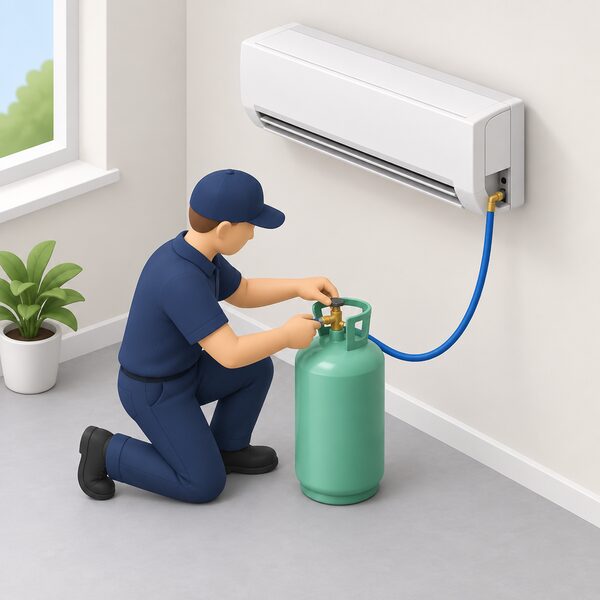
Refrigerant is the part of an air conditioning purchase that outlasts the hardware decision, because it determines what can legally be sold, serviced and refilled for the life of the unit.
Daikin's stated strategy is to choose the ideal refrigerant for each application by balancing safety, energy efficiency, environmental impact and cost over the entire life cycle of a product, always in line with current regulations13. Its air conditioning models use R-32, which the company describes as having low global warming potential8. R-32 is a single-component hydrofluorocarbon, and the maker's own framing places it as the lower-impact option in its air-to-air range.
R290, a natural refrigerant, is the alternative. One manufacturer states that R290 is 225 times more sustainable than appliances equipped with R32 and up to 700 times more sustainable than appliances equipped with R410A14. That figure comes from a maker describing its own R290 product, so it is a manufacturer's comparison rather than an independent assessment, and it is not a Daikin claim.
The regulatory position is what a household actually needs to know. Daikin states that products already installed can continue to be maintained and repaired as usual, and can still be refilled with new or reprocessed refrigerant13. For custom-made products with longer production times, Daikin only offers products that comply with the F-Gas Regulation at the time of completion and therefore at the time of placing on the market13. If a system is irreparably defective, a new F-Gas compliant product must be installed13.
ErP and F-Gas compliance: what it means for buying and repairing
Two regulatory layers sit behind a Daikin purchase, and they affect different things.
The Ecodesign regulations govern what can be sold. Daikin states that its products comply because they are designed for seasonal efficiency, and that it has a full range of air conditioning products optimised for the new seasonal efficiency ratings3. This is why the efficiency label on a UK unit shows SEER and SCOP rather than a single figure.
The F-Gas rules govern who may work on the equipment. The F-Gas Handler qualification for stationary refrigeration, air conditioning and heat pump equipment rests on Regulation 2015/2067 as retained in UK law, which establishes the minimum requirements for the training and certification of personnel15. In practice that means the refrigerant circuit is not a householder's territory.
There is also a rule at the point of sale. Anyone selling specialised air conditioning and heat pump equipment must be able to prove they received confirmation from the buyer that the equipment would be installed by someone holding a valid F-Gas handling certificate or by an F-Gas registered contractor16. That is why a supplier will ask who is fitting the unit before releasing it, and why a self-install of a pre-charged split is not a straightforward route. The rules are set out in more detail in F-Gas rules for home air conditioning.
For a household, the practical consequence is that servicing and repair depend on a certified trade. Daikin's own installation journey describes the installer removing unneeded elements of the existing heating system, upgrading pipework and heating emitters as required, making electrical connections and connecting wired or wifi controls17. None of that is a homeowner task on a refrigerant system.
Market standing: around 28% of MCS-certified UK heat pump installs
Daikin's position in the UK heat pump market is substantial but should be read with its date attached. Independent analysis of the MCS installation database covering January 2010 to September 2021 put Daikin at approximately 28% of MCS-certified installed heat pumps6. That is a share of certified installations over more than a decade, not a current annual market share.
The wider market context is that there are at least 33 manufacturers supplying air source heat pumps in the UK, with Mitsubishi Electric, Vaillant, Daikin and Samsung accounting for nearly two-thirds of total annual UK sales18. So Daikin sits in a four-brand group that between them hold most of the market, and the remaining manufacturers share the rest.
The direction of travel is set by policy. The Climate Change Committee's balanced pathway has 52% of existing homes in the UK needing to be heated using a heat pump in 2040, compared with around 1% in 202319. Government-supported heat pump installations are overwhelmingly air source: 98% of installations in the year ending September 2024, 98% in the year ending December 2024, and 98% in the year ending June 202520.
The installer base is growing alongside. MCS reported that 58% of its certified contractors are certified for heat pumps as of October 202423, that certified heat pump products rose 25% over the twelve months to July 202424, and that the UK was nearing the 10,000 mark for heat pump installers working within a certified business as of October 202425. Less than half of annual installations are MCS registered, according to MCS's own domestic heat pump guide26. Consumer research by Which? found that three quarters of surveyed homeowners said MCS certification would reassure them about getting a heat pump installed27.
Warranty, commissioning and service plans
Daikin states that all its domestic products come with a two-year guarantee as standard5. For air-to-water heat pumps, the installer registers the product on the Stand By Me portal, after which the householder can log in and extend the warranty from two to five years free of charge5. After-care runs through the same portal, with maintenance packages, extended warranty options and a dedicated homeowner contact centre17.
The published figures do not all agree. Daikin's material also refers to a five-year warranty and, separately, to a manufacturer's warranty of up to seven years, and those two figures are not reconciled in the published pages. A householder should treat the two-year standard and the free extension to five as the firm position and ask the installer to confirm anything longer in writing.
Maintenance is sold in tiers. Daikin offers a range of annual maintenance packages for its Altherma and Hybrid systems28. For Altherma, the Bronze, Silver and Gold tiers all include an annual maintenance service; parts are not included on Bronze but are included on Silver and Gold; callouts included are zero on Bronze and Silver and one on Gold29. For Hybrid systems, the Bronze and Gold tiers both include an annual maintenance service, with parts included on Gold and zero callouts on Bronze and one on Gold29.
Both the Sensira and Stylish air conditioning sets are sold with a warranty and service package2. The Stylish set comes in eight designs2. For a household buying a home with an existing system, the Energy Saving Trust advises requesting installation certificates, warranties and service records as part of the purchase31.
Daikin and home energy independence: what owning one means
A Daikin air conditioner changes what a household can do about heat, and it leaves several dependencies in place.
What it delivers is control over summer comfort without a portable unit and without opening windows to a hot street. An air-to-air heat pump provides cooling as well as heating, and Daikin units reach up to A+++ for both1. A multi-split serves up to five rooms from one outdoor unit, which Daikin says keeps installation and maintenance costs lower4. Daikin air conditioners carry 0% VAT7. For a home with solar panels, cooling load can be met from generation rather than import, which is covered at running air conditioning on solar panels.
What remains is a set of dependencies. The system runs on electricity from the grid and a supplier, with no on-site generation of its own. The refrigerant circuit requires an F-Gas certified engineer for maintenance and repair, so the household cannot service the equipment itself15. The warranty depends on an installer registering the product on Daikin's portal, which ties the longest cover to a continuing relationship with the trade5. Maintenance packages are bought from Daikin and its Service Partners28. And the equipment itself is a manufacturer's product with a manufacturer's app and portal behind it.
A hybrid system adds a further dependence rather than removing one: it keeps a gas boiler in the home and switches between heat pump, boiler and hybrid operation7. That is a deliberate hedge on cold weather performance, and it means the household stays on the gas grid.
Sources31 cited
- Daikin Sensira air conditioner, Daikin UK, 2026-09-17
- Daikin Stylish air conditioning set, Daikin UK, 2026-09-17
- What is seasonal efficiency, SCOP and SEER?, Daikin UK, 2026-09-17
- Daikin Multi split, Daikin UK, 2026-09-17
- Daikin hybrid heat pumps, Daikin UK, 2026-09-17
- Reduce the cost of heat pumps, Nesta, 2021-09
- Heating and cooling, Daikin UK, 2026-09-20
- How to choose an air-to-air heat pump, Daikin UK, 2026-09-17
- What is a heat pump?, Daikin UK, 2026-09-17
- Daikin cooling products, Daikin UK, 2026-09-17
- Onecta controllers, Daikin UK, 2026-09-17
- Daikin seasonal efficiency, Daikin UK, 2026-09-20
- F-Gas regulation, Daikin UK, 2026-09-20
- What is a heat pump, Ecoforest, 2025-10-21
- F-Gas Handler for stationary refrigeration, air conditioning and heat pump equipment, UK Register of Regulated Professions, 2026-09-17
- Heatwaves spark online AC selling alarm, BESA, 2026-07-07
- Your Daikin heat pump installation journey, Daikin UK, 2026-09-17
- Energy innovation needs assessment: heat and buildings, Department for Energy Security and Net Zero, 2025
- Environmental Audit Committee report on heat pumps, UK Parliament, 2040
- Heat pump deployment quarterly statistics, UK 2024 Q3, Department for Energy Security and Net Zero, 2024
- Heat pump deployment quarterly statistics, UK 2024 Q4, Department for Energy Security and Net Zero, 2024
- Heat pump deployment quarterly statistics, UK 2025 Q2, Department for Energy Security and Net Zero, 2025
- MCS celebrates milestone of 5,000 certified contractors, MCS Certified, 2024-10
- MCS welcomes Intertek Shanghai as its newest product certification body, MCS Certified, 2024-07-31
- Research highlights heat pump business size, MCS Certified, 2024-10-11
- Domestic heat pump guide, MCS Certified, 2024-04-02
- Homeowners view heat pumps as a high-stakes gamble, Which?, 2026-06-22
- Operate, maintenance and repairs, Daikin UK, 2026-09-20
- Daikin maintenance packages, Daikin UK, 2026-09-20
- Is my home ready for a heat pump?, Daikin UK, 2026-09-17
- Energy saving house viewing tips, Energy Saving Trust, 2026-05-20
 Daikin air source heat pumps for UK homesDaikin makes three kinds of heat pump for UK homes, so which one suits your house?