
In this comparison
R290 and R32 do the same job in a heat pump: they carry heat from the outdoor air into the house. What separates them is what happens if the gas escapes. R290, which is propane, has a global warming potential of 31. R32 has a global warming potential of 6751. That is the whole argument in one line, and it is why the newer monobloc heat pumps arriving on the UK market almost all run on propane.
The choice is not only environmental. It decides where the outdoor unit can sit, whether refrigerant pipework runs through the house, what an installer needs to be qualified to do, and how long the equipment stays sellable as the F-gas phase-down tightens. R290 is flammable, so it brings a safety zone and a set of manufacturer rules. R32 is not, which is why it has been the default for years and why it remains on sale.
For a household, the practical question is usually simpler than the chemistry: which units are available, what they cost to install, and whether the refrigerant inside will still be serviceable in fifteen years. This page sets out what the rules say, what is on the UK market, and where each refrigerant fits.
R290 and R32 in a nutshell
Both refrigerants are gases that boil and condense at useful temperatures, absorbing heat from outside air and releasing it into a heating circuit. The difference is how much warming they cause if they leak. R290 is propane, a natural refrigerant with a global warming potential of 31. R32 is a hydrofluorocarbon with a global warming potential of 6751. Some sources put R290 lower still: Glow-worm cites a 100-year figure of 0.02, noting it is "much lower than the traditional assumed value of 3"8, and Midea lists 0.02 for its R290 unit9. Either way, the gap to R32 is enormous.
That gap is not academic. A heat pump holds a refrigerant charge, and if the circuit leaks, that charge escapes. The larger the charge and the higher its global warming potential, the greater the climate impact of a single fault. SolaX lists a charge of 1.2 kg on the smallest unit in its R290 range and 1.5 kg on the larger models10. Small charges of a low-GWP gas are a very different proposition from the same weight of an HFC.
R290 also has a practical advantage beyond climate: it works well at higher flow temperatures. Midea's guidance notes that an R290 heat pump configured at a high flow temperature has higher running costs, which is a statement about how it is set up rather than the gas itself6. The same guidance states that an R32 heat pump has lower running costs than gas and oil boilers6.
The trade-off is flammability. R290 is a flammable gas, and that shapes installation, siting and the safety rules an installer must follow.
Why refrigerant choice matters: the F-gas rules
The F-gas regulation controls fluorinated gases, which covers R32 and the other HFCs used in heating. R290 is not an F-gas, so it sits outside that regime entirely. That single fact explains most of the market shift.
The rules work through a phase-down rather than a single ban. The permitted quantity of HFCs under the general quota schedule reaches zero in 20501. Alongside the quota, there are placing-on-the-market restrictions that bite earlier for specific equipment types. The direction is one way: less HFC, more natural refrigerant.
For R290, the regulatory weight falls on safety rather than climate. The Heat Pump Association's position is that manufacturer manuals may advise different approaches to mitigating risks from outdoor air-to-water heat pumps containing higher flammability refrigerants, and that installers, specifiers, designers and system owners must follow manufacturer guidance12. In other words, there is no single national rulebook for the safety zone; the maker's manual governs.
"The purpose of this statement is to explain that manufacturers manuals may advise different approaches to mitigating the"
That has a practical consequence for a household. Two R290 units of similar output from different makers may need different clearances from a door, a window or a boundary. The installer works to the manual for the specific model, not to a generic figure.
The rules in practice: GWP limits for split and monobloc systems
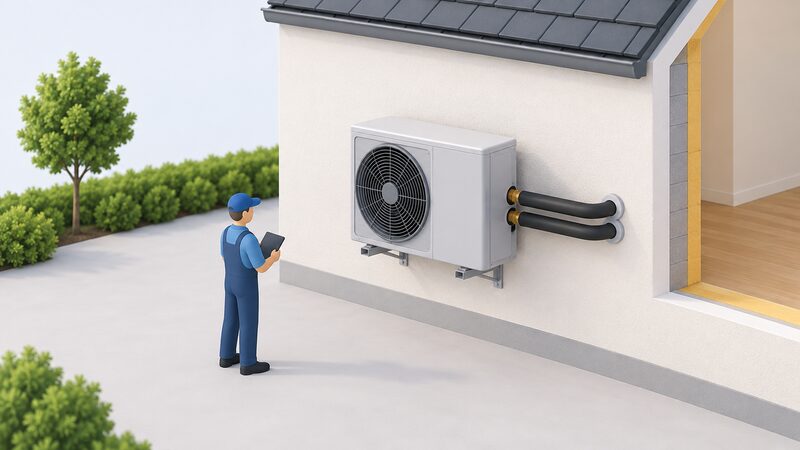
The restrictions distinguish between equipment types, and the distinction matters because monobloc and split systems are treated differently. A monobloc keeps the refrigerant circuit sealed in the outdoor unit. A split system has refrigerant pipework running to an indoor unit, which means a larger charge and a circuit that an engineer works on inside the home.
The European schedule sets out when each category is affected. Split air-to-air systems up to and including 12 kW face a placing-on-the-market restriction from 1 January 2029, and split systems above 12 kW face a restriction on F-gases with a global warming potential of 750 or more from 1 January 20331. Other self-contained heat pumps and split air-to-water heat pumps up to and including 12 kW face a restriction from 1 January 20301. Self-contained heat pumps up to and including 12 kW must not use any F-gases from 1 January 20321. All split systems up to and including 12 kW face a restriction from 1 January 20351.
The pattern is clear: self-contained equipment, which is what a monobloc is, is restricted earlier than split equipment, and the restrictions are on placing new units on the market rather than on using what is already installed.
| Equipment type | Restriction date | What is restricted |
|---|---|---|
| Split air-to-air up to 12 kW | 1 January 2029 | Placing on the market1 |
| Self-contained and split air-to-water up to 12 kW | 1 January 2030 | Placing on the market1 |
| Self-contained up to 12 kW | 1 January 2032 | Any F-gases1 |
| Split systems above 12 kW | 1 January 2033 | F-gases with GWP of 750 or more1 |
| All split systems up to 12 kW | 1 January 2035 | Placing on the market1 |
These are European rules. The UK has its own F-gas regime, and the dates above are the European schedule. Where a household is buying equipment in the UK, the practical effect is on which models makers choose to develop and supply, since most manufacturers build for the wider European market.
What the phase-down means for R32 systems already installed
The most common worry about R32 is whether an existing unit becomes unusable. The restrictions are on placing new equipment on the market, not on running equipment already in a home. An R32 heat pump installed today is not made illegal by the 2029, 2030 or 2032 dates.
The longer-term question is refrigerant supply. The EU quota schedule for HFCs reaches zero in 20501, which means the permitted quantity of virgin HFC falls steadily towards nothing. Over a fifteen-year life, that affects the availability and price of the gas used for a top-up or a repair. Reclaimed refrigerant and existing stocks are the usual routes, and the position on refilling a specific unit is one to confirm with the installer at the time.
There is also a review point. In 2030 the European Commission will evaluate whether the post-2030 product bans are technologically feasible, with amendments possible4. That leaves room for the later dates to move, which is worth knowing if a purchase decision turns on what happens after 2030.
For a household, the practical reading is this: an R32 unit bought now should run its normal life. The risk is not that it stops working, but that servicing gets harder and refrigerant gets scarcer towards the end of that life. An R290 unit avoids that particular exposure because propane is not subject to the HFC quota at all.
R290 monoblocs on the UK market
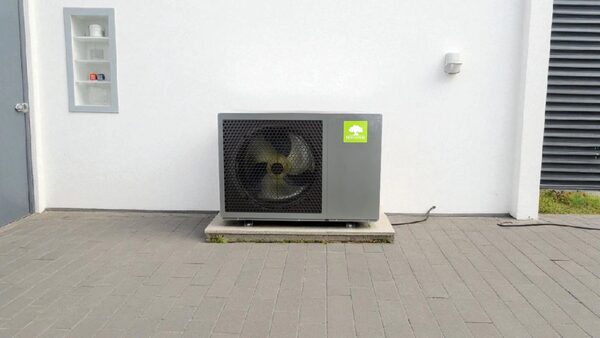
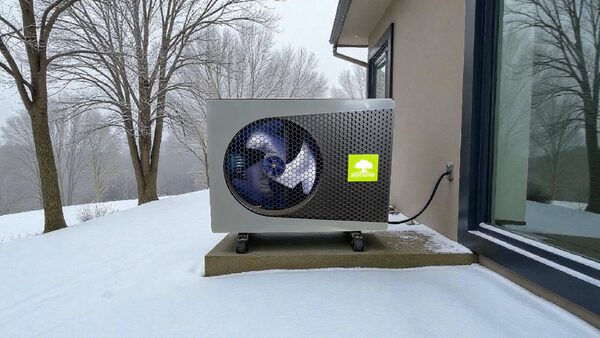
The R290 market in the UK is now broad, and most of it is monobloc. LG sells the Therma V R290 Monobloc across a wide range of outputs, in both single phase and three phase versions, with UK availability confirmed on the product pages, though some models may only be available in specific regions2. The units use a natural refrigerant with a global warming potential of 32.
Mitsubishi Electric makes Ecodan R290 units and states they are made in the UK7. NIBE lists the S2125 and the S2060, both on R29021. Grant sells the Aerona 290, using R290 with a low global warming potential of 324. SolaX offers the Thermal R290 Series, suitable for both new-build and retrofit10. Trianco's Activair Pro runs on R29026, and Midea's M Thermal Nature Plus Series lists R290 with a global warming potential of 0.029.
| Maker | Model range | Refrigerant |
|---|---|---|
| LG | Therma V R290 Monobloc | R2902 |
| Mitsubishi Electric | Ecodan R290 | R2907 |
| NIBE | S2125, S2060 | R29021 |
| Grant | Aerona 290 | R29024 |
| SolaX | Thermal R290 Series | R29010 |
| Trianco | Activair Pro | R29026 |
| Midea | M Thermal Nature Plus | R2909 |
Availability is not uniform. Several product pages note that certified products are available for the UK market but may only be available in specific regions15. That is worth checking before a model is specified.
R32 remains on sale alongside. Ideal lists the Logic Air range on R323, Daikin's Altherma 3 H HT uses R324, and NIBE's F2050 runs on R32, described as being for reduced environmental impact5.
Installation and servicing: why monobloc R290 units are simpler to fit
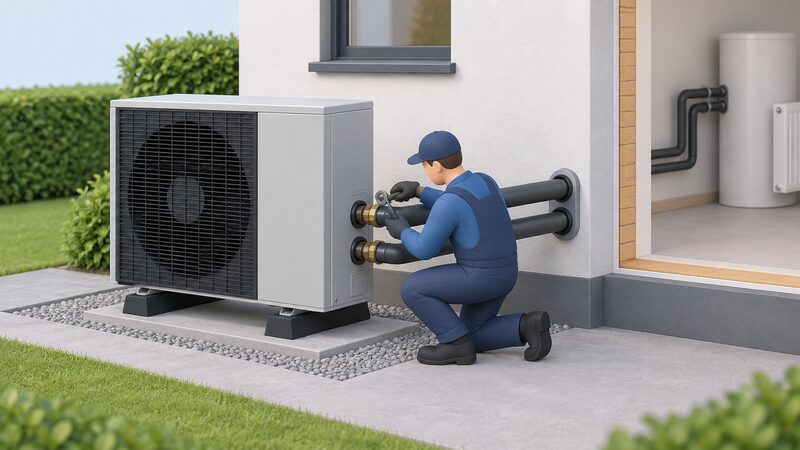
The monobloc design is what makes R290 practical for a domestic installation. LG describes the Therma V R290 Monobloc as a monobloc concept connected by water piping only, eliminating the need for refrigerant piping2. The same description appears across the range13.
That matters for two reasons. First, no refrigerant pipework runs through the house, so the flammable charge stays outdoors in a factory-sealed circuit. Second, the work inside the home is plumbing rather than refrigeration, which changes who can do it and what qualifications are needed.
"Basically it is a monobloc concept, it is connected by only water piping eliminating the need for refrigerant piping"
The units are also flexible on the indoor side. LG states the monobloc can be connected with three types of indoor unit13, which allows a cylinder, a wall-mounted unit or another arrangement depending on the home. Operation range extends down to minus 28 degrees Celsius on a three phase model13, and heating performance is quoted at A7/W3516.
Servicing follows the same logic. Because the refrigerant circuit is sealed and outdoors, routine servicing is largely about the water side, the controls and the outdoor unit itself. Where a refrigerant circuit does need attention, the manufacturer's guidance on the flammable charge governs the approach12.
Cost: what an R290 unit adds over an R32 model
Maker guidance is direct on this point: an R290 heat pump is more expensive to install than an R32 model, and an R32 model is cheaper to install than an R290 heat pump6. No published UK price is given for either, so costs are installer-quoted.
The same guidance notes that an R290 heat pump has higher running costs when configured at a high flow temperature6. That is a statement about setup rather than the refrigerant: a unit pushed to a high flow temperature works harder and costs more to run. An R32 heat pump is described as having lower running costs than gas and oil boilers6.
There is a secondary consideration on the cylinder side. The TAG R290 Heat Pump Cylinder lists an auxiliary electric heater of 1.5 kW and a power supply of 220 to 240 volts, single phase, 50 Hz29. It also lists a secondary benefit of room cooling, ventilation and dehumidification29. Those are cylinder features rather than refrigerant costs, but they form part of the installed system a household is paying for.
The honest position on cost is that the difference between an R290 and an R32 installation is not published as a figure. It depends on the unit, the cylinder, the emitter upgrades and the labour, all of which are quoted per property. What the guidance establishes is the direction: R290 costs more up front.
Which refrigerant suits which home

The choice comes down to three things: what is available for the property, how the unit will be sited, and how long the household expects to keep it.
R290 suits homes where the outdoor unit can meet the manufacturer's clearance requirements, where a monobloc connection by water pipe is straightforward, and where the household wants to avoid exposure to the HFC phase-down over the life of the equipment. The monobloc format means no refrigerant work indoors, which simplifies the installation. The trade-off is the higher install cost and the need to follow the maker's safety guidance on siting6.
R32 suits homes where an R32 model is what is available at the right output, where the installer is set up for it, and where the lower install cost matters more than the long-term refrigerant supply question. R32 units remain on sale from Ideal, Daikin and NIBE3, and the restrictions on new equipment do not affect units already installed.
For a household thinking about energy independence, the refrigerant choice is a second-order question next to the bigger one: a heat pump of either kind moves a home off gas or oil and onto electricity. What the refrigerant decides is the siting, the installation route and the servicing picture over the years ahead. R290 removes the HFC exposure entirely, because propane is not an F-gas and is not subject to the quota that reaches zero in 20501. R32 keeps a household inside that regime, with the supply of refrigerant for servicing becoming the practical question towards the end of the unit's life.
Where a property has a tight boundary, a narrow side return or a restriction on where an outdoor unit can go, the manufacturer's clearance rules for the specific R290 model are the deciding factor, and they vary between makers12. Where the property has room and the installer is familiar with the format, the monobloc R290 route is the one the market is moving towards.
Sources29 cited
- HFC Phasedown Reform De Minimis Assessment, Defra, 2025-09-02
- LG Therma V R290 Monobloc 12kW 1 Phase HM121HF UB60 Heat Pump, Quiet Mark, 2026-09-17
- Ideal Logic Air 8kW Heat Pump, Quiet Mark, 2026-09-17
- Daikin Altherma 3 H HT Heat Pump, Quiet Mark, 2026-09-17
- NIBE F2050-10 Heat Pump, Quiet Mark, 2026-09-17
- Best Heat Pump for My Home, Good Energy, 2025-02-17
- Mitsubishi Ecodan R290 Air Source Heat Pump 12kW, Quiet Mark, 2026-09-17
- Glow-worm GeniaAir 7kW HA 7-7.1 O 230V B2 Air Source Heat Pump, Quiet Mark, 2026-09-17
- Midea M Thermal Nature Plus Series MHC-V12WD2RN7-B2 Heat Pump, Quiet Mark, 2026-09-17
- SolaX Thermal R290 Series STU3-C12R290 12kW Air to Water Heat Pump, Quiet Mark, 2026-09-17
- SolaX Thermal R290 Series STU3-C08R290 8kW Air to Water Heat Pump, Quiet Mark, 2026-09-17
- HPA UK Statement on R290 Safety Zone, Heat Pump Association UK, 2026-05-12
- LG Therma V R290 Monobloc 7kW 3 Phase HM073HF UB40 Heat Pump, Quiet Mark, 2026-09-17
- LG Therma V R290 Monobloc 16kW 1 Phase HM161HF UB60 Heat Pump, Quiet Mark, 2026-09-17
- LG Therma V R290 Monobloc 9kW 3 Phase HM093HF UB40 Heat Pump, Quiet Mark, 2026-09-17
- LG Therma V R290 Monobloc 7kW 1 Phase HM071HF UB40 Heat Pump, Quiet Mark, 2026-09-17
- LG Therma V R290 Monobloc 14kW 3 Phase HM143HF UB60 Heat Pump, Quiet Mark, 2026-09-17
- LG Therma V R290 Monobloc 9kW 1 Phase HM091HF UB40 Heat Pump, Quiet Mark, 2026-09-17
- Mitsubishi Ecodan R290 Air Source Heat Pump 8.5kW, Quiet Mark, 2026-09-17
- Mitsubishi Ecodan R290 Air Source Heat Pump 10kW, Quiet Mark, 2026-09-17
- NIBE S2125-12 Heat Pump, Quiet Mark, 2026-09-17
- NIBE S2125-8 Heat Pump, Quiet Mark, 2026-09-17
- NIBE S2060-10 Heat Pump, Quiet Mark, 2026-09-17
- Grant Aerona 290 12kW HPR29012 Air Source Heat Pump, Quiet Mark, 2026-09-17
- SolaX Thermal R290 Series STU3-C16R290 16kW Air to Water Heat Pump, Quiet Mark, 2026-09-17
- Trianco Activair Pro R290 Heat Pump, Quiet Mark, 2026-09-17
- Ideal Logic Air 10kW Heat Pump, Quiet Mark, 2026-09-17
- NIBE F2050-6 Heat Pump, Quiet Mark, 2026-09-17
- TAG R290 Heat Pump Cylinder, Elnur, 2026-09-14
 Refrigerants and F-Gas RulesWhat refrigerant does your heat pump use, and is propane safe at home?
 High Temperature Heat PumpsHigh-temperature heat pumps deliver flow temperatures of roughly 65 to 80°C, close to boiler levels, so existing radiators can often stay in place.
 Which Homes Suit a Heat PumpMost UK homes can have a heat pump fitted, so the real question is whether yours makes it easy or expensive.
 Radiators and Heat EmittersA radiator's real heat output depends on how hot the water inside it is compared with the room, so the figure in a catalogue often overstates what you will actually get.
 Using a Heat Pump for CoolingCan a heat pump cool your home in summer as well as heat it in winter?
 Heat Pump Running CostsWhat does a heat pump cost to run each year, and is it cheaper than a gas boiler?