
In this guide
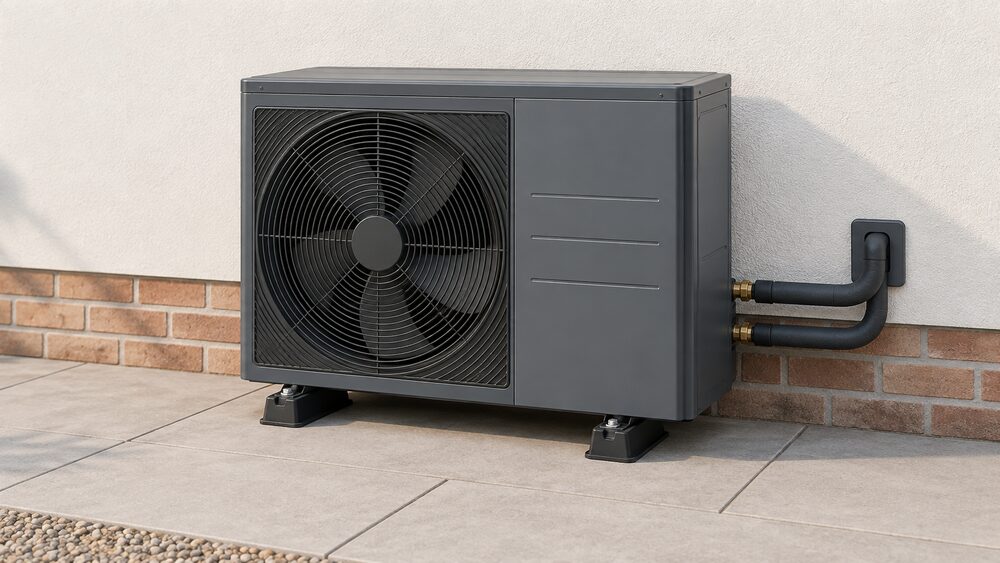
Trianco is a British heating brand that has moved from oil and solid fuel boilers into electric heating and, more recently, air source heat pumps. Its current heat pump line is the Activair range, sold in the UK through merchant distributors and an installer network rather than direct to householders. The Activair Pro R290 is listed in 6kW, 12kW and 17kW outputs, with published SCOP figures of 5.56, 5.1 and 5.13 for those three sizes and noise levels of 36, 38 and 39 dB(A)1.
The units use R290 refrigerant, described as having an ultra-low Global Warming Potential of just 3, and the Activair High Temp ASHP carries MCS certification numbers BSI KM 785261 and MCS HP0289/032. That certification is what makes the range eligible for the Boiler Upgrade Scheme, which pays £7,500 towards ground source heat pumps and supports air-to-water installations in residential and non-residential properties4.
For a household, the appeal is a UK-built brand with a long trading history and a heat pump that can be monitored remotely by the manufacturer over a built-in SIM. The dependence that remains is the same as for any heat pump: mains electricity, a grid connection, and for the remote features a mobile data link and the maker's own monitoring service.
Trianco today: from oil boilers to electric heating and heat pumps
Trianco's own advice pages now state that it no longer manufactures oil or solid fuel boilers, and recommend heat pumps, particularly the Activair range, for homes off the gas grid5. That is a significant shift for a company whose name was built on oil-fired appliances, and it places Trianco in the same transition as the wider UK heating market.
The company's product portfolio is described as a comprehensive renewable range including outdoor and indoor air source heat pumps for domestic and commercial applications1. That covers both the outdoor monobloc-style units most householders picture and indoor units, which matters where siting or planning constrains an outdoor installation.
The wider context is that air source heat pumps are the most commonly installed type in the UK, and the most common domestic heat pump type in Great Britain6. Heat pump types generally divide into air source, ground source and air-to-air, with air-to-water units (including exhaust air) forming the bulk of the residential market8. Trianco's Activair sits in the air-to-water category, which means it serves both space heating and hot water through a wet system.
For a household, the practical point is that a Trianco heat pump is a like-for-like replacement path for an existing wet central heating system. In many cases a gas, oil, LPG, electric or biomass boiler can be swapped out and replaced with a heat pump, and the newest high temperature models make that transition easier from fossil fuels5. The dependence that remains is on electricity rather than a delivered fuel, which changes the household's exposure from a fuel supplier to the grid and an electricity tariff.

The Activair range: outdoor and indoor air source heat pumps
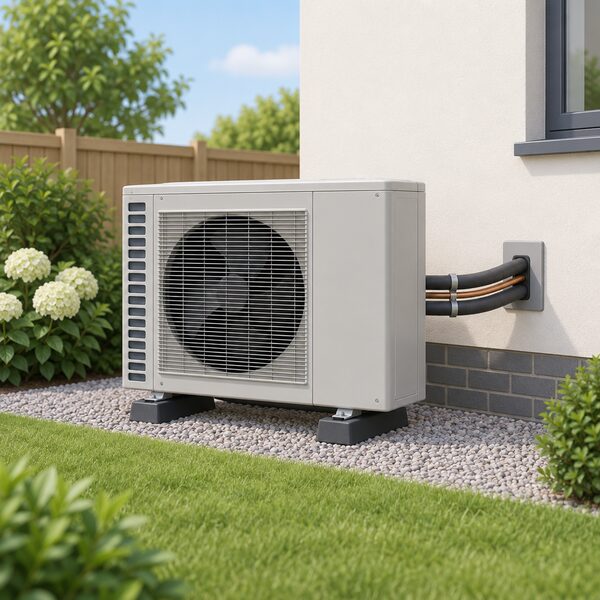
The Activair Pro R290 is the model with published performance detail. It is listed in 6kW, 12kW and 17kW outputs, and the maker's figures give a SCOP of 5.56 for the 6kW unit, 5.1 for the 12kW and 5.13 for the 17kW2. SCOP is the seasonal measure, so it reflects performance across a heating season rather than at a single test point.
Noise is a common concern with air source units, and the published figures are 36 dB(A) for the 6kW model, 38 dB(A) for the 12kW and 39 dB(A) for the 17kW. The range is Quiet Mark certified1. For context on what those numbers mean in practice, the site's guide to heat pump noise sets out how dB(A) readings translate at a neighbour's wall.
The units are described as engineered to maintain full heating capacity at outdoor temperatures as low as minus 10 degrees C, with no drop-off2. That is a maker's claim about cold weather behaviour, and it addresses the most common objection to air source heat pumps in the UK. Independent work on cold weather performance is covered in heat pumps in cold weather.
| Model | Output | Published SCOP | Noise | Refrigerant |
|---|---|---|---|---|
| Activair Pro R290 | 6kW | 5.562 | 36 dB(A)2 | R2902 |
| Activair Pro R290 | 12kW | 5.12 | 38 dB(A)2 | R2902 |
| Activair Pro R290 | 17kW | 5.132 | 39 dB(A)2 | R2902 |
The range also includes indoor air source heat pumps, which suit flats and homes where an outdoor unit is difficult to place1. Indoor units are a smaller part of the UK market but they widen the properties a heat pump can serve, and the site's guide to which homes suit a heat pump covers the property types involved.
Specifications: R290 refrigerant, MCS accreditation and Future Homes Standard alignment
The Activair High Temp ASHP is described as an MCS certified air-to-water heat pump using R290 refrigerant, with certification numbers BSI KM 785261 and MCS HP0289/033. The Activair Pro R290 uses the same natural refrigerant, described as having an ultra-low Global Warming Potential of just 32.
R290 is the refrigerant now common across the newer generation of heat pumps, and it appears in competing ranges as well2. Its low GWP is the reason it has displaced higher-impact refrigerants in new equipment, and the site's explainer on heat pump refrigerants covers the F-Gas rules that sit behind the shift.
MCS certification is the load-bearing specification for a household, because the Boiler Upgrade Scheme grant requires installation by an MCS accredited installer11. The scheme provides upfront capital grants to support the installation of heat pumps and biomass boilers in residential and non-residential properties, and air-to-water heat pumps are within scope4. Air-to-air heat pumps are not, which is why the distinction between the two matters when a grant is part of the plan; the site explains this in why air-to-air heat pumps do not get the Boiler Upgrade Scheme grant.
On testing, the wider R290 market publishes performance against EN 14825:2022, the standard used for seasonal efficiency declarations12. Trianco's published figures are given as SCOP values rather than a test-standard citation, so the two are not directly comparable on the face of the documents. The site's guide to heat pump efficiency: COP, SCOP and SPF explains what each measure covers.
SIM connectivity and remote monitoring: what it means in practice
Every Activair Pro heat pump comes with a built-in SIM, and the units are remotely monitored by Trianco through it. The maker states that this enables Trianco not only to assist with commissioning but also to change settings remotely2. That is an unusual level of manufacturer access, and it cuts both ways.
The benefit is diagnostic. A fault can be seen and in some cases corrected without a site visit, and commissioning support does not depend on an engineer being physically present. The same units can be controlled through a smart app, which shows power usage and information codes2. Remote control of heating from a phone is now a standard expectation, and the general case for it is set out in the site's guide to heat pump controls; independent guidance describes the basic function as turning the system on or off and changing the temperature from a smartphone when away from home13.
The dependence is the other side of it. Remote monitoring and remote settings changes rely on a mobile data connection, Trianco's own systems and the maker's continued operation of that service. A household that wants its heating to run without any external link should understand that the local controls continue to work, but the remote layer does not. This is the same pattern as any connected heating product, and it is worth weighing alongside the site's wider discussion of heat pumps and household energy independence.

The all-inclusive package: heat pump plus Sunamp Thermino battery
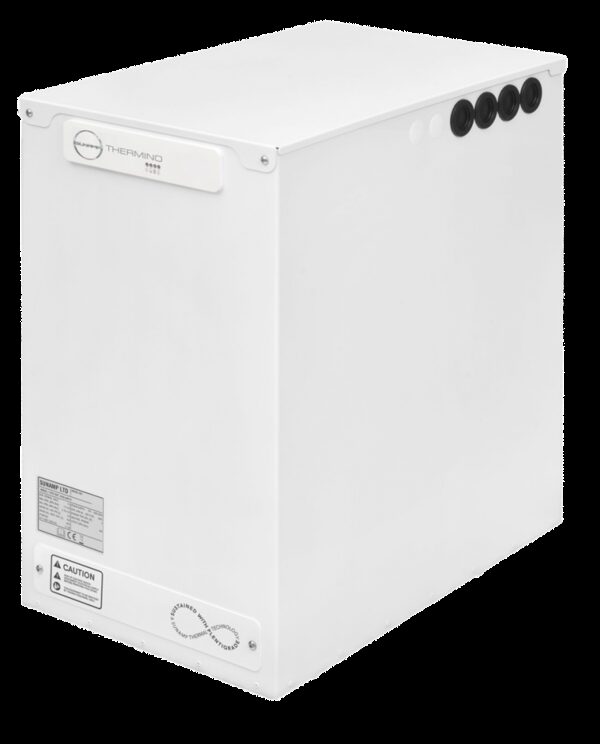
Trianco's offer is not limited to the outdoor unit. The Sunamp Thermino hp is a thermal battery that, in the maker's words, "allows heat pumps to be installed for homes with no space for an indirect hot water cylinder"14. That is the constraint it solves: a heat pump needs a store of hot water, and a conventional cylinder needs a cupboard or an airing space that many flats and smaller homes do not have.
The pairing matters because hot water is the part of a heat pump installation most likely to force building work. Where a cylinder will not fit, the alternatives are a thermal store of this kind, a hot water heat pump cylinder, an electric immersion heater or a point-of-use water heater15. The site covers the options in heat batteries used with heat pumps and hot water cylinders for heat pumps.
"The Sunamp Thermino hp thermal battery allows heat pumps to be installed for homes with no space for an indirect hot water cylinder"
For a household, a package of this kind changes the practical question from "where does the cylinder go" to "does the thermal battery fit". It does not change the underlying dependence: the heat still comes from electricity, and the battery stores heat rather than generating it. What it does is widen the set of homes where a heat pump is installable at all, which is the point of offering it alongside the Activair range.
UK availability: England and Wales installations, merchant distributors and spare parts
Trianco heat pumps are sold in the UK through merchant distributors and an installer network, with the Activair Pro R290 available to buy in the UK via Trianco2. There is no published manufacturer list price for a supplied and fitted installation, so prices are installer-quoted after a survey.
The route to an installation runs through an MCS certified installer, who applies for any grant on the householder's behalf through Ofgem. The official guidance is to get a quote via the MCS find a heat pump installer tool or to contact an energy supplier11. Trianco units are among those fitted by energy suppliers: EDF Energy installs Ideal, Daikin and Trianco heat pumps through its subsidiary EDF Heat Pumps, a Which? Trusted Trader16.
Official statistics on heat pumps used in central heating cover England and Wales, and the next release date for that dataset is to be announced17. Support is also available for installers and manufacturers to expand supply chains, which bears on how quickly a given model can be sourced7. Where a new connection or supply upgrade is needed, the distribution network operator route applies; Electricity North West, for example, takes applications to connect by form and email at domesticlct@enwl.co.uk10.
VAT treatment is a further consideration. Energy-saving materials relief covers water-source heat pumps among the included technologies18. The relief's application to a specific installation is a matter for the installer's invoice, and the figures quoted for heat pump work should be read with that in mind.
Grant support and funding partners

The Boiler Upgrade Scheme is the main grant route for a Trianco installation. It provides upfront capital grants to support the installation of heat pumps and biomass boilers in residential and non-residential properties, and the published figure for ground source heat pumps is £7,5004. Air-to-water heat pumps are within scope, which covers the Activair range4.
The application is made by the installer through Ofgem, and the official guidance is to obtain a quote through the MCS find a heat pump installer tool or through an energy supplier11. Because the grant requires an MCS accredited installer, the certification held by the Activair High Temp ASHP is what makes the model eligible in the first place3.
Support is not uniform across the UK. In Wales, the Nest scheme funds heat pumps alongside insulation and solar panels19. Hybrid heat pumps have historically qualified for grant funding under the Renewable Heat Incentive and the Sustainable Warmth Local Authority Delivery competition, and oil and LPG boilers can also be used in hybrid arrangements20. The site's guide to heat pump grants and funding across the UK sets out the devolved schemes in more detail.
Government guidance confirms that grants are available to cover part of the cost of installing a heat pump, and that the installer applies on the householder's behalf12. For a household weighing a Trianco unit, the practical sequence is: find an MCS certified installer, get a survey and quote, and let the installer handle the grant paperwork. The site's guide to how much a heat pump costs with a Boiler Upgrade Scheme grant covers what the grant does and does not cover.
The company behind the name: heritage since 1793 and the Royal Warrant
Trianco describes itself as a trusted supplier of heating solutions with a heritage spanning more than 165 years1. The brand's standing was reinforced in 1953 when it received a Royal Warrant as boiler manufacturers to the Queen Mother5. In 2000 it entered the electric heating market with the Aztec electric boiler range5.
That history explains the shape of the current business. A company that spent decades making oil and solid fuel boilers has had to reposition as those fuels are phased out, and its own advice now points households towards heat pumps for off-gas homes5. The Activair range is the product of that repositioning, and the company's help pages continue to address the older installed base, including caravan and holiday home heating5.
For a household, heritage is a weak signal compared with certification and warranty terms. What matters more is that the brand is trading, that the range holds MCS certification, and that spares and support routes exist through the company and its merchant network1. The site's guide to heat pump standards and certification explains how to check certification claims independently.
Sources20 cited
- Trianco brand page, Quiet Mark, 2026-09-17
- Trianco Activair Pro R290 heat pump, Quiet Mark, 2026-09-17
- ECO4 approved innovation measures, Ofgem, 2026-01
- Heat pump installation and grants, UK Government, 2026-09-10
- Trianco help and advice, Which?, 2025-09-22
- How do heat pumps work, Smart Energy GB, 2026-03-16
- Heat pumps and the UK's energy transition, UK Parliament POST, 2026-09-19
- Heat pumps, REA, 2026-09-17
- Hybrid heat pumps, Energy Saving Trust, 2026-09-17
- Heat pumps and new connections, Electricity North West, 2026-09-19
- Boiler Upgrade Scheme guidance for installers, Ofgem, 2026-04-24
- Heat pumps explained: experts answer your questions, UK Government, 2024-03-28
- Thermostats and heating controls, Energy Saving Trust, 2026-02-10
- Sunamp hot water products, Sunamp, 2026-09-17
- Air-to-air heat pumps, Nesta, 2026-09-17
- Air source heat pump costs and savings, Which?, 2026-04-14
- Heat pumps used in central heating, England and Wales, Office for National Statistics, 2025-10-28
- VAT energy-saving materials relief, UK Government, 2024-01-11
- Nest: free home energy efficiency improvements, Welsh Government, 2026-09-17
- Hybrid heat pumps and grant funding, HHIC, 2026-09-17