
In this guide
Electricity North West is the electricity distribution network operator for North West England. It owns and maintains the overhead lines and underground cables that bring power to 2.5 million homes and businesses in the region1. It is not an energy supplier: it does not sell electricity, does not fit meters and does not bill households for units used. Its role is the physical network between the transmission grid and the property, and it is the body a household contacts when the power goes off, when a new supply is needed, or when the connection has to change2.
For a household, the network operator is the part of the electricity system that cannot be switched. A supplier can be changed in a few weeks; the wires to the house cannot. That makes the connection itself the fixed point in a home's energy arrangements, and it makes the operator's timescales, charges and safety rules worth understanding before any work is planned.
Who Electricity North West is and the area it serves
Electricity North West describes itself as the electricity network operator for the North West, with what it calls a huge responsibility to provide the service households rely on1. The network of overhead lines and underground cables reaches 2.5 million homes and businesses across the region2. Independent supplier guidance places the area as North West England, which covers the Manchester conurbation, Merseyside, Lancashire and Cumbria9.
That footprint matters because the distribution network operator is determined by postcode, not by choice. A household in the North West cannot select Electricity North West any more than it can select a water company; the operator is fixed to the address. The supplier, by contrast, is a commercial relationship the household controls. Confusing the two is the most common source of a misdirected call, and the operator states the division plainly: it does not sell electricity or fit meters, and the meter is the supplier's responsibility7.
The network itself is the shared infrastructure of the region. Every home connected to it depends on the same cables, substations and control room, and every home's supply quality is affected by what else is connected nearby. That is the structural dependence at the heart of the relationship: a household can generate its own electricity and store it, but the connection to the network remains the route by which power is imported when generation and storage fall short, and the route by which surplus is exported. The operator's own smart meter work reflects this, since it can ask a smart meter to report the supply voltage a customer is currently getting, using that data to configure the network and identify where to improve it11.
For wider context on how the distribution layer fits between the transmission grid and the home, see electricity distribution networks and who is my distribution network operator.
Power cuts: reporting faults and getting updates
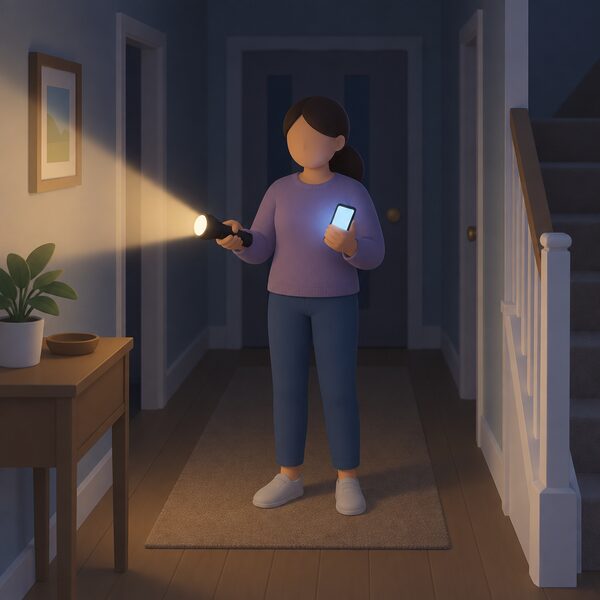
The reporting route is the national 105 number, which is free to call and available 24 hours a day3. Electricity North West directs households to 105 to report a power cut, and lists a 24 hour emergency number, 0800 195 4141 option 1, for electrical hazards or incidents as well as power cuts6. The same number is the route after flooding: the operator asks households to contact 105 or report a power cut online so that a safety check can be carried out10.
Once a cut is reported, the operator's temporary support service keeps the customer updated throughout the outage12. For households on the priority register, the customer contact team gets in touch throughout the power cut to check the household is alright and has the latest information, whether the cut was planned or unplanned13.
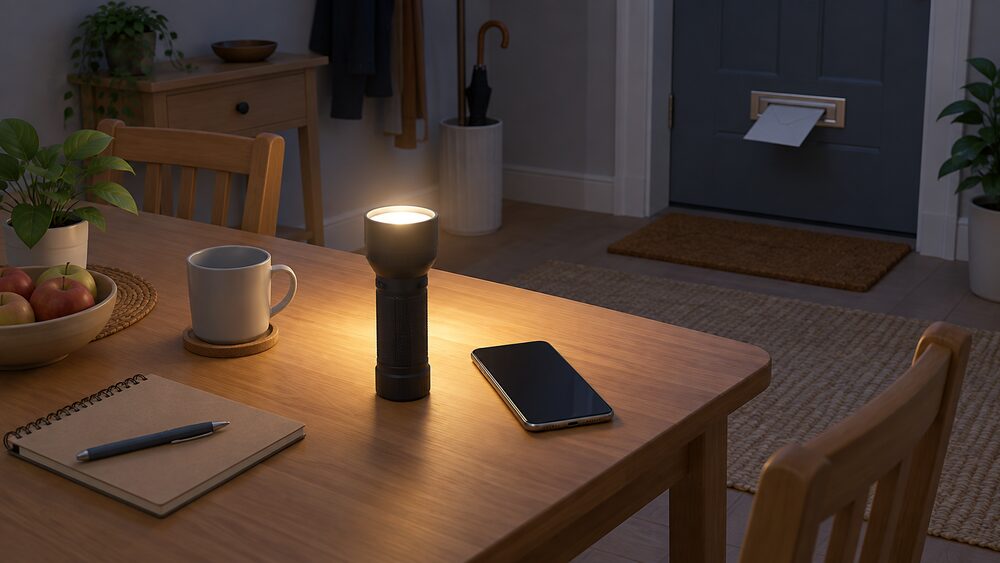
Practical preparation is mostly about what the household controls. A charged phone, a torch and a way to keep warm or cool without mains power cover the first hours. The operator publishes seasonal readiness guidance for summer and winter, and the pattern is the same in both: know the number, know where the isolator is, and know who in the household needs extra help8.
Northern Ireland works differently, and the contrast is useful. NIE Networks takes reports online, through its Powercheck real-time fault map, by WhatsApp, Facebook Live Chat or the customer helpline14. Powercheck is a live map showing whether a cut is already known, which is the first thing to check before reporting11. For the Northern Ireland network specifically, see NIE Networks.
Planned cuts: notice, timings and exemptions
Planned interruptions are scheduled work on the network, and the notice arrangements are specific. Electricity North West gives 10 days notice about a planned power cut4. Where contact details are on file, it emails and texts six days and one day before the cut, and posts a card ten days before5. The commitment is that customers are always notified in advance before a planned interruption, unless it is an emergency4.
The working window is deliberately narrow. 9am is the earliest the operator will turn power off, and 5pm is the latest it will turn it back on4. Where a job overruns, the operator says it may need to extend the times without power but will inform customers with reasonable notice4. Two policies soften the impact: times without power are shortened during the winter months, and interruptions for schools are planned outside term times4.
The exemptions from charges are worth knowing because they cover the common household cases. Electricity North West does not charge for budget estimates, minor connections of one to four properties, cancellations within the cooling off period, or offers for service alterations and diversions6. That means a household asking for an estimate, or cancelling a minor job inside the cooling off window, is not billed for the quotation stage.
For the general rules on notice periods, see planned power cut notice.
Priority services and support during a power cut
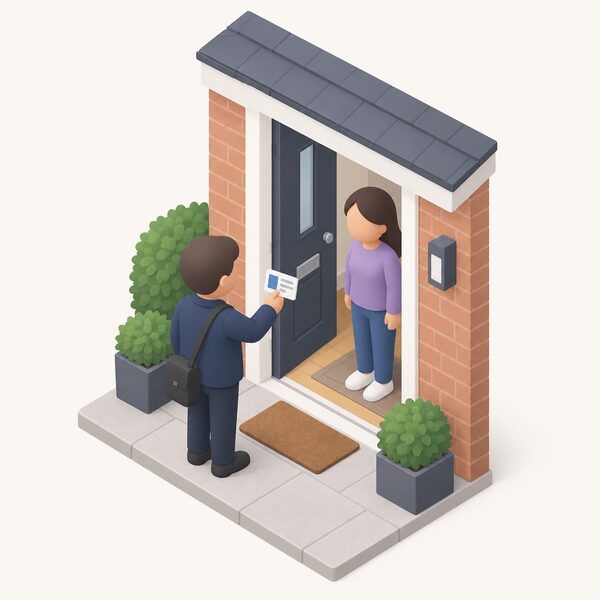
The Priority Services Register is the main support mechanism, and it is free3. Its benefits include priority support with heating and cooking facilities if the supply is cut off, advanced notice of power cuts, and an identification and password scheme for home visits15. The password scheme matters because it gives a household a way to verify that someone at the door is genuine.
Electricity North West runs its own extra support arrangements alongside the register. For customers with poor mobility, the customer contact team makes contact throughout the power cut, planned or unplanned, to check the household is alright and has current information13. Where a cut continues over a long period, the operator can provide hot food and drinks, or overnight accommodation where appropriate13. Its temporary support service provides hot food and drinks to keep the customer comfortable until power is restored12.
"Whether planned or unplanned, our customer contact team will be in touch with you throughout the power cut to make sure you are ok and have the latest information"
The practical value of the register is that it changes the operator's behaviour rather than the household's. A registered household is contacted rather than having to chase, and the welfare provisions are triggered by the length of the outage rather than by a request. Registration runs through the supplier or the network operator, and the support is free.
Compensation, outage letters and what the network won't cover
Compensation for a power cut is a regulated payment, and the exclusions are as important as the entitlement. Ofgem states that payments are not made for blackouts caused by a national power shortage, for damage to electrical equipment or appliances, or for a low supply after a power cut16. Those three exclusions cover a large share of the losses a household might assume were claimable.
Food loss is the clearest example. Electricity North West states it is unable to reimburse customers for food lost during a power cut8. It repeats the position in its FAQs: it cannot be held responsible for any loss of fridge or freezer contents due to interruptions, suggests home insurance might cover such losses, and says it can issue a letter for an insurance claim12. The letter is the practical output: the operator will document the outage, but the claim goes to the insurer.
Severe weather is a separate category. NIE Networks states that compensation will not be paid following the Storm Éowyn severe weather event, while confirming that a power cut lasting more than 24 hours for reasons other than a severe weather event may attract compensation17. The distinction between an ordinary fault and a named storm is therefore decisive for whether a payment is due.
For the general compensation rules, including the 24 hour threshold, see gas outage compensation 24 hours.
New connections, EV chargers and three-phase upgrades
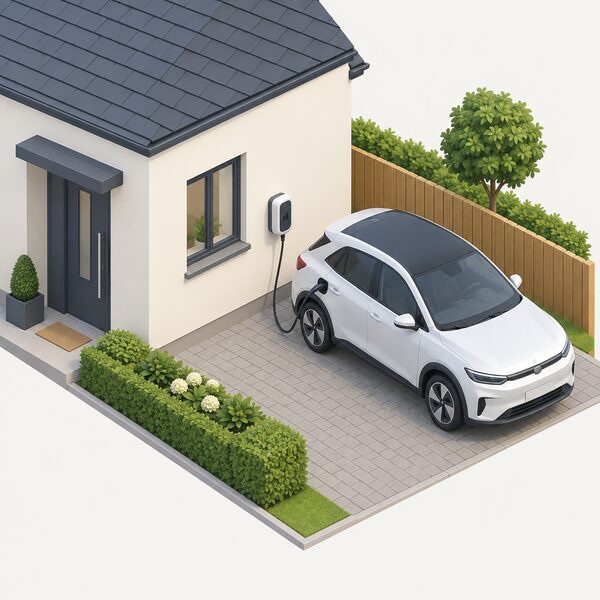
A new connection to the network is a quoted job with published indicative timescales. Electricity North West states that a new connection takes on average six to eight weeks from when the site is ready6. For one to four properties, the same six to eight week average applies from the site being approved, and after payment and site readiness the average completion is four to six weeks7. The operator commits to completing a supply move within 20 days of payment where the site is ready, and to contacting the customer within 48 hours of acceptance to agree a start date14. Prices start from £1,300 for single domestic supplies14.
| Stage | Published timescale |
|---|---|
| New connection, site ready | six to eight weeks on average6 |
| After payment and site ready | four to six weeks on average7 |
| Supply move after payment | within 20 days, if ready for work14 |
| Contact after acceptance | within 48 hours14 |
| Single domestic supply price | from £1,30014 |
EV charging is the case where the answer is often no application at all. Electricity North West states there will be no charges from it directly associated with an electric vehicle charger installation, provided the property's supply capacity is capable of supplying the full demand and the installer uses approved equipment2. The exception is a looped supply: in order to connect an EV charge point, the operator says it would need to install a new supply2. On the planning side, installation of a domestic EV charger is likely to be permitted development with no planning application required where the home has off-street parking, provided it meets the criteria18.
Three-phase is the larger upgrade. Electricity North West gives an average cost of £5,370 for upgrading to three-phase power rated at 80A per phase, and describes it as a chargeable service2. The trigger is capacity: a single phase supply that now requires more than 100A after maximum demand and diversity calculations2. Installing three-phase equipment such as water pumps is one of the recognised reasons for the upgrade19.
For the wider process, see new electricity connection, apply electricity supply upgrade and three phase supply house.
Solar, G99 applications and adding generation capacity
Small-scale generation connects under a notification or an application, depending on size. G98 covers small-scale electricity generation such as solar panels or wind turbines with a capacity of 3.68kW or less per phase20. The information required includes the proposed total capacity of the installed generation in kW20. Above that threshold, G99 applies: installations over 3.68kWp require prior approval from the distribution network operator17. For applications above 3.68kW up to 50kW, Electricity North West directs applicants to G99 Form A1.16.
| Generation size | Route |
|---|---|
| 3.68kW or less per phase | G98 notification20 |
| Above 3.68kWp | G99 prior approval from the DNO17 |
| Above 3.68kW up to 50kW | G99 Form A1.16 |
Adding capacity to existing solar is treated separately from a new connection. Electricity North West states that this application is not chargeable for installations under 1MW6. That is a meaningful threshold for a domestic array, since a household system sits far below it.
The practical sequence for a household adding generation is therefore: establish the size of the array, check whether it falls under the 3.68kW per phase notification threshold, and if it exceeds it, apply for prior approval before the equipment is connected. The network operator's approval is about the effect on the shared network, not about the household's own wiring, and it is a condition of connecting rather than an optional step.
For the connection queue and the wider reform picture, see grid connection queue.
Meter moves, supply responsibility and flood safety
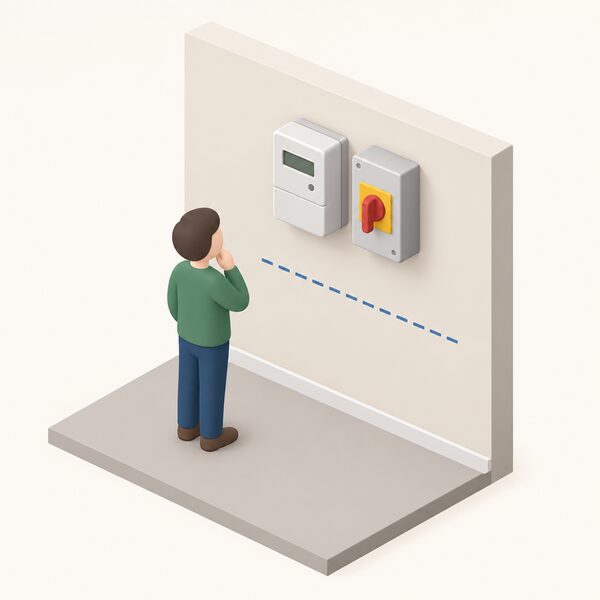
The division of responsibility is the key fact here. Your electricity meter is provided by your electricity supplier, and a flood damaged meter is a supplier matter10. Electricity North West states it does not sell electricity or fit meters, and that the meter will be installed by the chosen electricity supplier7. If only the meter needs to move, the supplier may be able to help, often for a small fee where the move is less than 1m21.
Where the supply itself moves, the network operator handles the cable and cut-out. As part of the project it will move the supply and meter, even a smart meter22. Internal wiring then needs altering, so an electrician is needed to connect it, and the operator says an electrician can be available on the same day the meter is moved23. Timescales run from receipt of a complete application and from quote payment where the site is ready, and the operator warns that during periods of high workload the times indicated may vary23.
Flood safety is set out in specific terms. In a flood prone area, the advice is to check that the meter is above the level of previous floods, and if it is not, the meter may need to move10. During a flood, the instruction is to turn off the supply by the isolator switch, but only if it is safe to do so10. After a flood, if the supply is still on or has been underwater but is now back on, the operator recommends contacting a qualified electrician10. For a flood damaged meter, the supplier is the contact10.
Disconnections are handled separately, and the online estimate service covers only disconnections with a single phase supply to underground services24. For the emergency route, 105 is the number to report an emergency 24 hours a day24.
For related procedures, see move electricity meter without moving supply and disconnect gas supply permanently.
What the connection means for a household's independence
The network operator is the fixed part of a home's electricity supply. A household can change supplier, add solar, fit a battery and charge an electric vehicle, but the connection to Electricity North West's network remains the route by which power arrives when the home cannot generate enough, and the route by which surplus leaves. The operator's own figures show how much of the relationship is procedural rather than commercial: a new connection averages six to eight weeks from site readiness and starts from £1,300, a three-phase upgrade averages £5,370, and a solar array above 3.68kWp needs prior approval before it can be connected6.
The dependence that remains is structural. The wires, the substation and the control room are shared, and the household's supply quality depends on the network as a whole. What a household controls is the demand it places on that connection, the generation it adds behind it, and the preparation it makes for the hours when the supply is interrupted. The Priority Services Register, the 105 number and a clear understanding of who owns the meter are the practical levers, and none of them requires changing supplier or fuel.
For the wider picture of what homes can and cannot control, see energy security and household independence and the UK energy supply pillar.
Sources24 cited
- Guaranteed standards, Electricity North West, 2026-09-19
- Single EV charger connection, Electricity North West, 2026-09-20
- Power cuts: what to do if your power goes out, Smart Energy GB, 2026-08-19
- Planned power cuts, Electricity North West, 2026-09-19
- How we will let you know, Electricity North West, 2026-09-19
- Connections FAQs, Electricity North West, 2026-09-20
- New connections for 1 to 4 properties, Electricity North West, 2026-09-19
- Be summer ready, Electricity North West, 2026-09-19
- Who is my gas and electricity supplier, Confused.com, 2026-07-03
- Flooding advice, Electricity North West, 2026-09-19
- Smart meter information, Electricity North West, 2026-09-20
- FAQs, Electricity North West, 2026-09-20
- Extra support for poor mobility, Electricity North West, 2026-09-20
- What to expect when planning your connection, Electricity North West, 2026-09-20
- Support schemes, Cheshire West and Chester Council, 2026-09-17
- Check if you can get payment for a power cut, Ofgem, 2026
- NIE Networks winter ready, NIE Networks, 2026-09-19
- Electric vehicle charging, Planning Portal, 2026
- What do you need to upgrade, UK Power Networks, 2026-09-17
- Micro-generation connections up to 3.68kW per phase, SSEN, 2026-09-17
- Meter move information, Electricity North West, 2026-09-20
- Moving your meter, Electricity North West, 2026-09-19
- Service alteration costs, Electricity North West, 2026-09-20
- Disconnect your supply, Electricity North West, 2026-09-19