

In this answer
Short answer
The Boiler Upgrade Scheme (BUS) is a UK Government grant that pays part of the cost of replacing fossil fuel heating with a heat pump or biomass boiler in England and Wales1. Among government-supported heat pump installations in the UK, the majority run through it: 56% of government-supported heat pump installations in the year ending March 2025 were funded through the BUS2.
That 56% is a share of government-supported installations, not of the whole heat pump market. The same official statistics put the Energy Company Obligation at 36% of government-supported installations in the same period, and the two figures are not reconciled in the published data2. An earlier release, for the year ending September 2024, put BUS at 49% and ECO at 46%3.
The scheme's own delivery is smaller than its target. By 31 July 2025 it had supported 49,136 low carbon heating systems since its start4, against a stated ambition of 600,000 heat pumps per year by 20285. The grant rose by 20% on 21 July 2026, from £7,500 to £9,000, to help rural households6.
What the Boiler Upgrade Scheme is and what it funds
The BUS provides upfront grants to help reduce the cost of installing heat pumps and biomass boilers in homes and non-domestic buildings1. It is a UK Government initiative8, and the Energy Saving Trust describes it as a grant of up to £7,500 to help pay for a heat pump or biomass boiler in England and Wales9. The scheme was announced as a £450m fund, spent on grants that predominantly subsidise the upfront cost of low carbon heating10.
Its purpose is to support the decarbonisation of heat in buildings, providing upfront capital grants towards approved heat pumps and biomass boilers in homes and small non-domestic buildings in England and Wales11. The grant helps cover the costs of installing low carbon heating technologies such as heat pumps12.
Eligible technologies are air-to-water heat pumps, air-to-air heat pumps, ground source heat pumps including water source heat pumps and shared ground loops, and biomass boilers13. Biomass boilers are only eligible in properties that are both in a rural location and not connected to the gas grid; heat pumps have neither restriction14.
The scheme is overwhelmingly domestic in practice. Domestic installations accounted for 41,063, or 99.5%, of all installations where the applicant declared this information15. In its first year, 99.6% of installations were in domestic properties11.
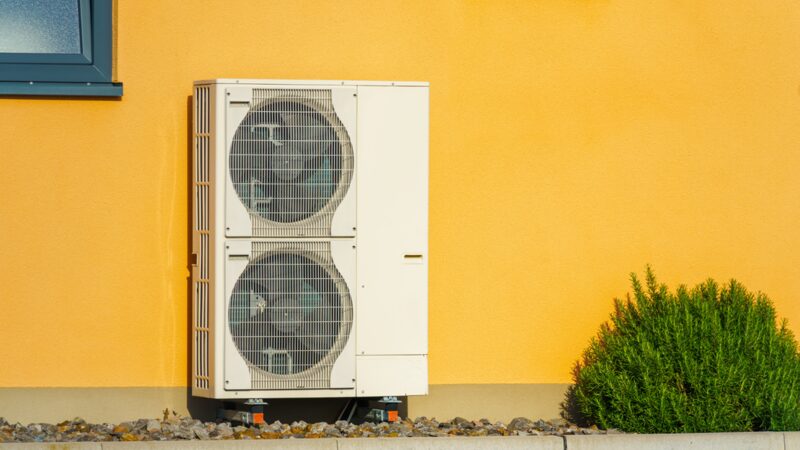
The scheme's share of heat pump installations: 56% and how it is measured
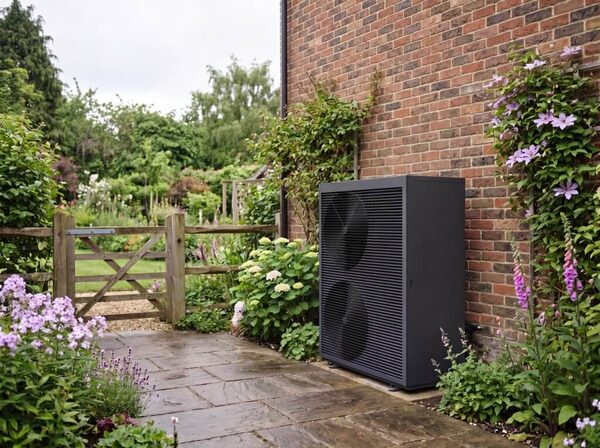
The headline figure is 56%: the share of government-supported heat pump installations in the year ending March 2025 that were funded through the BUS2. The measurement matters as much as the number. The denominator is government-supported installations, so the share describes how public money is split between schemes, not how many UK heat pumps in total carry a grant.
The same release puts the Energy Company Obligation at 36% of government-supported installations in the year ending March 20252. The two figures do not sum to 100%, and the published documents do not reconcile the remainder. An earlier release covering the year ending September 2024 gives BUS 49% and ECO 46%3. Read together, the two periods suggest the BUS share of government-supported installations rose while the ECO share fell, though the periods differ and the figures are not directly comparable.
The scheme's own statistics are published separately. The July 2026 release covers the uptake of the scheme to date, including the number of voucher applications and redemptions and the costs of installation16. Ofgem publishes quarterly and annual reports on the same scheme17.
What the share does not tell a household is the size of the unsubsidised market. Heat pump installations rose 56% in 2024 on the Climate Change Committee's figures18, and applications to the scheme rose 93% in April 2024 compared with the same month in 202319. Those are growth rates for different things, and neither converts the 56% share into a share of all UK installations.
How the BUS share compares with the Energy Company Obligation
The BUS and the Energy Company Obligation are different instruments that appear side by side in the same deployment statistics. The BUS pays an upfront capital grant and is installer-led20. The ECO figures appear in the government-supported installation series alongside it2.
The BUS carries a replacement condition that shapes what it funds. The funded system must fully replace the property's existing fossil fuel or electric heating system, except where supplementary heating appliances are permitted21. To qualify, a property must be replacing an existing heating system that operates on either fossil fuels or electricity, and properties with previous public funding for a heat pump or biomass boiler are not eligible15.
Sizing is also constrained. Updated guidance emphasises that the heat pump must be sized to meet full space heating demand either standalone or in combination with a supplementary appliance, with the key constraint that the BUS-funded heat pump must still be sufficient on its own for space heating22.
Non-compliance data show where applications fail. In Scheme Year 3, 109 cases, or 31.7% of non-compliances, involved an existing system that was not a fossil fuel or electric heating system, under Regulation 5(1)(c)(ii), the most common single non-compliance15. In Scheme Year 1, the same category accounted for 50.9% of the total11.
For a household, the practical difference is the route to the money. BUS grants are claimed by an installer on the owner's behalf; ECO is delivered through energy suppliers. Both reduce the upfront cost of a heat pump, and both appear in the same official series, which is why the two shares are read together.
What the numbers show about who uses the scheme
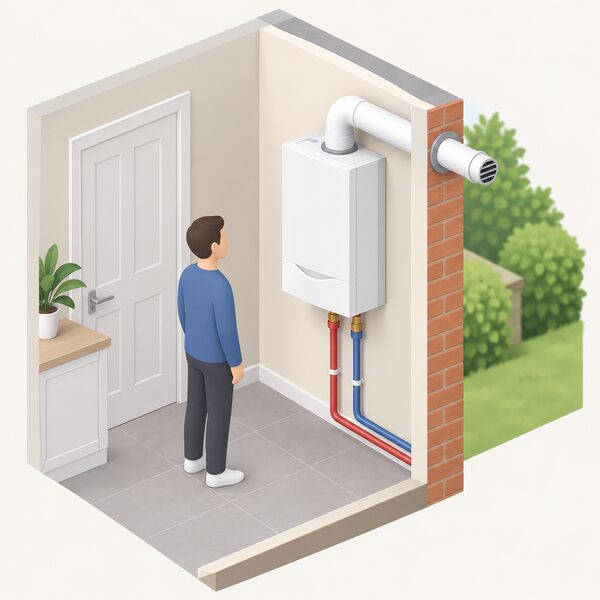
Gas heating dominates what the scheme replaces. Over the scheme's lifetime, gas systems made up 55.0% of original heating systems replaced, oil was second at 17.3%, direct electric at 9.0%, coal at 1.0% and other systems at 1.1%23. Around 76.3% of grants paid since the start of the scheme went to the replacement of fossil fuelled heating systems such as gas boilers7. An earlier annual report put gas at 52.6% of systems replaced and oil at 18.1%15.
Air source heat pumps take almost all the money. Since the scheme began, 97.6% of grants paid were for air source heat pumps7. The breakdown across technologies is air source 97.0%, ground source 2.3%, biomass 0.6%, with shared ground loop ground source heat pumps making up the remainder15. Of grants paid to 27 February 2026, 73,333 or 97.6% were for air source heat pumps23. An earlier independent tally found 96% of applications were for air source heat pumps between May 2022 and May 202324.
Rural homes are a large part of the picture. Around 50% of grants from the scheme are going to rural homes25. Self-builds are a smaller but distinct group, accounting for 14.5% of total installations17. In the scheme's first year, 15.9% of installations involved no heating system being replaced, all in eligible self-build properties11.
Geographically, South East England has the highest number of BUS installations, with 20.0% of the total15. On the installer side, the market is concentrated: in Scheme Year 3 the top 10 installers by application volumes were responsible for over 40% of all grant applications received4. In Scheme Year 1, the top 30 installers were responsible for 6,001, or 38.1%, of applications, and 915, or 86.7%, of installers with accounts had submitted applications11.
| Original heating system replaced | Share of installations, scheme lifetime |
|---|---|
| Gas | 55.0%23 |
| Oil | 17.3%23 |
| Direct electric | 9.0%23 |
| Coal | 1.0%23 |
| Other | 1.1%23 |
Grant amounts, budget and the 600,000-a-year target
The grant has moved twice in the scheme's life. It was announced as £450m of funding26, and the Heat and Buildings Strategy set out £2.7bn in funding to 2030 to cover £7,500 towards the cost and installation of ground and air source heat pumps, including water source heat pumps27. Ground source heat pumps had earlier attracted £6,000, including water source heat pumps and those on shared ground loops28, and the 2022 scheme leaflet stated £6,000 was available towards ground source heat pumps29.
From 21 July 2026 the grant is being increased by 20%, from £7,500 to £9,000, to help rural households6. The £7,500 figure covered nearly 60% of the average cost of installing a heat pump, based on the average cost in 202330.
Against that, the delivery target is far above current volumes. The stated target is deploying 600,000 heat pumps per year by 20285. The scheme had supported 49,136 low carbon heating systems by 31 July 20254. Applications reached 11,256 between January and March 2025, up 73% from the first quarter of 202431.

What the scheme's share means for household energy independence
A BUS grant changes what a household pays upfront, not what it depends on afterwards. The grant covers part of the cost of installing a heat pump12, and the funded system must fully replace the existing fossil fuel or electric heating system21. That replacement is the point for independence: a home that runs its heat from electricity is no longer buying gas or oil for that purpose.
The dependence that remains is on the electricity grid and a supplier. A heat pump does not make a home self-sustaining; it moves the household's heating demand onto a different fuel, and the carbon and cost profile of that fuel depends on how the electricity is generated and priced. The Climate Change Committee's position is that electricity should be made cheaper for consumers18.
The scheme's reach is also uneven. Around 50% of grants go to rural homes25, and rural off-gas-grid homes are where oil and solid fuel dependence is concentrated. The scheme's own history shows how many households were replacing boilers rather than adding heating: in the closed Domestic Renewable Heat Incentive, 52.3% of installations replaced boilers as of 31 March 202332.
For a household weighing a heat pump, the BUS share figure is a measure of how public funding is distributed, not a measure of how many homes have made the switch. The scheme is installer-led20, and the installer applies for the grant on the property owner's behalf, discounts it from the invoice, applies to Ofgem for a grant voucher, and redeems the voucher after installation and commissioning33. The property owner does not apply directly.
Sources33 cited
- Boiler Upgrade Scheme, Ofgem
- Heat pump deployment quarterly statistics, United Kingdom 2025 Q1, GOV.UK, 2025
- Heat pump deployment quarterly statistics, United Kingdom 2024 Q3, GOV.UK, 2024
- Boiler Upgrade Scheme annual report, April 2024 to March 2025, Ofgem, 2025-07-31
- Boiler Upgrade Scheme annual report 2022-23, Ofgem
- Thousands of homes will be eligible for £9,000 off a heat pump, GOV.UK, 2026-07-21
- Boiler Upgrade Scheme annual report, April 2025 to March 2026, Ofgem, 2026-07-31
- Robert and Maria's air source heat pump, Energy Saving Trust, 2022-04-20
- Energy jargon buster, Energy Saving Trust, 2026-03-20
- What the Heat and Buildings Strategy means for MCS certified installers, MCS Certified, 2021-10-21
- BUS Annual Report 2022-23, Ofgem, 2023-07-31
- Boiler Upgrade Scheme guidance for property owners, Ofgem, 2025-02-03
- Boiler Upgrade Scheme guidance for installers v5.1, Ofgem, 2026-07-02
- Boiler Upgrade Scheme, Find government grants service, 2026-09-18
- BUS Annual Report 2024 to 2025, Ofgem, 2025-07
- Boiler Upgrade Scheme statistics, July 2026, GOV.UK, 2026-08-27
- Boiler Upgrade Scheme quarterly report, Issue 13, Ofgem, 2025-08-29
- Make electricity cheaper for consumers, says climate advisor, Climate Change Committee, 2025-06-25
- Demand for heat pumps rises following increase in applications to the Boiler Upgrade Scheme, GOV.UK, 2024-05-23
- Boiler Upgrade Scheme guidance for property owners V5, Ofgem, 2026-04-28
- Boiler Upgrade Scheme guidance for installers V5, Ofgem, 2026-04-28
- Summary of updates to BUS guidance for installers V5, Ofgem, 2026-04
- Boiler Upgrade Scheme quarterly report, Issue 15, Ofgem, 2026-02-27
- Boiler statistics, Uswitch, 2022
- Heat pumps: a user survey, Nesta, 2023-05-23
- Heat Market Mechanism consultation, UK Parliament, 2021-10
- Carbon Budget and Growth Delivery Plan: heat and buildings factsheet, GOV.UK
- Government help with gas and electric bills, StepChange, 2026-09-20
- Boiler Upgrade Scheme leaflet, GOV.UK, 2022-05
- Public Accounts Committee report, UK Parliament, 2023
- Rooftop solar for new builds to save people money, GOV.UK, 2025-06-06
- Domestic Renewable Heat Incentive annual report, scheme year 9, Ofgem, 2023-03-31
- Apply for the Boiler Upgrade Scheme, GOV.UK, 2026-09-18
 Microgeneration UptakeScotland has more solar panels and heat pumps per household than England, while Wales has built larger solar schemes and Northern Ireland lags behind.
 Ground Source Heat Pump CostWhat a ground source heat pump costs in the UK, splitting groundworks and drilling from the heat pump and internal works, and how the £7,500 Boiler Upgrade Scheme grant and the £9,000 off-gas-grid uplift change the figure.
 How Much Does a Heat Pump CostA heat pump usually costs around eleven thousand pounds installed, though quotes vary a lot depending on your home.
 Heat Pump Install StatisticsHow many heat pumps are actually being fitted in the UK each year, and is that number going up?
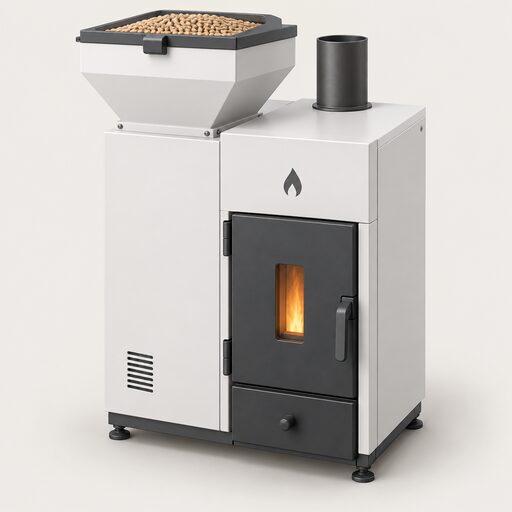 Biomass Boilers and StovesHow pellet and log biomass boilers and room stoves work in UK homes: the £5,000 Boiler Upgrade Scheme grant and its rural, off-gas-grid conditions, emissions limits, smoke control area law, fuel sourcing and the practical demands of storage and maintenance.
 Building RegulationsReplacing a boiler or heating system usually needs building regulations approval, and the rules differ across England, Scotland, Wales and Northern Ireland.