
In this answer
Short answer
Yes. A heat pump almost always needs a stored hot water cylinder, and that cylinder is usually larger than the one a boiler would use, with a bigger heat exchanger coil inside it. The reason is temperature: heat pumps run at lower flow temperatures than a boiler, with 55°C as a maximum, against the 65°C or more a boiler cylinder coil is built for1. A bigger coil surface transfers heat into the stored water fast enough at those lower temperatures.
The practical consequence is that a household moving from a combi boiler, which has no cylinder at all, gains a tank it did not have before. Which? states plainly that if you are replacing a combi boiler with a heat pump, you will probably need to install a hot-water tank or cylinder2. Nesta notes the same requirement, often replacing a cylinder that was removed to make way for a combi boiler after 20053.
Sizing is normally worked out per person rather than from a single figure, and stored water has to be held hot enough to stay safe. The sections below set out the coil, the volume, the temperature and the installation rules.
Yes: heat pumps need a larger cylinder, with a bigger coil
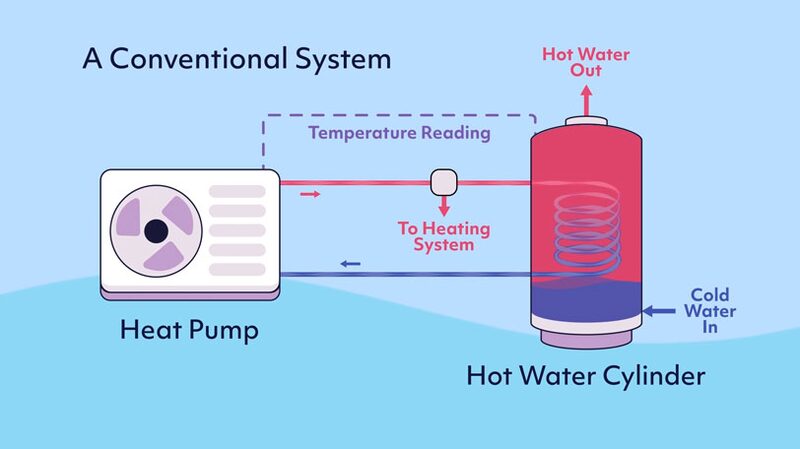
The short answer is that a heat pump installation requires a hot water tank, and that tank is usually bigger than the cylinder a traditional setup would use. Air-to-water heat pumps need a hot water cylinder so they can store heated water for taps and showers9. Air source heat pumps do not provide hot water instantly the way a combi boiler does, so a cylinder is the mechanism that bridges the gap between when the heat pump runs and when someone turns on a tap4.
The Chartered Institute of Plumbing and Heating Engineering puts the general rule clearly: low-temperature, low-carbon solutions such as heat pumps generally require a hot water cylinder, while many homes with gas combination boilers do not4. CIBSE reaches the same conclusion, noting that not all types of heat pump will supply hot water, and the ones that do will not deliver it on demand in the same way or to the same temperature as a combi boiler10.
That matters for a household's energy independence in a specific way. A cylinder is stored energy on your side of the meter. It lets a heat pump run when electricity is cheap or when the sun is out, and it decouples hot water from the moment of use. The trade is space and a standing heat loss, and the cylinder itself is still filled from the mains, so the household remains dependent on the water supply and on the electricity that drives the compressor.
Why heat pumps need a larger hot water tank
The driver is flow temperature. Heat pumps run at considerably lower temperatures than traditional boilers, with 55°C as a maximum1. A boiler cylinder coil is designed around a much hotter primary circuit, so it can be small and still recover quickly. Move to a cooler primary circuit and the same coil transfers heat too slowly.
The same physics shows up on the space heating side. Because heat pumps operate at lower flow temperatures, the heat-emitting surface area must be bigger than for boiler-operated heating, which is why some homes need larger radiators when switching11. A cylinder coil is simply another heat emitter, and it follows the same rule: lower temperature means more surface area.
There is a limit to how far oversizing helps. Heat pumps are already oversized for most of the year's thermal demand, so further over-sizing would compromise efficiency13. That is an argument for correct sizing rather than a bigger tank for its own sake. Northern Ireland's official guidance makes the same point about the unit itself: an undersized heat pump may struggle to meet demand, while an oversized one may cycle on and off often and lessen efficiency14.
In practice, a household should expect the cylinder to be specified alongside the heat pump, not chosen afterwards. The Energy Saving Trust notes that an installer will usually fit a hot water cylinder to store water heated by the heat pump, ready for when it is needed15. The cylinder is part of the system design, and its coil rating has to match the flow temperature the heat pump actually delivers.
Coil size: why heat pump cylinders have an oversized heat exchanger
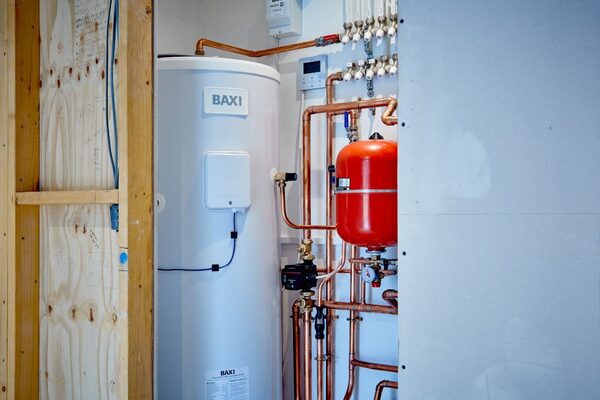
A heat pump cylinder contains a larger heat exchanger coil because heat pumps operate at lower flow temperatures than gas or oil boilers5. Baxi describes the same design feature from the maker's side: the cylinder has a larger coil than would be used in a traditional boiler cylinder, allowing heat to be transferred faster at lower flow temperatures16.
The coil is the interface between the heat pump circuit and the stored water. Its job is to move a given amount of heat in a given time, and the rate depends on surface area and temperature difference. Lower the temperature difference and you must raise the surface area to keep the recovery time acceptable. That is the whole reason a heat pump cylinder is not interchangeable with a boiler cylinder.
"Because heat pumps operate at lower flow temperatures than gas or oil boilers, the cylinder contains a larger heat exchanger coil."
A cylinder with an undersized coil will still heat water, but slowly, and it may not reach the stored temperature the household needs within the window the heat pump is running. That is why the coil specification belongs in the quotation rather than being assumed. It also explains why a cylinder that worked perfectly well on a boiler is rarely reused on a heat pump, even when the volume looks adequate.
Sizing the cylinder: 45 to 60 litres per occupant
Volume is usually worked out per person. MasterTherm's guidance is to ballpark around 50 litres per person as a starting rule, then adjust for lifestyle, distinguishing big baths from quick showers6. That places a two-person household in the region of 100 litres and a four-person household nearer 200 litres, before any adjustment for a large bath or heavy simultaneous use.
Real installations can run larger. One participant in a Which? study reported being told they would have to store a big tank of about 300 litres17. That is a single household's account rather than a sizing standard, but it shows how far the figure can move once a household's hot water habits and the heat pump's recovery rate are taken into account.
For scale, a domestic heating oil tank ranges from around 650 up to 10,000 litres for home heating18. A hot water cylinder is a different order of magnitude entirely, which is worth remembering when the space question comes up.
| Household | Starting volume at 50 litres per person | Notes |
|---|---|---|
| 1 occupant | about 50 litres | adjust upward for frequent baths |
| 2 occupants | about 100 litres | common minimum for a heat pump cylinder |
| 3 occupants | about 150 litres | check recovery time against usage |
| 4 occupants | about 200 litres | larger again if baths dominate |
The figures above are the rule of thumb applied, not a published table, and two independent guidance documents give 110 litres and 210 litres for the same attribute, so the underlying cylinder size question is unresolved2. A household should expect the installer's figure to sit somewhere in that territory and to be justified by a hot water demand calculation rather than a rule alone.
Cylinder temperature: 60 to 65°C, and how low you can safely go
Stored hot water has to be held hot enough to be safe. Most heat pumps will heat hot water to 50 to 55°C very efficiently, and then the sterilisation cycle raises the temperature higher7. Many heat pumps can provide hot water over 60°C consistently, which is the minimum temperature the hot water cylinder will need to reach7. Age UK describes 60°C as fine for most people19.
Where a heat pump cannot reach that on its own, a backup heat input is needed. Newark Cylinders states that this can be an immersion heater, gas or oil boiler, or any other heat application capable of raising the temperature of the stored water to around 60 to 65°C20. The maximum temperature most heat pumps can achieve is 55°C, which is why the backup exists20.
Lowering the cylinder to 45°C is a different proposition from lowering flow temperature to radiators. A heat pump operates most efficiently when delivering lower temperature water than a traditional boiler would, up to 45°C lower7, but that describes space heating. Cylinder settings need to be set by a boiler engineer and kept hot enough to avoid the build-up of bacteria in the storage tank22. The National Calculation Methodology recognises 45°C and 35°C as low-temperature design flow figures for heating systems, stated on the commissioning certificate and rounded to the nearest whole number23. Those are heating circuit figures, not stored water figures.
For comparison, a regular boiler with a separate cylinder has only one control for both radiators and hot water, set no lower than 65°C so it can heat the cylinder to 60°C24. A heat pump separates the two, which is what allows efficient space heating and safe stored water at the same time.
Space, materials and installer requirements
A cylinder takes room, and the room has to be found. Solar water heating guidance makes the point that a larger hot water cylinder is likely to be needed and will take up extra room25. The same applies to a heat pump cylinder, and it is often the constraint that decides where the system goes.
The outdoor side varies by technology. An air source heat pump is a bit larger than a domestic washing machine26. Ground source heat pumps suit larger homes that use a lot of heat, needing outdoor space for the ground array and access for specialist digging machinery27, and they require more outdoor work to install28. Air source split systems, ground source and water source heat pumps all require space for a compressor and controls, with an internal unit that is often smaller than a standard boiler7.
Installation cost depends on the size of the property, whether it is a new build or an existing house, and how much work is needed to adapt the existing heating system29. A cylinder change sits inside that adaptation work.
On lifespan, a well-maintained hot water cylinder can last between 10 and 20 years, depending on factors such as water quality and maintenance, and some cylinders under optimal conditions can last 40 to 50 years, though this is rare8. Newer models can hold their heat for up to 48 hours31. That retention matters for independence: with a cylinder and a time-of-use tariff, there is potential to use off-peak electricity for heating and storing hot water to balance the energy supply32. Insulating the cylinder with a jacket reduces heat loss by up to 75%33.
Sources33 cited
- An introduction to heat pumps, Which?, 2025-09-22
- Air and ground source heat pumps, Croydon Council, 2026-09-17
- Seven reasons we still need heat pump subsidies, Nesta, 2025-11-20
- Heat pump systems, CIPHE, 2026-09-17
- Will a heat pump provide hot water as well as heating, Alpha Heating Innovation, 2025-08-12
- Do you need a hot water cylinder with a heat pump and how big are they, MasterTherm, 2026-02-06
- Heat pump myths, Energy Saving Trust, 2025-09-02
- How long do hot water cylinders last, Newark Cylinders, 2026-07-13
- Everything you need to know about air to water heat pumps, E.ON Next, 2025-08-18
- Heating and heat pump factsheets, CIBSE, 2026-09-17
- Why is my house so cold with a heat pump, Aira, 2026-06-26
- Is my house suitable for a heat pump, NIBE, 2026-09-17
- Summary of findings from heat pump flexibility expert workshop, CREDS, 2023-10-04
- Heat pumps, nidirect, 2025-02-24
- Heat pump installation: a step by step guide, Energy Saving Trust, 2026-07-15
- Know about your air source heat pump cylinder, Baxi, 2026-06-18
- Beyond affordability: why heat pumps feel like a gamble, Which?, 2026-07-02
- Heating oil tanks, Which?, 2026-06-01
- How to use your heating controls, Age UK, 2026-03-23
- Solar and heat pump cylinders, Newark Cylinders, 2026-07-16
- Heat pump inheritance, Energy Saving Trust, 2025-07-04
- Make your home more energy efficient in one weekend, Which?, 2026-08-28
- Low temperature heating, NCM PCDB, 2026-09-17
- Thermostats and heating controls, Energy Saving Trust, 2026-02-10
- Your home guide to solar water heating, OFTEC, 2026-09-20
- Air source heat pumps fact sheet, Pendle Borough Council, 2026-09-17
- Installing a ground source heat pump, Which?, 2025-09-22
- Air source heat pump for rural off gas home, Energy Saving Trust, 2026-01-05
- In depth guide to heat pumps, Energy Saving Trust, 2026-07-16
- What is an unvented cylinder, Newark Cylinders, 2026-07-24
- Hot water, Uswitch, 2025-01-31
- Heat pump and hybrid guidance, HHIC, 2026-09-17
- Energy savings tips, British Gas Energy Trust, 2026-02-27
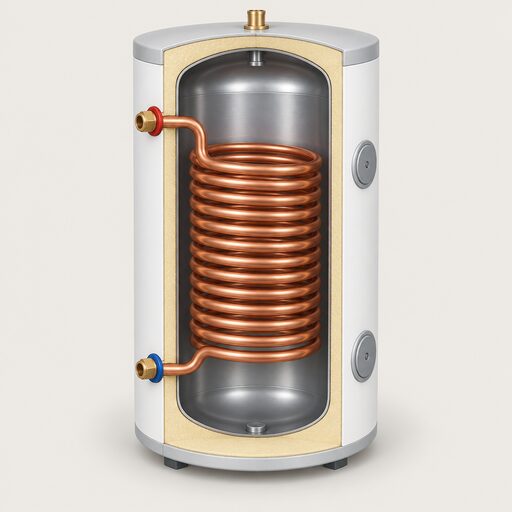 Hot Water CylindersA heat pump needs a cylinder to store hot water, so swapping a combi means getting one.
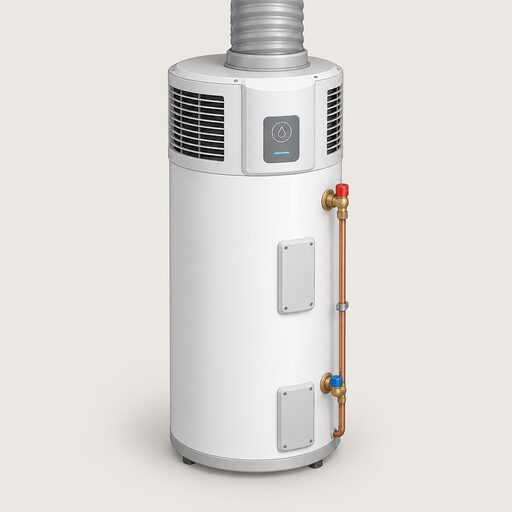 Hot Water Heat PumpsA hot water heat pump heats only the water in your cylinder, using air instead of a boiler flame.
 Replacing a Gas or Oil BoilerSwapping a gas, oil or LPG boiler for a heat pump changes how your home is heated and how much it costs.
 Heat Pumps vs BoilersWill a heat pump actually cost less to run than my boiler, and does it heat the house as well?
 System Boilers ExplainedA system boiler heats your radiators and stores hot water in a separate cylinder, so several taps and showers can run at once.
 The Full Boilers and Heating GuideWhich boiler suits your home, and when is it worth swapping the old one?