
In this guide
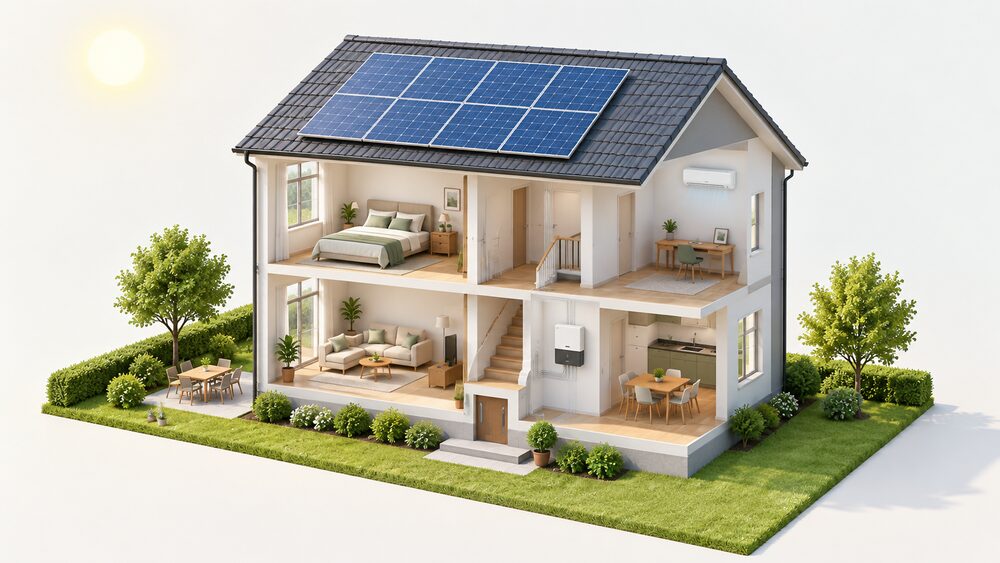
Air conditioning with solar panels is not a special kind of air conditioner. It is an ordinary cooling unit, or a reverse-cycle unit that also heats, supplied by electricity generated on the roof. The panels convert sunlight into electricity, which can be used to run household appliances1, and an inverter converts the direct current the panels produce into the alternating current appliances use2. Cooling is one of the loads that fits that supply unusually well, because the hottest part of the day is also the brightest.
The practical question is not whether it works but how much of the cooling load the array covers. Solar panels lower electric bills by providing an additional source of electricity, which can be used to power appliances without taking electricity from the grid1. Every kilowatt-hour used on site is a kilowatt-hour not imported, and cooling is a load that arrives at the same hours as generation. What remains is the dependence that no array removes: the grid at night, in cloud, in winter, and whenever the air conditioner runs harder than the roof can supply.
What solar-powered air conditioning is
The phrase covers two quite different things, and the difference matters for what a household can expect.
The first, and by far the more common, is a conventional air conditioner running on solar photovoltaic electricity. The panels generate electricity or heat water using energy from the sun9, and in the photovoltaic case that electricity feeds the home's circuits. Several panels are connected together with other parts, like an inverter and wiring, to make a full system10. The air conditioner does not know or care where the electrons came from; it draws from the house supply, and the meter records the difference between what the roof makes and what the house uses.
The second is solar thermal, which uses sunlight to produce heat11. This is a water-heating technology, not a cooling one. Solar water heating uses energy from the sun to work alongside your conventional water heater12, and generally solar thermal equipment is not used to heat a home and works in combination with a central heating system13. It has no role in cooling a room, and a household researching "solar air conditioning" that ends up buying solar thermal has bought the wrong product.
There is a third distinction worth holding on to. A solar air conditioner is not a refrigerant category. The panels are made from special materials, usually silicon, that absorb light14, and the cooling circuit in the unit is a separate matter governed by the F-Gas rules and by who is allowed to work on it. Nothing about the solar supply changes the refrigerant, the safety rules or the servicing regime.
How the panels drive the system
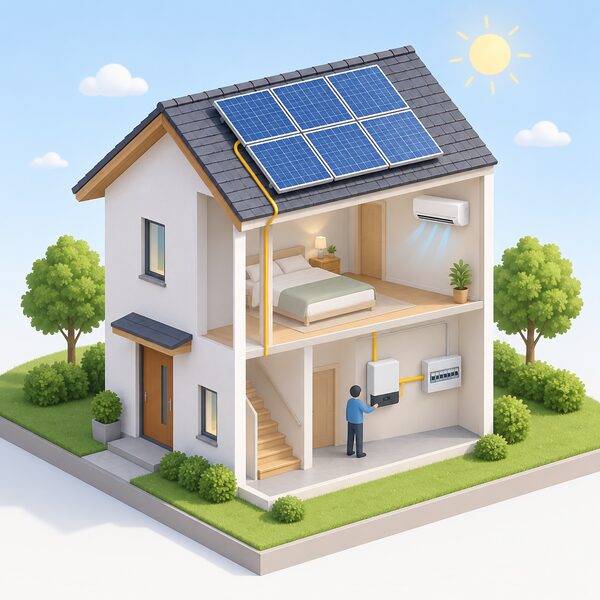
The chain is short. Solar cells convert the sunlight into electricity, which can be used to run household appliances15, and the cells do not need direct sunlight to work, since they can still generate some electricity on a cloudy day15. An inverter is installed along with the system to convert DC electricity to AC2, and from that point the air conditioner is simply another appliance on the consumer unit.
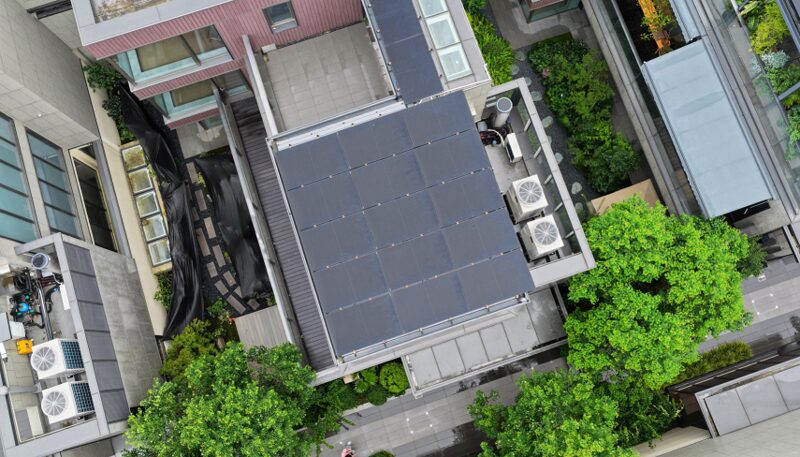
What the array delivers at any moment depends on several things: geographical location, the season and therefore hours of daylight, the roof's compass direction and slope, any shading that blocks the panels at certain times of day, and the efficiency of the system16. Cooling demand is driven by the opposite set of variables, chiefly outdoor temperature and solar gain through glazing, which is why the two curves overlap so well in summer and diverge so sharply in winter.
The electrical work is not a trivial add-on. Building regulations engage with the associated electrical works17, and the panels themselves are made with tempered glass so they will shatter rather than crack, like a car windscreen, on panels from MCS-registered brands18. That construction detail matters on a roof, where impact and thermal cycling are routine.
The advantages: clean, economical and long-lived
The case rests on three things that are well evidenced and one that is often overstated.
The first is that the fuel is free and renewable. The electricity generated from the sun is completely free and is 100% renewable22. Solar panels generate clean energy for your home, and as a bonus this can cut down on your energy bills23. For a household running cooling, that bonus is concentrated in exactly the hours when an air conditioner is working hardest, so the offset is larger per kilowatt-hour than for a load that runs at night.
The second is durability. Solar panels are long-term systems, often expected to remain operational for 25 years or more24, and regular upkeep will keep them working efficiently for their full lifespan, around 30 years4. Panels are made to last for 25+ years and need very little maintenance25. A cooling system added to an existing array therefore inherits a generation asset with decades left on it.
The third is the environmental arithmetic. Solar panels are a sustainable solution and can have a carbon neutral footprint in as little as a year26. That is a payback on embodied carbon, not on money, and it is the figure most often confused with financial payback.
The overstated claim is the bill reduction. For an average three-bedroom house, installing solar panels could save you 62% off your energy bills26. That is a whole-house figure from one source, not a cooling figure, and it depends on how much of the generation is used on site rather than exported. A household that adds air conditioning increases its own consumption, which raises self-consumption and can improve the economics of the array, but it also raises total use. The saving is against a counterfactual, not a discount on the cooling unit.
Panel lifespan: about 25 years
The estimates cluster tightly, and the disagreement between them is small enough to plan around.
The estimated lifespan of new solar panels is 25 to 30 years, although this can vary depending on their environment3. The average lifespan before they show significant degradation is about 25 years8, and you can typically expect the solar panels themselves to last around 25 years27. One source puts it higher, saying panels should last for 30 years or more28, and another says you can expect your solar system to last for 25 years2.
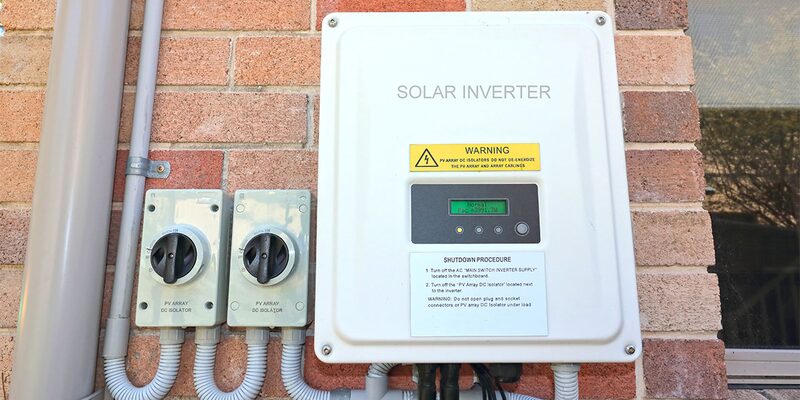
The component that will not last that long is the inverter. A solar inverter, which converts the energy generated by solar panels into electricity you can use to power your home, usually needs replacing after 10 to 12 years14. Another source gives every 10 to 15 years4. Solar panels can have warranties of up to 20 or 25 years, but inverters are not expected to last as long29.
Warranty terms follow the same split. Solar panels usually come with a 25-year performance warranty and a five to 10-year product warranty5. The performance warranty covers output, not failure, and the product warranty covers the panel as a manufactured item. Neither covers the inverter for the life of the array.
| Component | Expected life | Warranty |
|---|---|---|
| Solar panels | 25 to 30 years, varying with environment3 | 25-year performance, five to 10-year product5 |
| Inverter | 10 to 12 years14, or 10 to 15 years4 | Shorter than the panels29 |
| System as a whole | 25 years2 | Not stated as a single term |
For a household, the implication is a replacement budget with two lines, not one. The array is a 25-year asset; the inverter is a mid-life cost that will arrive once, possibly twice, within the life of the panels. Cooling equipment has its own service life and sits outside both.
Running costs in cooling and heating modes
Running cost is where solar changes the picture most, and where published figures are thinnest.
The efficiency of the cooling unit sets the baseline. Air conditioners working in cooling mode have a 4.0 SEER minimum energy efficiency ratio under the standards consulted on for domestic building services7. SEER is a seasonal measure, so a unit at the floor of the range delivers about four units of cooling per unit of electricity across a season. A more efficient unit uses less electricity for the same cooling, which matters more, not less, when the supply is a fixed array: a lower draw is covered by the roof for more of the day.
The cost of the electricity itself is the variable a household controls. Self-generated units avoid the import rate entirely, so cooling in daylight in sunny weather costs nothing at the meter for the portion the panels cover. The retailer's own estimate for a portable unit is around 25p to 40p per hour in cooling mode and 20p to 40p per hour in heating mode30, which is an imported-power figure and gives a sense of what the panels are displacing when they are generating.
Heating mode is the harder case. A reverse-cycle unit can heat, and it runs on the same supply, but the heating season is when the array produces least. The overlap that makes summer cooling so favourable disappears, and the household is back on imported electricity for most of the heat. Solar thermal, by contrast, is a heat technology: solar heating panels can still generate heat on cloudy days and during winter11, and alongside oil, LPG and biomass, solar thermal provides a viable option for homeowners to take a chunk off their carbon emissions31. It does not cool, and it does not run an air conditioner.
The installation cost of solar thermal gives a scale reference for the generation side: in 2025, the MCS Data Dashboard shows that the average installation cost of solar heating panels is around £6,20011. That is a solar thermal figure, not a photovoltaic one, and not an air conditioning figure. Residential solar panels are now over 50% cheaper than in 201132, which is the direction of travel on the photovoltaic side.
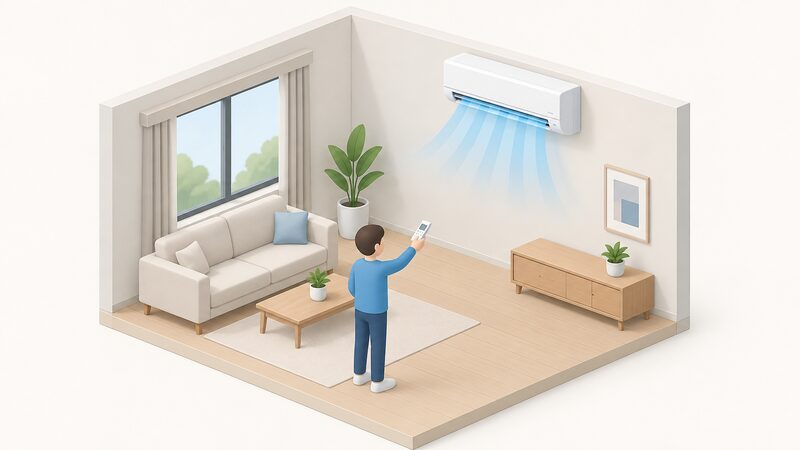
What solar air conditioning means for household energy independence
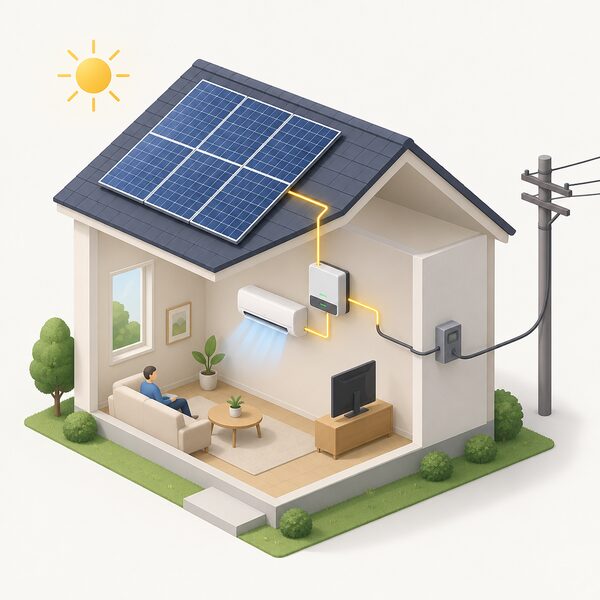
The independence a solar array delivers is real but partial, and it is worth being exact about which part.
What it removes is the import of electricity for every kilowatt-hour the roof supplies and the house uses on site. Solar panels lower electric bills by providing an additional source of electricity, which can be used to power appliances without taking electricity from the grid1. For cooling, that is a meaningful share of the load in summer, because generation and demand peak together. The household is no longer buying that electricity from a supplier, and is no longer exposed to the unit rate on it.
What remains is substantial. The grid is still the backup for every hour the array cannot cover: night, heavy cloud, winter, and any period when the air conditioner draws more than the roof produces. A supplier is still needed for the balance, and for the standing charge. The inverter is a single point of failure owned by a manufacturer, and its replacement at 10 to 15 years4 is a dependence on that company and its supply chain. If a battery is added, the household gains evening coverage but takes on another component with its own service life and its own maker.
Planning is the other dependency, and it varies across the UK. In many cases, even in conservation areas, homes can have solar panels without requiring planning permission from the Council under permitted development24. Scotland has its own permitted development regime, reviewed through a Scottish Government work programme9, and Wales publishes separate guidance on generating your own energy33. Northern Ireland publishes its own material on solar thermal34. The rules are not identical, and a household in a listed building or a conservation area should establish its position before ordering equipment.
The honest summary is that solar turns cooling from a pure running cost into a partly self-supplied load, with the self-supplied share highest in exactly the weather that drives demand. It does not remove the grid, the supplier, the inverter maker or the planning system, and it does not remove the need for a certified engineer for the refrigerant side of the cooling unit. For the wider picture of how cooling and self-generation fit together, see Home Cooling and Energy Independence, and for the cooling side alone, Home Cooling and Air Conditioning: The Full UK Guide.
Sources34 cited
- How do solar panels work?, Smart Energy GB, 2026-03-16
- Solar power facts, Energy Saving Trust, 2026-08-13
- POSTnote: solar panels, Parliamentary Office of Science and Technology, 2026-06-25
- Solar panel cleaning and maintenance, Energy Saving Trust, 2026-08-25
- Buying a house with solar panels, Energy Saving Trust, 2026-08-13
- Solar panel myths: five common concerns debunked, Which?, 2026-06-09
- Draft guidance: domestic building services compliance guide, Scottish Government, 2021-07
- How long do solar panels last?, Uswitch, 2026-07-13
- Extending permitted development rights in Scotland: sustainability appraisal, Scottish Government, 2019-06
- Solar photovoltaic (PV), MCS Certified, 2026-07-30
- Solar heating, MCS Certified, 2026-08-17
- Solar thermal water heating, Planning Portal, 2026-09-17
- Solar equipment on residential buildings: technical advice note, Hart District Council, 2025-01
- Solar panel installation, maintenance and repair, NICEIC, 2026-09-17
- Solar panels and renewable energy, House of Commons Library, 2026-09-17
- Solar panels: how much of your electricity can they produce?, Which?, 2024-06-27
- Solar panels guidance, City of York Council, 2026-09-17
- Solar panel problems and how to solve them, Which?, 2026-03-26
- Energy-saving materials: VAT relief, legislation.gov.uk, 2019-10-01
- Energy-saving materials: VAT relief, legislation.gov.uk, 2024-02-01
- Zero VAT on renewables announced in Spring Statement, MCS Certified, 2022-03-23
- Solar panels, Oxfordshire County Council, 2026-09-17
- What is global warming and what can I do about it?, Smart Energy GB, 2026-03-16
- Solar panels and permitted development, London Borough of Richmond upon Thames, 2026-07-06
- Solar PV panels, AgilityEco, 2026-09-20
- Are solar panels a good investment?, The CPA, 2023-08-23
- Solar panels, East Herts Council, 2026-09-17
- Solar panels, Home Energy Scotland, 2026-09-20
- Most common solar panel problems, Which?, 2026-09-20
- electriQ EcoPlus 10HPW air conditioner, electriQ, 2026-05-22
- Solar heat: the future of residential heat decarbonisation, Solar Energy UK, 2021-03-15
- New laws to guarantee payment for solar homes providing excess electricity, Department for Energy Security and Net Zero, 2019-06-09
- Generating your own energy: solar electricity, Welsh Government, 2026-09-17
- Solar thermal panels, nidirect, 2024-10-22
 Charging an EV from Solar PanelsCharging your car from solar panels means using the power your roof makes instead of sending it to the grid.
 Panels by Home TypeCan your house have solar panels, and how many will fit?
 Energy Bills and IndependenceSolar panels can cut the part of your bill that goes up with every unit you use, but you still pay a daily standing charge just for being connected to the grid.
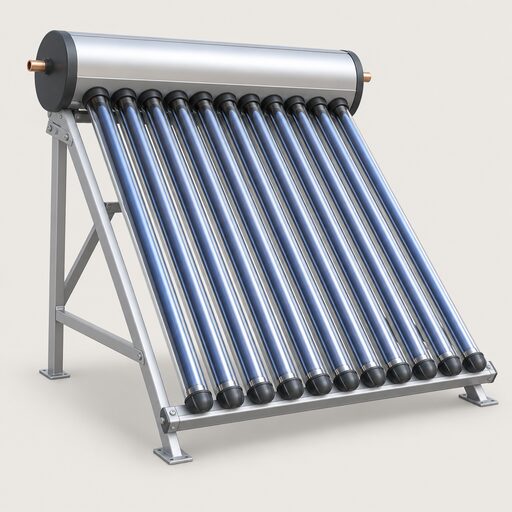 Solar Thermal Water HeatingSolar thermal panels heat your water using the sun, working alongside your boiler rather than replacing it.
 Using a Heat Pump for CoolingCan a heat pump cool your home in summer as well as heat it in winter?
 Solar Mounting SystemsWill your roof take the extra weight of solar panels, and will it still keep the rain out afterwards?