In this guide
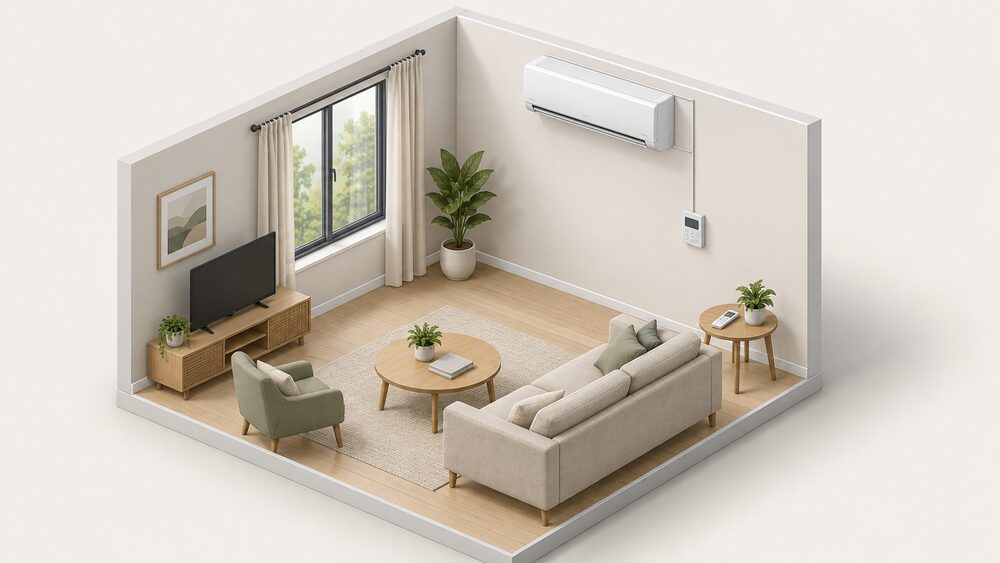
Air conditioning in a UK home is usually controlled in one of three ways: an infrared handset that comes in the box, an optional wired controller mounted on the wall, or Wi-Fi that puts the unit on a phone, a voice assistant and a smart home system. The first two work without a network. The third does not.
The distinction matters more than the feature list suggests. Carrier lists an infrared remote controller as standard on its residential mono-split range, with Wi-Fi control included on the same range and models ending -WF carrying Wi-Fi for smart control1. Fujitsu General takes the opposite approach on several wall-mounted indoor units, offering wireless LAN control only through an optional WLAN adapter that enables the air conditioner to be operated by smartphone or tablet from outside the home3. Toshiba builds Wi-Fi in at the factory on the RAS HAORI High-Wall, controlled through the Toshiba Home AC Control app7.
So the question is not whether an air conditioner can be controlled remotely, but what that control depends on. A handset depends on nothing but batteries. A wired controller depends on a cable. Wi-Fi control depends on your broadband, your router, the maker's cloud service and, in most cases, an account with the manufacturer. That is the trade a household makes, and it is worth understanding before choosing a model.
What Wi-Fi control adds to a home air conditioner
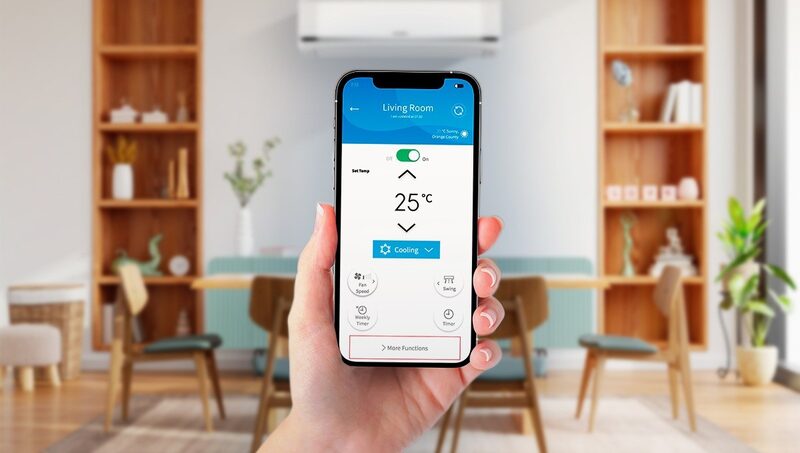
Wi-Fi turns a cooling unit into something a household can schedule, monitor and operate from another room or another country. Netatmo describes smart air conditioners as using wifi and being controlled through a dedicated smartphone app, with voice assistants such as Amazon Alexa or Google Assistant where compatible10. That combination, an app plus a voice assistant, is the core of what Wi-Fi adds.
The feature set goes further on some systems. Carrier's Wi-Fi app for its split systems allows the household to set on and off status and fan speed, obtain and modify the operation mode and temperature, customise a sleep curve, set time scheduling, run auto-diagnosis and view a monthly electricity curve1. The monthly electricity curve is the most useful of these for a household watching running costs, because it turns the unit's consumption into a visible trend rather than a single meter reading at the end of the quarter.
Wi-Fi also enables voice control in the home. Hitachi states that voice command lets users control their air conditioning hands-free when at home, which it describes as convenient when engaged in other activities11. That is a comfort feature rather than an efficiency one, but it changes how often a household adjusts settings rather than leaving a unit running.
What Wi-Fi does not do is reduce the electricity a unit draws. It changes when the unit runs and at what setpoint, and scheduling can avoid cooling an empty room. The saving comes from the schedule, not the radio. For a wider view of what drives consumption, see air conditioning running costs.
The same pattern appears in heating controls, which is where most UK households meet this technology first. Drayton describes smart heating systems as typically including a smart thermostat, smart radiator thermostats and a hub that connects to your Wi-Fi12. Sundirect describes WiFi control through a dedicated mobile app on its Plus range heaters, allowing remote monitoring and adjustment of heating settings13. Electrorad lists distance control by WiFi app across all its ranges14. The architecture is the same whether the appliance heats or cools.
Remote, wired or Wi-Fi: which control suits which household
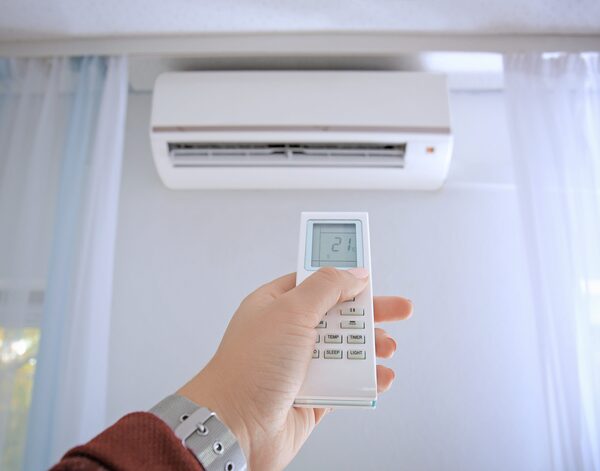
The three control types are not interchangeable, and the choice follows from how the household uses the room rather than from preference.
An infrared handset suits a single room with a predictable routine. It needs line of sight, it stays in the room, and it works during a broadband outage. Carrier supplies one as standard on its residential mono-split range1. Hitachi notes that most wireless controllers operate with infrared technology15.
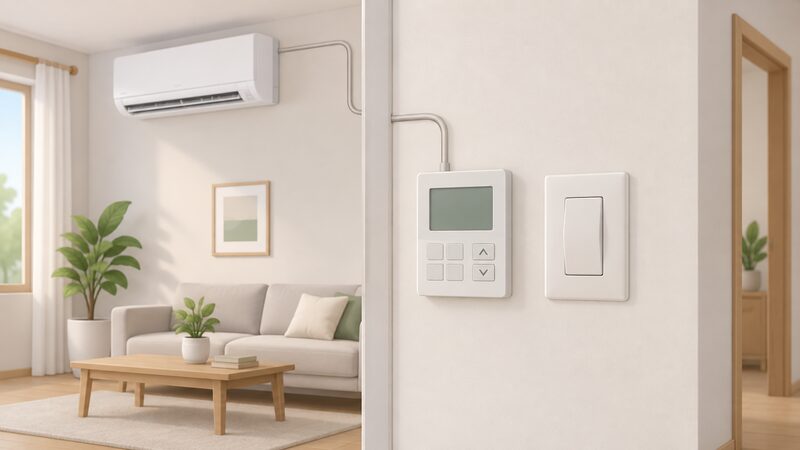
A wired wall controller suits a room where the unit is mounted out of easy reach, or where the handset would be lost. Daikin describes its concealed ceiling option as having an intuitive and easy-to-use wired remote control providing total control16. A wall controller is fixed, so it cannot be mislaid, and it does not depend on a network.
Wi-Fi suits a household that wants to run the unit from elsewhere in the house, from work, or on a schedule tied to occupancy. The Centre for Sustainable Energy states plainly that Wi-Fi is needed for remote control outside the home, while Bluetooth and Thread serve control at home17. That is the dividing line: if remote control from outside the home is the requirement, Wi-Fi is the only one of the three that delivers it.
A separate controller can add Wi-Fi to a unit that lacks it. The tado° Smart AC Control connects to Wi-Fi and is placed on any wall or surface with no wiring needed, and the maker states it connects straight to Wi-Fi with no bridge or extra hardware needed18. That route suits a household with an existing unit and no appetite for a new installation.
Wired remote controllers: the optional wall-mounted option
A wired remote controller is a wall-mounted panel connected to the indoor unit by a cable. It is an optional part on many systems rather than a standard fitting, and compatibility is set by the maker for each indoor model.
Fujitsu General lists a set of wired and simple remote controllers for the ASEH12KGTG: the UTY-RVRY, UTY-RCRYZ1, UTY-RNRYZ3, UTY-RLRY, UTY-RSRY and UTY-RHRY5. The same maker lists the UTY-RVRY, UTY-RCRYZ1 and UTY-RNRYZ3 as options for the ASEH14KGTG, the ASEH14KMCG and the ASEH12KMCG-B3. The UTY-RVRY and UTY-RNRYZ3 are described as wired remote controllers and the UTY-RCRYZ1 as a compact wired remote controller4.
Wired control is an optional extra rather than a standard fitting on most of the systems here. The maker lists a wired remote controller, a compact wired remote controller and a further wired remote controller as optional parts for its indoor units, alongside infrared handsets and optional user controllers on other ranges19. Wireless control is the more common default: infrared remote control is standard on wall-mounted fan coil units, and Wi-Fi appears as an optional add-on across several ranges, sometimes through a separate gateway that integrates into the indoor unit cabinet22. Where a household wants a fixed wall control, the practical point is that the controller is matched to the exact indoor unit, so compatibility is confirmed with the installer or the maker before ordering.
Wired control has one clear advantage over wireless: it does not depend on a battery, a signal or a network. Hitachi notes that wireless controllers are easier to install than wired controls15, which is the trade in the other direction. A wired controller needs a cable run at installation, which is straightforward when the walls are open and awkward afterwards.
The wider controls market shows the same split. Baxi has introduced a range of wireless controls compatible with its air source heat pumps, boilers and cylinders22. Alpha's Touch Wi-Fi thermostat offers local or remote control, described as managing your heating from anywhere, whether at home or on the go24. Both approaches exist because households differ in how much wiring they will accept.
Wi-Fi via an optional WLAN adapter: how it works
An optional WLAN adapter is a small module that connects a Wi-Fi-ready indoor unit to the home network. The unit ships without Wi-Fi, and the adapter is added at or after installation.
Fujitsu General describes the arrangement consistently across four wall-mounted indoor units. On the ASEH14KGTG, the ASEH14KMCG, the ASEH12KGTG and the ASEH12KMCG-B, the optional WLAN adapter enables the air conditioner to be operated by smartphone or tablet PC from outside the home3. The wording is identical across the four pages, which suggests a single accessory used across the range rather than a model-specific part.
Hitachi describes the same two-route approach from the maker's side: to use its airCloud Go service, Hitachi Cooling & Heating offers wifi-ready air conditioners, either with a built-in chip or by using an adapter11. That is the clearest statement of the choice a household faces at the point of purchase. The unit is either Wi-Fi-ready with a chip inside, or Wi-Fi-ready through an adapter that may or may not be included.
The practical consequences are worth setting out. An adapter adds a component that can be lost, damaged or discontinued. It also adds a step at installation, since the adapter has to be fitted and paired. Against that, it allows a household to buy a unit without paying for Wi-Fi it does not want, and to add control later if circumstances change.
"In order to enjoy airCloud Go, Hitachi Cooling & Heating offer wifi-ready air conditioners, either with built-in chip or by using an adapter"
Where an adapter is used, the household should expect the maker's app to be the only route to remote control. There is no open standard that lets a third-party system talk to an adapter-equipped unit directly, so the app and the maker's cloud sit between the household and the hardware.
Factory-integrated Wi-Fi: models that need no adapter
Some models ship with Wi-Fi built in, which removes the adapter and the pairing step. The trade is that the radio and the cloud service are part of the unit from the start, and the household has no option to run the unit without them.
Toshiba describes the RAS HAORI High-Wall as having factory-integrated Wi-Fi to control your air conditioner via the Toshiba Home AC Control app7. LG states that its Artcool air conditioners come with built-in Wi-Fi capabilities that allow users to control the temperature and settings from their smartphone or other devices through the LG SmartThinQ app8. Carrier lists Wi-Fi control as included on its residential mono-split air conditioners, with models ending -WF carrying Wi-Fi for smart control1.
| Model or range | Wi-Fi arrangement | App | Source |
|---|---|---|---|
| Toshiba RAS HAORI High-Wall | Factory-integrated Wi-Fi | Toshiba Home AC Control | 7 |
| LG Artcool | Built-in Wi-Fi | LG SmartThinQ | 8 |
| Carrier residential mono-split | Wi-Fi control included; -WF models have Wi-Fi for smart control | Carrier Air Conditioner Wi-Fi App | 1 |
| Fujitsu General ASEH14KGTG, ASEH14KMCG, ASEH12KGTG, ASEH12KMCG-B | Optional WLAN adapter | Maker app via adapter | 3 |
| Hitachi wifi-ready units | Built-in chip or adapter | airCloud Go | 11 |
| Daikin concealed ceiling | Wired remote control | Not applicable | 16 |
The pattern across makers is that Wi-Fi is either integrated at the factory or added through a maker-supplied accessory. Both routes lead to a maker's app, and both depend on that maker's cloud service for control from outside the home.
A separate controller offers a third route that does not depend on the air conditioner's own electronics. The tado° Smart AC Control connects to Wi-Fi and is placed on any wall or surface with no wiring needed, and the maker states no bridge or extra hardware is needed because it connects straight to Wi-Fi18. That approach suits a household with a unit from a maker whose app is unavailable or unwanted, though it still relies on the controller maker's service for remote use.

Which models offer Wi-Fi or wired control
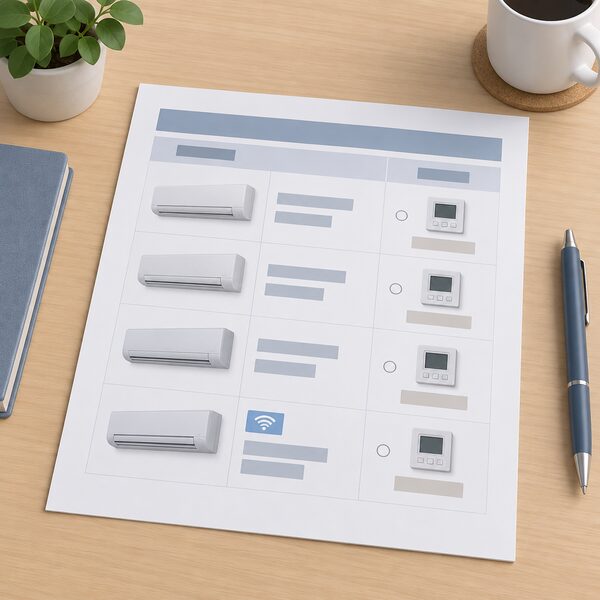
The table above covers the models named in the maker documentation. Two further points help a household read a specification sheet.
First, model suffixes carry meaning. Carrier states that -WF are models with WiFi for Smart Control, and lists -WF as the Wi-Fi model suffix across its residential A/C series2. A household comparing two otherwise identical units can use the suffix to tell which one has the radio inside.
Second, wired control is listed as an optional accessory rather than a standard feature on the models where it appears. Fujitsu General lists the UTY-RVRY, UTY-RCRYZ1, UTY-RNRYZ3, UTY-RLRY, UTY-RSRY and UTY-RHRY as wired and simple remote controllers for the ASEH12KGTG5, and the first three as options for the ASEH14KGTG, ASEH14KMCG and ASEH12KMCG-B3. Carrier, by contrast, supplies an infrared remote controller as standard on its residential mono-split range1.
The wider UK market shows the same optional pattern outside air conditioning. The electriQ iPAC Ceiling Cassette Air Conditioning Inverter System lists optional WiFi for smart control25. Easy-Fit single split systems are described as designed for quick, simple installation without the need for a professional engineer, with pre-charged pipework meaning no refrigerant handling is required25. Control options and installation method are separate decisions, and a household weighing a DIY route should read them separately. For the installation side, see DIY air conditioning installation.
Where a household wants voice control, the maker's own documentation is the reliable guide. Hitachi states that voice command lets users control their air conditioning hands-free when at home11. Netatmo describes smart air conditioners as controllable through voice assistants such as Amazon Alexa or Google Assistant if compatible10. The word "if compatible" is doing real work: voice control is a property of the specific model and app, not of Wi-Fi in general.
What controlling your air conditioner remotely means for energy independence
Remote control is a convenience feature with an independence cost, and the two should be weighed together.
The benefit is real. A household can run a unit only when the room is occupied, adjust a setpoint from another room, and see consumption over time through a monthly electricity curve where the app provides one1. Hitachi describes voice command as letting users control their air conditioning hands-free when at home11. Scheduling and remote adjustment reduce the hours a unit runs in an empty room, and that is where the electricity saving sits.
The dependence is also real, and it has several layers. Control from outside the home needs Wi-Fi rather than Bluetooth17. It needs the maker's cloud service, because the app talks to a server rather than directly to the unit. It needs an account with the manufacturer in most cases. It needs the maker to keep the service running and the app updated for the life of the unit, which is a commercial commitment rather than a technical one. And where an adapter is used, it needs that accessory to remain available11.
There is a further layer that applies to cooling specifically. Air conditioning draws electricity, and a household running a unit through a heatwave is buying that electricity from a supplier unless it has its own generation. A solar air conditioner case study describes a unit with no inverter, no battery, no charge controller and full DC drive23, which is a different architecture from the mains-powered split systems described above. For the general picture, see home cooling and energy independence and running air conditioning on solar panels.
The controls themselves attract VAT relief in some circumstances. The temporary zero rate applies to the installation of certain specified energy-saving materials, running from 1 April 2022 to 31 March 202726. Legislation sets the rate from 1 February 2024 to 31 March 20279. The MCS Foundation states the zero-rated VAT is currently in place until March 202728, and the Consumer Council for Northern Ireland gives the same end date20. A maker states the rate rises to 5% afterwards26. BEAMA confirms that heating controls are among the eligible materials21, and the government's own consultation outcome describes qualifying installations benefiting from a temporary VAT zero rate30. The relief applies to installation of qualifying materials, not to a unit bought on its own, and it is a GB measure.
Where the control question sits in a wider installation
Control choice is one decision among several, and it interacts with the others. A concealed ceiling unit with a wired controller is a different proposition from a wall-mounted split with a handset, and both differ from a portable unit that needs no fixed control at all.
The Future Homes and Buildings Standards consultation sets out ventilation options for new homes, including natural ventilation with intermittent extract fans19, which is the context in which cooling and control decisions are increasingly made. For the unit types themselves, see types of air conditioning and split air conditioning systems. For how control fits a multi-room installation, see multi-split air conditioning.
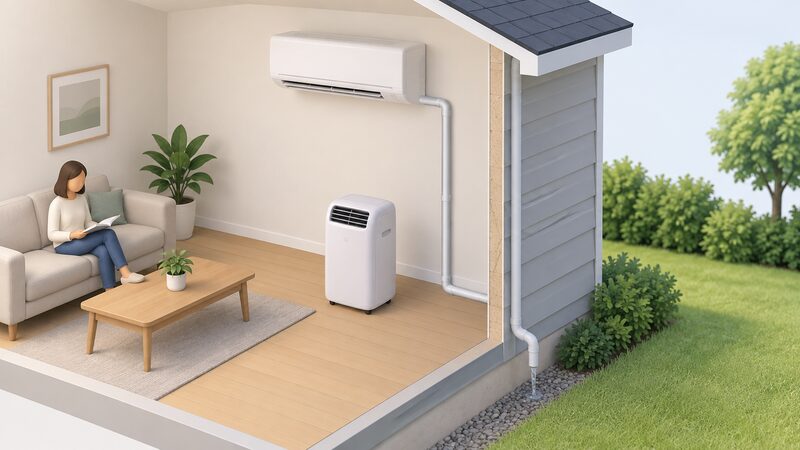
One practical point on drainage, which is often confused with control. The electriQ AirFlex 14000 BTU portable unit is described by its maker as not requiring a drain hose in cooling mode under normal operation, with the hose needed only if the internal water tank becomes full, shown as error code E4, or in dehumidifier mode31. Where a condensate drain port is used, the same maker specifies a hose with an internal diameter of about 13 mm31. That is a portable unit's arrangement; a fixed split system drains condensate continuously through pipework installed with the unit.
Sources31 cited
- Carrier split systems catalogue 2022, Carrier, 2022
- Carrier residential catalogue, Carrier, 2023-02
- Fujitsu General ASEH14KGTG indoor unit, Fujitsu General, 2026-09-23
- Fujitsu General ASEH14KMCG indoor unit, Fujitsu General, 2026-09-23
- Fujitsu General ASEH12KGTG indoor unit, Fujitsu General, 2026-09-23
- Fujitsu General ASEH12KMCG-B indoor unit, Fujitsu General, 2026-09-23
- Toshiba RAS HAORI High-Wall, Toshiba Air Conditioning, 2025-12-02
- LG Artcool air conditioning, Cooleasy, 2026-09-23
- The Value Added Tax (Installation of Energy-Saving Materials) Order 2024, legislation.gov.uk, 2024-01-10
- Smart air conditioner guide, Netatmo, 2026-09-20
- airCloud Home: how IoT improves comfort, Hitachi Cooling & Heating, 2026-09-17
- What are smart heating controls and which are worth it, Drayton Controls, 2026-04-15
- WiFi-enabled wireless thermostats, Sundirect, 2024-04-24
- New electric heating regulations, Electrorad, 2026-09-20
- Wireless AC controller glossary, Hitachi Cooling & Heating, 2026-09-17
- Daikin concealed ceiling air-to-air heat pumps, Daikin UK, 2026-09-17
- Smart plugs advice, Centre for Sustainable Energy, 2025-10
- tado° Smart AC Control, tado°, 2026
- The Future Homes and Buildings Standards 2023 consultation, GOV.UK, 2026-09-17
- Support with energy costs, Consumer Council for Northern Ireland, 2026
- Zero rate VAT on heating controls: 2022 update, BEAMA, 2022-07-22
- New smart control from Baxi simplifies wireless installation, CIPHE, 2026-05-12
- Solar air conditioner case study, Deye, 2026-09-17
- Alpha Touch Wi-Fi thermostat, Alpha Innovation, 2025-08-20
- Easy-Fit single split air conditioning systems, Cooleasy, 2026-09-23
- Updated guidance on zero VAT rates, NIBE, 2026-09-17
- Heating controls eligible for 0% VAT, BEAMA, 2022-04-01
- Zero carbon, zero VAT, MCS Foundation, 2026-09-20
- Zero rate VAT on heating controls 2022 update (PDF), BEAMA, 2022-04-01
- VAT energy saving materials relief: summary of responses, GOV.UK, 2023-12-11
- electriQ AirFlex 15 air conditioner, electriQ, 2026-03-18
 Controls and Energy IndependenceIf the broadband goes down, will your heating still come on?
 Local Control vs the CloudCan your solar, battery or charger still work if the maker's app or servers disappear?
 Zigbee, Matter, KNX and Wi-FiWill your smart thermostat and radiator valves keep working if the broadband goes down, and can gear from different brands talk to each other?
 Monitoring and AppsIf the internet goes down, does the app still show what the battery is doing?
 DIY Air ConditioningExplains which air conditioning can be fitted without a refrigerant engineer, including portable, through-wall and pre-charged quick-connect split kits, and where the limits lie.
 App Subscriptions and CloudWill you have to pay a monthly fee for the app that comes with your heat pump, boiler or solar setup?