
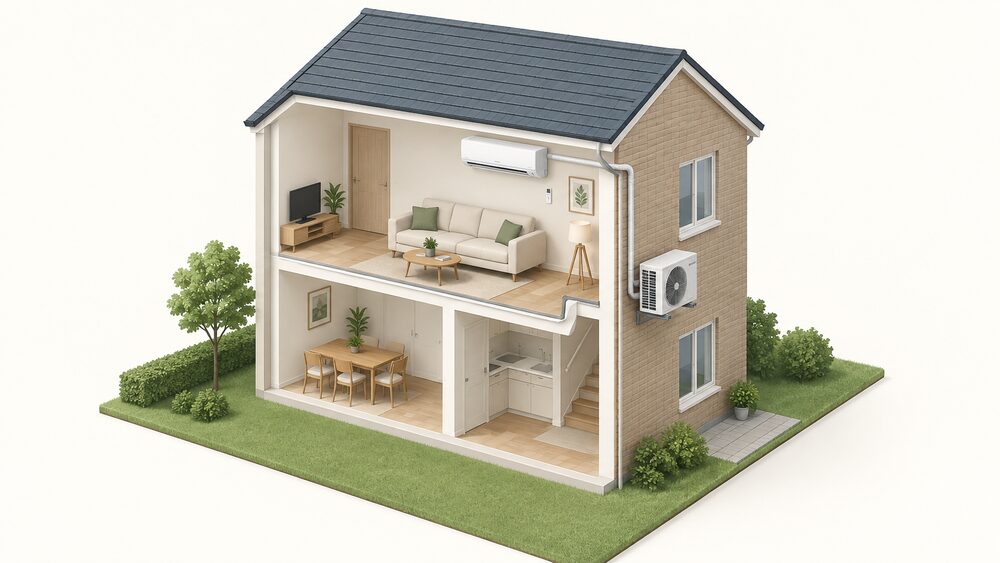
In this guide
Toshiba air conditioning reaches UK homes through Toshiba Carrier UK, which sells to residential and light commercial customers via authorised distributors and approved installers1. The residential line-up is built around R32 split systems: high-wall indoor units such as the RAS HAORI, and multi-split outdoor units that serve two to five rooms from a single condenser2.
The HAORI high-wall unit carries an A+++ energy class in both cooling and heating, and ships with factory-integrated Wi-Fi so the air conditioner can be controlled through the Toshiba Home AC Control app2. The multi-split outdoor range uses twin rotary inverter compressors, the component that lets output modulate rather than switching on and off3.
What Toshiba does not publish is a UK price. There is no list price for a Toshiba system in the material available here, so costs are installer-quoted, and the figures that do exist for the wider market are for other brands and other product types. That gap matters for anyone comparing Toshiba against the brands that do publish prices.
The range: which models suit which homes
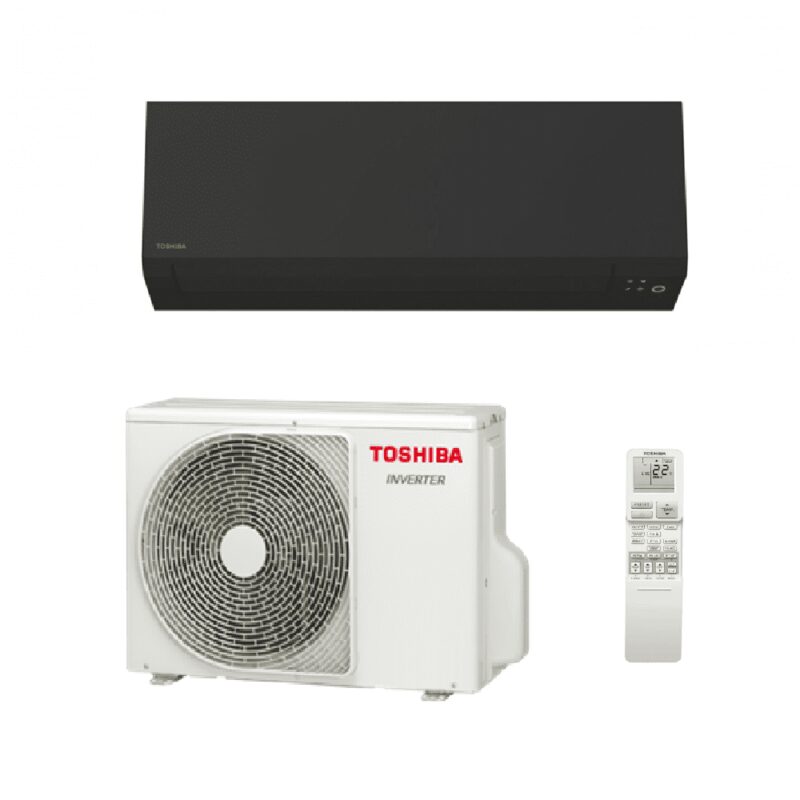
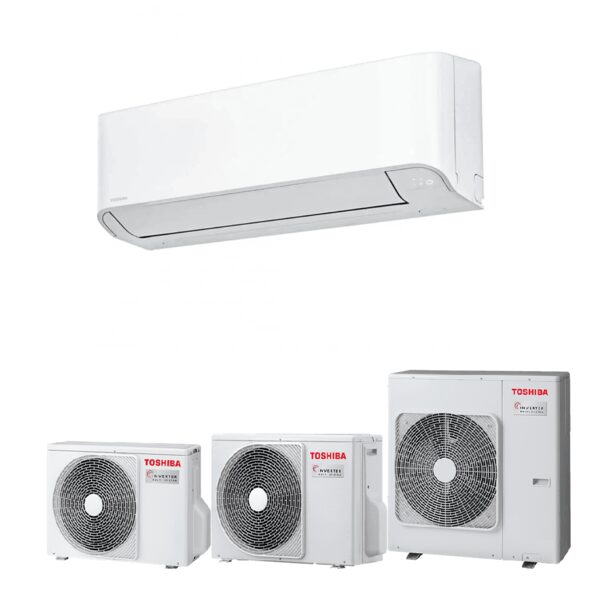
Toshiba's residential offer splits into two shapes. The first is the single high-wall split, where one indoor unit pairs with one outdoor unit. The RAS HAORI is the flagship of that shape, a wall-mounted unit with a magnetic wall-mounted remote holder, Power select and ECO modes intended to reduce energy bills, and a Hi-power setting for rapid cooling or heating4. It is rated A+++ in cooling and heating, which places it at the top of the current energy label scale rather than merely near it2.
The second shape is the multi-split. Toshiba's RAS outdoor unit for two to five rooms runs twin rotary inverter compressors and is designed so that several indoor units share one condenser on an outside wall3. That is the configuration that suits a flat or a terraced house where only one external elevation is available, and it is the reason multi-split systems exist at all: fewer boxes outside, one set of pipe runs to a plant area, and independent room-by-room control indoors. The trade-off is that all the connected rooms share one outdoor unit, so a fault or a service visit affects every room at once.
Toshiba also builds a Plasma Ionizer into the HAORI, which the maker states catches and neutralises contaminated particles2. That is an air-treatment feature rather than a cooling one, and it sits alongside filtration rather than replacing it.
Toshiba Carrier UK describes its own customer base as residential and light commercial, which is a useful signal about where the brand expects to be specified: homes, small offices and similar spaces rather than large commercial plant1. For a household, the practical question is which shape fits the building. A single room with an external wall suits a high-wall split; several rooms with one usable elevation suits a multi-split. The wider comparison between the two is set out in split vs portable air conditioning and single split vs multi-split air conditioning.
Specifications at a glance
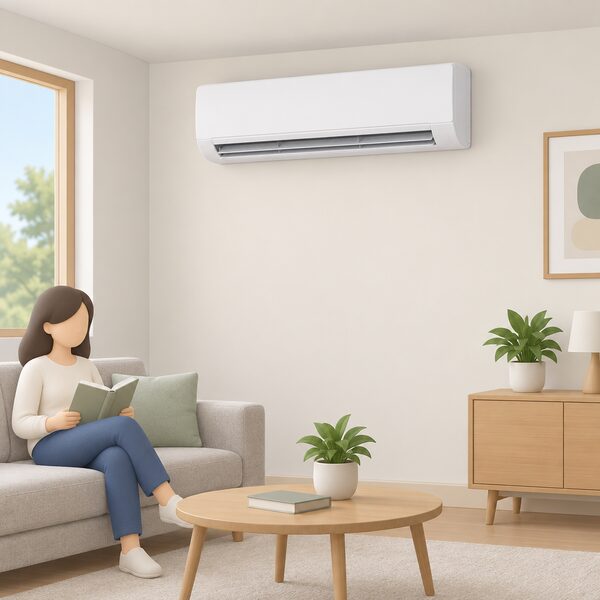
Toshiba publishes efficiency and control detail for its own units but not a full model-by-model capacity table in the material available here. What can be stated with a source is the shape of the range and the headline ratings.
| Feature | Toshiba RAS HAORI high-wall | Toshiba RAS multi-split outdoor (2 to 5 rooms) |
|---|---|---|
| Type | Single high-wall split | Multi-split condenser |
| Energy class | A+++ cooling and heating2 | Not stated |
| Compressor | Not stated | Twin rotary inverter3 |
| Wi-Fi | Factory-integrated2 | Not stated |
| App | Toshiba Home AC Control2 | Not stated |
| Air treatment | Plasma Ionizer2 | Not stated |
| Remote features | Power select, ECO, Hi-power, magnetic holder4 | Not stated |
Sizing a system is a separate exercise from choosing a brand, and the industry rule of thumb maps output to floor area. A 1.5 kW unit is quoted for rooms up to 12 m², 2.0 kW for up to 16 m², 3.5 kW for up to 30 m², 4.5 kW for up to 40 m², 5.0 kW for up to 45 m², 7.0 kW for up to 55 m², 8.0 kW for up to 65 m², 12.5 kW for up to 100 m² and 14.0 kW for up to 110 m²5. Those figures are a starting point, not a design: glazing, orientation, insulation and occupancy all move the number, and a proper survey is what fixes it. The full method is at air conditioning sizing.
Cost of a Toshiba system
There is no published Toshiba price for a UK installation in the material available here, so a Toshiba quote is installer-led and will vary with the number of indoor units, the pipe run and the access. That is not unusual for split systems, but it does mean a household cannot benchmark Toshiba against a list figure the way it can with some other brands.
What the market does publish is indicative. Portable packaged air conditioners run from £170 to £700 depending on capacity and features, while built-in models, which are trickier to install, usually range from £850 to £2,500 and may cost a bit more in some cases6. Those are different product categories from a Toshiba split, and they are given here only as the surrounding price context rather than as a Toshiba figure.
For comparison within the split market, published prices for other makers' high-wall systems include £974.99 including VAT for a Daikin Comfora high-wall system, with a high street price of £1,049.99 including VAT, and £702.99 including VAT for a Mitsubishi Electric Classic wall-mounted system7. A Daikin Emura high-wall system is listed at £150.00 excluding VAT on a nursery and baby room collection page, a figure that plainly does not represent a complete installed system and should be read as a component or promotional listing rather than a system price8.
Running cost is a separate line. A typical portable air conditioner of 1,000 to 1,500W can cost around 26 to 39p per hour, roughly 14 to 20 times more than a fan9. A Toshiba split is not a portable unit and its inverter compressor modulates rather than running flat out, so that figure does not transfer directly, but it shows the order of magnitude of electrical running cost for cooling in a UK home. More detail sits at air conditioning running costs and air conditioning cost.
UK availability and installation
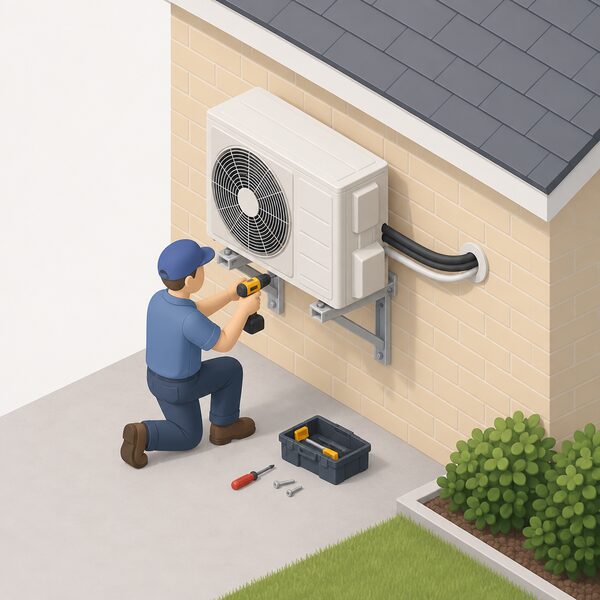
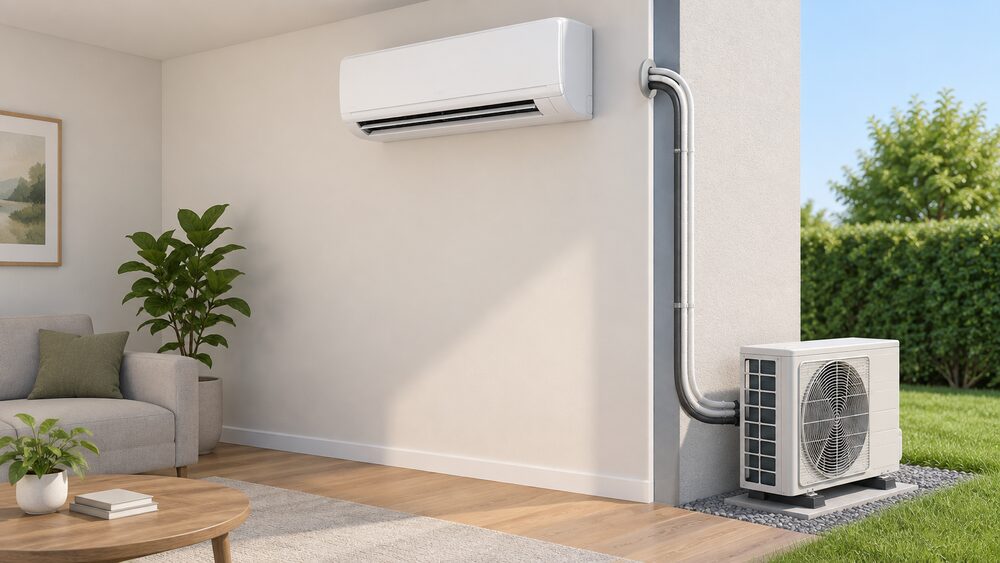
Toshiba Carrier UK sells through authorised distributors and approved installers, and that is the route by which a household buys the product1. The structure matters more than it sounds. A split system is not a plug-in appliance: it needs a surveyed position for the outdoor unit, a refrigerant pipe run, a condensate drain, an electrical supply and commissioning by someone qualified to handle refrigerant. Buying through the authorised chain is what connects the household to that work and to the manufacturer's support.
The pattern is visible in how Toshiba launches products. When the DAISEIKAI 10 was introduced, Toshiba Carrier UK stated it was available through Toshiba Carrier UK, its authorised distributors and approved installers1. That is the same three-part chain, and it is the chain a household enters when it asks for a quote.
Installation quality is the variable that most affects how a system performs over its life. Independent guidance on heat pumps, which share the same refrigeration and control principles, is to check the fault log for recurring fault messages and speak to the installer and manufacturer to find out what is happening10. That advice assumes a relationship with both parties, which is exactly what the authorised route provides and what a second-hand or self-sourced unit does not.
For the wider picture on how a split system is surveyed, piped and commissioned, see air conditioning installation. The rules on who may handle refrigerant are at F-gas rules for home air conditioning, and the noise question, which matters on a boundary wall, is at air conditioning noise.
Controls, the app and what stays local
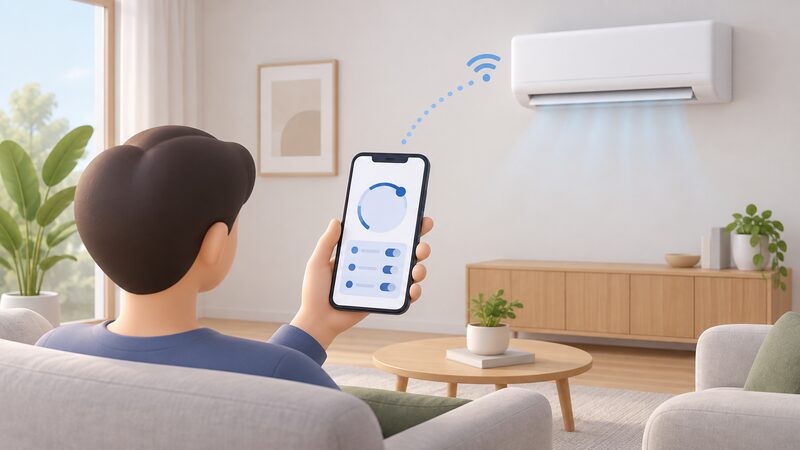
The RAS HAORI has factory-integrated Wi-Fi to control the air conditioner through the Toshiba Home AC Control app2. That is a genuine convenience and it is built in rather than added as an accessory, which removes one common point of failure in retrofit smart control.
It also creates a dependence. Remote scheduling, monitoring and any app-based diagnostics run through a home broadband connection, Toshiba's servers and a manufacturer's app. Local control at the unit and through the handset continues without any of that, but the phone features do not. This is the same pattern across the smart heating market: most smart heating controls link to a phone, and heating can be controlled via smartphone, tablet or laptop, or by telling a smart speaker what you want11. The convenience is real and so is the reliance on a third party's platform staying available.
There is a counterweight worth knowing. Heating controls can be upgraded or installed independently of the boiler, which means the control layer is not permanently tied to the heat source12. On a Toshiba system the app is tied to the unit, so the household's independence at the control layer is narrower than it would be with a separate, brand-agnostic control.
Servicing, faults and the paperwork
No Toshiba service interval is published in the material available here, so the general guidance applies. Independent sources are consistent that heating systems should be serviced once a year, or every 12 months13. Air conditioning follows the same logic: filters clog, coils soil, drains block and refrigerant charge can drift, and a system that is never serviced loses capacity before it stops working.
Warranty registration is the other piece of paperwork. Consumer guidance on boiler warranties notes that registration can usually be done on the manufacturer's website or by calling them, and that failing to register within 30 days of installation is one of the common mistakes that can invalidate a warranty17. Toshiba does not publish a registration route in the material available here, so the safe practice is to treat the installation paperwork and commissioning record as the warranty document and to confirm the route with the installer at handover.
On faults, the sequence that independent guidance recommends is to check the fault log for recurring fault messages and then speak to the installer and the manufacturer10. Fault codes are brand-specific and cannot be read across manufacturers: Vaillant's F28 and F29 codes, for instance, indicate that a condensate pipe needs to be thawed, which tells a household nothing about a Toshiba unit18. Where a consumer concern cannot be resolved with the installer or manufacturer, the Installation Assurance Authority accepts complaints by email at concerns@theiaa.co.uk19.
Serial numbers follow the same pattern as other domestic heating and cooling equipment. On boilers, the serial number is usually on the drop down panel on the front of the appliance, and some models have a tag underneath that slides out20. On a Toshiba indoor unit the equivalent plate is on the casing or behind the front flap, and it is the number the installer will need for any claim.
What owning Toshiba air conditioning means for energy independence
A Toshiba split system changes a household's position in two directions at once, and it is worth being precise about both.
The gain is that cooling and, in reverse cycle, heating are delivered at the point of use from electricity, with no gas supply, no flue and no combustion inside the home. Air conditioners are described by one manufacturer as low-carbon systems with a lower environmental impact than gas boilers, oil-based heating systems or even electric systems21. The A+++ rating on the HAORI in both cooling and heating means the unit converts each unit of electricity into more than one unit of delivered heat or coolth, which is the efficiency advantage a resistive heater cannot match. The comparison is set out at air conditioner vs electric heater efficiency.
The dependence that remains is threefold. First, the system runs on electricity from the grid and a supplier, so it is exposed to electricity prices rather than gas prices. Second, the app and any remote features depend on broadband, Toshiba's servers and a manufacturer's platform. Third, the hardware depends on the authorised installer and distributor chain for parts, refrigerant work and warranty support, since a split system cannot be serviced by an unqualified person.
There is a control-layer gain that is easy to overlook. Heating controls can be upgraded or installed independently of the boiler, and separate thermostatic controls let a space be controlled on its own12. Room-by-room control on a multi-split does the same thing for cooling: only the rooms in use are conditioned, which is where the running-cost saving actually comes from. Independent study evidence on smart thermostats points the same way, with one study finding that installing and correctly using a tado° smart thermostat can reduce energy use, and another finding savings of up to 23% by turning the temperature down when nobody is at home23.
For a household thinking about the whole picture, the honest summary is that a Toshiba system reduces dependence on gas and on a boiler, and increases dependence on electricity, on a broadband connection for its smart features, and on a manufacturer's service chain. The wider trade-offs are at cooling and energy independence and air conditioning that heats.
Sources23 cited
- Toshiba Carrier launches DAISEIKAI 10, Toshiba Air Conditioning, 2024-03-18
- RAS HAORI High-Wall, Toshiba Air Conditioning, 2025-12-02
- RAS Multi-split Outdoor 2-5 Rooms (G3), Toshiba Air Conditioning, 2025-12-02
- HAORI product brochure, Toshiba Air Conditioning, 2024-03
- Air conditioning size guide, Cool Easy, 2026-09-23
- Packaged air conditioning comfort guide, Netatmo, 2026-09-20
- High wall mounted single split air conditioning systems, Cool Easy, 2026-09-23
- Nursery and baby room air conditioning systems, Cool Easy, 2026-09-23
- Summer energy tips, National Energy Action, 2026-08-13
- How to ensure a heat pump runs efficiently, Energy Saving Trust, 2026-05-19
- Smart homes and lower carbon footprint, Energy Saving Trust, 2026-01-21
- Thermostats and heating controls, Home Energy Scotland, 2026-09-20
- Reduce your heating bill tips, Ivie, 2026-09-20
- Boiler maintenance guide, Uswitch, 2026-09-03
- Five important heating checks for oil households, OFTEC, 2026-08-13
- Home energy efficiency: the basics, Ivie, 2025-02-17
- Common mistakes that can invalidate your boiler warranty, Which?, 2025-10-22
- What do Baxi error codes E23, E53, E133, E119 or E128 mean?, Baxi, 2026-09-17
- Complaints procedure, Installation Assurance Authority, 2026-09-20
- Getting ready for winter: your condensate pipe, Vaillant, 2026
- How to choose an air-to-air heat pump, Daikin UK, 2026-09-17
- Conservatories and energy efficiency, Glass and Glazing Federation, 2023-12-22
- Boiler replacement, OVO Energy, 2026-09-17
 Toshiba air conditioning and heat pumpsToshiba air conditioning units can also heat your home, but they work differently from the heat pumps most UK homes are being encouraged to install.