
In this answer
Short answer
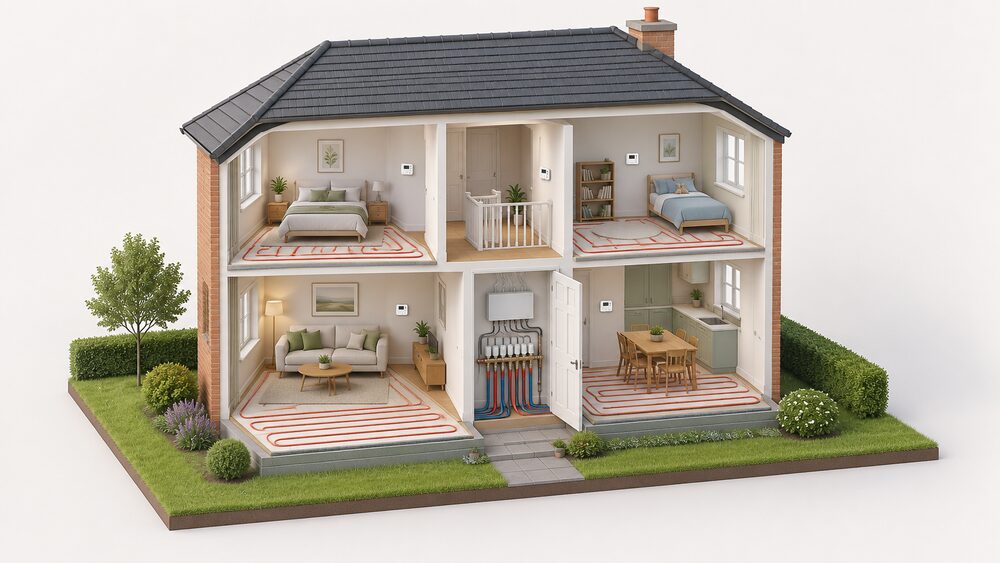
For warm water underfloor heating, the working rule is one thermostat per room, because each room is treated as its own zone. BEAMA, the trade body for the heating industry, states that warm water underfloor heating offers "individual room control as standard", giving users greater flexibility and comfort with heat on demand1. Approved Document L, the building regulations guidance for England, goes further and requires that "each room should be provided with thermostatic room controls" in new dwellings or when a heat generator such as a boiler is replaced in an existing dwelling2.
For direct electric underfloor heating, the same document sets a slightly different requirement: "Programmable room thermostats with an override feature should be provided for all direct electric zones"3. In practice, that means a thermostat in every heated room, whether the system is wet or electric.
The number of thermostats a household needs therefore equals the number of zones it wants to control independently. A single wiring centre or controller can serve several zones at once, and the products on the UK market come in 4, 6, 8 and larger zone variants. The sections below set out how zoning works, what the hardware can handle, and when one thermostat may reasonably cover two rooms.
One thermostat per room is the rule for warm water underfloor heating
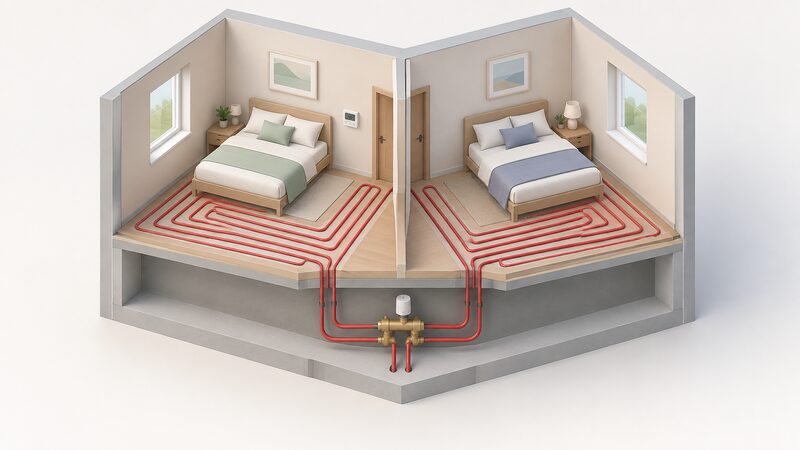
The reason each room gets its own thermostat is that underfloor heating is zoned by design. Warm water systems run from a manifold, and each zone on that manifold has a motorised valve or thermal actuator that controls the flow of warm water to that loop. The thermostat in the room tells the actuator when to open and close. As tado° explains, "in wet systems, the thermostat controls motorised valves on the underfloor heating manifold, regulating warm water flow"6.
In electric systems, the thermostat works differently: it controls the electrical supply to the heating cables or mats beneath the floor6. Either way, the thermostat is the point at which a room's temperature is measured and acted on.
Warmup's water underfloor heating systems are described as "ideal for larger zones over 25m²"7, which reflects the fact that a single zone can cover a substantial area. But the zone boundary is a design decision, not a fixed physical limit. A large open plan kitchen and dining area might be one zone; a bedroom is almost always its own.
The practical consequence for a household is that the number of thermostats is set at the design stage, when the manifold and wiring centre are specified. Adding a thermostat later means adding a zone, which means a spare actuator position on the manifold and a spare channel on the wiring centre. That is why the choice of wiring centre matters as much as the choice of thermostat.
Why each zone needs its own control to stay independent
Zoning is what allows different rooms to be heated at different times and to different temperatures. The Energy Saving Trust states that "if you want to heat different rooms at different times of the day, zone controls do this for you automatically"8. Ofgem's guidance on the ECO4 scheme defines time and temperature zone controls as those that "enable independent programming of temperature and heating times in at least two different areas or zones of a premise"9.
That definition is useful because it sets the minimum bar: two independently programmable zones. A house with a single thermostat and no zone control cannot meet it. A house with one thermostat per room comfortably exceeds it.
BEAMA notes that "modern control systems allow UFH to operate independently in different zones, meaning it can work seamlessly alongside other heat sources"10. This matters in homes that mix underfloor heating with radiators, where the underfloor zones need to run on their own schedules rather than following the radiator circuit.
For electric space heating, BEAMA states that "each room can be treated as a separate zone, and so can be controlled individually"11. The same principle applies to electric underfloor heating mats and cables, where each mat or cable run is wired back to its own thermostat.
The independence argument is not only about comfort. A zone that is not calling for heat does not open its valve, so no warm water flows through that loop. In a well-zoned system, unoccupied rooms are simply not heated. That is the mechanism by which zoning reduces demand, and it depends entirely on having a control per zone.
Zones, wiring centres and how many a controller can handle
A wiring centre is the hub that connects room thermostats to the actuators on the manifold. Salus describes its FGQ-11 set as including "a central wiring centre, room thermostat, and thermal actuator to provide simple and reliable multi-zone underfloor heating control"12. The wiring centre is what turns a collection of individual thermostats into a working multi-zone system.
The zone count of the wiring centre sets the ceiling on how many rooms can be controlled independently from one unit. The table below sets out the main variants and their capacities.
| Product | Zones or circuits | Notes |
|---|---|---|
| Salus FGQ-4 control set | 4 heating circuits | Expandable up to 8 zones13 |
| Salus FGQ-6 control set | 6 heating circuits | Expandable up to 8 zones14 |
| Salus FGQ-11 control set | 11 heating circuits | Central wiring centre, thermostat and actuator12 |
| Salus FG-6 system | 2 to 12 heating circuits | Individual room control15 |
| Salus KL06 wiring centre | Up to 6 heating zones | Controls zones independently16 |
| Warmup 8-Zone Wiring Centre | Up to 8 heating zones | Each zone set for UFH or radiators17 |
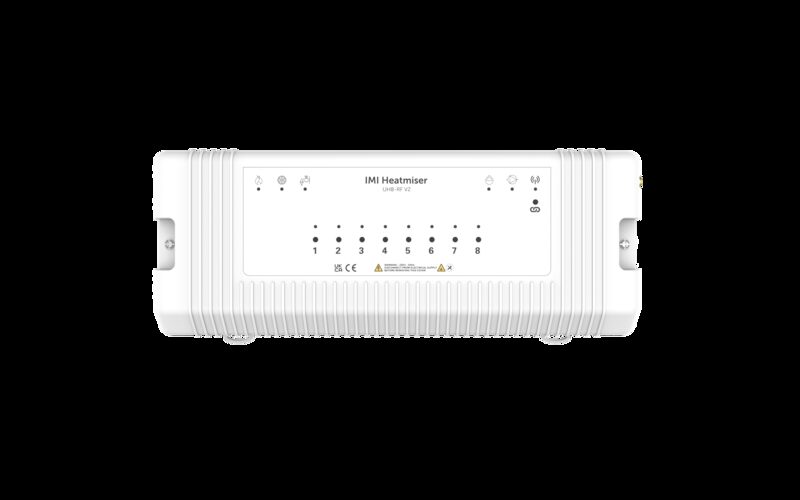
| Heatmiser UH8-RF V2 | 8 zones | Wireless; each zone configurable for UFH or radiator18 |
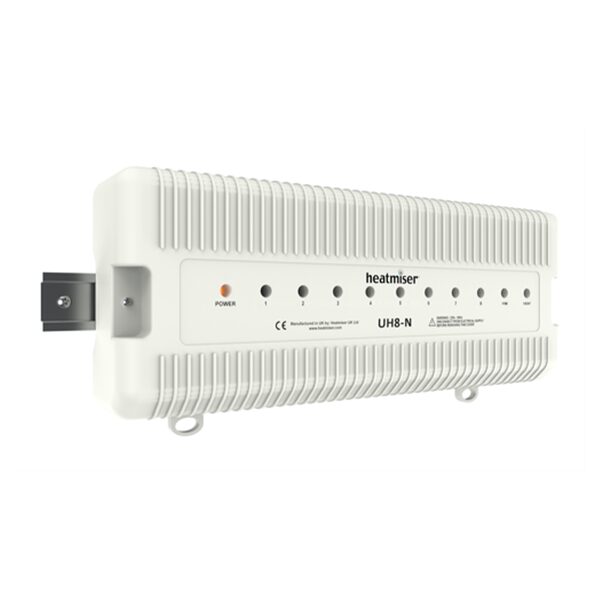
| Heatmiser UH8-N | 8 zones | For compatible Heatmiser 12V wired thermostats19 |
| Warmup Konekt Wiring Centre | Up to 10 zones / 15 circuits | Also handles other heating20 |
The pattern is clear: 4, 6 and 8 zone variants are the common sizes, with larger sets running to 11 circuits and the Konekt centre reaching 10 zones or 15 circuits. A three-bedroom house with a kitchen, living room and three bedrooms would need five zones, which fits comfortably within a six-zone unit. A larger house with separate studies, utility rooms or annexes may need eight or more.
Up to six zones with a single underfloor heating controller
Six zones is a common ceiling for a single controller, and several manufacturers build to it. The Wiser Underfloor Heating Controller from Drayton controls "up to 6 zones of water based UFH"5, and Drayton states that up to three controllers and 16 zones can be added to a system21. That gives a route to a much larger installation without changing the basic unit.
Other products at or near the same capacity include the ViCare floor thermostat, which offers "control of up to 6 heating zones"22, and the Hive Thermostat, which supports "up to 6 zones of heating if you have an existing multizone heating system"23. The Homematic IP wired underfloor heating controller is a six-channel unit, though its documentation states that "you can control up to 10 heating zones with one actuator"24, and it supports up to six adjustable heating profiles with 13 possible changes per day24.
The six-zone figure is not a hard limit on the number of rooms. It is a limit on the number of independently controlled zones. Two rooms with the same function and similar heat loss can share a zone, which is the subject of the next section.
When one thermostat may cover two rooms with a similar function
One thermostat can serve two rooms where they are used in the same way and have similar heat demand. A pair of bedrooms on the same aspect, both occupied at night, are the classic case. A bathroom and an adjacent cloakroom may also share a zone.
Some products are built explicitly around two-zone control. The Daikin ETVH16UE6V7 offers "bi-zone" operation, allowing temperature monitoring for two zones and the connection of underfloor heating to radiators to optimise efficiency25. tado° takes a different approach: its multi-zone system lets a householder replace the existing wall thermostat and then set via the app whether a room runs as a separate zone or is linked to other rooms26. That makes the zone boundary a software decision rather than a wiring one.
Warmup describes its systems as providing a "zoned" heating solution, meaning separate areas of the home can be heated independently through a zone-dedicated thermostat27. The phrase "zone-dedicated" is the key: the thermostat belongs to the zone, not to a single room, and a zone may contain more than one room.
The limits of sharing are practical. Two rooms on one thermostat cannot be held at different temperatures, and a sunny south-facing room will drag the zone's average up, leaving the north-facing room cooler. Where rooms differ in use, aspect or occupancy, separate controls give better regulation. Where they are genuinely similar, sharing a zone saves a thermostat, a cable run and a channel on the wiring centre.
Brands and products sold in the UK
Several manufacturers offer underfloor heating controls in the UK, and the zone counts differ between them.
Salus builds a range of control sets and wiring centres. The FGQ-4 has four heating circuits and is expandable to eight zones13; the FGQ-6 has six circuits and the same expansion path14; the FGQ-11 has eleven circuits12. The FG-6 system is available for 2 to 12 heating circuits with individual room control15, and the FG-12 and FG-1 systems also offer individual room control28. The KL06 wiring centre controls up to six heating zones independently16.
Warmup offers the 8-Zone Wiring Centre, providing central switching for up to eight heating zones, each set up for either underfloor heating or radiators17, and the Konekt Wiring Centre, which handles up to 10 heating zones or 15 heating circuits20. Warmup thermostats can be suitable for underfloor heating only, central heating only, or in some cases both30.
Heatmiser supplies the UH8-RF V2, an eight-zone wireless wiring centre where each zone can be configured independently for underfloor heating or radiator control18, and the UH8-N, an eight-zone unit for compatible Heatmiser 12V wired thermostats19.
Drayton makes the Wiser Underfloor Heating Controller, controlling up to six zones of water based UFH, with support for up to three controllers and 16 zones5.
Homematic IP offers a wired underfloor heating controller with six channels, supporting up to six heating profiles and 13 changes per day24.
Viessmann provides the ViCare floor thermostat, with control of up to six heating zones22, and Hive supports up to six zones where an existing multizone system is present23. Bosch offers the Smart Individual Room Thermostat for wired, water-based underfloor heating or radiators in a multi-zone setup31, and Daikin provides bi-zone control on the ETVH16UE6V725.
What this means for a household's energy independence
A well-zoned underfloor heating system gives a household a good measure of local control. Each room's thermostat decides when that zone calls for heat, and the wiring centre acts on it without reference to any external service. The manifold, actuators and thermostats are physical devices in the home, and they continue to work if a broadband connection drops.
The dependence that remains is on the heat source. Underfloor heating is "often installed in combination with a heat pump, and works with all types of heating systems"4, so a household running a wet system on a gas boiler remains exposed to gas prices and imports. A household running it on a heat pump remains exposed to electricity prices, though the Energy Saving Trust case study of a rural off-gas home notes a thermostat in each room reducing the temperature overnight32, which is the kind of control that shifts demand away from peak periods.
There is also a manufacturer dependence. Smart controllers from tado°, Wiser, Hive and Viessmann rely on apps and, in some cases, cloud services for scheduling and remote access. The zone control itself is local, but the convenience layer is not. Households weighing that trade-off can read more in Heating Controls and Energy Independence and Smart Heating Controls: Security, Data and Product Support.
For the wider picture on manifolds, actuators and wiring centres, see Underfloor Heating Controls, Manifolds and Wiring Centres. For the general principles of splitting a home into zones, see Heating Zones, and for the wiring arrangements behind them, Heating Control Wiring.
Sources32 cited
- Underfloor heating: efficient, flexible comfort, BEAMA, 2024-12-02
- Approved Document L, Conservation of Fuel and Power, Volume 1: Dwellings, HM Government, 2021 edition incorporating 2023 amendments
- Approved Document L, Volume 1: Dwellings, HM Government, 2026
- Underfloor heating system, NICEIC, 2026-09-17
- Wiser Underfloor Heating Controller, Drayton, 2026-09-20
- Heating thermostat, tado°, 2026-08-03
- Tectora Joisted, Warmup, 2026-09-20
- Thermostats and heating controls, Energy Saving Trust, 2026-02-10
- ECO4 New Measures and Products Guidance v3.0, Ofgem, 2026-03-26
- How underfloor heating works, BEAMA, 2024-07-08
- Electric space heating, BEAMA, 2026-09-19
- FGQ-11 Underfloor Heating Control Set, Salus Controls, 2026-09-20
- FGQ-4 Underfloor Heating Control Set, Salus Controls, 2026-09-20
- FGQ-6 Underfloor Heating Control Set, Salus Controls, 2026-09-20
- FG-6 Underfloor Heating System, Salus Controls, 2026-09-20
- KL06 Wiring Centre, Salus Controls, 2026-09-20
- Warmup Wireless Thermostat, Warmup, 2026-09-20
- Heatmiser UH8-RF V2 8-Zone Wireless Wiring Centre, Ambiente UFH, 2026-07-27
- UH8-N 8-Zone 12V Wiring Centre, Ambiente UFH, 2026-07-27
- Konekt Wireless, Warmup, 2026-09-20
- Wiser Underfloor Heating Controller, Drayton, 2026-02-19
- ViCare app components, Viessmann, 2026-08-11
- Hive Thermostat, Hive, 2026-09-17
- Wired underfloor heating controller, 6 channels, 24 V, Homematic IP, 2026
- ETVH16UE6V7, Daikin, 2026-09-17
- Multi-zone control, tado°, 2026-07-16
- 10 questions to help you choose your perfect UFH system, Warmup, 2024-09-25
- FG-12 Underfloor Heating System, Salus Controls, 2026-09-20
- FG-1 Underfloor Heating System, Salus Controls, 2026-09-20
- Thermostat buying guide, Warmup, 2026-09-20
- Bosch Smart Individual Room Thermostat, Worcester Bosch, 2026-09-17
- Air source heat pump for rural off-gas home, Energy Saving Trust, 2026-01-05
 Thermostat and Room TemperaturesWhat temperature should a thermostat be set to, and does it differ from room to room?
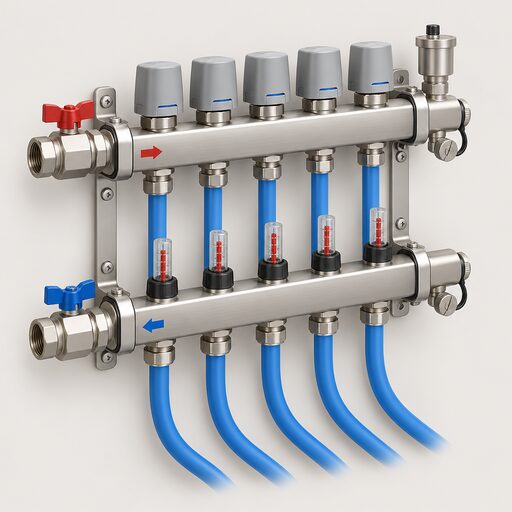 Underfloor Heating ControlsHow do you set different room temperatures with underfloor heating, and stop the floor getting too hot?
 Room Thermostats ExplainedExplains mechanical, digital, programmable, wired, wireless and smart room thermostats, how they call for heat and switch it off, where to site them, how many zones a home needs under the building regulations, and what one degree on the dial is worth.
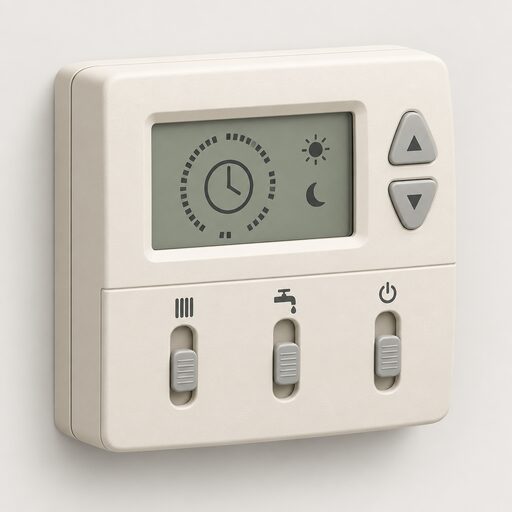 Controls, Thermostats and TRVsWhich heating controls actually cut your bills, and what does each one do?
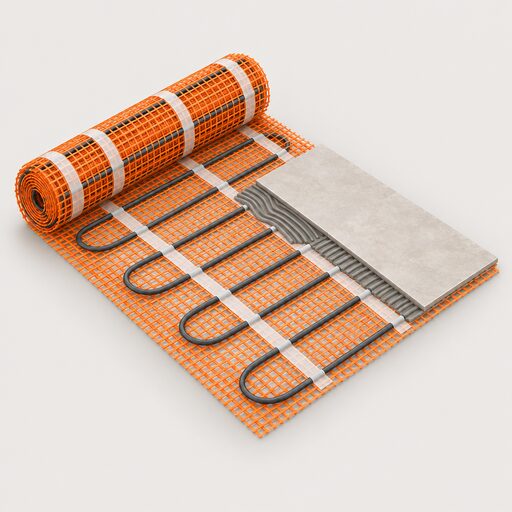 Underfloor Heating SystemsWhich rooms suit electric underfloor heating and which need a wet system?
 Smart Thermostats ExplainedWhat does a smart thermostat actually do, and is it worth it?