
In this answer
Short answer
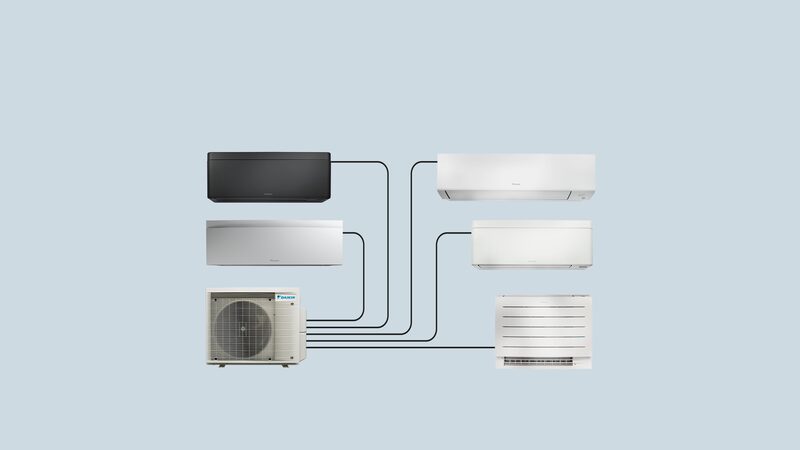
The short answer is six, and only on one maker's range. Mitsubishi Electric states that on Multi-Split MXZ systems, up to 6 indoor units can be connected to one outdoor unit1. Every other domestic range described in UK-facing documentation stops at five: Daikin, Fujitsu General and Haier all describe one outdoor unit serving up to five indoor units2, and Panasonic's Multi TZ system connects up to three6.
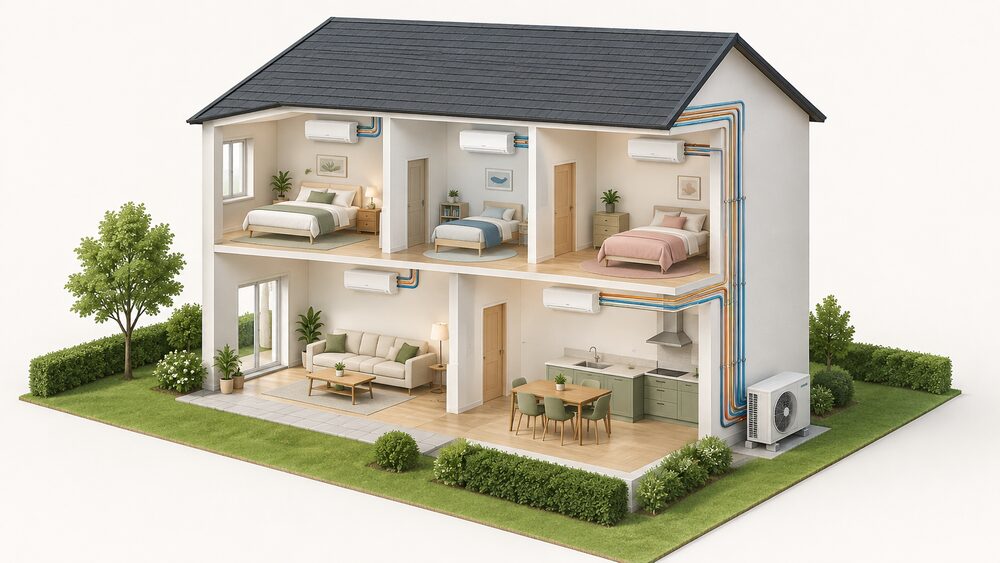
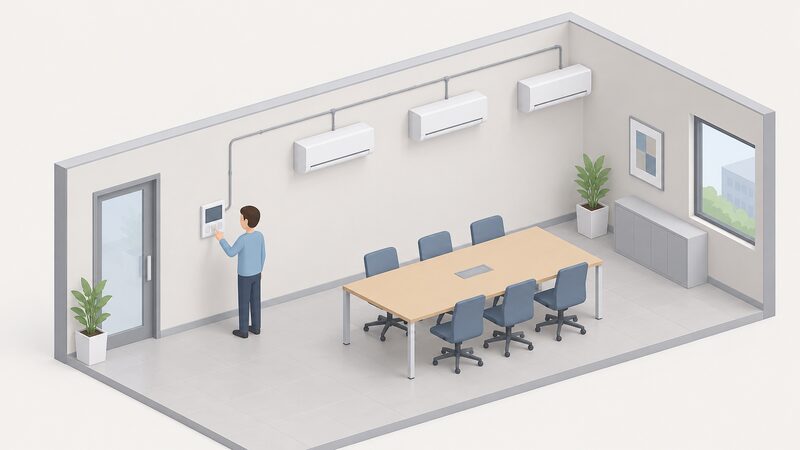
The number of ports on the outdoor unit, not the number of rooms in the house, sets the ceiling. A three bedroom house with a unit in each bedroom plus living and kitchen space typically needs four to five indoor units in total, according to independent guidance7. That sits inside the five-unit limit of most ranges, which is why five has become the practical domestic maximum.
What the limit does not tell you is whether the system will work well. Capacity matching, pipe runs, drainage, planning rules on external units and the fact that all indoor units must run in the same mode all shape what is achievable. This page sets out the numbers, the model-by-model variation and the constraints that decide the real figure.
The answer: up to 6 indoor units on one MXZ outdoor unit
Mitsubishi Electric's own product page is the only domestic source that puts the figure at six, and it is specific to the MXZ multi-split range1. That is a maker's statement about its own equipment, and it is the highest domestic figure in current UK-facing documentation.
The five-unit figure is far more widely stated. Daikin describes connecting up to five indoor units to just one outdoor unit for home heating and cooling2, and repeats the same limit in guidance on how many rooms an air-to-air heat pump can serve3. Fujitsu General's R32 multi-split range is described as one outdoor unit with up to five indoor units4. Haier states that a Multi system allows up to 5 indoor units to operate from a single outdoor unit5. Panasonic's Multi TZ system is the outlier at the lower end, connecting up to 3 indoor units to one outdoor unit6.
Above the domestic ranges, the ceiling rises sharply. The Mitsubishi Electric PUMY-SP series allows up to 10 indoor units to be connected to a single outdoor unit9, and a Haier wired controller is designed to control up to 16 indoor units10. Those are light commercial products, not the wall-mounted domestic systems most households are considering, and they carry different installation and control requirements.
The practical reading is that a householder choosing a domestic multi-split is choosing between three and six indoor units depending on the brand and range. The number is fixed at the point of purchase by the outdoor unit's port count, and it cannot be increased later beyond the model's stated maximum.
How the maximum varies by MXZ model
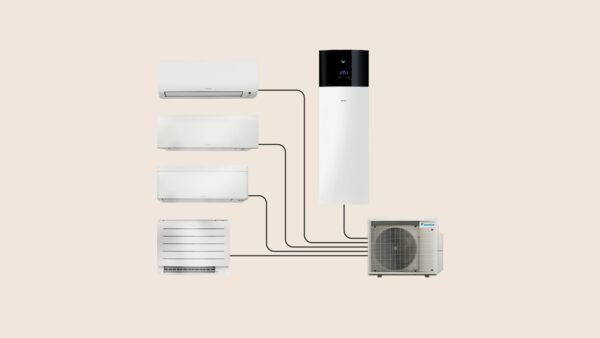
The six-unit figure is a range maximum, not a figure that applies to every MXZ outdoor unit. Within a maker's multi-split lineup, the number of connectable indoor units rises with the capacity class of the outdoor unit, so a small outdoor unit in the range will accept fewer indoor units than the largest.
Fujitsu General's R32 multi-split range illustrates how wide a single lineup can be: 5 types and 41 models are lined up in the capacity range from 2.0 kW to 6.0 kW class4. The outdoor unit is chosen from that range to suit the total connected indoor capacity, and the maker's matching tables determine which combinations are permitted.
Pipework limits also vary by model and matter as much as the port count. On the Fujitsu General AOEG30KBTA4, the maximum height difference between indoor units is 10 m, and between the outdoor unit and each indoor unit is 15 m11. The AOEG36KBTA5 carries the same 10 m limit between indoor units12. Intergas states that its Xtend Split installation allows a minimum distance of 3m or a maximum distance of 25m from the outdoor unit to the indoor unit13. These figures decide whether a first-floor bedroom and a ground-floor kitchen can share one outdoor unit at all.
Capacity matching: why total indoor power matters
Connecting indoor units is not simply a matter of counting ports. The outdoor unit has to be matched to the combined indoor capacity, and the maker's tables set out which indoor units can be paired with which outdoor unit and in what combinations.
The indoor lineup spans a wide capacity band. Fujitsu General's R32 multi-split indoor units run across 5 types and 41 models in the 2.0 kW to 6.0 kW class4, so a system with six indoor units could in principle be asked to serve a very large total load. The outdoor unit selected must be able to carry that load, which is why the largest port counts sit on the largest outdoor units.
There is a further consequence of running several rooms from one outdoor unit. Panasonic states that for the multi split air conditioner, electricity bill and energy consumption will be the same for all indoor units14. Individual rooms can be switched off, but the metering and consumption reporting does not separate them, so a household cannot see from the app which room is driving the bill.
Mixing indoor unit types is permitted. Daikin states that its Multi range allows indoor units of different types and colours to be combined to match every room2, which means a wall unit in a bedroom and a different indoor type in a living space can share one outdoor unit. What cannot be mixed is the operating mode: one UK supplier states that on multi-split systems all indoor units must be operating in cooling or heating mode simultaneously15. A system cannot heat one room while cooling another.
Do all indoor units have to run at the same time?
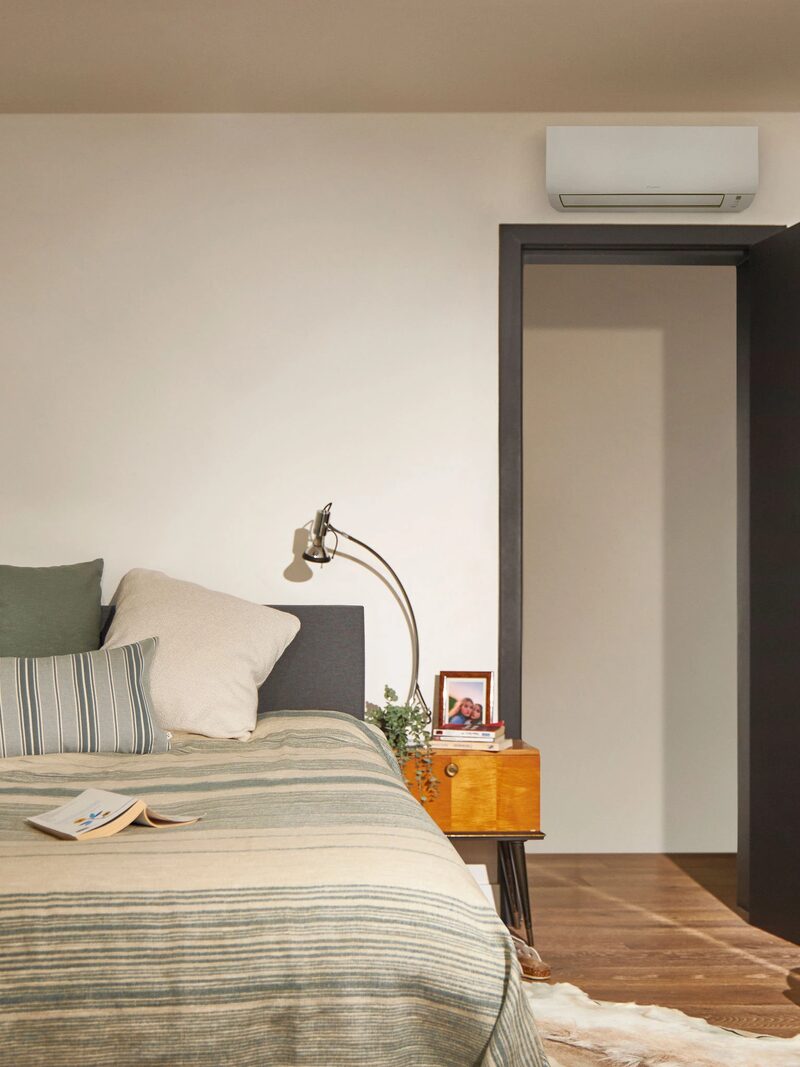
No. Individual indoor units can be switched off while others run, and the outdoor unit modulates to the load that remains. What is fixed is the mode: all indoor units must be in cooling or heating mode simultaneously15. That rules out the arrangement some households imagine, where a south-facing room is cooled while a north-facing room is heated, from the same outdoor unit.
Installation does not have to happen all at once. Haier states that indoor units do not need to be installed at the same time5, and describes its multi system as future-proofed to allow up to 5 indoor units to one outdoor unit5. Daikin states that with a multi system it might be possible to add an additional indoor unit at a later stage if required, up to a maximum of five per outdoor unit3. The word "might" matters: adding a unit depends on a free port, available capacity on the outdoor unit, and a pipe route that can still be run.
Adding an indoor unit later is refrigerant work. It requires a certified engineer, and it is not comparable to adding a plug-in appliance. The system has to be assessed for whether the outdoor unit can carry the extra load before any pipework is installed.
Where a multi-split falls short
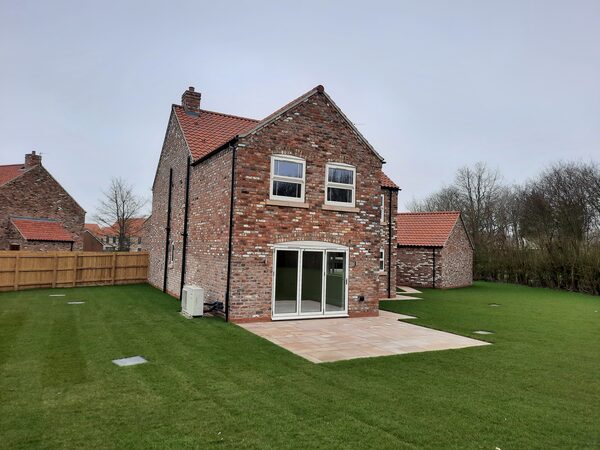
The concentration of several rooms onto one outdoor unit is the system's main weakness as well as its main advantage. A single outdoor unit failure takes every room it serves out of service at once, whereas separate single splits fail independently. That is a resilience trade-off a household should weigh against the reduced number of external units.
Planning rules constrain the number of external units regardless of how many indoor units a system can carry. Nesta reports that current planning rules only allow for one external heat pump unit per building, or two if the building is detached8. Richmond Council states that detached houses can install up to two heat pumps, while a non-detached house or a block of flats can install only one unit16. The rules differ between England, Scotland, Wales and Northern Ireland, so the position in each nation needs checking separately.
There is also a dependence that does not go away. A multi-split runs on mains electricity from a supplier, and its controls typically run through a manufacturer's app and cloud service. Panasonic's Comfort Cloud app is the control route for its systems14, which means the manufacturer's platform sits between the household and the equipment. The system reduces reliance on opening windows and on portable units, but it does not reduce reliance on the grid.
Multi-split against several single splits
The comparison turns on how many rooms are being served and how the pipework can be run. A multi-split uses one outdoor unit for several rooms, which reduces the number of external units on the wall and can simplify the external appearance of a property. Several single splits need one outdoor unit per indoor unit, which multiplies the external units and runs into the planning limits described above.
Independent guidance puts the typical multi-split configuration at two to five indoor units per outdoor unit8, and Which? states that one main outdoor air-to-air heat pump unit can be connected to up to five indoor units17. Daikin describes a multi-split system as one outdoor unit with up to five indoor units, with per-room temperature adjustment18.
The efficiency argument for splitting the system at all is that some of the heat transfer takes place inside the building where it is warmer, which the Energy Saving Trust describes as making split systems more efficient19. Vaillant makes the same point from the maker side, stating that split systems create most of the heat transfer within the walls of the home and thus operate with less heat loss and more efficiency, at the cost of increased installation costs20. A monobloc alternative keeps all components in a single outdoor unit, requiring less financial investment, effort in installation and indoor space, but is a little less efficient than split systems20.
For a household, the choice is between fewer external units with shared risk, and more external units with independent operation but a planning ceiling. The multi-split air conditioning page sets out the configuration in more detail, and single split vs multi-split air conditioning compares the two directly.
Brands and ranges sold in the UK
Mitsubishi Electric's MXZ multi-split range is the one that reaches six indoor units per outdoor unit1, and its PUMY-SP series extends to 10 indoor units on a single outdoor unit for larger installations9. Daikin's Multi range connects up to five indoor units to one outdoor unit and allows indoor units of different types and colours to be combined2. Fujitsu General's R32 multi-split range covers 5 types and 41 models in the 2.0 kW to 6.0 kW class, with up to five indoor units per outdoor unit4. Haier's Multi system allows up to five indoor units from a single outdoor unit and is described as future-proofed for later expansion5. Panasonic's Multi TZ system connects up to three indoor units to one outdoor unit6.
Daikin's port-counted outdoor units appear in independent product listings at four indoor units, including the 4-port and 5-port Class 90 models21. Those listings describe the port count of the specific outdoor unit rather than the range maximum, which is why a figure of four can appear alongside a range figure of five.
Sources22 cited
- Air Conditioning Products and Solutions, Mitsubishi Electric, 2026-09-17
- Multi Split Air Conditioning, Daikin UK, 2026-09-17
- How Many Rooms Can I Cool or Heat With an Air to Air Heat Pump, Daikin UK, 2026-09-17
- R32 Multi-Split Unit Range, Fujitsu General, 2026-09-23
- Multi-Split Outdoor Units, Haier HVAC, 2026-09-17
- Free Multi Split, Panasonic Air Conditioning, 2026-09-17
- Air-to-Air Heat Pumps: Common Questions on Air Conditioning, Nesta, 2026-06-24
- Air-to-Air Heat Pumps: A Low Carbon Solution for UK Homes, Nesta, 2026-02-17
- PUMY-SP R410A Inverter Heat Pump, Mitsubishi Electric Living Environmental Systems, 2026-09-20
- HW-BA316AFK Controller, Haier HVAC, 2026-09-17
- AOEG30KBTA4 Outdoor Unit, Fujitsu General, 2026-09-23
- AOEG36KBTA5 Outdoor Unit, Fujitsu General, 2026-09-23
- Xtend Split, Intergas Heating, 2026-09-17
- Panasonic Comfort Cloud App, Panasonic Air Conditioning, 2026-09-20
- FAQs, Cool Easy, 2026-09-23
- Planning Guidance: Heat Pumps, London Borough of Richmond upon Thames, 2026-04-22
- How a Heat Pump Can Cool Your Home, Which?, 2026-07-17
- Air-to-Air Heat Pumps vs Air Conditioning, Daikin UK, 2026-09-17
- Air Source Heat Pumps, Energy Saving Trust, 2026-07-16
- Air Source Heat Pump, Vaillant, 2026
- Daikin 4 Port Multi Air Conditioner 5MWXM68A9, Quiet Mark, 2026-09-17
- Daikin 5 Port Class 90 Multi Air Conditioner 5MWXM90A9, Quiet Mark, 2026-09-17
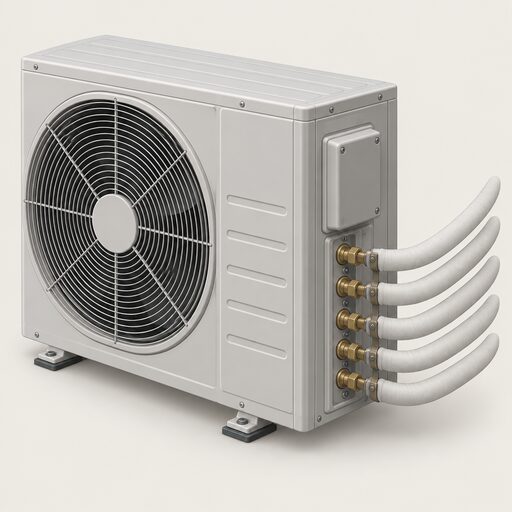 Multi-Split ACHow multi-split air conditioning works when one outdoor unit serves several indoor units: how many rooms one system can serve, independent room control, efficiency, outdoor unit size and sound, planning rules in England and Scotland, servicing and lifespan, the 0% VAT position and how it compares with separate single splits.
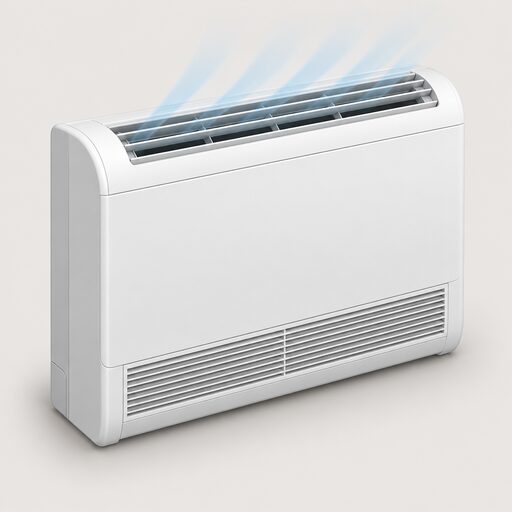 Split Air ConditioningA split air conditioning system cools or heats one room using an indoor unit and an outdoor unit linked by pipes.
 Air Conditioning SizingHow big an air conditioner does a room need?
 Which Homes Suit a Heat PumpMost UK homes can have a heat pump fitted, so the real question is whether yours makes it easy or expensive.
 Thermostat and Room TemperaturesWhat temperature should a thermostat be set to, and does it differ from room to room?
 System SizingMost UK homes need a solar system of around four kilowatts, which takes up roughly twenty square metres of roof.