
In this answer
Short answer
For a room of 20 square metres, the published sizing tables give 2.5 kW of cooling output, quoted as 9,000 BTU. That is the figure UK air conditioning suppliers use in their room size tables, where 2.5 kW and 9,000 BTU sit against 20 m² or 200 ft²1. The band below it, 2.0 kW or 7,000 BTU, is listed for rooms up to 16 m², and the band above, 3.5 kW or 12,000 BTU, for rooms up to 30 m²1.
The number is a starting point, not a specification. The same tables state they are based on standard room heights up to approximately 2.7 metres, and that sizing also depends on insulation, glazing, sunlight, ceiling height, room use and the number of people in the room1. A south-facing 20 m² room with large windows and four occupants is not the same cooling load as a shaded north-facing bedroom of the same floor area.
What the figure buys a household is a shortlist. It tells you which units to look at, which questions to ask in a survey, and whether a portable unit on castors will do the job or whether the room needs a fixed system. It does not remove the need for a proper heat gain calculation on anything other than a straightforward room.
Cooling output explained: kW and BTU
Cooling output is measured in two units that describe the same thing. The kilowatt is the metric figure used on UK product listings and in installer quotations. The BTU, or British Thermal Unit, is the older imperial measure still used in model names and in sizing rules carried over from North America. The conversion is fixed: multiply the kW figure by 3412.14 to reach BTU, or multiply the BTU figure by 0.000293 to reach kW2.
In practice the trade quotes rounded pairs rather than converted figures. The sizing table used by UK suppliers runs 1.5 kW against 5,000 BTU for up to 12 m², 2.0 kW against 7,000 BTU for up to 16 m², 2.5 kW against 9,000 BTU for up to 20 m², 3.5 kW against 12,000 BTU for up to 30 m², 5.0 kW against 18,000 BTU for up to 45 m², and 10.0 kW against 34,000 BTU for up to 80 m²1. The rounding is why 2.5 kW does not convert to exactly 9,000 BTU.
A second sizing method appears in manufacturer guidance: 20 BTU for each square foot of living space, attributed to a US Department of Energy recommendation and applied with an average ceiling height4. That rule produces a different answer for the same room, because a 20 m² room is roughly 215 square feet, and 20 BTU per square foot gives a figure well above the 9,000 BTU that the metric table assigns to that room size. The two methods are not equivalent, and the figures they produce disagree. The metric table is the one used in UK product listings, and it is the figure a UK household will see quoted against a model.
What changes the size you need

Floor area is the crudest input into a cooling calculation. The sizing tables say so themselves: they are based on standard room heights up to approximately 2.7 metres, and sizing also depends on insulation, glazing, sunlight, ceiling height, room use and occupancy1. Maker guidance repeats the point, stating that room sizes are approximate and that ceiling height, insulation, glazing and sun exposure can affect cooling performance6.
Ceiling height matters because cooling load follows the volume of air in the room, not its footprint. A room of 20 m² under a 2.7 metre ceiling holds a different quantity of air from the same footprint under a vaulted or loft ceiling, and the table does not cover the second case. Glazing and orientation matter because solar gain through glass is often the largest single heat source in a UK room on a summer afternoon. Insulation matters because it slows the rate at which heat enters, which is why a well-insulated, shaded room holds its temperature better than a poorly insulated one of the same size.
Occupancy and room use are the factors most often left out. A bedroom used by two people overnight has a different load from a home office with a desktop computer, monitor and two occupants through the working day. The independent evidence on insulation performance is stark: a Passivhaus case study describes increasing the insulation of a chiller's door, wall and floor from the recommended 19 mm to 300 mm, a change of an order of magnitude made to hold a controlled temperature7. Domestic rooms are not built to that standard, but the principle holds: the building fabric, not the floor area, sets how hard the unit has to work.
For a household, the practical consequence is that 2.5 kW is the right starting point for a straightforward 20 m² room and the wrong finishing point for a difficult one. A survey that measures the room, notes the glazing and orientation, and asks how the room is used will produce a figure that the table cannot.
Portable, split or window: which type suits a 20m2 room
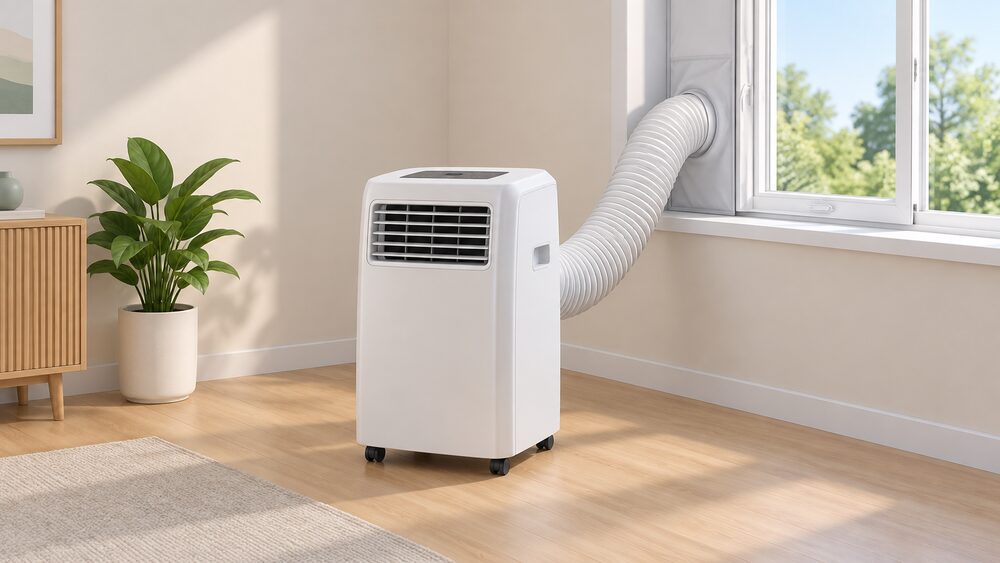
A 20 m² room sits in the overlap between portable and fixed air conditioning, and the choice turns on how the room is used and what can be installed.
Portable units are sold with coverage figures that reach 20 m² and beyond. One 12,000 BTU portable is listed for rooms of 20 to 30 m², described as an estimate based on a typical UK living space3. A 16,000 BTU model in the same range is listed for 35 to 40 m²8. Elsewhere in the portable market, coverage figures include areas up to 30 m²9. Maker guidance is more cautious about the category as a whole, noting that portable units suit temporary set-ups or rooms under 10 m²10, and that a single-packaged unit is ideal for small areas of up to 30 m²11. The gap between the marketing coverage figure and the guidance figure is the gap between a unit that will take the edge off a room and one that will hold a set temperature.
Portables have practical constraints. They sit on castors and can be wheeled between rooms, but can only cool small spaces11. They need somewhere for the exhaust hose to go: one 12,000 BTU model's kit is designed for sliding or sash windows and is not ideal for other window types12, while another range offers a standard kit for sash windows and a flexible kit for all window types, with the flexible kit reaching up to 39 cm in width and up to 4 m in length8. They also draw power: portable air conditioners are rated at up to 2000 W14, which is a load worth understanding before running one on a circuit shared with other appliances.
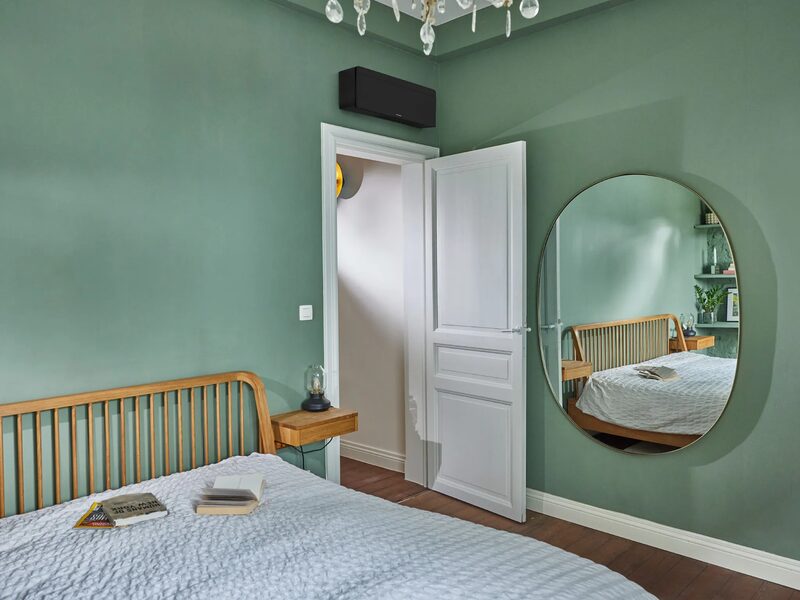
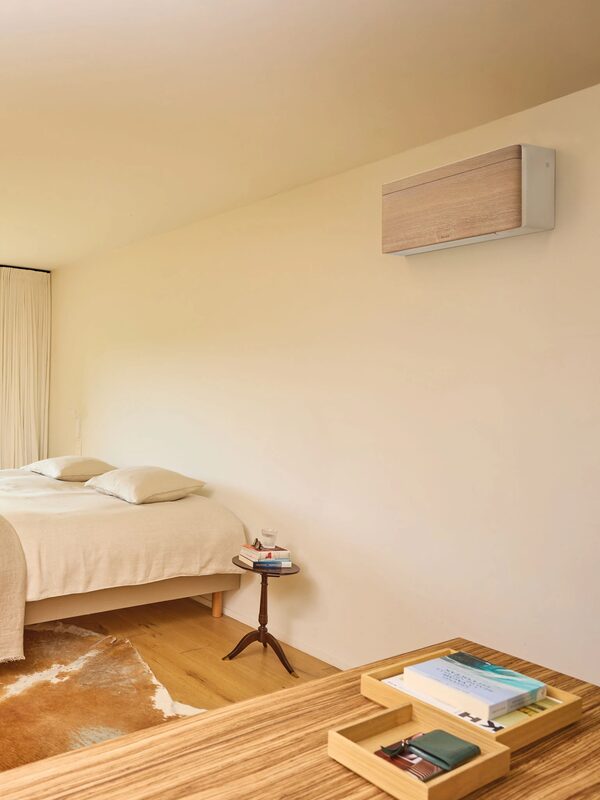
Fixed split systems avoid the window problem entirely. Single split wall-mounted units are described as ideal for single rooms, while multi-split units serve several rooms from one outdoor unit5. A 2.5 kW system is described as often suitable for smaller rooms such as compact bedrooms or small offices1, and a 3.5 kW system for larger bedrooms, larger home offices, garden rooms, small living rooms, or spaces with more sunlight and glazing16. For a 20 m² room that is used regularly through the summer, a fixed system sized at 2.5 kW is the option that holds a temperature rather than chasing one.
Where a portable unit falls short of a fixed system
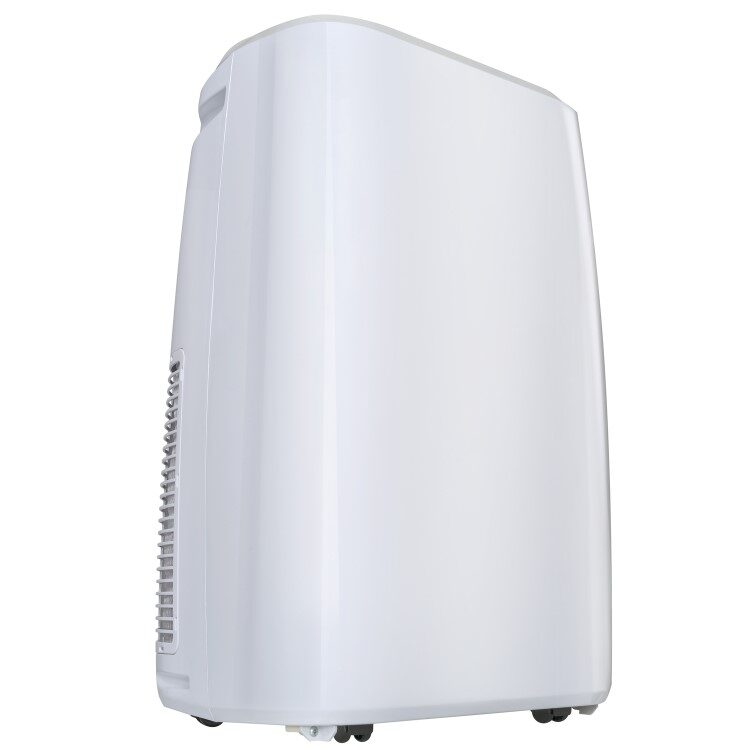
The limits of a portable unit in a 20 m² room are worth stating plainly, because the coverage figures on retail listings do not carry them.
A portable unit cools the air it draws in and expels the heat it removes through a hose. That hose radiates some heat back into the room it is trying to cool, and the unit has to work against its own exhaust. A fixed split system separates the two sides of the refrigeration circuit: the indoor unit moves cooled air, the outdoor unit rejects the heat outside the building. That is a structural advantage, not a matter of build quality.
Running cost is the second limit. A portable air conditioner draws up to 2000 W14. A standard fan, by comparison, is described as costing 20 times less to run than portable air conditioners15. That comparison is a maker's figure and applies to fans rather than to fixed systems, but it sets the scale: cooling a room with a compressor costs materially more than moving air around it.
The third limit is noise and placement. A portable unit sits in the room it cools, so its compressor is audible in that room. A fixed system puts the compressor outside. For a bedroom or a home office, that difference is often the deciding factor.
None of this makes a portable unit the wrong choice for a 20 m² room. It makes it the right choice where the room is used occasionally, where the building cannot take a fixed installation, or where the household is renting and cannot get consent for outdoor equipment. Where the room is used every hot day, the fixed system is the one that will hold its rated output.
Oversizing, and what it costs in comfort
A unit that is too powerful for the room is not simply a unit with headroom. Maker guidance states that an oversized air conditioner can create stronger airflow than needed and may not provide the steady, gentle temperature control wanted, especially in bedrooms or small offices1.
The mechanism is straightforward. A compressor that is too large for the load reaches the set temperature quickly, then stops. The room warms again, the compressor restarts. The result is a cycle of blasts of cold air and periods of nothing, rather than a unit running steadily at part load. In a bedroom, that cycling is felt as draught and noise rather than comfort.
This is why the sizing table's bands matter more than its headline figure. A 20 m² room sits at 2.5 kW, with 2.0 kW below it and 3.5 kW above1. Choosing the band above "for margin" moves the unit out of the range where it will run steadily. Choosing the band below leaves the unit running flat out on the hottest days and never quite reaching the set point.
The honest position is that the table gives a band, and the survey gives the figure. Where a room is straightforward, the band is enough. Where it is not, the difference between a well-sized unit and a badly sized one is felt every time it runs.
What 20 square metres means for a household's energy independence
Cooling a single room is a small load in the context of a whole house, but it is a load that arrives at the worst possible time. Air conditioning runs when the sun is highest and when the grid is under most strain from other cooling demand. A 2.5 kW cooling unit drawing up to 2000 W14 adds to that peak.
That is the dependence the household carries. A portable or split unit runs on mains electricity from a supplier, and its output depends on the grid staying up. There is no domestic fuel store for cooling in the way there is for heating. A unit sized correctly for the room draws less than one sized too large, because it runs steadily rather than cycling at full power, and a unit sized too small runs flat out for longer. Sizing is therefore an energy question as well as a comfort one.
The reduction available to a household is in the order of the measures taken before the unit is switched on. A standard fan costs 20 times less to run than a portable air conditioner15, and passive measures that keep solar gain out of the room reduce the load the unit has to meet. A 20 m² room with external shading and a fan may need no compressor at all on all but the hottest days.
Where a household does install fixed cooling, the unit can be specified as a reverse-cycle air-to-air heat pump, which heats in winter as well as cooling in summer. That changes the calculation: the same equipment then displaces some gas or electric heating, and the household's exposure shifts rather than simply growing. The sizing figure for cooling remains the same, but the case for the installation is no longer seasonal.
Sources16 cited
- Air conditioning size guide, CoolEasy, 2026
- What is BTU?, Viessmann, 2022
- Meaco Cirro 12000 BTU Super Quiet Smart Portable Air Conditioner, Meaco, 2026
- Smart air conditioner comfort guide, Netatmo, 2026
- What size of air conditioner do I need?, Hitachi Air Conditioning, 2026
- Air conditioners, Meaco, 2026
- Building Regulations guidance Part L: conservation of fuel and power, Welsh Government, 2014
- Meaco Cirro+ 16000 BTU Portable Air Conditioner, Meaco, 2026
- Portable air conditioners, electriQ, 2026
- Air-to-air heat pumps for small rooms, Daikin UK, 2026
- Packaged air conditioning, Netatmo, 2026
- electriQ P12C 12000 BTU Portable Air Conditioner, electriQ, 2026
- MeacoCool MC Series Pro 10000 BTU Portable Air Conditioner, Meaco, 2026
- Ratings of electrical appliances, Electrical Safety First, 2026
- Do fans work in hot weather?, Ecotricity, 2025
- Lux Air 3.5kW (12000 BTU) portable air conditioning heat pump, CoolEasy, 2026
 Air Conditioning SizingHow big an air conditioner does a room need?
 Thermostat and Room TemperaturesWhat temperature should a thermostat be set to, and does it differ from room to room?
 Do Smart Controls Save Money?Do smart heating controls really cut your bills, and by how much?
 Portable Power Station SizeHow big a portable power station does a home actually need, and how long will it keep things running in a power cut?
 Roof InsulationHow much heat escapes through your roof, how thick the insulation should be, what it costs and what it saves?
 Electric FansHow electric fans cool people rather than rooms, what the main UK fan types (desk, pedestal, tower, ceiling and bladeless) draw in watts and cost per hour, where they fall short in a heatwave, how to use them safely, and how they fit alongside night ventilation and shading.