

In this answer
Short answer
OVO Heat Pump Plus is an add-on to an OVO electricity account that bills the energy used by a heat pump at 15p/kWh, while the rest of the household's electricity stays on a standard rate1. It is not a whole-house tariff, and it is not open to every household: it is available to customers who install a heat pump through the OVO and Heat Geek offer, or who have a compatible heat pump as listed on the OVO website3.
The savings quoted for it vary widely, and the variation is the story. OVO's own case study puts the figure at £443.77 for an air source heat pump with a SCOP of 2.8 and annual consumption of 3,689 kWh, measured against OVO's average standard variable tariff, and describes savings of up to £440 a year for heat pump owners using automated time-of-use tariffs such as Heat Pump Plus4. Independent guidance puts the wider benefit of a heat pump-appropriate tariff at up to £330 a year on heating bills5. A separate OVO claim of more than £500 a year, and a figure of £428, both appear in reporting of the same period and are not reconciled3.
What Heat Pump Plus is: a cheaper rate for the heat pump's own electricity
Heat Pump Plus sits alongside an OVO heat pump installation rather than replacing the household's supply contract. OVO offers heat pump installation plus the Heat Pump Plus add-on, which gives cheaper electricity rates for the energy the heat pump uses1. The rate is 15p/kWh, and it applies to the heat pump's consumption only; a standard rate applies to all other energy use in the home2.
That structure matters for how the saving works. A heat pump runs on electricity, and because it runs on electricity it can make savings on bills where the tariff is designed around it8. But the discount is confined to one load in the house. Everything else, lighting, cooking, appliances, any supplementary electric heating, is billed at the standard rate. The saving therefore scales with how much of the household's total electricity the heat pump accounts for, and with how efficiently that heat pump runs.
There is a further route to a lower running cost that does not depend on the supplier at all. Where a household already has solar panels, using the free energy they generate to power the heat pump saves more, and a solar PV system can be used to power a heat pump, lowering both electricity and heating bills9. That is a self-generation route to the same end: less of the heat pump's running cost bought in at any rate.
How much you can save: £249 to £444 a year, and OVO's claim of over £500
The independent and case-study figures for annual heating bill savings sit between £249 and £444. A typical heat pump household saving under the Renewables Obligation offset is put at £2498, while heat pumps are estimated to save around £295 per year compared with a G-rated boiler9. Switching to a heat pump appropriate tariff is reported to save up to £330 a year on heating bills6, and heat pump owners using automated type-of-use tariffs such as Heat Pump Plus could potentially save up to £440 per year compared to a standard variable rate7. OVO's own calculation for Heat Pump Plus puts the figure at £443.77, based on an air source heat pump with a SCOP of 2.8 and annual consumption of 3689 kWh against the OVO average standard variable tariff7. E.ON Next's Next Pumped tariff claims up to £67 savings on annual heating bills10. The spread reflects differences in the baseline tariff, the efficiency of the plant and how flexibly the household operates it.
The published savings figures for heat pump tariffs span a wide band, and they are not measuring the same thing.
| Figure | Basis | Who states it |
|---|---|---|
| £443.77 a year | Air source heat pump, SCOP 2.8, 3,689 kWh annual consumption, against OVO's average standard variable tariff | OVO case study4 |
| Up to £440 a year | Heat pump owners using automated time-of-use tariffs such as Heat Pump Plus | OVO case study4 |
| Up to £330 a year | Heat pump-appropriate tariff, heating bills | Independent guidance5 |
| £249 a year | Typical heat pump household, from a renewables obligation offset | Independent guidance11 |
| Around £295 a year | Heat pumps against a G-rated boiler | Independent guidance12 |
| £640 to £750 a year | Heat pump flexed on a time-of-use tariff against a single-rate tariff, standard heat pump profile | Independent modelling13 |
The £443.77 figure is the most specific, and it is also the most conditional: it assumes a SCOP of 2.8 and a stated annual consumption, so a household running a less efficient heat pump, or using more or less heat, will not land on it4. The £640 to £750 range comes from modelling rather than a supplier's case study, and it compares flexible operation against a single-rate tariff rather than against a named product13. The £249 figure is a modelled offset rather than a bill11.
OVO's claim of more than £500 a year, and a separate figure of £428, both appear in reporting of the same period and are not reconciled3. Where documents disagree, both figures stand: a household comparing them should treat the range as £428 to more than £500 on OVO's side, and £249 to £444 across the independent and case-study figures, with the higher numbers resting on efficient plant and flexible operation.
The 15p/kWh rate and how it compares with OVO's standard variable tariff
The headline number is 15p/kWh, described as a specialist OVO electricity tariff for heat pump owners1. The same rate is reported as applying to the energy used by the heat pump only, with a standard rate on everything else2.
The comparison that gives the rate its meaning is the price cap. Heat pumps use electricity which, bought at the standard, price-capped rate, currently costs around four times more per unit than gas7. That ratio is the reason a heat pump's running cost can look poor on a standard tariff and good on a specialist one. A rate of 15p/kWh narrows the gap between electricity and gas for the heat pump's own consumption, and the saving is the difference between that rate and the standard rate, multiplied by the heat pump's annual kWh.
Two qualifications follow. First, the discount applies only to the heat pump's share of consumption, so a household with high non-heat electricity use captures less of the benefit. Second, the comparison is against a moving baseline: the standard variable tariff changes, and the Which? heat pump savings calculator is updated quarterly to reflect the latest price cap7. A saving quoted against one quarter's cap is not a fixed annual amount.
"specialist OVO electricity tariff of 15p/kWh (for heat pump owners)"
Eligibility: who can add Heat Pump Plus to their account
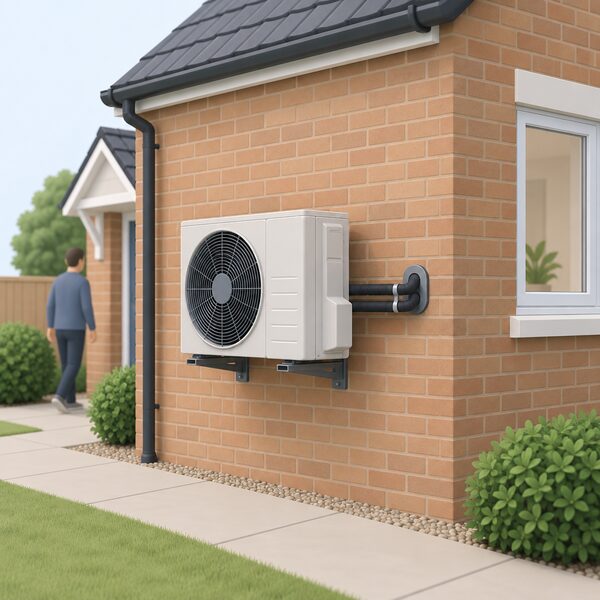
Eligibility is narrower than the marketing suggests. The Heat Pump Plus tariff is only available as an add-on to customers who install a heat pump through the OVO and Heat Geek offer, or who have a compatible heat pump as listed on the OVO website3. So there are two routes in: buy the installation through OVO, or already own a model that appears on OVO's compatibility list.
For households on the outside of that, the practical questions are the same ones any heat pump owner faces. A heat pump installation is exempt from VAT at 0%, which reduces the upfront cost14. Boiler Upgrade Scheme support requires an in situ SCOP of at least 2.8, a capacity of no more than 45 kWth, and a heat pump that meets the property's heating and hot-water demands6. Eligible technologies under the scheme include air-to-water heat pumps16.
There is also a supply-side condition that catches some properties. Installing an air source heat pump can require a fuse or supply upgrade, and that work has a cost and a lead time17. None of this is specific to OVO, but it determines whether a household is in a position to take a heat pump tariff at all.
Heat Pump Plus or OVO Beyond: the two heat pump offers side by side
OVO's heat pump proposition has more than one element, and they are not the same product. Heat Pump Plus is the tariff add-on: a 15p/kWh rate for the heat pump's energy1. A Heat Pump Plus trial also suggested a wider set of incentives, including reduced tariff rates, reductions to standing charges, bill credit and running cost guarantees4. Those are trial suggestions rather than a published product, and no monthly credit figure is given for them.
The distinction matters because a household comparing offers may be comparing a rate against a bundle. A rate is measurable: 15p/kWh against a standard rate, applied to a known annual consumption. A bundle of standing-charge reductions, credit and guarantees is harder to value, and no figure is published for any of its parts.
For context on how suppliers structure these offers, E.ON Next allows customers to spread the cost of an air source heat pump with up to two years 0% APR interest-free credit7. That is a finance mechanism rather than a running-cost discount, and it addresses the upfront barrier rather than the bill. The two approaches answer different problems: one lowers the cost of the electricity, the other lowers the cost of the equipment.

What your actual saving depends on: SCOP, consumption and tariff
Three variables decide whether a quoted saving materialises.
SCOP. The £443.77 case study assumes a SCOP of 2.84. That is also the minimum in situ SCOP for Boiler Upgrade Scheme support, so it is a floor rather than an ambitious figure6. Independent guidance goes further: with a specialist tariff providing cheaper energy, savings would be made even with a lower SCOP of 2.07. Efficiency is not the only lever, but it sets how many kWh the heat pump draws for each unit of heat delivered.
Consumption. The case study uses 3,689 kWh a year4. A larger or leakier home draws more, and a well-insulated one draws less. Because the discount applies per kWh, the saving moves with consumption in a straight line.
Tariff and how the heat pump is run. Switching to a heat pump time-of-use tariff should reduce the cost of running the heat pump, making it more likely that a household saves money19. A study by energy consultancy Cornwall Insight found savings simply from being on a typical time-of-use tariff20. But not every tariff helps: research identifies which tariff types provide the best heat pump savings, and which might actually increase energy bills21. Heat pump tariffs vary by supplier, taking the form of a set, cheaper rate per kWh regardless of where you live, or a discount against the region's standard tariff20.
Additional savings are possible with flexible electricity tariffs22. The scale of that flexibility is significant: modelling found average savings of £640 to £750 a year by operating a heat pump flexibly on a time-of-use tariff, against a single-rate tariff with a standard heat pump profile13.
What this means for a household's energy independence
A tariff like Heat Pump Plus changes the price of imported electricity; it does not change where that electricity comes from. The household remains connected to the grid and to a supplier, and the heat pump remains dependent on both. What the tariff does is reduce the running-cost penalty that electricity carries against gas at the standard, price-capped rate, where electricity costs around four times more per unit7.
The independence available here is partial and comes from two directions. One is price: a specialist rate of 15p/kWh for the heat pump's consumption lowers the cost of each unit bought in1. The other is self-supply: where a household has solar panels, using the free energy they generate to power the heat pump saves more, and a solar PV system can power a heat pump to lower both electricity and heating bills9. A household with generation and a heat pump tariff is buying less at the margin and buying what remains more cheaply.
The dependence that remains is worth stating plainly. The rate is set by the supplier and can change; the standard variable tariff it is measured against moves with the price cap, and the savings calculator tracking it is updated quarterly7. Eligibility is tied to a supplier relationship, either an OVO installation or a compatible model on OVO's list3. And the discount covers one load in the house, not the household's supply. A heat pump can provide both space and water heating, which significantly lowers fuel bills, but the tariff that makes it cheap is still a commercial product held by someone else23.
For households weighing the wider picture, loft insulation is ten-times more cost effective at bringing down bills than a heat pump24, and not everyone who installs a heat pump will see savings straight away, because electricity is currently more expensive than gas9. Dedicated savings schemes could encourage people to save for a heat pump and related changes like insulation25. The Heat Pump Ready Programme is intended to help bring down costs and installation time26. After grant support, the additional cost of a heat pump has been put at £5005.

Sources26 cited
- Heat pumps vs boilers, Which?, 22 September 2025
- Heat pump calculator, Which?, 30 April 2025
- A heat pump might be a lot cheaper than you think, Which?, 26 November 2024
- The future of heat, Nesta, 24 October 2025
- Renewable technologies: what really cuts energy bills, Energy Saving Trust, 12 August 2026
- Boiler Upgrade Scheme: guidance for installers, Ofgem, 17 September 2026
- Air source heat pump costs and savings, Which?, 14 April 2026
- Heat pumps, Welsh Government, 17 November 2025
- Is now a good time to get a heat pump, Energy Saving Trust, 12 December 2025
- Solar photovoltaic, MCS Certified, 30 July 2026
- Tax-free electricity, Nesta, 5 November 2025
- Energy UK explains the Clean Heat Market Mechanism, Energy UK, 23 January 2024
- Domestic heat pump flexibility modelling, Nesta, 19 November 2024
- Heat pump, GOV.UK, 10 September 2026
- What is the Boiler Upgrade Scheme, Which?, 22 October 2025
- Boiler Upgrade Scheme guidance for installers, Ofgem, 2 July 2026
- What do you need to upgrade, UK Power Networks, 17 September 2026
- Energy bills help, Scope, 24 July 2026
- In-depth guide to heat pumps, Energy Saving Trust, 16 July 2026
- Time of use tariffs explained, Which?, 23 April 2026
- Flexible futures: integrating smart tariffs with low carbon home technologies, Energy Saving Trust, 10 July 2026
- Additional savings from flexible electricity tariffs, UK Parliament POST, 19 September 2026
- Heat pumps, REA, 17 September 2026
- No country for cold homes, Resolution Foundation, 7 August 2025
- When the heat is not on, Energy Systems Catapult, 24 June 2026
- Information about the Heat Pump Ready Programme, GOV.UK, 11 May 2026
 How Much Does a Heat Pump CostA heat pump usually costs around eleven thousand pounds installed, though quotes vary a lot depending on your home.
 Heat Pump Electricity TariffsA heat pump tariff gives you cheaper electricity for part of the day, so running your heating costs less than on a standard rate.
 Do Smart Controls Save Money?Do smart heating controls really cut your bills, and by how much?
 High Temperature Heat PumpsHigh-temperature heat pumps deliver flow temperatures of roughly 65 to 80°C, close to boiler levels, so existing radiators can often stay in place.
 Heat Pump Running CostsWhat does a heat pump cost to run each year, and is it cheaper than a gas boiler?
 Efficiency COP SCOP and SPFA heat pump can give out three or four times more heat than the electricity it uses, so what do the efficiency numbers on a quote actually mean?