In this guide
OVO Energy is the UK's fourth-largest energy supplier, a British company formed in 2009 and headquartered in Bristol1. It sells gas and electricity to households across Great Britain, appears in Ofgem's supplier-level satisfaction research, and is due to be acquired by E.ON in the near future1. For a household, OVO is a conventional grid supplier: it buys wholesale energy, bills for what a meter records, and offers a mix of fixed, standard variable, time of use and export tariffs on top.
The company's own performance record is mixed and worth stating plainly. Ofgem's January 2026 supplier-level findings put OVO at 70% overall satisfaction, with 67% satisfied with customer service, and both figures significantly lower than the survey average3. Citizens Advice rated it 3.30 out of 5 overall for January to March 2026, with complaints at 2.5 out of 5 and billing and metering at 3.8 out of 54. Against that, its customer commitments score was 5 out of 5 and its smart meter billing accuracy was 98.52%4.
What follows covers what OVO offers, what its tariffs cost, what protections apply, the company's status, and what the whole arrangement means for a household's energy independence.
What OVO offers UK households
OVO's core product is a domestic gas and electricity supply on a fixed or standard variable tariff. It is one of the suppliers offering smart time of use tariffs, alongside British Gas, E.ON Next, EDF Energy, Octopus Energy and Scottish Power, and smaller firms including 100Green, Fuse Energy, Good Energy and So Energy7. Time of use tariffs charge different rates at different times of day, which suits households that can shift demand, such as electric vehicle charging or heat pump running.
Beyond the standard supply, OVO has run several add-ons and specialist products. Charge Anytime is an electric vehicle charging product, and eligibility requires the customer to already be an OVO customer signed up to a home energy tariff, fixed or standard variable8. The company also ran Battery Boost, a solar export add-on, from October 2024 to January 2026, after which it was no longer available9. On the export side, OVO appears in Smart Export Guarantee rate tables with a 12 month fixed term tariff paying 4.0p per kWh, with no requirement to take an import tariff from OVO and with battery storage included9.
OVO also took part in the Electrification of Heat Demonstration Project as delivery contractor for the south east of England excluding London, a government-funded trial of heat pump installation at scale10. That is a research role rather than a product a household can buy, but it places the company inside the heat electrification work that shapes future tariffs.
For a household, the practical point is that OVO's offer is a supply contract plus optional add-ons. Nothing in the range changes where the energy comes from: the gas arrives through the grid and the electricity through the distribution network, and the household remains dependent on both.
Tariffs, rates and what a bill actually shows
OVO's published rates vary by region, payment method and tariff. One independent rate table for the South Wales (SWALEC) region, direct debit, lists OVO Simpler Energy at 27.23p per kWh for electricity, 18.34p per kWh for gas and a standing charge of 54.13p per day, as of 8 September 202611. That is a single regional snapshot, not a national figure: unit rates and standing charges differ across the fourteen GB distribution regions, and the same tariff will not cost the same in two homes.
For heat pump owners, independent guidance published in September 2025 refers to a specialist OVO electricity tariff of 15p per kWh6. That is well below the standard unit rate in the snapshot above, and it reflects the general pattern that electrified heating is cheaper to run on a tariff designed for it.
Reading an OVO bill is straightforward once the layout is known. Usage is shown in kWh based on smart meter readings, and the bill specifies whether each reading is a smart meter automatic send, a manual send or an estimate5. The supplier will tell a customer if they are not on its cheapest plan5. Billing accuracy was 98.52% on smart meters and 89.98% on traditional meters in January to March 2026, a gap that reflects how much easier it is to bill correctly when readings arrive automatically4.
What protections apply, and what replaces a warranty
A domestic energy supply is not a product with a warranty. What a household gets instead is a set of regulatory protections, and these matter more than any guarantee a manufacturer would offer on a boiler.
The central one is the energy price cap. The first cap for default energy tariffs, or standard variable tariffs, was introduced on 1 January 2019, and people on this type of tariff are protected by it12. The cap limits the unit rate and standing charge a supplier can charge on a default tariff, not the total bill: a household that uses more pays more. VAT is added at 5% on top of the capped rates13.
Where a fixed tariff is concerned, the protection is the contract itself. E.ON has promised to honour any existing fixed tariffs that OVO customers are locked into for the duration of their contract, and OVO states that existing tariffs will be honoured in full throughout the acquisition process14. That commitment covers the fixed term, not whatever comes after it.
On the social obligation side, OVO is one of the suppliers funding the Park Homes Warm Home Discount Scheme, which offers £150 payments to eligible park home and static caravan residents in England, Scotland and Wales, assessed first come, first served15. The Energy Company Obligation, the government energy efficiency scheme for Great Britain, is not a grant scheme, and different companies or installers may provide different levels or types of support16. The Welsh Government has issued a written statement on support for householders affected by the announced closure of the ECO scheme17.
What OVO costs, and the fees that catch people out
There is no single OVO price. The cost of a year's supply depends on region, payment method, tariff type and how much energy the household uses. The figures that exist are snapshots.
The South Wales direct debit snapshot above gives a standing charge of 54.13p per day on Simpler Energy, before any unit rate is applied11. That is a daily figure rather than an annual one, and it illustrates how much of a bill arrives before a single kilowatt hour is used. Standing charges vary by region and by tariff, and the wider pattern is covered in standing charges.
Exit fees are the other cost that surprises households. On the sample fixed deal in billing guidance, the fee was £50 per fuel, so £100 in total for a dual fuel customer switching before the final 49 days of the contract5. After that point, no exit fee should apply5. When a fixed deal ends, the household is rolled onto the supplier's standard variable tariff, which would probably cost more5. The mechanics of that transition are set out in what happens when a fixed energy deal ends.
For households on a prepayment meter, OVO lists emergency credit at £15 per fuel18. Prepayment customers on a standard variable tariff are protected by the price cap in the same way as credit customers, though the rates differ by payment method, as covered in price cap rates by payment method.
| Item | Figure | Date |
|---|---|---|
| Simpler Energy electricity unit rate, South Wales, direct debit | 27.23p per kWh11 | 8 September 2026 |
| Simpler Energy gas unit rate, South Wales, direct debit | 18.34p per kWh11 | 8 September 2026 |
| Simpler Energy standing charge, South Wales, direct debit | 54.13p per day11 | 8 September 2026 |
| Heat pump owner electricity tariff | 15p per kWh6 | 22 September 2025 |
| Exit fee, sample fixed deal | £50 per fuel5 | 10 September 2025 |
| Emergency credit, prepayment | £15 per fuel18 | January 2026 |
| Smart Export Guarantee rate | 4.0p per kWh, 12 month fixed9 | 12 May 2026 |
The company's status: a pending acquisition
OVO Energy is due to be acquired by E.ON in the near future, a deal reported in May 20261. Until it completes, OVO continues to operate as a supplier and to bill its customers. The commitments made around the deal are the ones that matter to a household: existing OVO tariffs to be honoured in full throughout the process, and fixed tariffs honoured for the duration of the contract14.
Ownership of OVO is majority held by OVO Group (UK), with Stephen Fitzpatrick, Morgan Stanley Investment Management and Mayfair Equity Partners among the other shareholders, and Mitsubishi Corporation holding a 20% stake2. The company was founded in 2009 and is headquartered in Bristol2.
On service quality, the official picture is worth setting out in full because it is the most reliable evidence available. Ofgem's July to August 2025 research, with a sample of 314 respondents including SSE, found 73% satisfied or very satisfied overall, 10% dissatisfied or very dissatisfied, and 60% satisfied with customer service19. By January 2026, with a sample of 340, overall satisfaction was 70%, dissatisfaction 7%, neutrality 22%, and customer service satisfaction 67%, with both overall and customer service satisfaction significantly lower than average3.
Citizens Advice's January to March 2026 ratings give OVO 3.30 out of 5 overall, 2.5 out of 5 for complaints, 3.2 out of 5 for contact waiting time, and 3.8 out of 5 for billing and metering4. The same data records 39.5 complaints per 10,000 customers and an average call centre wait time of 1 minute 33 seconds4. Which? scored OVO at 61% overall and 60% in its assessment, with complaints at 6 out of 15, contacting at 8 out of 12, supporting customers at 9 out of 10 and smart meters at 5 out of 1020.
Contact routes are split by payment type. Pay monthly customers reach OVO on 0330 303 5063, Monday to Friday 9am to 5pm, with weekends closed; prepayment customers use 0330 175 9669, Monday to Friday 8am to 8pm and Saturday and Sunday 9am to 5pm4. There is a mobile hotline on 01173 326 945, web chat, ring backs and SignVideo, but no Minicom or text service4. Direct debit, cash and cheque are all accepted4.
What OVO means for a household's energy independence
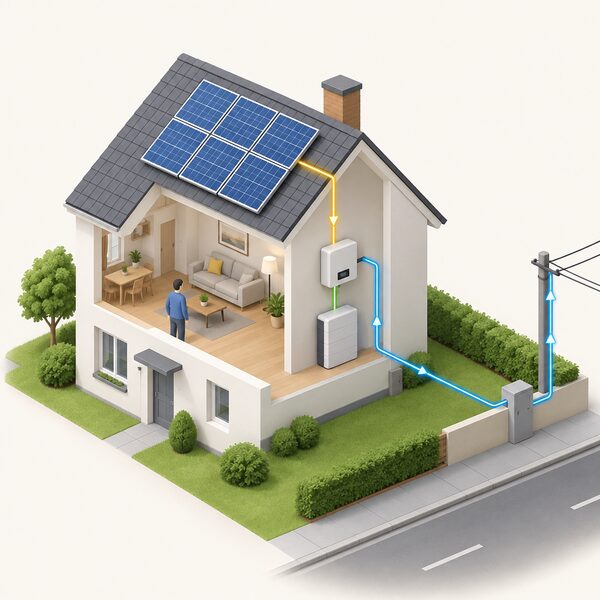
A supply contract with OVO does not make a home more self-sustaining. It makes the home a customer of a grid supplier, and the dependencies are worth naming clearly.
The household depends on the gas and electricity networks to deliver energy, on OVO to buy wholesale and bill correctly, and on the price cap to limit what a default tariff can cost. OVO's own fuel mix is 74% fossil fuel, 9% nuclear, 11% renewable and 6% other, so the electricity supplied under a standard tariff is predominantly generated from fossil sources4. The company offered a Greener Electricity bolt-on with 100% renewables for the period 1 April 2024 to 31 March 2025, which is a purchasing arrangement rather than a change to the physical supply21.
Where OVO does support independence is at the edges. The Smart Export Guarantee tariff pays 4.0p per kWh for exported solar generation on a 12 month fixed term, with no requirement to buy import from OVO and with battery storage included9. That lets a household with solar and a battery sell surplus rather than give it away, though the rate is set by the supplier and can change at the end of the term. The specialist heat pump tariff at 15p per kWh reduces the running cost of electrified heating, which is the point at which a household starts to substitute grid gas with grid electricity6. Battery work on home heating, including the role of storage in shifting demand, is covered by UK Power Networks research16.
The remaining dependencies are structural. A household on an OVO tariff is still on the grid, still on a supplier, and still exposed to wholesale prices through whatever tariff it holds. The acquisition by E.ON adds a change of counterparty to that list, mitigated only by the commitment to honour existing fixed tariffs for their term14. For a household weighing independence, the honest position is that OVO is a well-established supplier with a below-average satisfaction record and a pending change of owner, and that the routes to genuine independence run through generation, storage and tariff choice rather than through the supplier's brand.
Sources21 cited
- Big Six energy suppliers guide, Uswitch
- Which energy suppliers are British?, Uswitch, 26 June 2026
- Customers' satisfaction with their supplier, January 2026, Ofgem, 2026
- OVO Energy supplier details, Citizens Advice
- How do I read my OVO Energy bill?, Uswitch, 10 September 2025
- Heat pumps vs boilers, Which?, 22 September 2025
- Time of use tariffs explained, Which?, 23 April 2026
- OVO EV energy tariffs, Uswitch, 9 October 2025
- Smart Export Guarantee, Solar Energy UK, 12 May 2026
- Electrification of Heat summary reports and datasets, Energy Systems Catapult, 19 December 2024
- Economy 7 guide, Uswitch, 8 September 2026
- Check if you are owed money on your energy bill, Ofgem, 2026
- The history of Ofgem's energy price cap, Energy Helpline, 20 September 2026
- E.ON OVO acquisition announced, Uswitch, 11 May 2026
- Support for householders impacted by the closure of the Energy Company Obligation scheme, Welsh Government, 13 March 2026
- Batteries could revolutionise UK home heating, UK Power Networks
- Energy Company Obligation: homeowners and tenants, Ofgem, 17 September 2026
- Is a prepayment energy meter right for you?, Which?, January 2026
- Customers' satisfaction with their supplier, July to August 2025, Ofgem, 2025
- Which? energy survey results, Which?, 19 January 2026
- Green energy, Uswitch, 1 April 2024
 OVO Energy TariffsMajor supplier with a wide household tariff range including EV and export plans.