
In this comparison
OVO Energy and British Gas sit at opposite ends of the UK supply market: a challenger brand built on digital billing and rewards, against the incumbent that has supplied British homes for decades. The choice between them turns less on the unit rate than on service, support and what happens when something goes wrong. Both have recorded customer satisfaction below the market average in Ofgem's supplier-level surveys, and both have been the subject of enforcement or redress action1.
On price, the default tariff cap for gas paid by Direct Debit averaged 5.93 pence per kilowatt hour with a standing charge of 35.09 pence per day across England, Scotland and Wales from 1 January 2026, both including VAT at 5%4. Fixed tariffs sit outside the cap entirely, so a fixed deal is a bet on where the market goes next5. VAT on domestic electricity falls from 5% to 0% on 1 October 2026, which the government expects to take around £45 off the yearly Ofgem price cap in October6.
OVO Energy vs British Gas at a glance
The two suppliers differ most in scale and in what they sell alongside energy. British Gas offers two variable rate tariffs, a standard variable and a pay-as-you-go tariff, and a set of fixed rate tariffs covering a standard fix, electric vehicles and Dimplex Quantum storage heaters5. OVO's recent tariff activity has centred on fixed products: it launched 1 Year Fixed, 2 Year Fixed and Online Exclusive tariffs on 9 July 2025, with boiler cover and greener electricity variants, then launched a further 2 Year Fixed and Online Exclusive on 18 July 2025 and removed the earlier versions10.
Both are covered by the Energy Ombudsman, which is approved by Ofgem to handle service disputes in the energy sector and can look at complaints about bills, mis-selling, supply problems and switching11. The Ombudsman matches a dispute to the company name written on the account holder's bill, so a British Gas dispute is raised against British Gas12. Where a supplier has taken over another company's customers, the dispute follows the new supplier: British Gas Evolve customers are directed to continue their dispute with British Gas12.
For a household, the practical difference is what each supplier bundles. British Gas has moved into selling plug-in solar technology to its customers, describing itself as pleased to be bringing the technology to customers13. OVO has built its proposition around rewards and support payments rather than hardware. Neither arrangement changes the underlying dependence: the home still draws from the grid, and the supplier still sets the tariff, the payment terms and the support it chooses to offer.
| OVO Energy | British Gas | |
|---|---|---|
| Variable tariffs | Fixed-led range, with 1 Year Fixed, 2 Year Fixed and Online Exclusive launched July 202510 | Standard variable and pay-as-you-go5 |
| Fixed tariff types | Fixed terms with boiler cover and greener electricity variants10 | Standard fix, electric vehicles, Dimplex Quantum storage heaters5 |
| Ombudsman route | Energy Ombudsman, approved by Ofgem11 | Energy Ombudsman, matched to the name on the bill12 |
| Complaints per 10,000 customers | 39.5, January to March 20261 | Not published on the same basis in this comparison |
| Additional products | Boiler cover with a discount ending 10 December 202610 | Plug-in solar technology offered to customers13 |

Tariffs and pricing: what each offers

British Gas's variable range is deliberately narrow: a standard variable tariff and a pay-as-you-go tariff, with no other variable variants5. Its fixed range is broader, covering a standard fix alongside electric vehicle and Dimplex Quantum storage heater tariffs, which are aimed at households with a car to charge or storage heaters to run5. The price cap set each quarter by Ofgem does not apply to fixed-rate tariffs, so a fixed deal removes cap protection as well as cap risk5.
OVO's tariff changes through 2025 show a supplier iterating quickly on fixed products. The July 2025 launches were followed within nine days by replacements, with the earlier 09 and 16 July versions removed10. The terms and conditions for the 1 Year Fixed No Direct Debit plan were last updated in September 202510. That pattern matters to a household: a tariff name can persist while its terms are refreshed, so the version being signed matters as much as the name.
The cap figures give the reference point. From 1 January 2026, gas on a default tariff paid by Direct Debit averaged 5.93p per kWh with a 35.09p daily standing charge across England, Scotland and Wales, both including VAT at 5%4. Earlier cap levels show how far the reference point has moved: the Eastern region gas cap for 1 April to 30 June 2024 was £839.73 a year at 12,000 kWh on Standard Credit14. The two figures rest on different consumption bases and cover different periods, so they are not a single comparable series.
For independence, the position is the same with either supplier. A household on a capped default tariff has its unit rate and standing charge set by the regulator's cap, not negotiated with the supplier. A household on a fix has traded that protection for a set term and, usually, an exit fee. Neither route gives the home control over the wholesale price behind the number.
Fixed tariffs and direct debit terms
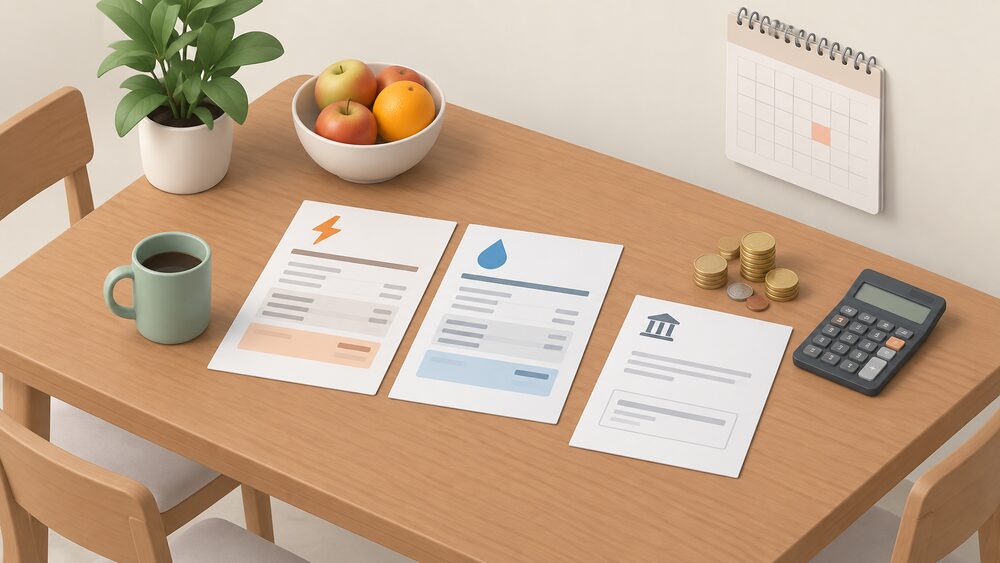
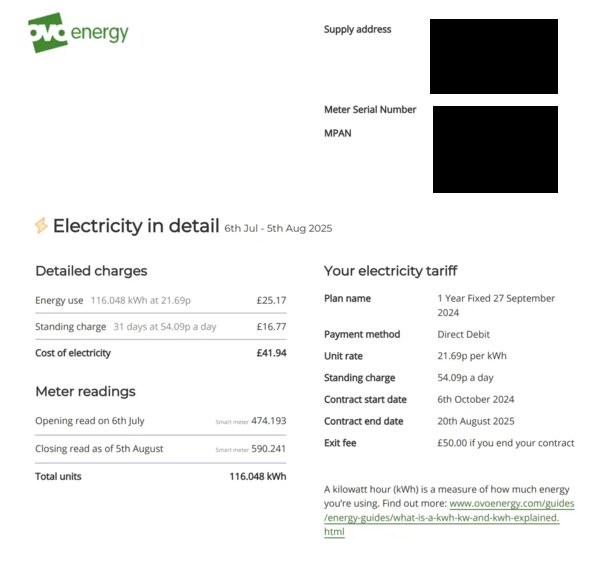
Direct Debit is the payment method the cap figures assume, and it is where the gap between what a home uses and what it pays becomes visible. In a worked example of an OVO bill, a customer spent £55.23 on gas and electricity in a month while their Direct Debit was set at £88, so the account was accumulating credit rather than matching spend15. That is normal for level monthly payments, but it means the bill and the bank statement tell different stories.
Exit fees are the other term to read. On the same OVO example, the exit fees were £50 per fuel, electricity and gas, giving £100 in total for switching before the final 49 days of the contract15. That is a fixed charge tied to the contract end, not a penalty that applies throughout the term.
British Gas's fixed range includes tariffs built around specific loads, such as electric vehicles and Dimplex Quantum storage heaters5. Those are not general-purpose products, and a household without the matching equipment is not the intended user. The business tariff figures published for British Gas, 9.4p per kWh gas on a 1-Year business tariff and 26.3p per kWh electricity on a 2-Year business tariff, are business rates and do not describe domestic supply5. A separate listing gives 26.2p for the same electricity figure, so the two published figures for that rate do not agree5.
Support schemes: the Extra Support Package, Warm Home Discount and Lightning Reach
The Warm Home Discount pays a £150 rebate per household energy bill, funded through a levy on all domestic gas and electricity customers8. It is a scheme-wide figure, not a supplier rate, and it applies across the suppliers that take part. Timing has been the weak point. Thousands of OVO customers did not receive their Warm Home Discount payments for winter 2023/24 until November 2025, 19 months late10. OVO's own complaints guidance sets an eight-week waiting period before a complaint can escalate10.
OVO's winter Extra Support Package, totalling £56 million, opened for customer applications on 1 October 202510. Separately, Lightning Reach announced a partnership with OVO on 1 October 2025 to make it easier for households to access energy support through its platform10. These sit alongside the statutory scheme rather than replacing it.
Support for heating costs varies by nation, and the differences matter for off-gas-grid homes. In Northern Ireland, the Home Heating Oil Support Scheme provides a £100 digital pre-paid card towards the cost of home heating oil, with an additional £19.2 million from the Executive16. Scotland's Emergency Heating Oil Scheme offers £300 per household for users of heating oil and LPG struggling with recent price increases, applicable from 1 April18. In Wales, households on the Council Tax Reduction Scheme using heating oil or LPG were eligible for a one-off £200 payment as of 31 March 202619. The New Warm Homes Programme in Wales signposts people to and seeks to leverage ECO4, the Great British Insulation Scheme and Boiler Upgrade Scheme funding20.
For households on mains gas, the relevant schemes are different. The Warm Homes Plan is supported in part by the heat and buildings factsheet21, and the Warm Homes: Local Grant in England is open to all fuel types, including on-gas-grid households heated by mains gas and off-gas-grid households heated by electricity, oil, coal or liquid petroleum gas22.
Boiler cover and add-ons
OVO sells boiler cover plans, and the current promotional offer of up to 35% off those plans ends on 10 December 202610. The discount changes the price of the cover, not what the plan includes, and it is a product separate from the energy tariff. A household weighing cover should read the plan terms rather than the headline percentage.
Government support for heating upgrades runs on its own timetable. The Boiler Upgrade Scheme applies to England and Wales23, and the uplift period runs until 31 March 2027 according to the Energy Saving Trust24. Ofgem may take compliance actions against an installer where non-compliance is identified, including withholding or recouping payments or revoking vouchers25. Feedback on the scheme's administration can be sent to feedback@ofgem.gov.uk26.
Boiler Plus is a separate English requirement: existing households in England must install an additional energy saving measure from a choice list at the point of installing a new or replacement combi gas boiler in an existing dwelling27. BEIS decided not to make the English Boiler Plus standard a specific ECO requirement throughout Great Britain, so installations follow building regulations for each nation28. Complaints about an ECO installation follow Ofgem's dedicated complaints process28.
Complaints, enforcement and the Ofgem redress settlement
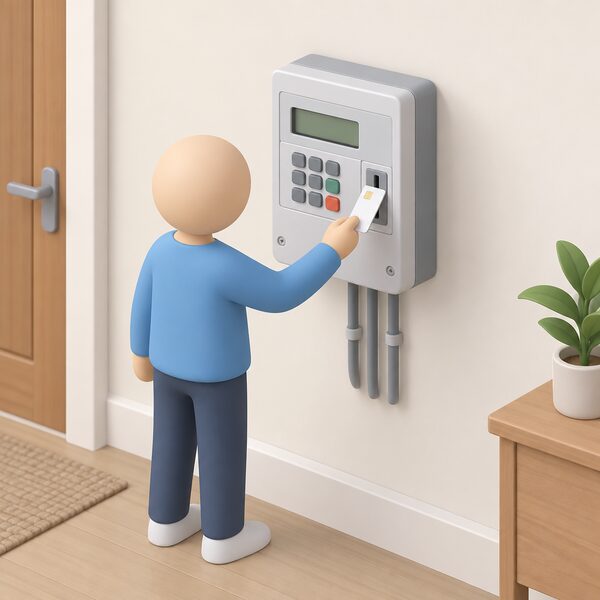
Ofgem concluded its OVO Energy investigation in June 2026 with a redress settlement. Ofgem found OVO failed to adequately monitor prepayment meter customers, and OVO agreed to pay £7 million into the Voluntary Redress Fund, £3.4 million in credit and debt relief, and £1.1 million in rural compensation9. The investigation had been extended in May 2025 to include the prepayment meter market compliance review10. Ofgem has previously used its enforcement powers to require OVO Energy to contribute more than £1 million to a redress fund, and has said it is considering more severe financial penalties9.
"has previously used its enforcement powers for smart meters to require one energy supplier, OVO Energy, to contribute mo"
Complaints data gives the day-to-day picture. OVO recorded 39.5 complaints per 10,000 customers to Citizens Advice Consumer Service, the Extra Help Unit, Advice Direct Scotland and the Energy Ombudsman between January and March 20261. OVO's own published complaints data for Q2 2026 reported 101,965 complaints received, equal to 1,775 per 100,000 customers10.
The Ombudsman route is the same for both suppliers. The Energy Ombudsman is approved by Ofgem to handle service disputes and covers complaints about energy bills, mis-selling, supply problems and switching11. For British Gas, the dispute is raised against the name on the bill12. OVO's own guidance sets an eight-week wait before escalation10.
Customer service: what the satisfaction surveys show
Ofgem's supplier-level surveys track satisfaction wave by wave, and both suppliers have recorded results below the market average. In the July to August 2025 wave, a significantly lower proportion of EDF Energy, E.ON / E.ON Next, OVO Energy and Scottish Power customers reported being satisfied or very satisfied with customer service than the average, and OVO's customer service satisfaction stood at 60%2. In the same wave, a significantly larger proportion of OVO Energy and EDF Energy customers said they were very dissatisfied or dissatisfied overall than the average, with OVO's overall dissatisfaction at 10%2. British Gas recorded 7% dissatisfied or very dissatisfied with customer service, and a significantly higher proportion of its customers were dissatisfied or very dissatisfied with customer service than the average2.
The January 2026 wave found a significantly lower than average proportion of OVO customers satisfied or very satisfied overall, with customer service satisfaction at 67%3. Earlier waves show movement in both directions: British Gas was the only supplier in the January 2025 survey to see a statistically significant increase in overall satisfaction since the previous wave29, and in July 2024 British Gas, OVO Energy and Utilita all saw a statistically significant increase in the proportion of customers satisfied overall since January to February 202430. A single wave is a snapshot, not a verdict.
VAT on domestic electricity and the price cap: how it affects both
VAT on domestic electricity falls from 5% to 0% on 1 October 2026, following a UK Government decision, with the price cap changing on the same date10. The government expects cutting VAT on electricity bills to take around £45 off the yearly Ofgem price cap in October6. Gas keeps VAT at 5% for the period 1 October 2026 to 31 March 20277.
The cap itself is set each quarter by Ofgem and does not apply to fixed-rate tariffs5. For the period from 1 January 2026, gas on a default tariff paid by Direct Debit averaged 5.93p per kWh with a 35.09p daily standing charge across England, Scotland and Wales, both including VAT at 5%4. Ofgem is the independent energy regulator for England, Scotland and Wales, so the cap framework described here is the Great Britain framework2. Northern Ireland runs a separate market.
The effect is the same for both suppliers' customers: a capped default tariff moves with the cap, and a fixed tariff does not. The VAT change reduces the capped number rather than the supplier's margin, and it applies to electricity only. A household on a fix signed before October 2026 will see the benefit only when the fix ends or the terms say otherwise.
Which supplier fits which household
The market context shapes the choice. Six large companies dominate the domestic market with 91% market share, and Octopus is now the largest electricity supplier and second largest gas supplier in Great Britain29. British Gas's position as the long-standing incumbent is visible in older data: in 2014 its home supplier bill for 15,000 kWh a year was £821 on credit31. Its domestic combined gas and electricity EBIT margin was 7.0% in 201532. Those figures are historical and describe a market that has since changed.
What the current evidence supports is narrower. A household that wants a fixed term with a defined end date and is willing to accept an exit fee has fixed products from both suppliers5. A household that wants cap protection and no exit fee stays on a default tariff, where the rate is set by the cap rather than the supplier5. A household that needs support with bills has the Warm Home Discount at £150 and, for OVO customers, the Extra Support Package and the Lightning Reach route8. A household that values a clean complaints record has the Ombudsman data and the Ofgem satisfaction waves to read1.
Neither supplier removes the household's dependence on the grid, on a supplier's billing systems, or on the wholesale market behind the tariff. What a household controls is the contract: its length, its exit terms, its payment method and the support it claims. Those are the terms worth reading before switching.
Sources32 cited
- OVO Energy supplier details, Citizens Advice, 2026
- Customers' satisfaction with their supplier: July to August 2025, Ofgem, 2025
- Customers' satisfaction with their supplier: January 2026, Ofgem, 2026
- Changes to the energy price cap between 1 January and 31 March 2026, Ofgem, 2025
- British Gas tariffs and company guide, Energy Helpline, 2026
- New PM cuts tax on household electricity bills, GOV.UK, 2026
- Energy price cap, Ofgem, 2026
- Continuing the Warm Home Discount Scheme: government response, GOV.UK, 2026
- Public Accounts Committee report, UK Parliament, 2023
- OVO Energy dispute, Energy Ombudsman, 2026
- Energy Ombudsman FAQs, Energy Ombudsman, 2025
- British Gas dispute, Energy Ombudsman, 2026
- Households can save as plug-in solar panels come to market, GOV.UK, 2026
- Default tariff cap level: 1 April 2024 to 30 June 2024, Ofgem, 2024
- How do I read my OVO Energy bill?, Uswitch, 2025
- Lyons announces agreement on Home Heating Oil Support, Northern Ireland Executive, 2026
- Consumer advice: problems with services, Isle of Anglesey County Council, 2026
- Support for households using heating oil and LPG, Scottish Government, 2026
- Thousands of Welsh households get help with oil and LPG heating costs, Welsh Government, 2026
- New Warm Homes Programme integrated impact assessment, Welsh Government, 2024
- Carbon Budget and Growth Delivery Plan: heat and buildings factsheet, GOV.UK, 2026
- Heat pump deployment quarterly statistics, UK 2026 Q1, GOV.UK, 2026
- Approval to increase the budget for the Boiler Upgrade Scheme, GOV.UK, 2026
- Oil heating heat pump grant, Low Carbon Hub, 2026
- Boiler Upgrade Scheme guidance for property owners v5.1, Ofgem, 2026
- Boiler Upgrade Scheme guidance for property owners v5 draft, Ofgem, 2026
- Carbon Budget Delivery Plan, GOV.UK, 2023
- ECO4 consultation: scoring methodology decision, Ofgem, 2022
- State of the energy market report: retail, Ofgem, 2025
- Customers' satisfaction with their supplier: July 2024, Ofgem, 2024
- Quarterly energy prices, December 2014, UK Parliament, 2014
- Retail energy markets in 2016, Ofgem, 2016
 UK Energy Prices vs EuropeWhy does the UK pay so much for electricity when our gas is cheaper than most of Europe?
 The Full Tariffs GuideWhich energy tariff suits how you live, and will switching really save you money?
 Global Events and UK PricesWhy do gas prices here go up when something happens far away?
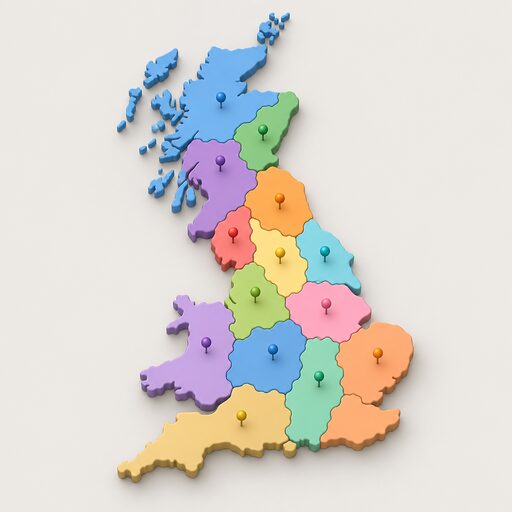 Unit Rates by RegionWhy do electricity and gas prices differ depending on where you live?
 The Full Rules and Regulation GuideConfused about who actually decides what you pay for gas and electricity, or why rules differ in Scotland and Wales?
 Ofgem Consumer ArchetypesWhich kind of household are you, and does it change what you pay for energy?