
In this comparison
Octopus Energy is the largest supplier of electricity in Great Britain and the second largest for gas, behind British Gas. In July 2026 it was reported as supplying 25.7% of electricity customers and 25.9% of gas customers1. British Gas remains the largest gas supplier and says it serves more than 8 million homes and businesses across the UK2. Six large companies still hold 91% of the domestic market between them3.
The two are the most common matchup householders weigh up when a fixed deal ends, and they are genuinely different propositions. Octopus entered the market in 2016 and has grown by acquisition as well as by switching, absorbing Shell Energy Retail's household book in December 20234. British Gas is Britain's oldest energy supplier, with the scale, the legacy systems and the service record that go with that history4.
On service the published evidence favours Octopus. In Ofgem's January 2026 supplier-level findings, 86% of Octopus customers reported being satisfied or very satisfied with customer service, and a significantly lower proportion than average were dissatisfied5. In the July to August 2025 wave, Octopus was the only supplier with a significantly higher proportion of customers satisfied overall than the GB average, while a significantly higher proportion of British Gas customers were dissatisfied with customer service than average6.
Two suppliers, two very different stories
Octopus Energy is majority owned by Octopus Group, a UK company, with other shareholders including Origin of Australia, Tokyo Gas of Japan, Generation of the United States and the Canadian CPP Investment board1. It holds its supply licences through Octopus Energy Limited, Octopus Energy Operations Limited, Octopus Energy Operations 2 Limited and Octopus Energy Trading Limited9. It also manages the Co-op Energy brand on that brand's behalf1.
British Gas is the trading name most households know, and the domestic gas bill statistics have long used British Gas Trading as the definition of the home supplier for Great Britain10. It has been included in the quarterly smart meter statistics since the first release in March 2015, alongside EDF Energy, E.ON, Npower, Scottish Power and SSE11.
The two companies therefore sit at opposite ends of the same market. Octopus is a challenger that became an incumbent by buying scale: Shell's domestic business in 2023, and before that the Bulb customer book through the supplier of last resort process. British Gas is an incumbent that has had to compete for customers it once held by default.
For a household, the practical difference is what happens when something goes wrong. Octopus has built its reputation on service scores and on tariff design. British Gas has the largest installed base, which means more complaints in absolute terms and a longer history of regulatory attention. Ofgem's 2023 market compliance review of customer service and complaints handling placed British Gas among eleven suppliers identified with moderate weaknesses, alongside E Gas & Electricity, EDF, Good Energy, Outfox the Market, OVO, Scottish Power, SO Energy, Utilita, Utility Warehouse and Tru Energy12. An earlier Ofgem review of support for customers in vulnerable situations placed Octopus in a second group identified with moderate weaknesses13.
Neither finding is recent, and both predate the current service data. They are useful mainly as a reminder that the regulatory record is longer than the survey window.
Market position: who supplies more homes now
Octopus became the UK's largest electricity supplier in late 2023, overtaking British Gas4. By March 2026 it had closed the gap in the gas market to become the largest energy supplier overall4. Ofgem's state of the energy market report describes six large companies holding 91% of the domestic market, with Octopus now the largest electricity supplier3.
The customer share figures for July 2026 put Octopus at 25.7% of electricity customers and 25.9% of gas customers1. British Gas is described as the largest supplier for gas14 and as Britain's oldest energy supplier4. OVO is the fourth largest supplier of electricity and gas to UK customers1.
| Measure | Octopus Energy | British Gas |
|---|---|---|
| Electricity customers | 25.7% share, July 20261 | Largest gas supplier; more than 8 million homes and businesses2 |
| Gas customers | 25.9% share, second largest1 | Largest supplier for gas14 |
| Market entry | 20164 | Britain's oldest energy supplier4 |
| Ownership | Majority owner Octopus Group (UK)1 | Part of the Centrica group |
| Notable acquisitions | Shell Energy Retail household book, December 20234 | None in the current period |
The distinction between "largest overall" and "largest for gas" matters when reading headlines. Octopus leads on electricity and on the combined customer count; British Gas still leads on gas alone. A household comparing the two on size alone is comparing two different measures.
Scale also shapes what each supplier can offer. Octopus's size gives it the customer base to trial products such as the Nook battery range and the lower standing charge tariff. British Gas's size gives it the engineering workforce and the national coverage that underpin its heat pump and boiler installation business. Neither advantage is a reason to choose one over the other on price, which is set tariff by tariff.
Tariffs and pricing: fixed deals, standing charges and price changes
The price cap set each quarter by Ofgem does not apply to fixed-rate tariffs2. That single rule explains most of the confusion in this comparison. The cap limits what a supplier can charge on a default or standard variable tariff, and it is not a cap on what a household pays, because it is set per unit and per standing charge rather than per bill.
The cap level from October 2025 was £1,755 a year for an average household paying by Direct Debit for gas and electricity7. The prepayment cap for the same period was £1,707, up from £1,672, a rise of £35 or 2%15. The gas standing charge moved by 2.2% between July and October 2026, and by minus 4.35p per day across the year to October 202616.
Regional variation is large. For 1 July to 30 September 2026, the gas cap for a standard credit customer was £127.57 standing charge and £819.26 annual bill at 9,500 kWh in Eastern, and £127.54 standing charge and £831.35 in the South East17. For 1 July to 30 September 2025, gas at 12,000 kWh per annum on other payment methods ranged from £818.97 in Eastern to £838.80 in London18.
British Gas sells a standard fix, an electric vehicle tariff and a Dimplex Quantum tariff for storage heaters, plus a standard variable tariff and a pay-as-you-go tariff2. It charges home energy customers £75 per fuel to cancel2. Octopus runs its own fixed and flexible tariffs, and amended prices on its Key and Card and Flexible Octopus tariffs in July 20254.
Ofgem's lower standing charge pilot, which began in June 2026, involves British Gas, EDF, E.ON Next and Octopus offering eligible customers a lower standing charge tariff19. Octopus introduced its version to a limited number of homes from 27 July 202619.
Customer service: what the scores show

Ofgem's supplier-level satisfaction findings are the most consistent public measure, published in waves. In January 2026, 86% of Octopus customers were satisfied or very satisfied with customer service, and 3% were dissatisfied or very dissatisfied5. Octopus had a significantly higher proportion satisfied and a significantly lower proportion dissatisfied than the average5.
In the July to August 2025 wave, 84% of Octopus customers were satisfied or very satisfied with customer service, against a GB average pattern in which Octopus was the only supplier significantly above average for overall satisfaction at 95% confidence6. In the same wave, a significantly higher proportion of British Gas customers said they were dissatisfied or very dissatisfied with customer service than the average6.
The January 2025 wave put Octopus at 81% satisfied or very satisfied with customer service and 3% dissatisfied, and named it the only supplier significantly above the GB average for overall satisfaction20. The July 2024 wave found Octopus and Utilita the only suppliers significantly above the July 2024 average for overall satisfaction, with Octopus again showing a significantly lower proportion dissatisfied with customer service21. Sample bases in that wave were British Gas 1,015, Octopus Energy 796, E.ON and E.ON Next 556, EDF Energy 371, OVO Energy 373, Scottish Power 257 and Utilita 130 respondents21.
Which? gave Octopus a five-star rating for customer service overall in its 2024 survey, the only energy company to receive one22. The same coverage described British Gas, the biggest supplier in Great Britain, as returning mediocre scores across the board22. Which? also records a 10 out of 10 score for Octopus on supporting customers14.
The pattern across four Ofgem waves and one consumer survey is consistent, and it is the strongest single argument in this comparison. It is also worth reading carefully: satisfaction surveys measure the experience of customers who stayed, and a supplier growing quickly can post good scores while its complaint volumes rise in absolute terms.
Smart tariffs, batteries and the Nook range
Smart time of use tariffs are offered by British Gas, E.ON Next, EDF Energy, Octopus Energy, OVO Energy and Scottish Power, as well as smaller firms including 100Green, Fuse Energy, Good Energy and So Energy23. Several providers also offer smart storage battery tariffs, including British Gas, E.ON Next and EDF Energy23.
Octopus's Intelligent Octopus Flux is a two-rate tariff with matching import and export prices and automated battery management, charging when power is cheapest and exporting between 4pm and 7pm24. For Octopus customers with solar panels and a battery, the export rate was 23p per kWh in April 202624.
On the Smart Export Guarantee, the lowest tied tariff rate in Year 5 was 5p per kWh from Octopus, and the lowest untied rate was 1p per kWh from E Energy25. That is a useful reminder that export rates vary enormously between tariffs and between tied and untied products.
Octopus Go, its electric vehicle tariff, had peak rates of around 28.69p per kWh, at which a 77kWh battery charge could cost £22.29 or more26. Both Octopus and British Gas have offered complete heat pump installations from £50027. Octopus's Cozy electricity tariff was stated to save heat pump users £96 compared with a standard flexible tariff27.
The Nook range is the newest development. Octopus announced the Nook Cube plug-in battery and the Nook Colossus wall-mounted battery system at its Energy Tech Summit on 22 June 202628. The range is scheduled to become available to Octopus customers in the UK, Germany, Italy, Spain and France from the year after that announcement, so 202728. No price has been published.
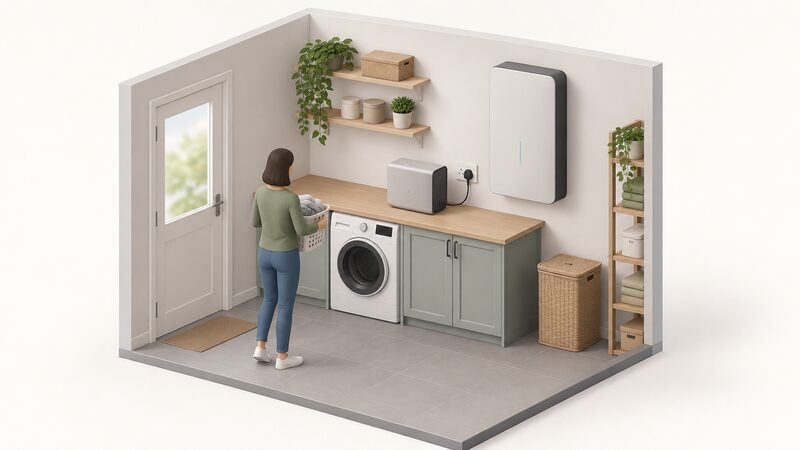
For household independence, the picture is mixed. A battery plus a time of use tariff reduces reliance on the grid at peak times and on wholesale prices, but it deepens reliance on one supplier's app, tariff design and export rates. The hardware is bought once; the tariff terms can change.
Prepayment meters and the force-fitting question
A prepayment meter lets a household pay for electricity or gas in advance rather than after use29. Ofgem's guidance sets out how they work and what help is available29. Which? explains when a prepayment meter is and is not suitable8.
Force-fitting is the contested part. As of August 2026, only EDF Energy, E.ON Next, Good Energy, Octopus Energy, Ovo Energy, Scottish Power, Utilita and Utility Warehouse were allowed to install prepayment meters involuntarily8. Ofgem had allowed EDF, Octopus and Scottish Power to resume the practice from January 2024 after it was suspended in early 20238.
Octopus's emergency credit levels are £10 per fuel on a smart meter, and £20 for gas and £10 for electricity on a traditional meter8.
Prepayment customers pay a different cap. The prepayment cap from October 2025 was £1,707, up from £1,67215. Regional gas prepayment figures for 1 July to 30 September 2025 at 12,000 kWh per annum were £816.25 in London, £798.73 in Eastern, £793.73 in the South East and £797.24 in Northern18. Benchmark maximum charges for Charge Restriction Period 14a in February 2025 were £901.99 in London, £880.56 in North West, £884.83 in Eastern, £879.88 in South East, £901.71 in Southern and £883.19 in Northern, with standing charges of £114.57, £113.85, £112.88, £112.75, £112.49 and £113.80 respectively30. The default tariff cap for Eastern prepayment gas at 12,000 kWh was £767.79 with a £107.80 standing charge for 1 April to 30 June 202431.
Which supplier fits which household

There is no winner here, and the evidence does not support naming one. What the facts allow is a description of which circumstances each supplier's structure suits.
Octopus suits households that value service scores, want a smart time of use tariff or an electric vehicle tariff, and are willing to manage consumption around peak and off-peak windows. Its Intelligent Octopus Flux product is designed for homes with solar and a battery24. Its export rate of 23p per kWh for that product is among the higher published rates, though the lowest tied SEG rate it offers is 5p per kWh24. Households considering a battery should note that the Nook range is scheduled for 2027 and has no published price28.
British Gas suits households that want a conventional fixed tariff, an established installation business for boilers and heat pumps, or a supplier with the largest gas customer base. It charges £75 per fuel to cancel a fixed tariff, which is a real cost if a household switches mid-term2. It is also one of the suppliers in Ofgem's lower standing charge trial19.
Both are large enough to be covered by the same protections. The Energy Ombudsman accepts disputes against British Gas where the company name on the bill matches, and separately against British Gas New Heating for Green Deal cases33. Households in dispute with either supplier should check the exact company name on the bill before raising a case.
For energy independence, the honest summary is that neither supplier offers it. Both sell grid electricity and gas. A household that adds solar, a battery and a smart tariff reduces its exposure to peak prices and to wholesale volatility, but it remains connected to a distribution network, dependent on a supplier's licence and billing systems, and dependent on that supplier's app and tariff terms. The choice between these two is a choice about service, tariff design and installation capability, not about sovereignty over supply.
Sources34 cited
- Which energy suppliers are British?, Uswitch, 2026-06-26
- British Gas guide, Energy Helpline, 2026-09-20
- State of the energy market report: retail, Ofgem, 2025-04-15
- Big six energy suppliers guide, Uswitch, 2026-07-17
- Customers' satisfaction with their supplier: supplier level findings, January 2026, Ofgem, 2026-05
- Customers' satisfaction with their supplier: supplier level findings, July to August 2025, Ofgem, 2025-12
- Energy price cap will rise 2 percent, Ofgem, 2025-08-27
- Is a prepayment energy meter right for you?, Which?, 2026-08
- Feed-in Tariff licensee contact details, Ofgem, 2026-09-17
- Quarterly energy prices, December 2014, UK Parliament, 2014-12-01
- Smart meters in Great Britain, quarter 4 2014, GOV.UK, 2015-03-19
- Ofgem completes review of suppliers' customer service and complaints handling, Ofgem, 2023-02-02
- Ofgem completes review of how suppliers support customers in vulnerable situations, Ofgem, 2022-11-22
- Which energy survey results, Which?, 2026-01-19
- Summary of changes to the energy price cap, 1 October to 31 December 2025, Ofgem, 2025-08
- Ofgem price cap explained, End Fuel Poverty Coalition, 2026
- Energy price cap levels, 1 July to 30 September 2026, Ofgem, 2026
- Energy price cap levels, 1 July to 30 September 2025, Ofgem, 2025-05
- Should I get a no standing charge tariff?, Uswitch, 2026-08-26
- Customers' satisfaction with their supplier: supplier level findings, January 2025, Ofgem, 2025-05
- Customers' satisfaction with their supplier: supplier level findings, July 2024, Ofgem, 2024-11
- Best energy companies for 2024, Which?, 2024-01-22
- Time of use tariffs explained, Which?, 2026-04-23
- Smart Export Guarantee rates: the best and worst SEG tariffs, Which?, 2026-04-24
- Smart Export Guarantee annual report, Year 5, Ofgem, 2025-12
- Electric car charging guide, Carwow, 2025-07-16
- Demand for heat pumps rises following increase in applications to the Boiler Upgrade Scheme, GOV.UK, 2024-05-23
- Octopus Energy launches the Nook range, Octopus Energy, 2026-06-22
- Get help with your prepayment meter, Ofgem, 2026
- Benchmark maximum charges for the Charge Restriction Period 14a, Ofgem, 2025-02
- Default tariff cap level, 1 April 2024 to 30 June 2024, Ofgem, 2024-02
- Consumer vulnerability strategy progress report, Ofgem, 2026-07
- Raise a dispute: British Gas, Energy Ombudsman, 2026-09-19
- Raise a dispute: British Gas New Heating, Energy Ombudsman, 2026-09-19
 The Full Energy Suppliers GuideWho the UK's domestic gas and electricity suppliers are, how the market is structured across Great Britain and Northern Ireland, what a supplier is licensed and obliged to do, how the price cap limits bills, what happens when a supplier fails, and who regulates it all.
 Supplier Market ShareWho supplies most homes in Britain, and does the answer change for gas and electricity?
 The Full Rules and Regulation GuideConfused about who actually decides what you pay for gas and electricity, or why rules differ in Scotland and Wales?
 Ofgem Consumer ArchetypesWhich kind of household are you, and does it change what you pay for energy?
 UK Energy Prices vs EuropeWhy does the UK pay so much for electricity when our gas is cheaper than most of Europe?
 Gas Pipelines and LinksWhere does the gas in your home actually come from, and what happens when it gets really cold and the wind stops blowing?