
In this comparison
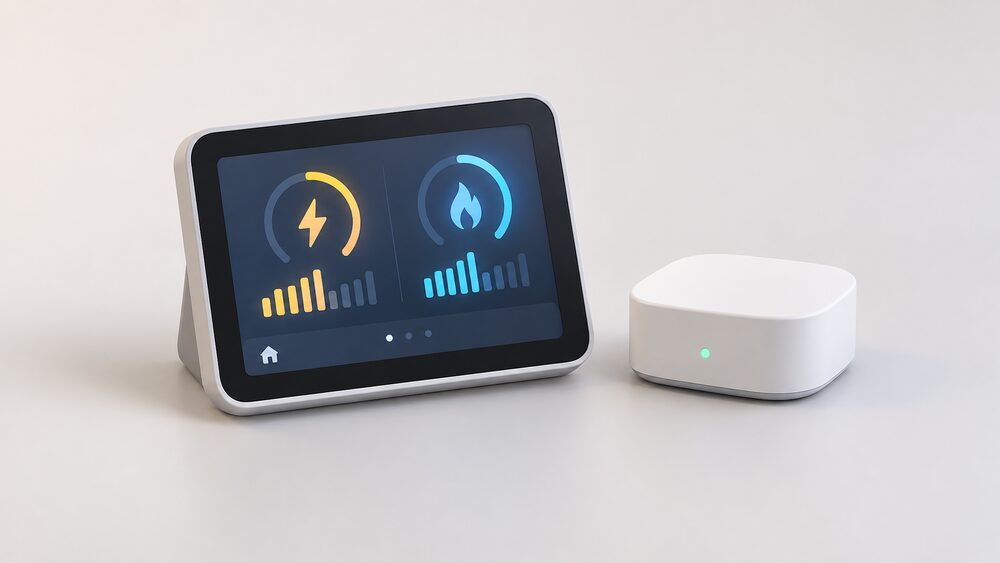
The Hildebrand Glow and the Octopus Home Mini solve the same problem from opposite directions. Both get live consumption data out of a smart meter and into something a household can read, but the Glow range is built as hardware that talks to the meter and the GB smart meter network, while the Home Mini is a supplier's accessory that pushes readings into the Octopus app and online account, updating every 5 to 15 seconds1.
That difference decides almost everything else. A Glow device is bought as a product and works with the meter; a Home Mini is supplied through an Octopus account and depends on that account continuing. Octopus Energy was named a Which? Recommended Provider again in 2026 and ranked 4th in the supplier comparison table for January to March 2026, so the account side is not a weak point today, but it is still a dependency2.
Neither device replaces a smart meter. Both read one. A household without a working smart meter has nothing for either to display, and a standalone energy monitor is not a substitute because it cannot send meter readings to a supplier4.
What the Glow and the Home Mini actually are
The Octopus Home Mini is a small device that uses wi-fi to transmit your usage and costs to the Octopus app and online account within a few seconds2. It is not a meter, not a display in the ordinary sense, and not a general-purpose monitoring product: it is a bridge between an Octopus smart meter account and Octopus's own software. The data lands in the app, and the app is where a household reads it.
Hildebrand's Glow range is a family of products rather than a single box. The Glow In-Home Display + CAD is described by the maker as a Consumer Access Device with Display, and it monitors electricity and gas consumption in real time through an easy-to-use touchscreen interface5. The Glow Bridge Duo is listed as a Communication Hub, and the Glow SAPC communicates additional IoT data back through the GB Smart Meter Network5. The same maker also lists a Glow Aqua water meter and Glow Electricity Meters, described as an advanced smart electricity meter compatible with GB electricity markets5.
So the two are not quite the same category of object. One is a supplier's accessory that feeds a supplier's platform. The other is a hardware range, sold as products, that reads the meter and in some variants passes data onward through the national network. That distinction matters for anyone thinking about how independent their monitoring setup is from any one company.
Where each device sits in the smart meter chain
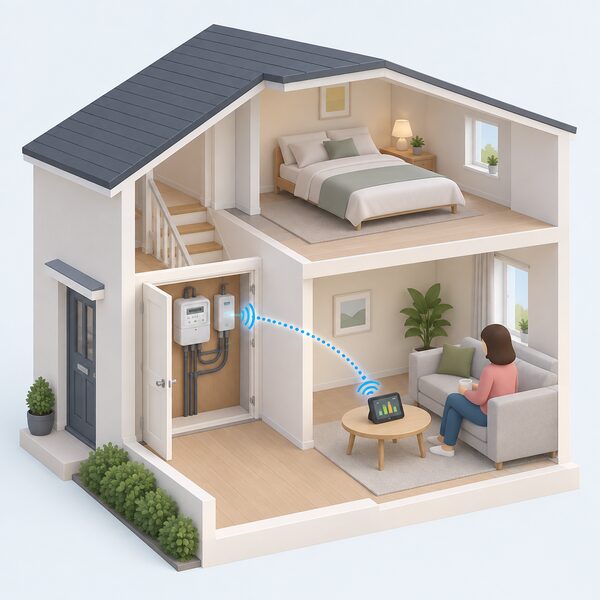
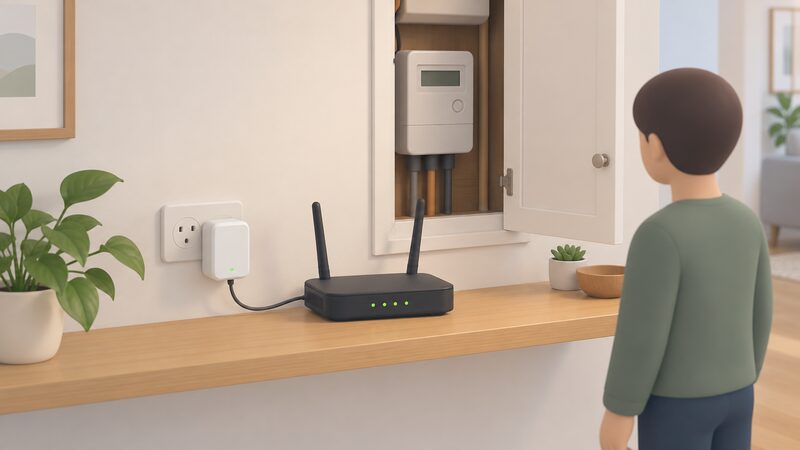
A smart meter system is made up of two parts: the smart meters, which replace traditional gas and electricity meters, and the in-home display7. Smart meters are usually installed in the same place as the analogue meter, such as a cupboard or outside the front door, and the in-home display is a separate wireless touchscreen device that shows historical and current energy use in near real time, including costs, tariff details and prepayment information8.
Everyone who gets a smart meter installed is provided with an in-home display, and suppliers are expected to offer and demonstrate one during the appointment, alongside key safety checks10. That display is not the same as the smart meter itself, which sits in a fixed position, usually in a cupboard inside or outside the home11.
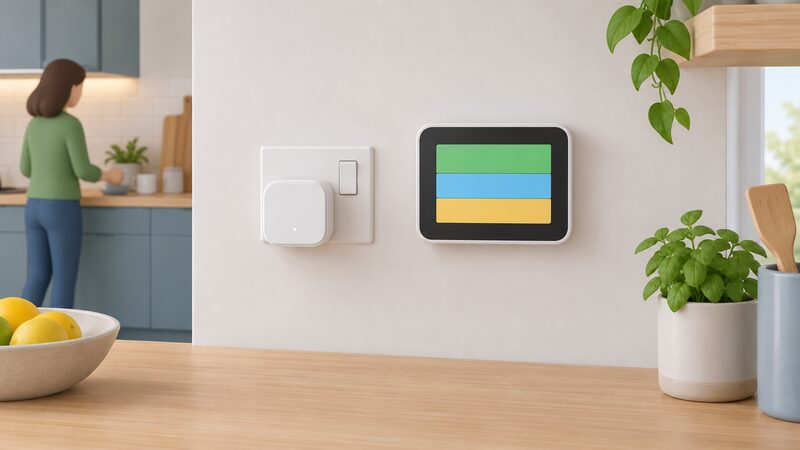
Both the Glow and the Home Mini sit downstream of that chain. They are not the meter and they are not the mandated display. The Home Mini takes what the meter and the Octopus platform already hold and mirrors it into an app. Glow hardware reads the meter directly and presents it, with the SAPC variant communicating additional data back through the GB smart meter network5. In practical terms, the Home Mini is a layer on top of a supplier's service, and the Glow is a layer on top of the meter.
Live consumption display: what each shows and how
The Home Mini's headline number is its refresh rate: it updates the data in the Octopus app and online account every 5 to 15 seconds1. That is fast enough to watch a kettle or an oven change the reading while it is running, and it is the reason the device appeals to households trying to connect behaviour to cost.
The Glow In-Home Display + CAD monitors electricity and gas consumption in real time through a touchscreen interface5. That covers both fuels, which matters because a great deal of household energy spend is gas for heating and hot water rather than electricity.
What neither does is break usage down by appliance. A smart meter in-home display does not automatically break usage down by appliance, though it can help you spot changes in energy use throughout the day4. The same limitation applies to the data these devices carry: they show the whole home, not the individual circuit or plug.
The standard in-home display shows energy consumption in kWh and pounds and pence in near real time, and for prepay mode it also shows how much credit is left12. A smart meter in-home display shows in near real time how much gas and electricity a customer is using and what it cost14. The Glow and the Home Mini are doing the same job through different hardware and software, and the underlying figures come from the same meter.
Tariff integration: Octopus accounts vs other suppliers
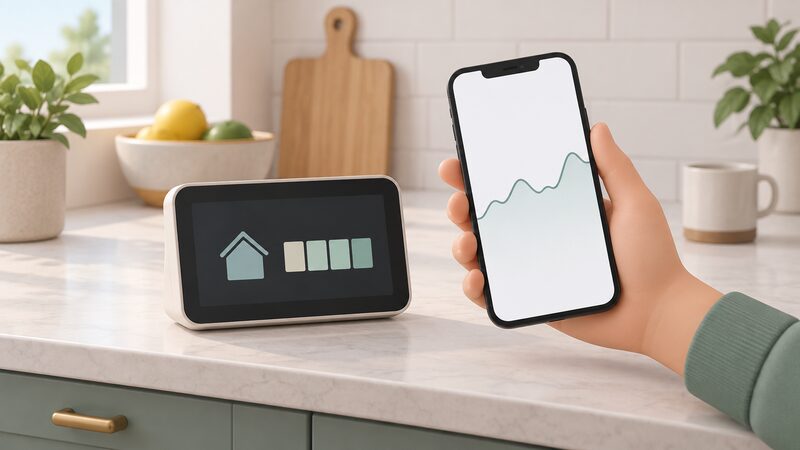
This is where the two diverge most sharply. The Home Mini is an Octopus product, and its whole purpose is to transmit usage and costs to the Octopus app and online account2. That makes it useful to an Octopus customer and largely inert to anyone else. Octopus Energy holds a set of encompassing licences covering Octopus Energy Limited, Octopus Energy Operations Limited, Octopus Energy Operations 2 Limited and Octopus Energy Trading Limited, so the group structure behind the account is not a single entity15.
Octopus also runs a wide range of time-of-use products that make live data more valuable. Octopus Go works with any vehicle, while Intelligent Octopus Go has some vehicles that will not work with it16. On the export side, some tariffs pay you if you export electricity at peak times, for example Octopus Energy's Octopus Flux, and Intelligent Octopus Flux is a two-rate tariff with matching import and export prices, automated battery management charging when power is cheapest and exporting between 4pm and 7pm17. Octopus Flux appears in Smart Export Guarantee listings with Octopus as the supplier, and Outgoing Agile likewise19.
None of that is available through the Home Mini to a customer of another supplier. A Glow device, by contrast, is not tied to a supply account in the same way: it reads the meter, and the meter is the same meter whoever bills you. That does not make it tariff-aware in itself, but it means the hardware does not become useless on switching.
| Octopus Home Mini | Hildebrand Glow range | |
|---|---|---|
| What it is | Supplier accessory feeding the Octopus app2 | Consumer access device, display and communication hub products5 |
| Refresh | Every 5 to 15 seconds in app and online account1 | Real-time electricity and gas on a touchscreen5 |
| Supplier tie | Octopus account required2 | Reads the meter; not an account product5 |
| Network role | None beyond the supplier platform | SAPC communicates additional IoT data through the GB smart meter network5 |
Cost and how each device is supplied
The Home Mini is supplied through Octopus rather than sold as a retail product, so its cost to a household is bound up with holding an Octopus account. Octopus Energy was a Which? Recommended Provider again in 2026 and ranked 4th in the supplier comparison table for January to March 20262. On price, the Octopus 12M Fixed November 2025 v2 tariff is listed at £1,193 annual cost for a low user and £1,647 for another usage level, with £0 exit fees and a requirement to sign up for paperless billing; the two annual figures are given side by side in the same listing and are not reconciled20.
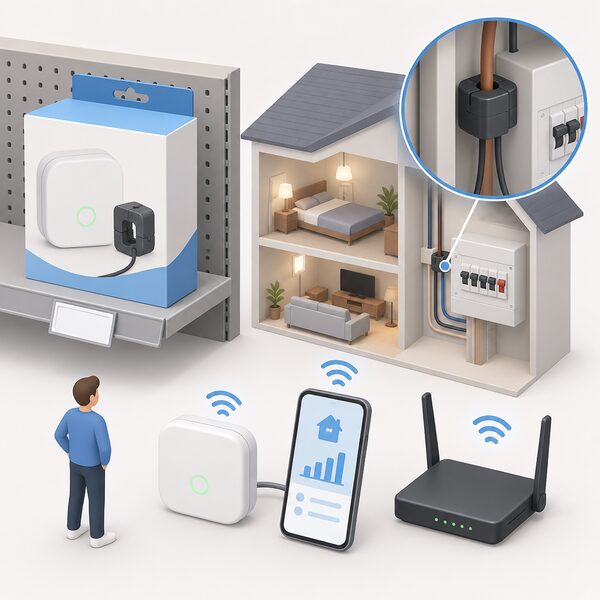
For context on what monitoring hardware costs when it is bought outright, a whole-home energy monitor that hooks up directly to the home power supply typically costs more than £60 and requires a wi-fi connection and a smartphone to operate6. That is the market the Glow products sit in: bought as goods, priced by the seller, with no supplier subsidy attached.
Where a household is moving a meter rather than buying a monitor, some suppliers such as Octopus will do the work for free for small positional changes21. That is a separate service from either device and does not affect what the devices cost.
Data, privacy and local access
Both devices exist because smart meter data belongs to the household, and the arrangements around it are set out in official guidance on smart meters, rights and expectations10. The practical question is where the data goes once it leaves the meter.
The Home Mini sends it to Octopus: usage and costs travel by wi-fi into the app and online account within a few seconds2. That is convenient and it is also a cloud dependency. The reading is only as available as the app and the account.
Glow's range includes a Communication Hub in the Glow Bridge Duo and a Glow SAPC that communicates additional IoT data back through the GB Smart Meter Network5. That is a different architecture: the data path runs through national metering infrastructure rather than a single supplier's servers. For a household thinking about local data access and keeping energy data in the home, that distinction is the whole argument.
Neither route is a substitute for the meter's own communications. If the meter is not sending readings, nothing downstream of it has fresh data, and the remedies sit with the supplier. Suppliers named as helping with in-home displays older than a year include E, E.ON Next, Good Energy, Octopus Energy, OVO Energy, Scottish Power, Utilita Energy and Utility Warehouse11.
Which suits which household
The choice comes down to which dependency a household prefers. An Octopus customer who wants live cost data with almost no setup gets the fastest refresh available here, at 5 to 15 seconds, inside an app that already holds the bills1. The trade is that the device is only as good as the account behind it.
A household that wants the data to come from the meter rather than from a supplier's platform is looking at the Glow side of the comparison, where the products are consumer access devices, displays and communication hubs rather than account accessories5. That route is less tied to one company, but it is bought hardware with its own setup and its own price.
Households on time-of-use tariffs have a further consideration. Octopus's electric vehicle tariffs let customers select the time they need their car by and the amount of charge they need, and Octopus's systems charge at the cheapest times16. Several chargers integrate with Octopus and OVO smart tariffs, including the Ohme Home Pro, while the Wallbox Pulsar Max works with Octopus's Intelligent tariff but is not yet compatible with OVO's equivalent22. The Indra Smart LUX and Simpson & Partners Home Series V3 are both listed as compatible with Octopus Intelligent Go22. Live consumption data is what makes those arrangements legible to the household paying for them.
On the independence question, both devices leave the same dependencies in place: the grid, a supplier, and the meter's own communications. What they change is who holds the record of what the home used. For a wider view of that trade, see smart meters, monitoring and energy independence and consumer access devices.
Sources22 cited
- How to use your smart meter data, Which?, 2026-07-14
- How to choose the best energy company, Which?, 2026-01-19
- Octopus Energy details, Citizens Advice, 2026-09-20
- Smart meters vs home energy monitors, Smart Energy GB, 2026-08-17
- Products, Hildebrand, 2026-09-20
- Are energy monitors the best way to measure your power usage, Which?, 2026-03-31
- What is a smart meter, Smart Energy GB, 2026-08-10
- How accurate are smart meters, Smart DCC, 2026
- How do you know if you have a smart meter, Smart DCC, 2026
- Smart meters: your rights and expectations, GOV.UK, 2025-08-08
- Fixing problems with your smart meter in-home display, Citizens Advice, 2026-09-17
- Smart meters and carers, Smart Energy GB, 2026-08-19
- Smart meters and wifi, Smart Energy GB, 2026-03-16
- FAQs, Smart Energy GB, 2025-08-08
- FiT licensee contact details, Ofgem, 2026-09-17
- EV energy tariffs: Octopus, Uswitch, 2025-10-09
- Time of use tariffs explained, Which?, 2026-04-23
- Smart Export Guarantee rates, Which?, 2026-04-24
- Smart Export Guarantee, Solar Energy UK, 2026-05-12
- Revealed: the energy suppliers that top our rankings for 2026, Which?, 2026-01-07
- How to move your gas or electricity meter, Uswitch, 2026-09-04
- Home electric vehicle chargers, Carwow, 2026-01-09
 Ofgem Consumer ArchetypesWhich kind of household are you, and does it change what you pay for energy?
 Home Energy MonitorsWhich home energy monitor suits your house, and what will it actually show you?
 The Full Smart Meters GuideDo smart meters really save you money, and how do you use one to cut your bills?
 Current Transformers and SensorsA clamp monitor measures the current in your cables, while a P1 module reads your smart meter instead.
 Comparing Specs Like for LikeTwo solar panels or heat pumps can look different on paper even when they do the same job.
 The Full How To GuideSwitching supplier, sending meter readings, sorting an EPC, claiming a grant, complaining when something goes wrong, coping in a power cut: where do you start with any of it?