

In this comparison
Octopus Energy and E.ON Next are the two suppliers most often put side by side by households comparing a digitally-run account with a large traditional firm. Octopus is majority owned by Octopus Group (UK), while E.ON Next is majority owned by E.ON SE of Germany1. In the January 2026 Which? survey E.ON Next scored 66%, the highest-ranked of the traditional big firms that year, and was one of four Which? Recommended Providers alongside E (Gas & Electricity), Octopus Energy, 100Green and Sainsbury's Energy2. Octopus took the Overall Customer Satisfaction award for big suppliers in the 2026 Uswitch Energy Awards3.
The size question has moved. Octopus closed the gap in the gas market to become the UK's largest energy supplier overall in March 2026, and the proposed E.ON acquisition of OVO was described as putting E.ON "neck and neck with the current heavyweight, Octopus"4. On collective switches, E.ON Next has been the recurring winner: it took the winning tariff in the April 2026, May 2026, June 2026 and September 2026 rounds of the Uswitch collective switch scheme6.
What follows sets out where each supplier's tariffs, service record, export payments and product range differ, and what each means for a household's grip on its own energy.
Octopus and E.ON Next at a glance
The two companies have different histories and different owners. E.ON Next traces back to Powergen, founded in 1989 and acquired in 2002; in 2018, through an asset swap between parent companies, E.ON took on npower and all its customers and changed its name1. Its majority owner is E.ON SE of Germany1. Octopus Energy's majority owner is Octopus Group (UK), and it also operates Co-Op Energy, which scores the same in the Which? survey1. Sainsbury's Energy is a trading name of E.ON Next and likewise scores the same as its parent5.
Both hold several supply licences. Ofgem lists Octopus Energy Limited, Octopus Energy Operations Limited, Octopus Energy Operations 2 Limited and Octopus Energy Trading Limited under the Octopus group, and E.ON Next Energy Limited, E.ON Energy Solutions Limited, E.ON UK plc and Npower Commercial Gas Limited under E.ON11. That matters to a household only in the sense that the brand on the bill is not always the licensed entity.
| Octopus Energy | E.ON Next | |
|---|---|---|
| Majority owner | Octopus Group (UK)1 | E.ON SE, Germany1 |
| Origin | Challenger brand | Powergen 1989, acquired 2002; took on npower 20181 |
| Which? score, January 2026 | Recommended Provider2 | 66%, top traditional firm2 |
| Collective switch wins, 2026 | None recorded in the rounds listed | April, May, June and September rounds6 |
| Fuel mix, coal | 0%12 | 2.1%12 |
Tariffs and pricing: fixed deals, variable rates and the price cap
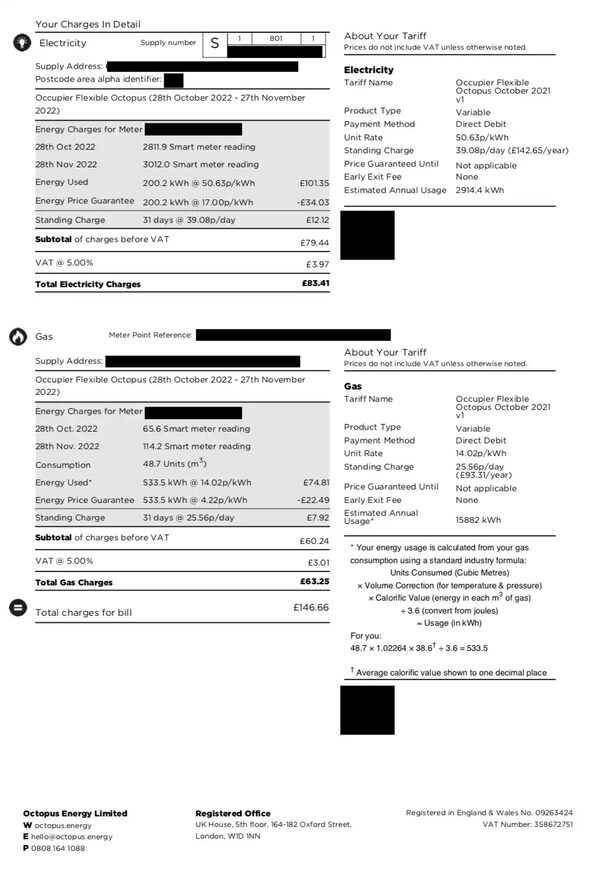
E.ON Next's standard variable tariff is exposed to the cap cycle: its own guidance states prices could go up or down when the price cap gets reviewed, in January, April, July and October each year13. That is the rhythm a household on a variable deal lives with, and it applies across suppliers, not just this one. E.ON Next's bill layout shows the tariff name, whether it is fixed or variable, exit fees, unit rates and standing charges, so the terms are visible on the statement itself14.
On the fixed side, E.ON Next has been the dominant name in the collective switch rounds run through 2026. The USWCSS-APR26 scheme ran from 1 to 13 April 2026 with E.ON Next's Next Fixed 14m Collective v1 as the winning tariff; the May round ran from 12 to 18 May with E.ON Next and Ecotricity winning; the June round from 9 to 17 June with E.ON Next and Fuse Energy; and the September round from 11 to 17 September with E.ON Next and Ecotricity6. A household that joins a collective switch is choosing from whatever the winning suppliers offer in that window, and in 2026 that has repeatedly meant an E.ON Next fixed product.
Switching tariff within E.ON Next carries no extra cost, though the company states it might charge an exit fee if a customer leaves before the contract ends15. That distinction matters: changing product inside the same supplier is not the same as leaving it. On the export side, Octopus's Outgoing tariff is fixed with no fixed end date, and its SEG tariff is likewise fixed with no fixed end date16.
Smart tariffs and time-of-use options compared
Time-of-use pricing is where the two suppliers diverge most clearly. Octopus Energy's Intelligent Octopus tariff has six hours of cheaper electricity overnight17. For electric vehicle drivers, Octopus's systems take over the scheduling: customers select the time they need the car by and the amount of charge they need, and Octopus's systems charge at the cheapest times18. That is a genuine transfer of control to the supplier's software, and it is the mechanism that makes the cheap window usable without a household watching the clock.
Octopus also runs Intelligent Octopus Flux, a two-rate tariff with matching import and export prices and automated battery management that charges the battery when power is cheapest and exports between 4pm and 7pm8. For a household with solar and a battery, that combination of import and export rates in one product is the closest thing in this comparison to a self-managing system.
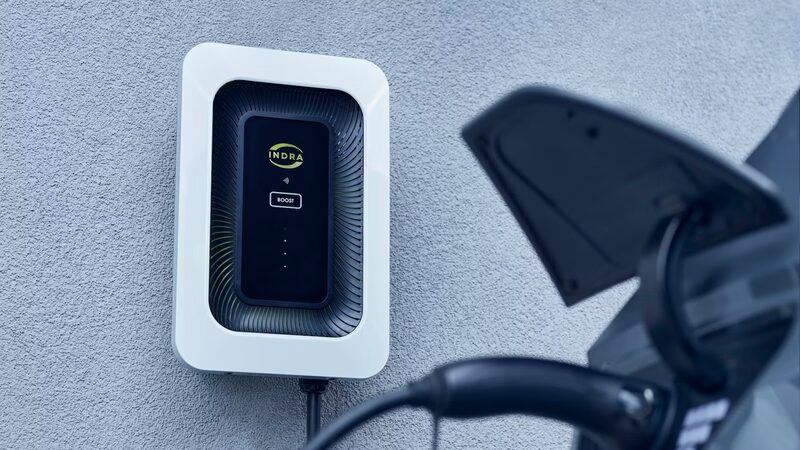
Charger compatibility is not universal. The Wallbox Pulsar Max is described as able to make the most of the Intelligent tariff from Octopus, although it is not yet compatible with OVO's equivalent19. E.ON Next's own charger guidance covers the Ohme ePod, Ohme Home Pro and zappi GLO, all with solar charging compatibility, Wi-Fi or 3G/4G connectivity, and tethered or untethered options20. Both suppliers simplify the move between tariffs and may help with smart meter installation, which is often the prerequisite for any of these products21.
Customer service: Citizens Advice scores, complaints and Trustpilot
The independent evidence favours Octopus on service. Ofgem's January 2026 supplier-level findings record that a significantly higher proportion of Octopus Energy customers reported being satisfied or very satisfied with customer service than the average, at 86%, and a significantly lower proportion reported dissatisfaction7. In the July to August 2025 findings, 84% of Octopus customers were satisfied or very satisfied and 1% dissatisfied or very dissatisfied, while EDF Energy, E.ON / E.ON Next, OVO Energy and Scottish Power all had a significantly lower proportion satisfied than the average22.
Citizens Advice publishes a quarterly five star rating on suppliers' customer service including complaints23. For January to March 2026 Octopus Energy scored 3.67 out of 5 overall and 3.4 out of 5 on complaints, ranking 4th in the supplier comparison table15. E.ON Next's own Q2 2026 performance report records 760 complaints received and 758 resolved per 100,000 customers, with 59,276 complaints opened and 59,138 resolved in the quarter; customer service was the largest single reason at 32.28% of complaints and payments at 12.16%9.
Trustpilot figures for E.ON Next are inconsistent across the documents. One independent source gives 4.5 out of 5 based on over 162,000 reviews, another gives 4.3 stars out of 5, and the company's own pages give 4.5 out of 5 with a review count of 231,86424.
"A significantly higher proportion of Octopus Energy customers reported that they were satisfied or very satisfied with the service they received from their supplier."
Export payments: Smart Export Guarantee rates for solar households

The Smart Export Guarantee opened in January 2020 as the replacement for the Feed-in Tariff, paying households for electricity exported to the grid25. Eligibility requires solar panels, or small wind of 5MW or less, or micro CHP of 50kW or less, installed at the home or business26. Ofgem's Year 5 report on the scheme found the lowest tied and untied tariff rates were 5p per kWh from Octopus and 1p per kWh from E Energy respectively27.
The rates a household can actually get vary enormously by product and by condition. Octopus Energy's standard SEG rate is 4.1p per kWh8. Its Intelligent Octopus Flux pays 23p per kWh, but only to Octopus customers who have both solar panels and a battery8. E.ON Next's Next Flex Export v1 pays 6p per kWh to customers with solar panels and an installer capacity of up to 5MW, while Next Export Premium v3 pays 17.5p per kWh to E.ON customers who have their solar panels or battery storage installed by E.ON Energy Installation Services after 10 November 20258.
That last condition is the crux. The highest E.ON Next export rate is tied to buying the hardware through the same company, whereas Octopus's high rate is tied to owning a battery, not to buying it from Octopus. Which? notes that Octopus offers some of the highest export tariff rates, but that a household does not have to buy its solar solutions28. For a household weighing independence, the difference is whether the export premium locks in a hardware purchase or only a tariff.
| Tariff | Rate | Condition |
|---|---|---|
| Octopus Energy SEG | 4.1p per kWh8 | Open |
| Octopus Intelligent Flux | 23p per kWh8 | Solar and battery, Octopus customer |
| E.ON Next Flex Export v1 | 6p per kWh8 | Solar up to 5MW |
| E.ON Next Export Premium v3 | 17.5p per kWh8 | Hardware installed by E.ON after 10 Nov 2025 |
Batteries, EV charging and the wider product range
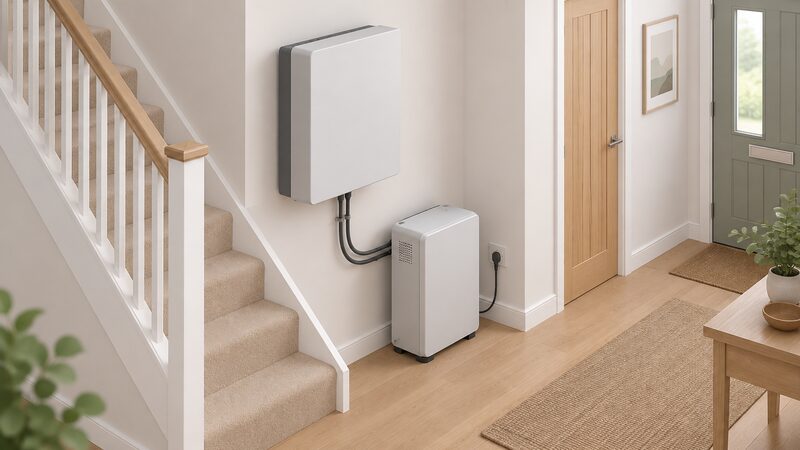
Octopus announced the Nook home battery range on 22 June 2026, comprising the Nook Cube plug-in battery and the Nook Colossus wall-mounted battery system, at its Energy Tech Summit29. The range is scheduled to become available to Octopus customers in the UK, Germany, Italy, Spain and France from the year after that announcement, so 202729. No firmer UK date has been published. Octopus's Outgoing tariff already includes battery storage as a feature16.
The Octopus Home Mini, a small device for reading live consumption, had a waiting list as of January 202617. That is a reminder that the product side of these suppliers is not always immediately available, and that a household planning around a device should check availability rather than assume it.
On charging, E.ON Next's guidance covers the Ohme ePod, Ohme Home Pro and zappi GLO, each with solar charging compatibility, Wi-Fi or 3G/4G connectivity, and a choice of tethered or untethered20. Octopus's charging proposition is built around the Intelligent tariff and the scheduling software behind it18. Both approaches depend on a smart meter and a stable connection to the supplier's systems, which is the dependence that remains even when the hardware is owned outright.
Billing, Direct Debit and switching practicalities
Octopus Energy accepts Direct Debit, Pay As You Go, bank transfer, credit or debit card, cash, Fuel Direct, where payments are deducted from benefits, and cheque30. It also offers weekly or fortnightly direct debits, with payments reviewed and adjusted more easily31. E.ON Next accepts monthly Direct Debit, card payments through the online account or by phone, bank transfer, and cash at Post Office, Payzone and PayPoint using the barcode on the bill13. Its bill shows the overall account balance, which indicates whether the account is in debit or credit and helps a household check whether the direct debit level is right14.
For new E.ON Next customers, the first monthly payment is estimated from the quote and the previous supplier, because actual data is only accessed after the switch under data protection guidelines13. That estimate is the usual source of a first-year surprise in either direction. When switching supplier, the standard sequence is to set up the direct debit with the new supplier ahead of the takeover date and cancel the old one after paying the final bills32. Moving from cash or cheque to Direct Debit is done by calling the supplier and asking about the discount offered, with the change appearing on the next bill33.
E.ON Next states the whole switch can take around five working days with a 14 day cooling off period, and that switching directly takes about five minutes online10. Its support pages put the supply transfer at up to five working days15. Both suppliers are named among those that simplify the move from one tariff to another and may help with smart meter installation21, and both are listed among the suppliers that should help a household whose in-home display is more than a year old34.
Which supplier fits which household

The choice turns on what a household already owns and how much it wants the supplier's software to do. A household with solar and a battery that wants a high export rate without buying hardware from the supplier is looking at Octopus's Intelligent Flux at 23p per kWh, against E.ON Next's 17.5p per kWh that requires installation by E.ON after 10 November 20258. A household with an EV that wants the supplier to schedule charging automatically is looking at Intelligent Octopus and its six cheap overnight hours17.
A household that wants a large traditional firm with a strong Which? score and a record of winning collective switches is looking at E.ON Next, which scored 66% in January 2026 and took the winning tariff in four collective switch rounds that year2. A household that weights independent service data most heavily is looking at Octopus, with 86% satisfaction in Ofgem's January 2026 findings and a 3.67 out of 5 Citizens Advice score for January to March 20267.
What neither supplier removes is dependence. Both rely on the grid, on a smart meter and a connection to the supplier's systems, and on the price cap cycle for anyone on a variable tariff13. Octopus's high export rate depends on owning a battery; E.ON Next's highest export rate depends on buying hardware from E.ON. The Nook battery is scheduled for 2027, not now29. For a household weighing energy independence, the practical question is which dependencies are acceptable, not whether any can be eliminated. Households comparing more widely can look at Octopus against British Gas or E.ON Next against British Gas, and the full guide to UK suppliers sets out the wider market.
Sources34 cited
- Which energy suppliers are British?, Uswitch, 2026-06-26
- Which? energy survey results, Which?, 2026-01-19
- Energy customers' satisfaction reaches highest point since 2021, Uswitch, 2026-05
- E.ON OVO acquisition announced, Uswitch, 2026-05-11
- Differences between green energy suppliers, Which?, 2026-03
- The Great Energy Savings Switch, Uswitch, 2026-09
- Customers' satisfaction with their supplier: supplier-level findings, January 2026, Ofgem, 2026-05
- Smart Export Guarantee rates: the best and worst SEG tariffs, Which?, 2026-04
- Our performance, E.ON Next, 2026
- Energy and gas switching, E.ON Next, 2026-09-17
- FIT licensee contact details, Ofgem, 2026-09-17
- Where does my energy come from?, Uswitch, 2026-08-03
- Fixed Direct Debits, E.ON Next, 2026-09-17
- How do I read my E.ON energy bill?, Uswitch, 2025-09-10
- Tariffs, E.ON Next, 2026-09-17
- Smart Export Guarantee, Solar Energy UK, 2026-05-12
- How to choose the best energy company, Which?, 2026-01-19
- Octopus EV energy tariffs, Uswitch, 2025-10-09
- Home electric vehicle chargers, Carwow, 2026-01-09
- How to do electric vehicle charging at home, E.ON Next, 2026-09-17
- Should EV owners get a fixed or time-of-use tariff?, Uswitch, 2025-07-02
- Customers' satisfaction with their supplier: supplier-level findings, July to August 2025, Ofgem, 2025-12
- Compare domestic energy suppliers' customer service, Citizens Advice, 2026-08-26
- Octopus Energy customer service details, Citizens Advice, 2026-09-20
- Feed-in Tariff, Uswitch, 2026-07-13
- Smart Export Guarantee, MCS Certified, 2026-04-27
- Smart Export Guarantee Annual Report Year 5, Ofgem, 2025-12
- Solar panel costs, Which?, 2026-08-03
- Octopus Energy launches the Nook range, Octopus Energy, 2026-06-22
- How do I read my Octopus Energy bill?, Uswitch, 2025-09-10
- Consumer vulnerability strategy progress report, Ofgem, 2026-07-21
- Direct Debit, Uswitch, 2025-10-22
- Paying for energy by cash, Uswitch, 2025-09-05
- Fixing problems with your smart meters and in-home display, Citizens Advice, 2026-09-17
 The Big Six Energy SuppliersWho were the Big Six energy suppliers, and do they still exist?
 Customer Service RatingsWhich energy suppliers answer the phone quickly and deal with complaints properly?
 Comparing Energy TariffsHow to compare energy tariffs on a like-for-like basis using estimated annual costs, personal projections and Tariff Information Labels, and the consumption assumptions behind the headline figures.
 Green Energy TariffsDoes a green tariff really mean greener electricity comes into your home, or just that your supplier buys renewable certificates to match what you use?
 EV Tariffs and Home ChargingHow EV-specific import tariffs and charging bolt-ons work, including supplier-controlled charging where the energy company decides when the car draws power, which charge points each scheme supports, and what a household needs in place.
 Who Supplies Your Energy?Not sure who bills you for gas or electricity?