

In this guide
Bulb Energy is gone. The supplier ceased trading and was placed into a Special Administration Regime, run by an administrator appointed by the government rather than going through the usual Supplier of Last Resort route, because with 1.6 million customers it was too big for that process1. It continued to trade under administration during the energy crisis, and its household accounts were later transferred to a new supplier.
For anyone who was with Bulb, the practical answers are these. Your gas and electricity supply was never cut off. Your credit balance was protected. Any debt on your account moved with you. Your fixed tariff did not survive the transfer, and the account continued on the new supplier's terms.
The wider context matters too. Between July 2021 and July 2022, 29 energy suppliers failed, and the lack of financial resilience across the market combined with rising wholesale costs to bring them down1. Bulb was the largest of them, and the way it was handled was different from the rest.
Bulb Energy has ceased trading: what that means for customers
A failed supplier does not mean a failed supply. Ofgem's position is unambiguous: if your energy supplier goes out of business because of financial problems, you will still have electricity and gas supplied to your home or business, and your energy supply will not be cut off2. The same guidance tells households they do not need to do anything, because the regulator moves them automatically to a new supplier and makes sure supply is not interrupted3.
What changes is who you pay and on what terms. The old company stops being your counterparty, the account transfers, and the new supplier becomes responsible for billing, refunds and any debt that comes with the account. Bulb's failure was unusual in scale rather than in kind: it was one of 29 suppliers that exited the market in the year to July 2022, a period when the lack of financial resilience within many suppliers met a rise in wholesale prices1.
The Energy Price Guarantee, which capped unit rates during the crisis, is now closed4. That matters for anyone reading old Bulb paperwork: the support arrangements described at the time no longer exist, and current bills are governed by the price cap instead.
Why Bulb went into special administration, not the usual Supplier of Last Resort process
The normal route for a failed supplier is the Supplier of Last Resort process. Ofgem chooses a new supplier through a bidding process, where energy companies bid to take on the customers, and they are only chosen if they can supply energy to the new customers without affecting their existing ones2. It is designed for suppliers small enough that another company can absorb the book without strain.
Bulb was too large for that. The Department took Bulb Energy into a Special Administration Regime precisely because, with 1.6 million customers, it was too big to go through the Supplier of Last Resort process1. Instead, an administrator was chosen to run the company of the energy supplier that had gone out of business2, and Bulb continued to trade under that arrangement.
The administrator runs the company until it is rescued, for example through restructuring, or sold, or until its customers are moved to other suppliers2. Bulb became insolvent during Scheme Year 2 of the Smart Export Guarantee and, due to its size, was placed into a Special Administration Regime, meaning it continued to trade5. That continuation is the key difference: customers stayed with Bulb, under administration, rather than being moved immediately.
The Supplier of Last Resort process also has boundaries worth knowing. It does not apply to Heat Networks or Green Deal6. Households on a heat network, or with Green Deal finance attached to their property, sit outside the automatic transfer arrangements that cover ordinary gas and electricity accounts.
| Supplier of Last Resort | Special Administration Regime | |
|---|---|---|
| Used when | Supplier is small enough to absorb | Supplier is too big for SoLR1 |
| Who runs it | A new supplier chosen by Ofgem through bidding2 | An administrator appointed to run the company2 |
| What happens to customers | Moved to the new supplier | Stay with the company while it trades5 |
| Example | Smaller failures of 2021 and 2022 | Bulb, 1.6 million customers1 |
What happened to the 1.6 million households on Bulb's books
Bulb's 1.6 million customers were the reason for the special treatment, and they were also the reason the administration lasted as long as it did. Running a supplier of that size through an administrator kept the accounts trading while a buyer was found, rather than splitting the book across several suppliers through competitive bidding.
The scale is easier to see against the wider failure wave. During the period between July 2021 and May 2022, 29 energy suppliers failed, affecting nearly four million households in the UK1. Bulb's 1.6 million customers were a substantial share of that total, which is why the government's approach to Bulb differed from its approach to the smaller failures around it.
For the households involved, the practical experience was continuity rather than disruption. Supply continued, billing continued, and the account eventually transferred as a whole. That is a different outcome from a Supplier of Last Resort transfer, where the customer book is broken up and households may find themselves with a supplier they did not choose, on terms set by that supplier.
The transfer of a large customer book also carries a cost that does not disappear. Ofgem's explanatory note on customer credit balances records that credit balances are protected when a supplier fails, but that these costs can be recovered from all consumers7. The protection is real for the individual household, and it is paid for across the market.
Your supply, credit balance and tariff when a supplier fails
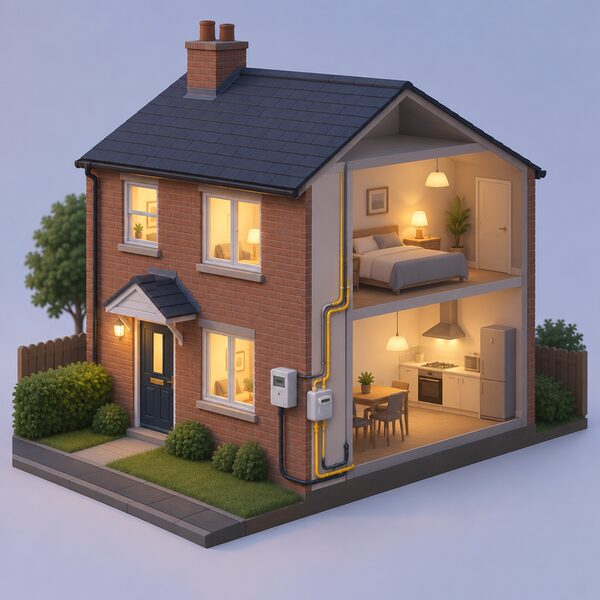
Three things matter to a household when a supplier fails: whether the lights stay on, whether the money in credit comes back, and what happens to the tariff.
On supply, the answer is settled. Ofgem states that if your supplier goes out of business because of financial problems, you will still have electricity and gas supplied to your home or business, and your energy supply will not be cut off2. Households do not need to act, because the regulator moves them automatically to a new supplier and ensures supply is not interrupted3.
On credit, the position is also settled. If your supplier goes out of business, your credit balance is still protected by the rules Ofgem sets, and the new supplier will contact you about a refund2. The cost of that protection is recovered from consumers generally, as Ofgem's explanatory note sets out7. In ordinary switching, the same principle applies in a simpler form: when you switch to a new supplier, your old supplier will refund any credit in your final bill, and you could get compensation if they do not8.
On tariff, the fixed terms end. A fixed rate contract is with a named supplier, and when that supplier fails the contract does not carry over. The account moves to the new supplier on its deemed terms, which in practice means a standard variable tariff governed by the price cap.
"If your supplier goes out of business, your credit balance is still protected by the rules we set."
Fixed tariffs, exit fees and what your new deal might look like
A fixed tariff is a contract with a particular company, so it cannot survive that company's failure. The account transfers to the new supplier on a deemed contract, and the fixed rate, the fixed term and the exit terms all fall away with the old supplier.
There is a second reason fixed deals look different now. The Energy Price Guarantee, which ran during the crisis, no longer provides support for customers on fixed tariffs, because the price cap is below the EPG level9. The scheme itself is closed4. That means a fixed tariff taken out today stands or falls on its own numbers against the cap, with no crisis-era subsidy behind it.
Exit fees are the part households most often misread. Ofgem's guidance is that you may have to pay your previous supplier an exit fee if you were on a fixed rate tariff and chose to leave before it ended3. The fee attaches to leaving a fixed contract early, not to the failure itself. Consumer research published in July 2025 found that only 57% net of consumers could identify that exit fees may still apply to a fixed contract even when moving to another deal with the same supplier10, so the confusion is widespread.
Independent consumer guidance from Which?, published through the Welsh Government's energy advice pages, suggests choosing a tariff with low or no exit fees in case circumstances change and you want to cancel your contract early11. That is a general point about contract design rather than a recommendation of any particular deal.
Debts, prepayment meters and the Warm Home Discount after a transfer
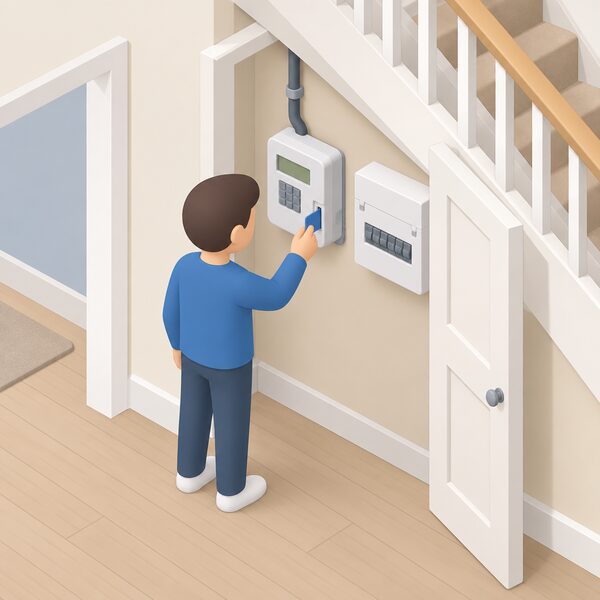
Debt is where a supplier failure touches a household most directly. Ofgem's guidance is that if the new supplier transfers customer debts from your old supplier, you will need to pay them for your debt instead2. In Bulb's case the household accounts moved as a book, so debts moved with them. The debt does not vanish because the original company failed.
Where a household is struggling, suppliers are expected to review current payments and debt repayments12, and there are schemes and grants aimed at paying off energy debt13. The Energy Ombudsman has published casework on exactly this situation: a consumer on an agreed 12-month debt payment plan whose changing financial circumstances were not reviewed by the supplier, where the outcome required the supplier to reconsider what the consumer was being asked to pay, offer alternative cheaper tariffs and energy efficiency advice, apologise and make a time and trouble award14.
Prepayment customers face their own rules. Once your credit runs out you will not be able to use any energy until you top up again15. Suppliers can switch off energy supply remotely through a smart meter, but they cannot disconnect customers without first taking all reasonable steps to help them repay debts, and cannot cut off supply for certain vulnerable consumers16. Where a supplier installs a prepayment meter without permission, it must give you £30 credit once it has installed the meter or remotely switched your existing meter to prepayment mode17.
On the Warm Home Discount, the recovery of scheme costs is shifting from the standing charge to the unit rate from April 202618.
What the administration cost, and who paid
The direct cost of running a large supplier through administration falls on the public purse and, indirectly, on the market. The credit balances of Bulb's customers were protected, and Ofgem's explanatory note records that while credit balances are protected when a supplier fails, these costs can be recovered from all consumers7. That is the mechanism: individual households are made whole, and the bill is spread across the customer base.
The wider failure wave carried its own costs. Between July 2021 and July 2022, 29 energy suppliers failed, and the lack of financial resilience within many suppliers combined with rising wholesale prices to cause it1. Wholesale costs, the price a supplier pays to buy energy, are the largest single input into a bill8, and the speed of the rise in 2021 and 2022 is what broke suppliers that had not hedged or capitalised for it.
Government support during the same period ran in the opposite direction. The Energy Price Guarantee, set by the UK government, limited the price that suppliers can charge for each unit of energy and subsidised all energy consumption above the price cap, at a total cost of £23 billion4. Government actions were described in Parliament as taking £150 out of energy costs19. The Feed-in Tariffs scheme recorded its own market exits: as a consequence of the wholesale energy crisis, 27 suppliers exited the market during Scheme Year 1220.
For a household, the lesson is about where the risk sits. A supplier is a billing and hedging business, not an infrastructure provider, and its failure is absorbed by the market and by public arrangements rather than by the individual account holder.
Getting help: the helpline and where to take a dispute

With Bulb gone, the route for a problem depends on what the problem is. If you have a case open with the Energy Ombudsman, they will contact you to discuss next steps2. For anything arising since the transfer, the first step is the supplier that now holds your account.
Ofgem's guidance lists the issues to raise with your energy supplier21:
- Late, incorrect or missing bills
- Back billing
- Being overcharged
- A faulty meter
- Poor customer service
- Refusing to refund credit from your account
If the supplier does not resolve it, the Energy Ombudsman may be able to help with an unresolved dispute22. The Ombudsman's most common dispute types are gas and electricity bills, smart meters and Feed-in Tariffs, customer service, problems arising from switching supplier, the way an energy product or service has been sold including doorstep sales, and the supply of energy to a home23. A consumer can register a dispute after complaining to the energy company if a final decision or deadlock letter is received, or eight weeks have passed without resolution24. Where a complaint about a Supplier of Last Resort transfer is unresolved after eight weeks, the consumer can pursue dispute resolution through the Energy Ombudsman6.
The Ombudsman can tell suppliers to take practical action such as crediting or cancelling an account or changing your tariff, to make an apology, or to offer a financial award, or a combination of these, and can make recommendations to prevent the issue happening again22. Suppliers can also be required to offer financial compensation, an apology, an agreement to fix the problem, a refund, or an affordable payment plan21.
For broader help, Citizens Advice offers information and support on a range of topics, including struggling to pay bills, problems with a supplier or supply, saving energy at home, and getting a better energy deal13. Ofgem also publishes guidance on getting help with energy bills13, and on checking whether you are owed money on your energy bill8. Small and microbusiness energy bill support runs through a separate government helpline12.
Sources24 cited
- Public Accounts Committee: The energy supplier market, UK Parliament, 2022-11-13
- What happens if your energy supplier goes out of business, Ofgem, 2026
- Switch your home energy supplier, Ofgem, 2026
- Energy Price Guarantee up until 30 June 2023, GOV.UK, 2026-09-17
- Smart Export Guarantee Annual Report 2022-23, Ofgem, 2023-09
- Supplier of Last Resort information, Energy Ombudsman, 2026-09-20
- Customer credit balance explanatory note, Ofgem, 2024-03
- Check if you are owed money on your energy bill, Ofgem, 2026
- Energy Price Guarantee: support up until 30 June 2023, House of Commons Library, 2026-08-28
- Understanding consumers' energy tariff choices: research report 2024, Ofgem, 2025-07
- Five top tips from Which? to cut your energy bills, Welsh Government, 2026-03-18
- Get help with your home or business energy bills, Ofgem, 2026-09-17
- Get help with your energy bills, Ofgem, 2026-09-17
- Case study: debt and payment, Energy Ombudsman, 2026-09-20
- Prepayment meters consumer guidance, Ofgem, 2026
- Energy market consumer protection, House of Commons Library, 2026-09-20
- Check if energy suppliers can install prepayment meters without household permission, Ofgem, 2026
- DESNZ annual report and accounts 2025 to 2026, Department for Energy Security and Net Zero, 2026-04
- Heating oil support, UK Parliament, 2026-03-16
- Feed-in Tariffs Annual Report: Scheme Year 13, Ofgem, 2023-12
- Complain about your energy supplier or network operator, Ofgem, 2026
- What to expect, Energy Ombudsman, 2026-09-19
- How we can help: energy suppliers, Energy Ombudsman, 2026-09-20
- Our process, Energy Ombudsman, 2026-09-19