

In this guide
Utility Warehouse sells gas and electricity as part of a package that also includes broadband and mobile, and it was the first firm to bundle energy with other home services in that way1. For a household, the appeal is one account and one bill across several services; the trade-off is that the energy supply itself still runs through the national grid and the gas network, and the bundle ties more of the household's spending to a single company.
The published evidence on service quality is mixed rather than poor. In the January 2026 Which? energy satisfaction survey, based on nearly 12,000 energy customers, Utility Warehouse scored 69% overall, 72% on customer score and 65% on the Which? assessment, from a sample of 291 of its own customers2. It was named a Which? Recommended Provider in 2025, the first year it held that status3.
On price and switching, the mechanics are standard. A domestic switch takes up to 21 days to complete, and switching is free4. Fixed terms usually run 12 to 24 months, and a fixed plan rolls onto a standard variable rate tariff when it ends, which independent guidance describes as more expensive6.
What Utility Warehouse is and how the bundle works
Utility Warehouse provides energy, broadband and mobile in one package, and was the first firm to do this1. That single fact shapes everything else about the proposition. A household that takes all three services deals with one company for billing, one account login and one contact route, rather than separate providers for gas, electricity, broadband and mobile.
The energy side is a licensed supply business. Utility Warehouse's Feed-in Tariff contact details are published by Ofgem under encompassing licences held by Electricity Plus Supply Ltd and Telecom Plus9. That licensing structure matters for a household weighing independence: the energy is supplied under a supply licence like any other domestic supplier, so the gas and electricity still arrive through the same networks, and the household remains dependent on the grid and on a gas supplier regardless of how many services sit on one bill.
The bundle also carries a data dimension. Utility Warehouse's UTrack service gives personalised energy insights, such as when a household typically uses most electricity, and alerts if usage rises above normal, alongside a Power Hours scheme that pays customers for cutting energy use at particular times10. That is a demand-flexibility arrangement: the household gets information and occasional payments, and in return its consumption pattern becomes visible to the supplier and adjustable at the supplier's prompting.
What the bundle does not do is change where the energy comes from. It does not make a home self-sustaining, and it does not reduce the physical dependence on the grid, the gas network or imported gas. What it changes is the commercial relationship: fewer suppliers, one bill, and a set of rewards and insights attached to staying. Households weighing that against the wider market can compare the structure with other challenger energy suppliers and with the UK energy supplier guide.

Energy tariffs: fixed, variable, tracker and EV options
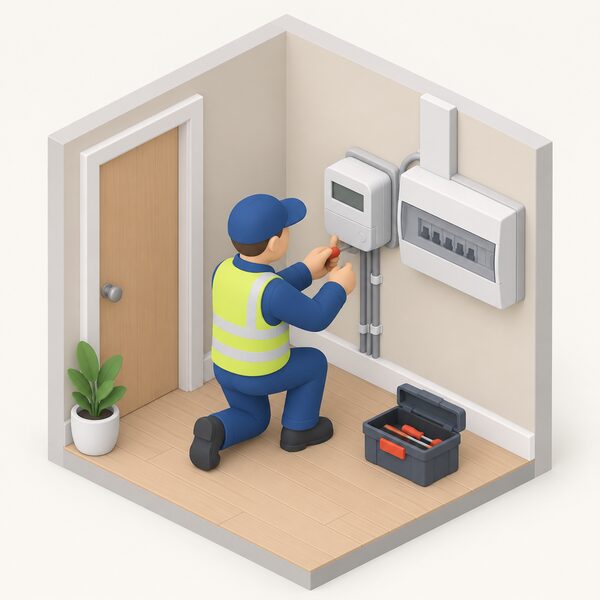
Ofgem describes three main types of domestic tariff: fixed rate, standard variable tariff and multi-rate11. Utility Warehouse operates within that framework. Its fixed products have been launched and retired on a rolling basis, with UW Fixed Saver 47 and UW Fixed 47 introduced in May 2025 and the 46 versions removed, then UW Fixed Saver 54 and UW Fixed 54 introduced in July 2025 with the 53 versions removed12. That churn is normal for the market and means the tariff name a household signs up to will not be the one on offer a few months later.
| Tariff type | Term | Exit fee | What happens at the end |
|---|---|---|---|
| Fixed rate | Usually 12 to 24 months7 | £100 or more if ended early7 | Rolls onto a standard variable rate tariff6 |
| Standard variable | No fixed term | None6 | Continues until the household switches |
| Multi-rate / time of use | Varies | Set by the tariff | Requires a smart meter to bill12 |
Fixed terms usually run 12 to 24 months7. When a fixed plan ends, the household is automatically moved to a standard variable rate tariff, which independent guidance describes as more expensive6. Standard variable rate plans carry no exit fee, so leaving at that point is free6.
Multi-rate and time-of-use arrangements are the category that covers electric vehicle and heat pump tariffs. Ofgem's own research on consumer tariff choices examined how households respond to exit fees, and found that a £300 exit fee reduced the share choosing a deal to 61%, against 93% where no exit fee applied13. The same research put a £200 exit fee at 66%13. Those figures describe consumer behaviour generally, not Utility Warehouse specifically, but they explain why exit fee terms are worth reading before signing.
Utility Warehouse has appeared as a winning supplier in collective switching. The first Great Energy Savings Switch collective ran from 30 January to 16 February 2026 with winning tariffs from Utility Warehouse, EDF Energy and Fuse Energy14. Collective schemes are covered in more detail under collective energy switching, and the general tariff landscape under green energy tariffs where a household is weighing fuel mix.
The savings promise: double the difference, or leave without exit fees
The savings promise attached to Utility Warehouse sits inside the standard switching protections rather than outside them. The Energy Switch Guarantee states there is no charge to compare and switch energy, and that a household will not be charged twice for the gas and electricity it uses during the changeover5. Independent guidance is blunter: a household should not be billed twice for the same units of energy when it changes supplier15.
On exit fees, the position depends entirely on the tariff. Fixed energy tariffs typically carry exit fees of £100 or more if ended early7. Standard variable rate plans do not have an exit fee and are free to switch at any time without penalty6. Independent guidance advises comparing the exit fee with the savings available from switching, since moving to a cheaper tariff could still save money overall even after paying the fee16.
The "double the difference" style of promise is a commercial commitment made by the supplier, and its exact terms are not published in the figures available here, so no figure can be given for it. What can be said is what the surrounding rules require. The Energy Switch Guarantee covers the switching mechanics and double-charging protection5, and the exit fee position is set by the tariff type rather than by the promise6.
For a household, the practical reading is that the promise changes nothing about the physical supply. The switching pages on exit fees when switching and the Energy Switch Guarantee set out the wider rules.
Switching incentives: credit and exit fee contributions

Switching incentives are a marketing cost, and the evidence on how much they move behaviour is measurable. Ofgem's research found that 70% of consumers who thought they had an exit fee on their current contract would take a deal with a £300 exit fee, against 93% where no exit fee applied13. The gap between those two figures is the value households place on being able to leave.
Independent guidance puts the potential saving from switching to a better deal at up to £497 on yearly bills4. That figure is a general market estimate rather than a Utility Warehouse specific number, and it depends on the tariff being left and the tariff being taken. The comparison factors that matter are:
- unit rates and standing charges
- whether prices are fixed or can change
- the length of any fixed-term contract
- the payment methods available
- customer service and support
- any additional benefits or incentives16
Where a supplier offers credit for switching and a contribution towards exit fees, the arithmetic is straightforward: the credit offsets the cost of leaving the old contract. A household on a fixed tariff with a £100 or more exit fee7 is weighing that fee against the credit on offer and the saving on the new tariff. A household on a standard variable tariff has no exit fee to offset6, so the credit is a straight reduction.
The mechanics of switching are covered under does switching cost anything and cancel switch without penalty. Renters who are directly responsible for paying the energy bill can switch15, and a household can begin a switch as soon as it becomes responsible for the property, after exchanging contracts when buying4.
Smart meters: free upgrade, compatibility and export payments
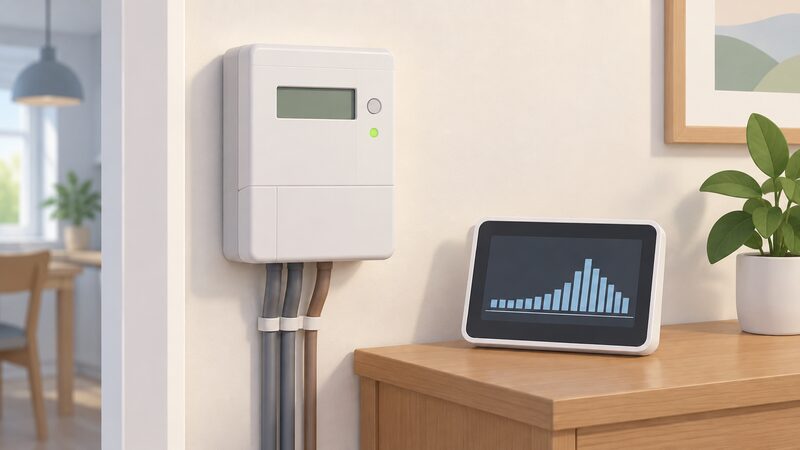
Smart meters are free to the household and available to both payment-on-account and prepay customers8. Ofgem's guidance is to contact your supplier to get a smart meter for free12. Some providers may offer a free energy efficiency inspection during installation17.
The functional case for a smart meter is tariff access. A smart meter allows a household to access more flexible tariffs, including dual-rate tariffs12. That is the mechanism behind time-of-use pricing: without half-hourly consumption data, a supplier cannot bill a multi-rate tariff. Smart meter data is used to bill for energy, to offer new products and services with permission, and to help make the energy system more efficient by recording demand more accurately13.
For households with solar panels, the smart meter is not optional. Generators must have a smart meter to monitor exports in order to qualify for the Smart Export Guarantee18. Utility Warehouse appears on the published list of SEG licensees with two tariffs, UW Smart Export Guarantee Bundle and UW Smart Export Guarantee Standard19. The export rate is not settled across the market: independent guidance gives figures of 12p and 16.5p per kWh in different places, so a household should read the rate from its own supply terms rather than from a comparison. The wider scheme is explained under Smart Export Guarantee and in the suppliers and smart meter installation guide.
In Wales, smart meter guidance is published through the Welsh Government's green energy choices material17, and the practical position is the same as in England and Scotland: the meter is free, and the tariff access it unlocks is the reason to have one.
Prepayment: emergency credit, friendly credit hours and support
Prepayment customers have specific protections. Authorised heat network suppliers are obliged to offer a reasonable amount of Emergency Credit and Friendly Hours Credit to any consumer using a prepayment meter, unless it is technically infeasible20. That obligation is written for heat networks, and it reflects the standard expected of prepayment supply more broadly.
"a reasonable amount of Emergency Credit and Friendly Hours Credit"
Support for households in difficulty runs through local authority energy advice services, which cover tackling energy emergencies, managing fuel debt and related issues, advocating on the customer's behalf, accessing energy grants and crisis funds, and optimising energy usage and efficiencies21. In Wales, county-level services such as Carmarthenshire's housing and heating pages provide a route to that advice22.
The Priority Services Register is a separate protection and is free23. Registration is made by contacting each utility supplier directly22, so a household with gas, electricity, water and broadband from different companies has to register with each one. The register matters most during a power cut, and the Met Office advises households to sign up to it in case of power cuts23.
For a household on prepayment, the dependence is sharper than for a credit customer: supply stops when the credit runs out unless emergency credit is available and used. The protections exist, but they are triggered by the household asking. The supplier conduct on prepayment and debt page covers the wider rules, and debt assignment protocol explains switching with prepayment debt.
Customer service ratings: what surveys and reviews actually say

The independent survey evidence on Utility Warehouse is specific and worth reading in full. In the Which? energy satisfaction survey published in January 2026, based on nearly 12,000 energy customers, Utility Warehouse recorded a total score of 69%, a customer score of 72% and a Which? assessment score of 65%, from a sample of 291 of its customers2.
| Which? measure, January 2026 | Utility Warehouse score |
|---|---|
| Total score | 69%2 |
| Customer score | 72%2 |
| Which? assessment | 65%2 |
| Supporting customers | 10 out of 102 |
| Complaints | 6 out of 152 |
| Contacting | 7 out of 122 |
| Switching | 3 out of 52 |
Those components tell a more useful story than the headline. Supporting customers scored full marks; complaints scored poorly. A household reading that should expect good day-to-day support and a harder time if something goes wrong and needs escalating. The complaints route itself is covered under complaining about an energy supplier and energy supplier customer service ratings.
Utility Warehouse was named a Which? Recommended Provider in 2025, the first year it held that status3. Recommended Provider status is awarded on survey performance and is reviewed annually, so it reflects the survey period rather than a permanent rating.
The company also publishes its own complaints data. Its financial services complaints report for the period ending 31 March 2026, covering 1 October 2025 to 31 March 2026, shows 1,824 complaints opened and 1,663 closed for insurance and pure protection24. That covers regulated financial services rather than energy supply, so it is not a measure of energy complaints, but it is a published figure from the company itself.
The company behind the brand: licences, network and scale
Utility Warehouse's energy supply sits under encompassing licences held by Electricity Plus Supply Ltd and Telecom Plus9. That is the licensing identity behind the brand, and it is the entity that appears in Ofgem's licensee records.
The wider supplier landscape includes a long tail of small licensees, and the Energy Ombudsman's dispute pages show how quickly that tail changes. Business Utility Services Ltd carries company number 1042873025, and Enetic Utilities Ltd carries company number 1634241926. Several similarly named businesses have ceased trading: Utility Link North West Ltd is listed as inactive with a trading period ending 5 May 2026, and S & S Utility Hub Limited became inactive on 6 May 2026. Others have joined the scheme recently, including Taurus Utility Consultants from 14 June 2026, MGM Utility Broker Ltd from 24 June 2026, Northstar Utility Group Limited from 8 September 2026 and Utility Genie Ltd from 16 September 2026.
That churn is the context for any household weighing a smaller supplier. Utility Warehouse is not in that category: it holds supply licences, it appears on Ofgem's Feed-in Tariff licensee list9, and it appears on the published Smart Export Guarantee licensee list19. The failures of 2021, when Utility Point and People's Energy both ceased trading on 14 September 2021 and their customers moved to British Gas and EDF, are covered under energy supplier failures and supplier of last resort.
For a household, the independence question is the same as with any licensed supplier. The bundle reduces the number of companies to deal with, and the licensing structure means the supply is regulated in the ordinary way. It does not reduce the dependence on the grid, the gas network or imported gas, and it adds a dependence on the supplier's app and account systems for the insights and rewards attached to the bundle. Households wanting to compare the structure with a rival can read Octopus Energy vs Utility Warehouse, and the wider market is set out in the UK energy supplier guide.
Sources26 cited
- How to choose the best energy company, Which?, 2026-01-19
- Which? energy survey results, Which?, 2026
- Revealed: the latest Which? energy company rankings, Which?, 2025-01-17
- A step by step guide to setting up gas and electricity in a new home, Energy Helpline, 2026-09-20
- Energy Switch Guarantee, Uswitch, 2026-07-20
- Standard rate tariffs, Uswitch, 2026-08-26
- How to switch energy supplier, Which?, 2026-05-15
- Smart meter cost, Smart Energy GB, 2026
- Feed-in Tariff licensee contact details, Ofgem, 2026-09-17
- How to use your smart meter data, Which?, 2026-07-14
- Understand your electricity and gas bills, Ofgem, 2026
- Getting a smart meter, Ofgem, 2026
- Understanding consumers' energy tariff choices, Ofgem, 2025-07
- The Great Energy Savings Switch, Uswitch, 2026-01-30
- How to switch energy supplier, Confused.com, 2025-12-15
- How to check your energy tariff and switch if you find a better deal, British Gas Energy Trust, 2026-07-30
- Smart meters, Welsh Government, 2026
- Smart Export Guarantee, Parliamentary Office of Science and Technology, 2026-06-25
- Smart Export Guarantee, Solar Energy UK, 2026-05-12
- Heat networks consumer protections draft guidance, Ofgem, 2025-09-05
- Home energy efficiency, Bridgend County Borough Council, 2026-09-17
- Heating your home, Carmarthenshire County Council, 2026-09-17
- What to do in a power cut, Met Office, 2026-09-20
- Making a complaint, Utility Warehouse, 2026-03-31
- Business Utility Services Ltd, Energy Ombudsman, 2026-09-19
- Enetic, Energy Ombudsman, 2026-09-19
 Utility Warehouse Tariffs and Bundled Energy DealsUtility Warehouse sells gas and electricity as part of a bundle with broadband and mobile, so the price you pay depends on taking those too.