


In this guide
Utility Warehouse is a supplier that sells energy as part of a wider bundle. Independent guidance describes it plainly: "Utility Warehouse provides energy, broadband and mobile in one package"1. That single sentence explains most of what a householder needs to know before comparing it with a conventional gas and electricity supplier, because the energy tariff and the connectivity services are marketed together rather than separately.
The company's tariff history is a sequence of numbered fixed deals. It launched Fixed Saver 15 and Fixed 15 on 29 February 2024, priced below the January and April price caps of that year2. The naming has moved on repeatedly since: UW Fixed Saver 47 and UW Fixed 47 replaced the 46 versions on 14 May 2025, and UW Fixed Saver 54 and UW Fixed 54 replaced the 53 versions on 17 July 20253. A householder comparing Utility Warehouse tariffs today is therefore looking at a moving target, and the version number in the name is the only reliable way to tell one deal from another.
In the wider market, the Which? energy survey gave Utility Warehouse a total score of 69%, with 72% for one measure and 65% for another4. That places it mid-table rather than at either extreme, and it is a satisfaction measure rather than a price measure.

What Utility Warehouse is and how the bundle works
The bundle is the defining feature. Rather than selling gas and electricity alone, Utility Warehouse combines them with broadband and mobile, and the appeal to a household is administrative: one provider, one relationship, one bill to track. Independent guidance records the package in exactly those terms1.
Bundling of this kind is not unique to energy. A separate model, Huddle, combines energy bills with water, broadband and TV into one payment and then charges each housemate for their share4. That is a different proposition aimed at shared households, but it illustrates the same underlying idea: consolidating several utility relationships into one.
For a household thinking about energy independence, the bundle cuts both ways. It simplifies billing and can reduce the number of direct debits leaving an account. It also concentrates dependence. A household that takes energy, broadband and mobile from one company has one point of failure and one set of terms and conditions governing all three. If the energy tariff becomes uncompetitive, leaving it may mean disturbing the broadband and mobile arrangements too, depending on how the package is structured.
The energy side of the bundle is a conventional supply relationship. Utility Warehouse buys wholesale and sells to the household, and the household remains connected to the national gas and electricity networks. Nothing about the bundle changes the physical dependence on the grid or on gas imports. What it changes is the commercial layer: who bills you, how many contracts you hold, and how easily you can move one service without touching the others.
It is worth separating the two questions a householder usually has. The first is whether the energy tariff itself is competitive, which is a question about unit rates and standing charges. The second is whether the bundle as a whole represents good value, which requires pricing the broadband and mobile alongside the energy. Those are different calculations, and a competitive energy rate can sit inside an uncompetitive bundle, or the reverse.
Tariff types: variable, fixed and EV

Ofgem's own guidance states that there are three main types of tariff: fixed rate, standard variable tariff (SVT) and multi-rate tariff5. That framework applies across the market, and Utility Warehouse's energy products sit within it.
| Tariff type | How the price behaves | Cap protection | Typical term |
|---|---|---|---|
| Fixed rate | Unit price protected for the term8 | Not capped | 12 months, sometimes 24 or 369 |
| Standard variable | Can rise or fall at any time9 | Protected by the price cap6 | Open ended |
| Multi-rate (time-of-use) | Varies through the day, cheaper overnight10 | Not capped | Contract dependent |
| Multi-rate (type-of-use) | Cheaper rate on EV charging only, any time11 | Not capped | Add-on to existing tariff |
A fixed rate tariff protects the unit price from changes during the fixed term8. The usual duration is 12 months, though suppliers offer two and three year deals, and independent guidance notes that fixed rate tariffs can run for 12, 24 or even 36 months9. The important qualification is that a fixed rate fixes the price per unit, not the bill: usage and standing charges still move the total8.
A variable rate tariff works the other way. The price paid for each unit of gas and electricity can go up or down at any time9, and a variable-rate tariff means the price per unit can rise or fall over time8. Standard variable tariffs are the type affected by the energy price cap, which changes every three months12, and people on this type of tariff are protected by the cap6. Independent guidance is consistent that standard variable tariffs are usually the most expensive tariffs offered by energy companies13, and that they are usually the most expensive types on the market, often hundreds of pounds more expensive per year than a fixed tariff12.
Multi-rate tariffs are the third category, and this is where EV products sit. EV energy tariffs come in two broad forms: two-rate time-of-use tariffs, and type-of-use tariffs11. Time-of-use tariffs vary the electricity price through the day, usually with a cheaper overnight charging window10. Type-of-use tariffs offer cheaper rates just for the specific energy used to charge an EV, with the cheaper cost applying at any time of day or night, and they work as add-ons to an existing tariff requiring a compatible home charger and a working smart meter11.
Fixed deals: Fixed Saver 15 and Fixed 15
Utility Warehouse's fixed tariff history is documented in dated launches. On 29 February 2024 the company launched Fixed Saver 15 and Fixed 15, two fixed tariffs priced below the January and April price caps of that year, available from 9am that morning2. The pair of names reflects a pattern that continues: a "Saver" version and a standard version launched together.
That pattern is worth understanding because it is how the company's fixed range is structured. Each launch introduces a numbered pair and withdraws the previous pair. The numbering is not a measure of quality or length; it is a version marker. A householder who reads a comparison of Utility Warehouse tariffs from an earlier period may be looking at a deal that no longer exists.
The wider fixed market context matters here. The average fixed tariff offered in May 2026 was above the price cap, reflecting supplier expectations that the cap would increase in the future15. That is a market-wide observation, not a Utility Warehouse figure, but it explains why fixed deals are not automatically cheaper than the cap at any given moment. A fixed tariff is a bet on future prices, priced by the supplier.
Most fixed tariffs include exit fees for each fuel, payable if switching before the end of the contract12. That is a standard feature rather than a Utility Warehouse peculiarity, and it is the main thing that limits a household's ability to move mid-term. The exit fees and contract terms page sets out how those charges work.
When a fixed tariff ends, customers rolling off are usually moved onto their supplier's standard variable tariff, and new occupants start on the property's current supplier's SVT12. That default is the mechanism by which a household can end up on the most expensive tariff type without actively choosing it. The fixed deal ends page covers what happens at that point.
The May fixed launch and later tariff changes

The dated record of Utility Warehouse's tariff changes shows a company that refreshes its fixed range several times a year. The May 2025 launch introduced UW Fixed Saver 47 and UW Fixed 47 and removed the 46 versions3. Two months later, on 17 July 2025, UW Fixed Saver 54 and UW Fixed 54 replaced the 53 versions3. The jump in numbering between the 47 and 54 series suggests intermediate launches that the record does not itemise.
This cadence has a practical consequence for anyone comparing Utility Warehouse tariffs. A deal quoted in a comparison article, a forum post or a supplier email has a shelf life measured in weeks or a few months. The version number is the identifier, and the only way to know what is currently available is to check the supplier directly.
The company also took part in collective switching. The first Great Energy Savings Switch collective ran from 30 January to 16 February 2026, with winning tariffs from Utility Warehouse, EDF Energy and Fuse Energy16. Collective switches work by aggregating households to negotiate a rate, and they produce a named winning tariff rather than an open-ended offer.
On the administrative side, Utility Warehouse updated its guide to setting up utilities when moving house on 17 March 2026, covering notice periods, deemed contracts, rentals, prepayment meters and new builds17. That guide is relevant to the practical question of how a household joins or leaves the supplier during a move.
What bundling means for household energy independence
The honest assessment of a bundled energy deal is that it changes the commercial relationship, not the physical one. A household on a Utility Warehouse tariff is still connected to the national electricity grid and, where it has a gas supply, to the gas network. The electricity is generated by someone else and delivered over wires the household does not control. The gas is bought on a wholesale market exposed to international prices. Bundling does not alter any of that.
What bundling does is concentrate the commercial dependence. A household that takes energy, broadband and mobile from one provider has a single counterparty for three essential services. That is convenient when everything works and the price is competitive. It is less convenient when one element becomes uncompetitive, because the household has to weigh the cost of moving one service against the disruption to the others.
There is a second dependence worth naming: the contract terms. Fixed tariffs carry exit fees per fuel in most cases12, which means the freedom to leave mid-term has a price attached. A household that fixes during a period of falling wholesale prices may find itself paying above the market and facing a charge to escape. That is the trade-off a fixed rate makes: certainty in exchange for flexibility.
For households pursuing genuine energy independence, the levers lie elsewhere. Generating electricity on the roof, storing it in a battery, or shifting consumption to cheaper periods all reduce reliance on purchased units rather than changing who sells them. Time-of-use tariffs, including the EV products described above, are one route into that: they reward a household for moving consumption rather than for switching supplier. The tariffs and energy independence page develops that argument.
Demand side response, where households shift or cut consumption in response to a signal, could make household energy bills cheaper18. That is a system-level finding rather than a Utility Warehouse one, but it points in the same direction: the household that can flex its consumption has more control than the household that simply changes who it buys from.
How Utility Warehouse compares with single-service suppliers
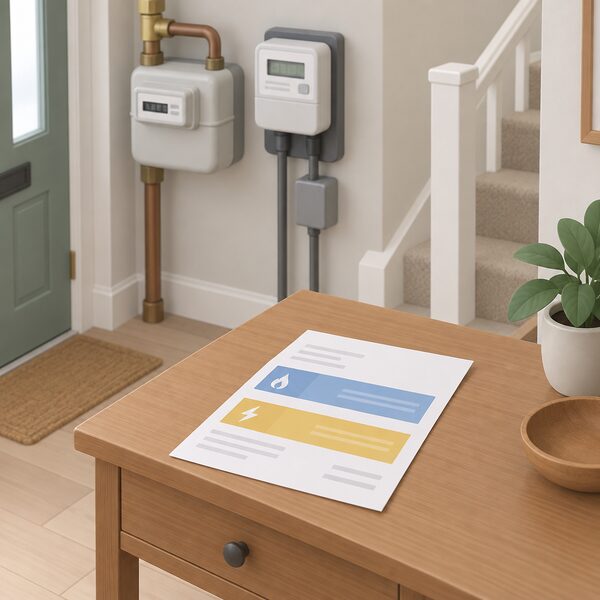
The comparison a householder actually makes is between a bundle and a set of separate arrangements. On the energy side alone, the relevant question is whether the tariff is competitive on unit rate and standing charge, and that depends on the specific deal rather than on the brand.
Single fuel tariffs exist across the market. Electricity-only tariffs, also called single fuel tariffs, exclusively provide electricity to a home, and they are used by people who do not have a gas supply and by those who prefer to keep their electricity and gas suppliers separate19. A dual fuel tariff, by contrast, covers both gas and electricity use and bills both on one monthly or quarterly invoice20. The dual fuel tariffs page compares the two structures.
The Which? energy survey result gives one independent data point on how customers rate the supplier. Utility Warehouse scored 69% overall, with 72% and 65% on the two component measures4. That is a satisfaction score, not a price comparison, and it should be read as such.
On price, the market-wide position is that standard variable tariffs are usually the most expensive type available, with fixed rates usually the cheapest13. Independent guidance suggests money can be saved by selecting a fixed-rate deal no more than 40% more expensive than the current price cap13. That threshold is a rule of thumb for judging whether a fix is worth taking, and it applies to any supplier's fixed deal.
For a household in Northern Ireland, the comparison works differently. There is no Ofgem price cap; instead there is a tariff review process overseen by the Utility Regulator7. Energy prices were not capped in Northern Ireland and suppliers have the flexibility to set their tariffs independently to reflect their costs of operating21. The Consumer Council offers an energy price comparison tool to compare electricity and gas tariffs for all suppliers in Northern Ireland22. The tariffs in Northern Ireland page covers that market in full.
Sources22 cited
- How to choose the best energy company, Which?, 2026
- Which? energy survey results, Which?, 2026
- Latest energy price updates, EnergyLinx, 2025
- Understand your electricity and gas bills, Ofgem, 2026
- Check if you are owed money on your energy bill, Ofgem, 2026
- Understanding consumers' energy tariff choices, Ofgem, 2025
- Fixed and variable tariffs: what's the difference, Energy Helpline, 2026
- Switching your energy supplier, Energy Saving Trust, 2026
- EDF Energy tariffs, Energy Helpline, 2026
- Energy price cap research briefing, House of Commons Library, 2026
- How your electricity or gas bill is calculated, Ofgem, 2026
- Best deal energy, Home Energy Scotland, 2026
- How to compare dual fuel tariffs, Confused.com, 2025
- Guidance for FIT generators, Ofgem, 2026
- Electricity only tariffs, Confused.com, 2026
- Demand side response research briefing, Parliamentary Office of Science and Technology, 2026
- Gas and electricity standing charges, Confused.com, 2026
- ECO Flexible eligibility statement of intent, Bristol City Council, 2023
- FIT licensee contact details, Ofgem, 2026
- Switch your home energy supplier, Ofgem, 2026
- EV tariffs and home charging, Energy Ombudsman, 2026
- The average gas and electricity bills in the UK, Energy Helpline, 2026
 Utility WarehouseUtility Warehouse bundles your gas and electricity with broadband and mobile on one bill.