

In this answer
Short answer
Retirement housing and sheltered flats sit in a distinct corner of the UK energy picture. Many are leasehold, many are rented from a housing association or council, and a large share are heated by something other than an individual gas boiler: a communal heat network, storage heaters, or electric panel heaters. That changes who you pay, what you can change, and how exposed a household is to rising costs.
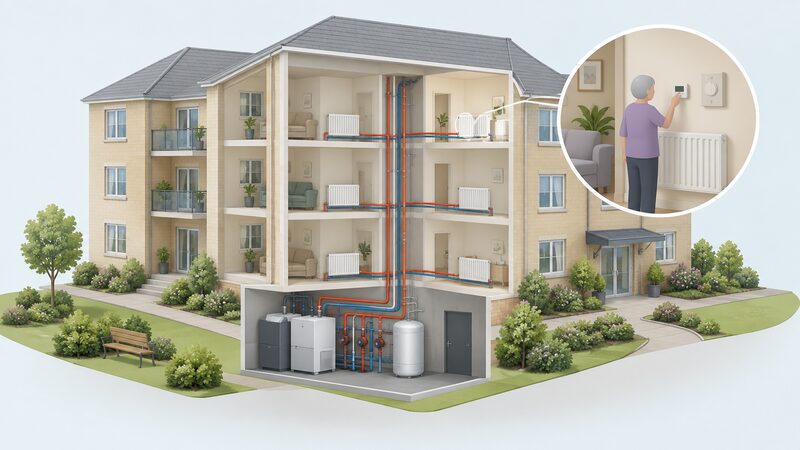
The service charge is the centre of it. Where a development is served by a heat network, the network supplier charges for the heat, and residents pay either directly or through the service charge. Official guidance states that where individual metering comes into effect for networks covered by the Landlord and Tenant Act that charge through service charges or rent, suppliers would be expected to charge for heat separately and unbundle the heat charge from service charges or rent1. Until that applies, the heat cost can be buried inside a single monthly figure.
For a household, the independence question is blunt. A retirement flat on a communal system is dependent on the network operator, the managing agent and the freeholder for its heat, and often cannot switch supplier at all. Where heating is individual and electric, the household can switch supplier but carries the full running cost of resistive heating. This page sets out what the rules and the evidence say, and what to check before committing.
What a retirement flat's service charge actually covers
A service charge is a single payment that bundles several distinct costs, and energy is only one of them. In a retirement development the charge typically funds the upkeep of communal areas, the management fee, buildings insurance, and, where the development has one, the communal heating or hot water system. The energy element is the part that behaves least like a normal household bill, because it is set by the freeholder or managing agent and passed through rather than bought by the resident.
Where the development sits on a heat network, the resident may also pay a standing charge for maintenance costs, and how much that is can change over time6. That is a separate charge from the heat itself, and it is the one most often overlooked at the point of purchase. The same applies in Wales, where the guidance is identical in substance7.
The billing rules are tightening. Ofgem's draft consumer protection guidance for heat networks sets minimum billing information for metered networks: the charges for the relevant period, a clear and understandable explanation of how the bill has been calculated, and the final due date for payment and the acceptable methods of payment1. It also requires comparisons of current consumption with the same period in the previous year, displayed in a graph where possible, and estimates of future charges1.
For a household, this matters because it converts an opaque service charge line into something that can be interrogated. The independence a retirement flat offers is partial: the resident controls the thermostat in the flat, but not the fuel source, the tariff or the supplier behind it.
Heating in retirement flats: communal systems, storage heaters and electric panels
The heating system in a retirement flat is usually one of three types, and each carries a different cost profile and a different degree of household control.
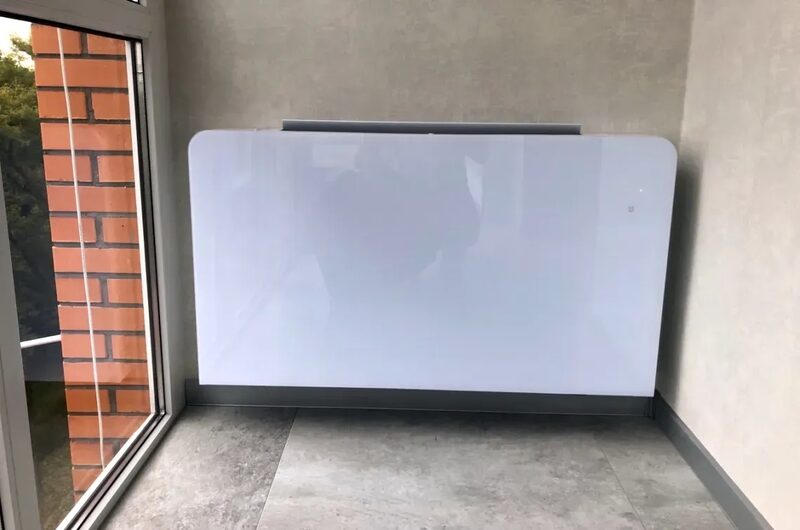
Communal heat networks serve a whole building or estate from a single plant. The resident buys heat, not gas or electricity, and cannot switch supplier in the ordinary sense. Storage heaters charge overnight and release heat during the day. Electric panel heaters are the simplest and the most expensive to run.
Independent guidance puts panel heater installation at £100 to £200 each, with running costs of around £1,080 a year for a flat2. That running-cost figure is the one to hold onto: it is the baseline against which any claim of cheaper heating in a retirement property should be tested.
Storage heaters are subject to a specific control requirement. Approved Document L states that automatic control of input charge should be provided8. In practice this means a storage heater should be able to vary how much it charges according to conditions, rather than charging flat out every night regardless of the next day's weather.
Where heating equipment is grant-funded for people aged over 60 or in receipt of certain benefits, VAT applies at 5% to a defined list that includes electric storage heaters, gas-fired boilers, radiators, and the installation, repair and maintenance of a boiler, radiators, pipework and controls forming a central heating system9. The reduced rate also covers installing, maintaining and repairing central heating systems and similar, and renewable source heating systems10.
Service charge energy costs: what you pay and what you can question

The energy portion of a service charge is not fixed. It moves with wholesale prices, with the network's own costs, and with the maintenance standing charge. Independent guidance is explicit that the standing charge for maintenance can change over time6, which means a figure quoted at purchase is a snapshot, not a commitment.
The components behind any domestic energy bill give a sense of what is being passed through. Ofgem lists VAT at 5%, wholesale costs, network costs, operating, debt and industry costs, EBIT, and policy costs11. A heat network passes through an equivalent set of costs, but without the price cap that protects domestic electricity and gas customers in the same way.
For context on the domestic side, the Midlands electricity cap for 1 July to 30 September 2026 shows a standing charge of £207.57 and an annual bill of £810.72 at 2,500 kWh on a single-rate tariff, or a £206.15 standing charge and £977.09 annual bill at 3,400 kWh on a multi-rate tariff5. Those are cap levels, not bills, and they apply to domestic electricity supply rather than to heat networks.
What a resident can question is narrower than for a standard household. The bill must show the charges, the calculation and the payment terms1. Beyond that, the route is the managing agent, the freeholder, or a residents' association. Disconnection is possible in principle, and independent guidance notes that a heat network supplier might say they can disconnect you if you pay a fee, with the amount set by the contract6.
Modern methods of construction: McCarthy Stone's commitment across 40 developments
Modern methods of construction, usually shortened to MMC, describe buildings assembled from factory-made components rather than built entirely on site. For retirement housing the appeal is speed, consistency and tighter fabric control, all of which bear on how much heat a flat loses.
McCarthy Stone announced a commitment in February 2022 to build 40 new retirement developments in full using modern methods of construction12. That is a developer's own commitment, reported in an industry body's energy report, and it is the clearest dated statement linking a named retirement developer to MMC at scale.
What the evidence does not do is put a running-cost figure on it. No dated figure here links MMC retirement housing to a specific heating bill, so a claim that an MMC retirement flat is cheaper to heat is unproven on this evidence. Fabric quality affects heat demand, and heat demand affects bills, but the chain has to be measured rather than assumed.
The wider policy context shows where the barriers sit. The Heat Pump Ready Programme invested £42 million across 45 projects across 3 streams13, and its second round of innovation funding targeted specific barriers: the capital cost of heat pump system hardware and components, in-property changes required, internal and external space requirements, and the time taken for a heat pump install from accepted quote14. Those are the same constraints that shape what can be fitted into a retirement flat.
Overheating is the other side of the fabric question. Work commissioned on overheating risk considers current and future risks posed by summertime overheating to the UK housing stock at scale, the factors influencing risk, adaptation and upgrade options, and costs15. A well-sealed MMC flat that holds heat in winter can also hold it in summer.

Energy MOTs in retirement living: the Telford scheme and its £8,500 boost
An Energy MOT is a tailored advice visit rather than a statutory assessment. It looks at how a household uses energy, what tariffs and systems it has, and what practical changes are available. Housing Plus Group's Energy Advice team delivered energy MOTs at Newfield Court in Telford, achieving almost £8,500 in combined positive financial outcomes for residents.
That figure is a combined outcome across the residents involved, not a per-household saving, and it covers financial outcomes rather than energy units alone. It is nonetheless the clearest dated example of an energy advice intervention aimed specifically at retirement living residents.
The wider retrofit evidence shows what fabric and heating upgrades can achieve. Improvements such as external wall insulation and heat pumps can reduce energy bills by approximately 25% or £350 per year, according to a council programme cited as evidence16. A separate council partnership is spending around £1.4 million to replace ageing fossil fuel based heating systems in 10 council-owned buildings with low carbon electric alternatives17.
For a retirement flat, the practical route to an Energy MOT is through the landlord, the managing agent, the housing association, or a local advice service. The scheme at Newfield Court was delivered by a housing group's own advice team, which indicates the model: an organisation that already holds the relationship with residents runs the visit.
What to check before buying or renting a retirement property
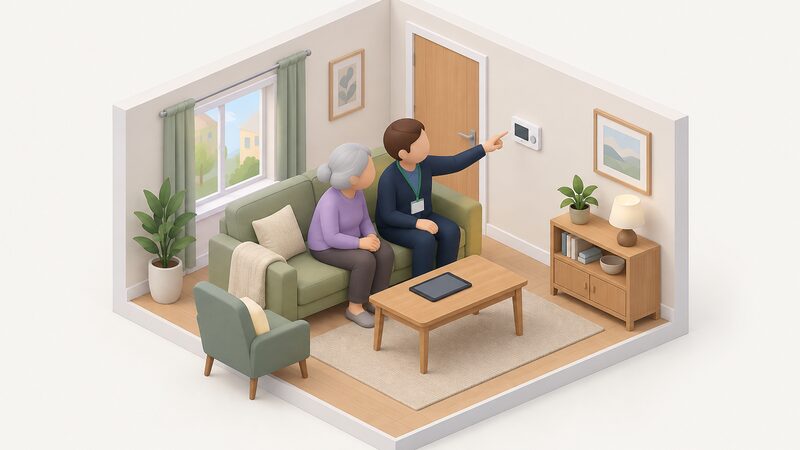
The checks that matter most are about who controls the heat and who sets the charge. Ask what the service charge covers, whether heating is communal or individual, whether the development sits on a heat network, what the maintenance standing charge is, and how charges are calculated and billed. Ofgem's draft guidance requires metered heat network bills to show the charges for the period, how they were calculated, and the due date and payment methods1.
Ask about the heating system itself. If it is storage heaters, the control requirement in Approved Document L is that automatic control of input charge should be provided8. If it is electric panels, the running cost benchmark is around £1,080 a year for a flat2. If it is underfloor heating, independent guidance notes that it is cheaper with a single-rate tariff2, and that electric underfloor heating has lower installation costs while water underfloor heating has lower running costs18.
Ask about consent. Alterations in a leasehold or rented flat normally need permission, and communal systems are controlled centrally. Independent guidance puts heating controls at £600 for a semi-detached home3, which gives a sense of scale for a controls upgrade, though in a flat on a communal system the controls are usually the landlord's or management company's responsibility.
Ask about support. The Pension Age Winter Heating Payment helps people of State Pension age pay their heating bills, is paid once a year, and is administered by Social Security Scotland19. For winter 2025/26 it was £203.40 per eligible household where the oldest person is under 80, and £305.10 for households containing a person aged 80 or over20. It replaced the Winter Fuel Payment in Scotland4, and the payment range is £105.55 to £316.704.
"It's paid once a year and has replaced the Winter Fuel Payment for people in Scotland."
For households in Northern Ireland, owner occupiers and private renters may be able to get up to £7,500 for energy-efficiency upgrades through the Affordable Warmth Scheme23. In Scotland, an uplift of £1,500 is available for remote rural and island homes to both the energy efficiency and clean heating grant24, and the SME Loan and Cashback Scheme funds the installation of renewable heating and energy efficiency measures25.
Sources25 cited
- Heat networks consumer protections draft guidance, Ofgem, 2025-09-05
- Electric heating advice, Centre for Sustainable Energy, 2026-06
- Retrofit explained, Energy Saving Trust, 2026-02-06
- Pension Age Winter Heating Payment (Scotland), Citizens Advice Scotland, 2026-09-20
- Energy price cap levels, 1 July to 30 September 2026, Ofgem, 2026
- If your home is on a heat network, Citizens Advice, 2026-09-17
- If your home is on a heat network (Wales), Citizens Advice Wales, 2026-09-17
- Approved Document L: Conservation of fuel and power, Volume 1 Dwellings, Ministry of Housing, Communities and Local Government, 2021
- VAT rates on different goods and services, HM Revenue and Customs, 2026-07-10
- VAT Energy Saving Materials and Grant Funded Heating Supplies, HM Revenue and Customs, 2026-09-17
- How your electricity or gas bill is calculated, Ofgem, 2026
- HBF Energy Report: Watt a save, Home Builders Federation, 2022-10
- Information about the Heat Pump Ready Programme, Department for Energy Security and Net Zero, 2026-05-11
- Heat Pump Ready Programme Round 2 innovation funding competition, Department for Energy Security and Net Zero, 2026-04-21
- Addressing overheating risk in existing UK homes, Climate Change Committee, 2026-09-19
- High Rise Retrofit and Upgrade Programme Phase 1, City of Edinburgh Council, 2026-04-20
- Our climate action on buildings, Bristol City Council, 2026
- Electric vs water underfloor heating, Which?, 2026-05-27
- Pension Age Winter Heating Payment, mygov.scot, 2026-09-17
- Pension Age Winter Heating Payment, House of Commons Library, 2026-02-26
- About the new Pension Age Winter Heating Payment, Home Energy Scotland, 2025-11
- What is a Pension Age Winter Heating Payment, Turn2us, 2026-08-10
- Affordable Warmth Scheme, House of Commons Library, 2026-05-13
- Heat in buildings progress report 2025, Scottish Government, 2025-10-02
- Local and small scale renewables, Scottish Government, 2026-09-17
 The Full Your Type of Home GuideLiving in a flat, an old listed house or somewhere off the gas grid changes what energy help you can get and what you are allowed to install.
 Energy in Social HousingWhat must your landlord do if your home is cold, damp or mouldy?
 HMOs and Shared HousesWho is responsible for the electrics, the gas and the fire alarms when you rent a room in a shared house?
 Installation Cost TrendsTracks the published median and average installed costs of domestic solar, heat pumps and batteries and how they have moved.
 Prepayment and Pay As You GoHow prepayment and pay as you go energy tariffs work in the UK: meter types, top-ups, emergency credit, debt repayment through the meter, price cap treatment and how households move to a credit meter.
 Cost of Energy IndependenceA heat pump and better insulation are the usual starting point, but what does the whole job really cost, and what help is there with the bill?