

In this guide
A home energy assessment is any structured check of how a dwelling uses energy, and there are four practical routes. A free online energy check, run by a council or a national advice body, helps a household understand how energy efficient the home is and what changes could reduce energy use, with no visit and no rating. An Energy Performance Certificate survey provides an assessment of the home's energy efficiency and is carried out by an accredited assessor using the Standard Assessment Procedure, or the reduced version, RdSAP, for existing homes where full information may not be available. A PAS 2035 retrofit assessment, introduced in 2019 as a framework for best practice in the energy retrofit of domestic properties, goes further and is managed by a qualified Retrofit Coordinator. A whole building assessment covers a block or tenement rather than a single flat.1
The important distinction is between a rating and a plan. An EPC produces a rating plus a recommendations report, which lists measures that could improve energy efficiency with an indication of cost and typical savings for each improvement over three years. It is calculated on standard assumptions of occupancy and use, and does not take into consideration variations in occupant behaviour or the state of repair of the building. A retrofit assessment, by contrast, exists to support a sequence of work on one specific dwelling, with a named professional coordinating it.5
Coverage is patchy. Around a third of domestic properties in England and Wales do not have an EPC rating at all, so for many households the first assessment of any kind is the one they commission themselves. Among homes that do have a certificate, homes in England had a median EPC score of 69, which is band C, recorded in March 2025.6
The four routes side by side
| Route | What it produces | Who carries it out |
|---|---|---|
| Free online energy check | An understanding of how energy efficient the home is and what changes could reduce energy use4 | Self-completed, hosted by a housing body or council4 |
| Local advice service visit | Tailored advice; some schemes include a free home visit from a qualified home energy advisor10 | Scheme advisor10 |
| EPC survey | An assessment of the home's energy efficiency, plus a recommendations report with indicative cost and typical savings over three years1 | Qualified or accredited experts, acting independently11 |
| PAS 2035 retrofit assessment | Input to a whole-dwelling retrofit project | Managed by a qualified Retrofit Coordinator3 |
| Whole building assessment | Recommendations on energy efficiency measures and zero direct emissions heat systems for the building as a whole and for individual dwellings12 | Commissioned for the block, not the flat12 |
Free online checks: the lowest-cost starting point

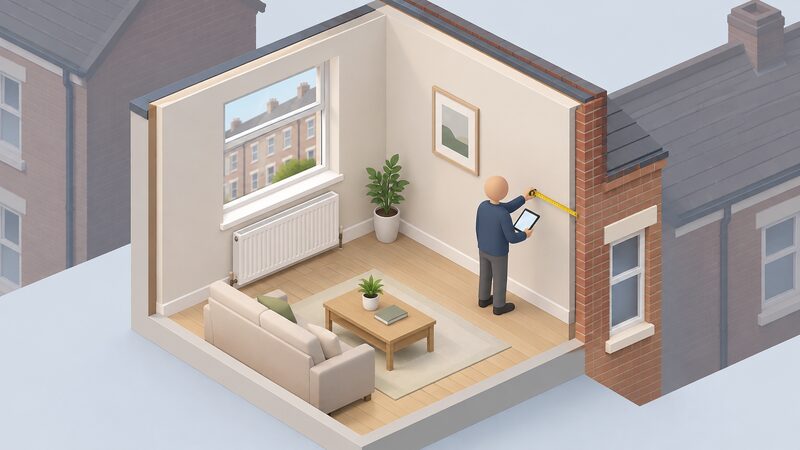
An online home energy saving tool is designed to help a household understand how energy efficient the home is and what changes could help reduce energy use. It costs nothing, needs no appointment, and relies entirely on what the householder types in, which is also its limit: it cannot see a wall build-up, a blocked cavity or a failed seal. Tools of this kind are offered by housing bodies and by councils, sometimes branded locally, such as a tool that gives energy saving advice to help save money on energy bills and boost the energy rating of the home.4
Local schemes sit between an online tool and a formal survey. Community advice programmes provide communities with advice and support for improving home energy efficiency, and some local energy advice programmes include a free home visit from a qualified home energy advisor. At UK level, a single-entry point for consumer home energy advice on GOV.UK is intended to help homeowners, landlords and tenants find tailored, impartial and trusted advice on how to heat their homes and make them more energy efficient. Northern Ireland has a long-standing equivalent: the Consumer Council NI and NI Energy Advice give free, independent and impartial energy advice to all domestic householders in Northern Ireland, including independent advice on solar panels, heat pumps and other energy efficiency measures.14
Qualitative research into home energy advice provision explored which sources are trusted, what advice is perceived as most important, perceived gaps in provision, the customer journey in searching for advice, and how advice could be tailored to encourage homeowners to decarbonise their homes. That framing matters: the barrier is often not the absence of an assessment but knowing which assessment answers the question being asked. Related routes are set out in the pages on free home energy advice in England, Scotland, Wales and Northern Ireland.17
The EPC survey: what the rating actually measures
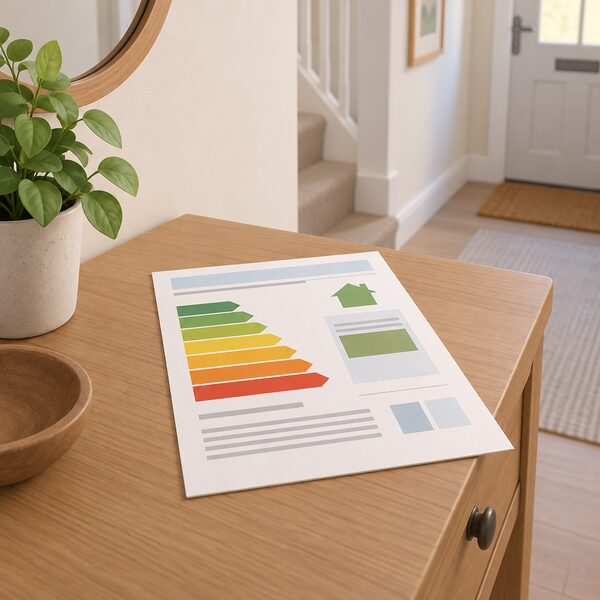
An EPC provides an assessment of the home's energy efficiency, and it is described in official Northern Ireland guidance as a good starting point to help improve the energy efficiency of a property. Alongside the rating, both the domestic and non-domestic EPC display estimated annual primary energy use for the property, in kilowatt-hours per square metre. In the domestic certificate this primary energy indicator is described as the amount of energy used to produce one kilowatt of power for the household.1
The recommendations report is the part a household can act on. It gives information on measures which could improve energy efficiency, with an indication of cost and typical savings for each improvement over three years. Using that report well is covered in using an EPC and its recommendation report to plan improvements.5
Its weaknesses follow from its method. The calculation is based on standard assumptions of occupancy and use, and does not take into consideration variations in occupant behaviour or the state of repair of the property, using a UK-wide calculation methodology managed by the UK Government with input from the devolved administrations. Two identical houses receive the same rating whether one is heated to 21 degrees around the clock or barely heated at all. That is deliberate, because the certificate is a comparison between buildings, but it means an EPC is not a bill forecast. For what a specific household actually consumes, see working out how much energy your home uses before you spend.5
"The calculation is based on standard assumptions of occupancy and use, and does not take into consideration variations i"
PAS 2035 assessment and whole building assessment
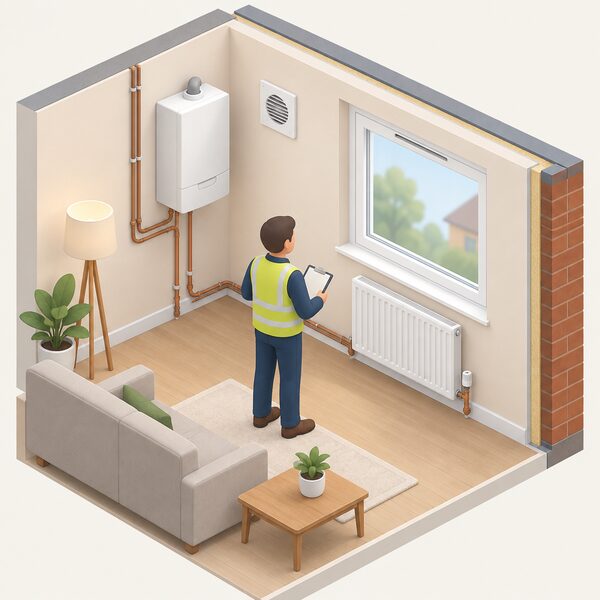
PAS 2035 was introduced in 2019 as a clear framework for best practice in the energy retrofit of domestic properties, and work under it has to be managed by a qualified Retrofit Coordinator, so the householder does not carry that coordination burden. The practical difference from an EPC is scope and ownership: the retrofit route treats fabric, ventilation and heating as one system in one specific dwelling, and a named professional is accountable for the sequence. The division of roles is explained in retrofit assessors and retrofit coordinators: who does what, and what the survey itself includes in what is included in a PAS 2035 retrofit assessment.3
Flats and tenements raise a problem no single-dwelling assessment solves. A whole building assessment should provide information and recommendations to owners on both the energy efficiency measures and zero direct emissions heat systems appropriate for the building as a whole and for individual dwellings, and it could potentially be used as a basis for regulation. For a flat owner, this is the difference between knowing what can be done inside the front door and knowing what the roof, the close and the shared walls require.12
Timing is often decided by something else entirely. Research into able-to-pay households found other building work was named as a potential trigger for the installation of energy efficiency improvements by 14% of respondents. An assessment commissioned alongside planned building work is therefore doing different work from one commissioned in isolation: see doing energy work as part of a renovation or extension.19
What an assessment involves on the day
The sequence a household meets is usually the same: an application or booking, then a survey, then a discussion of options. One council case study describes an online application followed by a survey of the home to check its energy rating, after which the options and their benefits were talked through. How long each route takes is set out in how long does a home energy assessment take.20
Advice services can widen beyond the building. Home Energy Scotland provides advice on how to use energy in the home more efficiently, information on switching energy supplier and referrals for benefit checks, and its Energycarers can make home visits and assess eligibility. That combination, a physical visit plus an eligibility check, is what turns an assessment into access to funded work rather than a document filed away.21
The figures: what the assessment record shows
The national picture comes from statistics built on assessment data, and those statistics carry health warnings. Household energy efficiency statistics headline releases are provisional and subject to future revisions, and include further analysis and geographical breakdowns of measures, delivery costs and estimated carbon and energy savings. In Northern Ireland, energy rating of housing figures are classed as official statistics in development.22
| Measure | Value | Coverage |
|---|---|---|
| Median EPC score, homes in England | 69, band C (March 2025)7 | England |
| Domestic properties with no EPC rating | around a third6 | England and Wales |
| Council or housing association houses at EPC A to C | around two-thirds, against around 40% in other tenures6 | England and Wales |
| UK homes at EPC C or above | 14% in 2010, 46% and rising (September 2022)8 | UK |
| Non-domestic properties rated A+, A or B | 38% (July to September 2023)24 | England |
The tenure split is the sharpest number here. Around two-thirds of council or housing association houses have EPC ratings A to C, compared with around 40% of houses in other tenure types, so the homes least likely to have been assessed and improved are largely those owned or rented privately. The wider cost of not acting has been estimated: the average annual energy bill for UK households is around £40 higher than if insulation rates from pre-2012 had continued for the last decade. Measure delivery has also varied by nation, with the Energy Company Obligation recording an average of 118 measures per 1000 households in Scotland, against 81 in Wales and 77 in England, as reported in December 2020.6
England, Scotland, Wales and Northern Ireland
The calculation engine is shared, but the certificate around it is diverging. Scotland is introducing a new EPC rating system for domestic buildings giving clearer information on the fabric energy efficiency of a property, the emissions, efficiency and running costs of its heating system, and the cost of energy to run the home to standardised conditions. The Energy Cost Rating will be based on the cost of energy to run the dwelling to standardised conditions, modelled on UK-wide fuel cost factors and normalised climate data, showing a current and a potential rating, and will be in line with the current Energy Efficiency Rating or SAP Rating.26
Scotland's non-domestic rating differs in kind as well as in label. The Energy Performance rating in Scotland is absolute, not based on comparison to a reference building as is the case in England and Wales. The reformed Energy Efficiency Rating will run A to G on a zero to 150-plus scale with kgCO2e per square metre per year also shown, the same scale as the Asset Rating used on non-domestic EPCs in England, Wales and Northern Ireland; consultation responses, mainly from organisations, were positive on having a relative Energy Rating aligning with the rating system used in other parts of the UK.29
| Nation | Methodology position |
|---|---|
| England | The Home Energy Model and SAP are the approved calculation methodologies for new dwellings; SAP version 10.3 approved 24 March 202631 |
| Wales | Approved Document L Volume 1 (2026 edition) requires SAP version 10.3 for target rates; SAP 10.2 edition was approved from 23 November 202233 |
| Scotland | Absolute Energy Performance rating; new Energy Cost Rating and Energy Efficiency Rating under EPC reform29 |
| Northern Ireland | The Building Regulations (Northern Ireland) 2012 name SAP for Energy Rating of Dwellings as the national calculation methodology for dwellings34 |
Scotland's draft buildings legislation takes the further step of providing that regulations may provide for the assessment of the energy performance of such buildings, which is the legal hook by which assessment moves from voluntary to required.35
The rules behind the rating
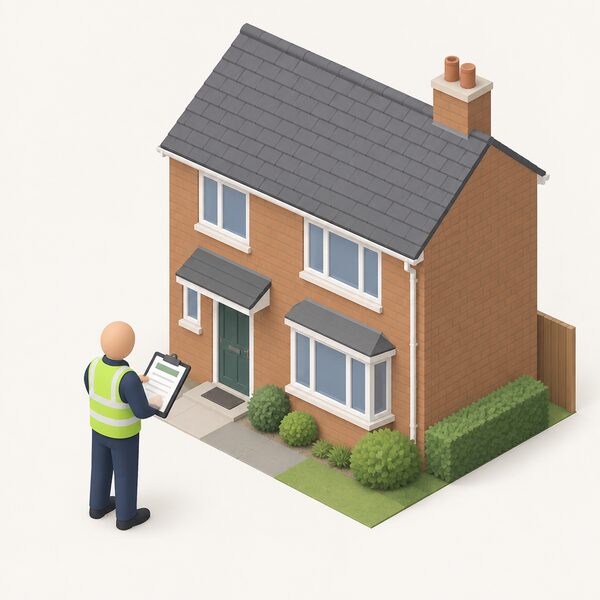
Assessment is not a free-form survey: the methodology is set in law. In England, notices of approval set out the approved calculation methodologies for calculating the energy performance of new buildings under regulations 24 and 25 of the Building Regulations 2010, approving SAP version 10.3 for new dwellings and the 2026 version of the National Calculation Methodology for buildings other than dwellings. Non-domestic buildings are assessed using the Simplified Building Energy Model. For existing homes, EPC assessors use SAP, or reduced SAP where information may not be available.32
Different regimes have locked to different SAP editions over time, which is why older documents disagree. The Energy Company Obligation legislation refers both to the 2009 Edition as amended in October 2010 and to the 2012 Edition, version 9.92. The Welsh consultation draft of Approved Document L Volume 1 in 2019 specified version 10.1, and a later Welsh consultation version specified version 10. A rating produced under one edition is not directly comparable with one produced under another.37
From SAP to the Home Energy Model
The Standard Assessment Procedure, the methodology used to calculate the energy efficiency rating of a home, will be replaced with the Home Energy Model, a change planned for 2027. The Home Energy Model is a calculation methodology designed to assess the energy performance of homes, and the Scottish Government describes the change as establishing new technical infrastructure to replace the current SAP. During the transition, both the Home Energy Model and a version of SAP will be available for a limited period.9
For a household, two consequences follow. A certificate obtained now is produced under the outgoing methodology, and a rating produced after the change will not be like-for-like with one produced before it. Scotland is also proposing an Energy Use Rating, which would inform dwelling owners about the energy use of their property, complementing running costs and carbon emissions, and display how measures and heating systems can reduce energy use. Anyone setting a target for their home in EPC band terms should treat the band as a moving reference point rather than a fixed one.5
What an assessment does, and does not, do for energy independence
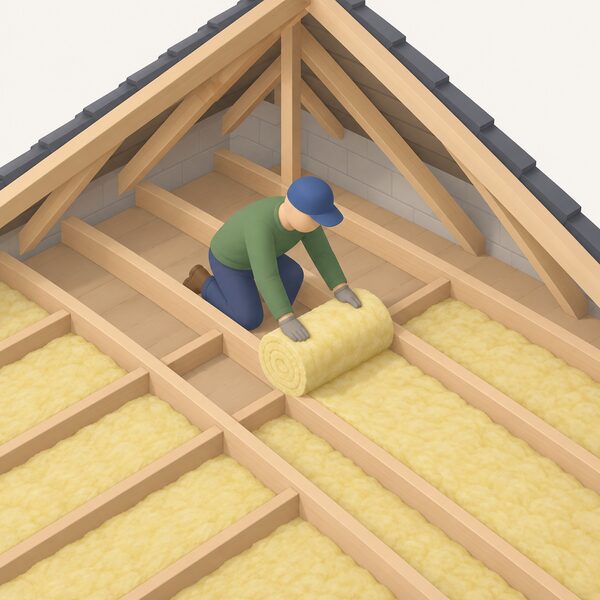
An assessment is the only route by which a household replaces guesswork with a record. It names the fabric weaknesses that drive heat loss, and its recommendations report puts an indicative cost and a three-year saving against each measure, which is what makes a sequence of work possible rather than a series of impulses. Every kilowatt-hour removed by fabric work is a kilowatt-hour that never has to be bought, from any supplier, at any price. That is the durable part of independence, and it is why a fabric first approach and the order of improvements matter more than any single product choice.5
The dependencies are real and should be stated. The rating itself is a modelled output, not a measurement, built on standard assumptions of occupancy and use that exclude both behaviour and state of repair, so it cannot tell a household what it will actually spend. The certificate depends on a methodology controlled centrally and due to change in 2027. Around a third of domestic properties in England and Wales have no EPC rating, so for many homes the record does not yet exist. And an assessment converts to independence only when the work follows: the measures, not the document, cut the imported energy.5
The safeguard worth knowing is the independence requirement itself: energy performance certification of buildings and the inspection of heating systems and air-conditioning systems are to be carried out in an independent manner by qualified or accredited experts. That is a protection against an assessment being shaped by whoever hopes to sell the work that follows. Where the assessment is free and publicly funded, as with the free, independent and impartial advice available to all domestic householders in Northern Ireland, the same principle is being applied at the advice stage. Next steps for most households run through where to start energy improvements and checking what grant help you can get before you start work, or the overview at /getting-started/.11
Sources40 cited
- Energy efficiency advice and assessment, Bromley Council, 2026
- Energy Performance Certificates research briefing, House of Commons Library, 2026
- Home energy efficiency key terms explained, Development Bank of Wales, 17 October 2024
- Energy advice and home energy saving tool, Northern Ireland Housing Executive, 2026
- Domestic EPC reform consultation, Scottish Government, 23 July 2021
- National Energy Efficiency Data-Framework report, 2026, GOV.UK, 11 June 2026
- Energy efficiency of housing in England and Wales, 2025, Office for National Statistics, March 2025
- £1.5 billion to improve energy efficiency and slash bills, GOV.UK, 29 September 2022
- EPB certificates statistical release, January to March 2026, GOV.UK, 2026
- Grants and funding: Local Energy Advice Programme, Tameside Council, 2026
- Energy performance of buildings directive text, legislation.gov.uk, 2026
- Tenements short life working group final report, Scottish Government, 28 November 2023
- Green improvements and the Homewise tool, Cornwall Council, 21 May 2025
- Energy incentives and schemes, South Cambridgeshire District Council, 2026
- Reforming consumer protection for home upgrade schemes, GOV.UK, 17 June 2026
- Low carbon heating, nidirect, 2026
- Home energy information, advice and guidance, GOV.UK, 11 March 2026
- What EPCs measure: technical annex, GOV.UK, 9 March 2026
- Able to pay retrofit research, executive summary, Bristol City Council, July 2022
- Council initiative helps Witney mum keep her energy bills down, Oxfordshire County Council, 4 June 2026
- Tackling fuel poverty in Scotland: a strategic approach, Scottish Government, December 2020
- Household Energy Efficiency Statistics, headline release June 2026, GOV.UK, 25 June 2026
- Northern Ireland energy efficiency of housing consultation, nidirect, July 2024
- EPB certificates statistical release, July to September 2023, GOV.UK, 2023
- Current programmes will not deliver net zero, Climate Change Committee, 29 June 2022
- Reforming Energy Performance Certificates, Scottish Government, 21 January 2025
- EPC reform consultation: government response, Scottish Government, January 2025
- EPC reform consultation government response summary, Scottish Government, 21 January 2025
- EPC reform consultation, Scottish Government, 25 July 2023
- EPC reform consultation analysis, Scottish Government, 23 January 2025
- Approved Document L Volume 1: Dwellings, GOV.UK, 2026
- Notice of approval of calculation methodologies, 24 March 2026, GOV.UK, 24 March 2026
- Approved Document L Volume 1, 2026 edition, Welsh Government, April 2026
- The Building Regulations (Northern Ireland) 2012, legislation.gov.uk, 15 May 2012
- Draft Buildings (Heating and Energy Performance) and Heat Networks (Scotland) Bill, Scottish Government, 18 November 2025
- National Calculation Methodology and Product Characteristics Database, NCM PCDB, 2026
- The Electricity and Gas (Energy Company Obligation) Order 2012, legislation.gov.uk, 4 December 2012
- 2013 Home Energy Conservation Act (HECA) reports, GOV.UK, 10 October 2013
- Home Energy Model heat pump methodology, GOV.UK, January 2026
- Home Energy Model: replacement for SAP consultation, GOV.UK, 13 December 2023
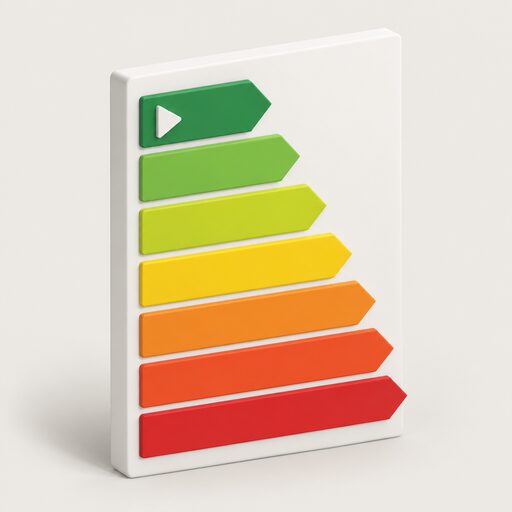 Energy Performance CertificatesAn Energy Performance Certificate rates how energy efficient your home is, from A down to G.
 Home Energy ModelThe energy rating on your EPC is about to be worked out differently when you buy, sell or build a home.
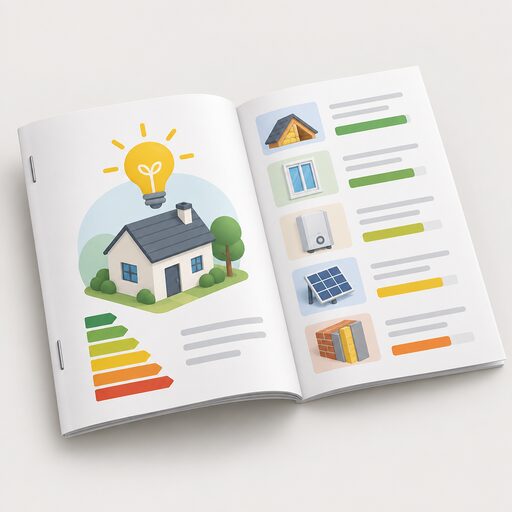 Using Your EPC to Plan WorkAn EPC comes with a recommendations report, and that report is the part worth reading before you spend anything.
 Read an EPCA walk through each part of an EPC: the A to G rating and potential rating, the estimated costs, the fabric and heating assumptions and the recommendation table, plus what the assessor did and did not inspect and how the rules differ across the UK.
 Measured vs Modelled PerformanceWhy does a home use more energy than its rating predicts, and what does that mean for your bills?
 Where to Start ImprovementsThe first steps are assessment, not purchase: read the home's EPC and its recommendation report, see actual consumption on a meter or in-home display, and take the no-cost adjustments such as turning the thermostat down one degree.