
In this guide
A whole-house retrofit in the UK does not have a single price. The most useful published guide for an average semi-detached home puts a shallow retrofit at £5,000 to £15,000 and a deep retrofit at £45,000 to £55,0001. Between those two poles sits the figure most often quoted in policy work: taking a typical existing home to net zero standards is estimated at about £11,400 to £12,650 before any government subsidies, and higher where fabric retrofit is needed first2. A parliamentary committee put the average cost of retrofitting an individual home, such as to install a low carbon heating system and energy efficiency measures, at just under £15,0003.
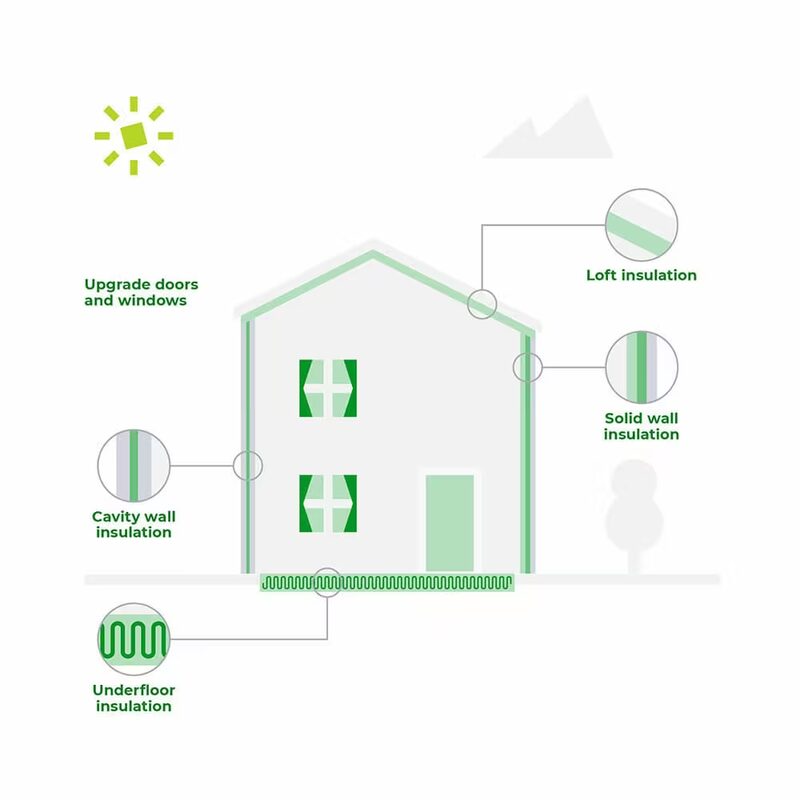
Those numbers describe different scopes, which is why they disagree. A shallow programme is loft top-ups, draught proofing and controls. A deep programme replaces the heating system, insulates solid walls and floors, upgrades windows and doors and often adds mechanical ventilation. One independent cost set gives £12,000 to £50,000 for the major insulation package of internal or external wall insulation, floor insulation, room-in-roof insulation and new windows and doors, and £100 to £7,000 for draught proofing and ventilation depending on whether the work stops at basic sealing or extends to mechanical ventilation with heat recovery4. Real projects land at the top: a Welsh bungalow retrofit programme cost approximately £55,000 per house5.
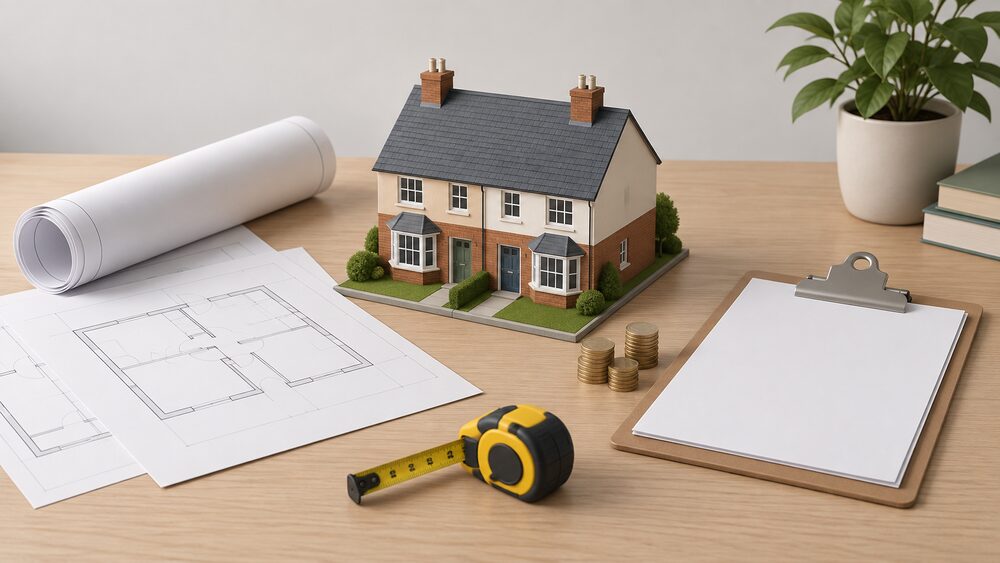
Before any of that, there is the cost of knowing what to do. A retrofit assessment runs £150 to £300, and a full whole house retrofit plan, the most expensive option, is sometimes in the range of £7506. That plan buys impartial, scientific recommendations with detailed costings, architectural drawings and scheduling options6. On a £40,000 programme it is a small fraction of the spend and the thing that stops measures being installed in an order that makes later ones harder.
The figures, and why the published estimates differ
The spread between roughly £10,000 and roughly £55,000 is not noise. It reflects three different questions being answered.
| Estimate | Figure | Scope | Source type, date |
|---|---|---|---|
| Shallow retrofit, average semi-detached | £5,000 to £15,000 | Lighter measures1 | Official guidance, 2024 |
| Deep retrofit, average semi-detached | £45,000 to £55,000 | Full programme1 | Official guidance, 2024 |
| Typical existing home to net zero | ~£11,400 to £12,650 | Before subsidies, higher if fabric work needed2 | Official consultation, 2026 |
| Home built to the 2021 Part L uplift | ~£9,800 | Before subsidies, learning rates applied2 | Official consultation, 2026 |
| Average cost of retrofitting an individual home | just under £15,000 | Low carbon heating plus efficiency3 | Parliamentary, 2025 |
| Major insulation package | £12,000 to £50,000 | Walls, floor, room-in-roof, windows and doors4 | Independent statistics, 2026 |
| Draught proofing and ventilation | £100 to £7,000 | Basic sealing through to MVHR4 | Independent statistics, 2026 |
The net zero figures are modelled averages across a housing stock, so they average cheap homes with expensive ones and assume a particular end point. The £45,000 to £55,000 deep retrofit figure describes what a single house actually costs when every element is addressed. A separate estimate of the same work put the cost to retrofit a typical existing home to net zero standards, before subsidies are considered, at about £12,0009. These are consistent with each other only if "net zero standards" is a narrower target than "deep retrofit", which is how the documents read.
Two component figures anchor the rest. An air source heat pump is given a typical installation cost of around £12,00010, and the same figure of around £12,000 appears as the average cost in separate guidance11. Airtightness work at deep retrofit level was costed at £2,000 for 100 per cent draught proofing1. Those two alone account for much of a mid-range budget before a single wall is insulated.
At national scale the same arithmetic appears: the Climate Change Committee estimates that retrofitting all of the UK's housing stock will cost £250 billion by 205012, across 29 million homes13, which the sector describes as needing approximately two low energy home retrofits every minute for the next 25 years13.
What drives the number: condition, not ambition

The single largest source of overrun is work that has nothing to do with energy. Across a sample of 14 whole house retrofit projects, enabling and repair works accounted on average for 26 per cent of total costs, and actual enabling costs came in at roughly £1,600 to £3,000 per property, far higher than estimated at the outset7. Enabling work is the roof repair that must happen before insulation, the damp remediation behind a wall lining, the rewiring that a new consumer unit demands. None of it shows on an energy model, all of it appears on the invoice.
Building form and construction are the next driver. Solid walls lose even more heat than cavity walls14, and a property built before the 1930s has a good chance of being solid wall construction15. Solid wall insulation can be expensive, and guidance notes that the ideal time to do it is when the walls need some other corrective work16, which is precisely the sequencing argument for a plan. External systems need insulation between 50 and 100mm thick; internal insulation and plasterboard laminates run up to 90mm total14. External work is usually installed where there are severe heating problems or the exterior requires other repair work, providing the opportunity of adding insulation14.
Site and services can move the figure sharply. In one case study of electrical supply upgrades, a house 100 metres from the substation cost £22,000 while one 1,000 metres away cost £45,00017. Distance from infrastructure is not something a householder can design around.
Householder behaviour also shapes what gets bought. Research based on in-depth interviews found that householders categorised measures into three stages of a whole-house retrofit journey, with a perception that benefits decline as costs increase18. The same work found that most householders are attracted to the idea of a whole-house plan once it is explained to them, especially the benefits of knowing upfront how to sequence measures and ensure forward compatibility, and that those contemplating more extensive works indicate they would willingly pay for the service19. A nationally representative survey of over 10,000 homeowners examined the same barriers and motivators20. The costs of this work are significant and for many homeowners there is currently limited financial support21.
Survey, design and the cost of planning the work
The assessment layer is small money that determines how the large money is spent. The published range is £150 to £300 for a retrofit assessment and sometimes around £750 for a full whole house retrofit plan, described as the most expensive option6. Free help exists in parts of the country: some councils operate a free Home Repairs Support Service22, and free advice services are available in each nation.
The value of the plan is sequencing. Parliamentary evidence made the point bluntly about designing in standards from the outset:
"will need to be retrofitted later at up to five times the cost of designing-in appropriate standards from the start"
That multiple applies to new build, but the logic carries into staged retrofit: a heat pump sized for an uninsulated house, or wall insulation installed before a window is replaced, is money spent twice. A whole house plan exists to prevent that, and the choice between doing the work all at once or in stages is the main budget decision a household makes.
There is a governance caveat worth knowing. A public accounts committee recorded that retrofit assessors and retrofit coordinators can be appointed and contracted by the installer they are assessing, and the Department agreed that there is not enough independence between these roles under the relevant standard, PAS 203524. That does not make assessment worthless; it means the reader should understand who is paying the assessor. The division of duties is set out in more detail under retrofit assessors and coordinators.
How the four nations differ
The measures are the same across the UK; the funding, the standards routes and some of the savings figures are not.
| Nation | What the evidence shows |
|---|---|
| England | Full fabric retrofit of homes in England is modelled to provide NHS cost savings of around £0.26 billion over 25 years25. Permitted development rights for air source heat pumps were eased from 20 September 202526. |
| Scotland | Home Energy Scotland offers £7,500 grant plus £2,500 loan per improvement for solid wall insulation, internal or external27. The Scottish Government committed to delivering an increasing number of whole house retrofits to fuel poor households over five years with a zero emissions first approach28. One Edinburgh energy efficiency delivery area recorded an average retrofit cost of £7,439 per property29. |
| Wales | A Craigcefnparc bungalow retrofit programme cost approximately £55,000 per house5. Assessment and plan pricing of £150 to £300 and around £750 is published by Welsh Government climate guidance6. Heat pump permitted development rights changed on 1 June 202626, and installation of a ground or air source heat pump must comply with the Building Regulations30. |
| Northern Ireland | Solid wall insulation is described as either a weatherproof insulating treatment externally or ready made insulation boards internally31. A semi-detached house could save around £280 a year in Great Britain and £330 in Northern Ireland after installing solid wall insulation32. |
The Scottish figure of £7,439 is an average across a delivery area rather than a whole-house deep retrofit, so it should not be read against the £45,000 to £55,000 deep retrofit band. It illustrates what a targeted, socially funded package costs per property. The gap between £7,439 and £55,000 is the gap between fixing the worst of a home's fabric and finishing the job, and it is the clearest illustration in these figures of how much scope drives price. Advice routes differ too: see home energy advice in Scotland, Wales and Northern Ireland.
The rules the spend has to satisfy
PAS 2035 is the overarching UK retrofit standards framework33, developed by the British Standards Institute34. Government-backed schemes require that installations comply with PAS 2035 and that installers are TrustMark registered or meet equivalent requirements35. Under that framework the retrofit designer is responsible for ensuring that selected products are appropriate and comply with Building Regulations35. ECO4 delivery guidance was updated to reference PAS 2035:2023 throughout36, and PAS 2035 is referenced in the current Approved Document as a means to assess background ventilation in an existing dwelling, a reference to be retained in the 2026 edition37.
Older and traditional buildings carry extra requirements. For traditional or historic buildings, PAS 2035 mandates adherence to BS 7913, the guide to the conservation of historic buildings; these projects are typically categorised as high-risk and require professionals to hold specialised qualifications such as the ABBE Level 3 Award in Energy Efficiency and Retrofit of Traditional Buildings38. That scarcity of qualified people is itself a cost driver on a period property.
- Fabric standards: where a solid wall is upgraded by the installation of insulation it must meet the minimum energy efficiency values set out in the Approved Documents; where such an upgrade is not technically or functionally feasible, the element should be upgraded to the best standard achievable within a simple payback of no greater than 15 years39.
- Planning, insulation: the installation of solid wall insulation constitutes an improvement rather than an enlargement or extension to the house40.
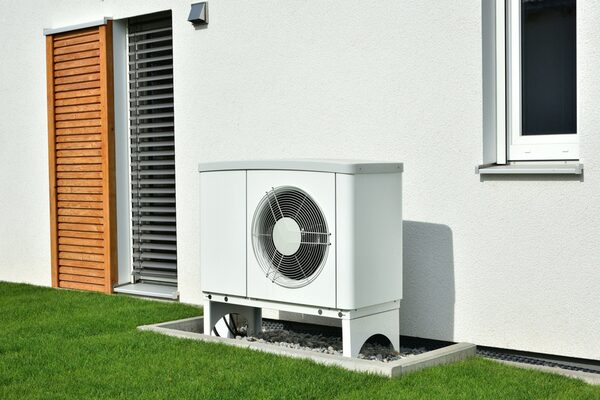
- Planning, heat pumps: permitted development covers installation on a house or block of flats or within its curtilage, only if the installation complies with the MCS Planning Standards; the outdoor compressor unit including housing must not exceed 1.5 cubic metres on a house or 0.6 cubic metres for a block of flats; installations on pitched roofs are not permitted development, and on a flat roof all parts must be at least one metre from the external edge41.
- Scope limits: only the first installation is permitted development on a house which is not detached or a block of flats, while for detached houses the first two are permitted development; rights do not apply within the curtilage of a listed building or a scheduled monument41.
- Funding conditions: where Home Energy Scotland grant and loan funding is used for solid wall, underfloor, flat roof or room-in-roof insulation, the installer is required to be registered with TrustMark for those measures27.
What the money buys in bills and comfort
The bill effect of a full programme is substantial but rarely transformational on its own. Improvements such as external wall insulation and heat pumps are cited as reducing energy bills by approximately 25 per cent, or £350 a year43. A monitored project recorded energy costs of £1,300 before retrofit against £780 after44. At the deeper end, reductions in energy use and carbon emissions can be as much as 80 per cent44.
Individual measures carry their own figures. External insulation of solid walls is reported to save up to £435 each year and 1,770 kg of CO2 a year15, while a semi-detached house is put at around £280 a year in Great Britain and £330 in Northern Ireland32. Those two ranges are not reconciled in the documents and should be read as estimates on different assumptions. Replacing an old gas boiler with an air source heat pump is given as reducing annual carbon dioxide emissions by up to 2,200 kg in Great Britain and up to 3,500 kg in Northern Ireland45. Heat pumps are described as more than three times more efficient than a gas or oil boiler10.
Uptake tells its own story about cost. Solid wall insulation is assumed to be installed in only around 15,000 homes under one budget, against a stock where it is needed at far greater scale25, and cumulative ECO reporting records 88,919 solid wall insulation measures46. For comparison with individual payback, see payback periods compared and how much insulation saves.
What a retrofit does, and does not do, for independence
A deep retrofit is the most durable form of household energy security available, because reduced demand cannot be withdrawn, repriced or interrupted. An 80 per cent cut in energy use44 shrinks exposure to every future price movement, and a bill reduction of approximately 25 per cent or £350 a year43 persists without any contract, tariff or app.
The dependence that remains is real and should be stated plainly. Electrifying heat moves the home from a gas supply to an electricity supply, not off supply: all air source heat pumps run on electricity26, and on standard electricity tariffs, where electricity is nearly four times more expensive than gas, heat pumps can cost slightly more to run than new gas or oil boilers, with running costs reduced significantly on a heat pump time-of-use tariff10. That makes the bill outcome partly a function of the tariff market rather than the building. A supply capacity upgrade may be needed, and its cost turns on distance from the substation17; the supply capacity check covers that question.
There is also a financial dependence. The costs of this work are significant and for many homeowners there is currently limited financial support21. Fully funded upgrades for low-income households are the policy intent47, and Scotland has committed to an increasing number of whole house retrofits to fuel poor households28, but for most owner-occupiers the programme is self-funded or grant-part-funded, and the grant landscape determines what is affordable in any given year. Checking what grant help is available before starting work changes the effective cost more than any negotiation on price.
Finally, a staged programme creates a dependence on continuity: on the plan surviving, the paperwork being kept and the next contractor understanding what the last one did. That is the argument for the £750 plan and for a fabric first order of work, and it is where getting started properly begins.
Sources47 cited
- Guidance Toolkit on Building Retrofit, Birmingham City Council, 2024-02
- The Future Homes and Buildings Standards 2023 consultation, GOV.UK, 2026-09-17
- Heating our homes report, UK Parliament, 2025-05-09
- Watt a Save, Home Builders Federation, 2026-02
- Energy Use in Wales report, Welsh Government, 2022-05
- Five top tips from Which? to cut your energy bills, Welsh Government, 2026-03-18
- Energy Innovation Needs Assessment: heat and buildings, GOV.UK, 2025-06
- How to reduce the cost of heat pumps, Nesta, 2022-03-02
- Solar panels set to be standard on new homes, Solar Energy UK, 2023-12-14
- Air source heat pumps, Energy Saving Trust, 2026-07-16
- Energy saving upgrades for home renovation, Energy Saving Trust, 2026-05-05
- Call for evidence: decarbonising home heating, National Insulation Association, 2024-04-16
- Domestic retrofit, UKGBC, 2024-08-15
- Solid wall insulation permissions, Planning Portal, 2026
- About solid wall insulation systems, SWIGA, 2026-09-20
- Insulation guidance, nidirect, 2026-09-02
- Three phase supply and EV charging report, REA, 2018-08
- Consumer insight: motivating whole-house retrofit, UKGBC, 2024-03-25
- New insights into home retrofit, UKGBC, 2023-01-24
- Consumer attitudes to retrofit, Citizens Advice, 2025-06-03
- Demand net zero, Citizens Advice, 2023-05-12
- Home improvement assistance, Manchester City Council, 2026-09-20
- Energy efficiency in buildings report, UK Parliament, 2019-07-12
- Public Accounts Committee report on retrofit, UK Parliament, 2026-01-23
- Balancing investment in clean heat and energy efficiency, ClimateXChange, 2026-06-03
- Air source heat pumps for consumers, MCS, 2026-07-24
- Grants and loans, Home Energy Scotland, 2026-09-17
- Tackling fuel poverty in Scotland: strategic approach, Scottish Government, 2021-12-23
- Edinburgh LHEES delivery plan, City of Edinburgh Council, 2023
- Building regulations: heat pumps, Welsh Government, 2026-09-17
- Insulation, nidirect, 2026-09-02
- Tips to improve the EPC rating of your home, Energy Saving Trust, 2026-08-03
- Green Homes Wales, Development Bank of Wales, 2026-09-17
- What is a PAS 2035 retrofit assessor, The Retrofit Academy, 2025-11-24
- The Warm Homes Plan, Elmhurst Energy, 2026-07
- ECO4 delivery guidance update summary, Ofgem, 2025-08-07
- Future Homes and Buildings Standards consultation response, GOV.UK, 2026-03
- PAS 2035 guide, The Retrofit Academy, 2026-04-06
- Building regulations: solid wall insulation, Welsh Government, 2026-09-17
- Permitted development rights for householders: technical guidance, GOV.UK, 2026-09-17
- Planning permission for air source heat pumps, Planning Portal, 2026-09-17
- Get help with faulty solid wall insulation, Citizens Advice, 2026-09-17
- High Rise Retrofit and Upgrade Programme Phase 1, City of Edinburgh Council, 2026-04-20
- The domestic retrofit challenge, CIBSE, 2022-10
- Top energy saving ideas for your home improvement project, Energy Saving Trust, 2026-08-03
- ECO public reports and data, Ofgem, 2026-08-11
- Response to the fuel poverty strategy consultation, Citizens Advice, 2025-04-04
 How Much Does a Heat Pump CostA heat pump usually costs around eleven thousand pounds installed, though quotes vary a lot depending on your home.
 Cost of Energy IndependenceA heat pump and better insulation are the usual starting point, but what does the whole job really cost, and what help is there with the bill?
 Insulation and Glazing CostsTypical installed costs for cavity wall, solid wall, loft and roof insulation, draught-proofing and replacement glazing, by measure and home size, with the savings, VAT position and funding schemes that shape the final bill.
 Roof InsulationHow much heat escapes through your roof, how thick the insulation should be, what it costs and what it saves?
 Solar Panel CostsA typical UK home pays somewhere between four and eleven thousand pounds for solar panels fitted, with most landing in the middle.
 Air Conditioning CostPublished UK equipment prices and the parts of an installed price for portable, single split, multi-split and whole-house air conditioning.