
In this guide
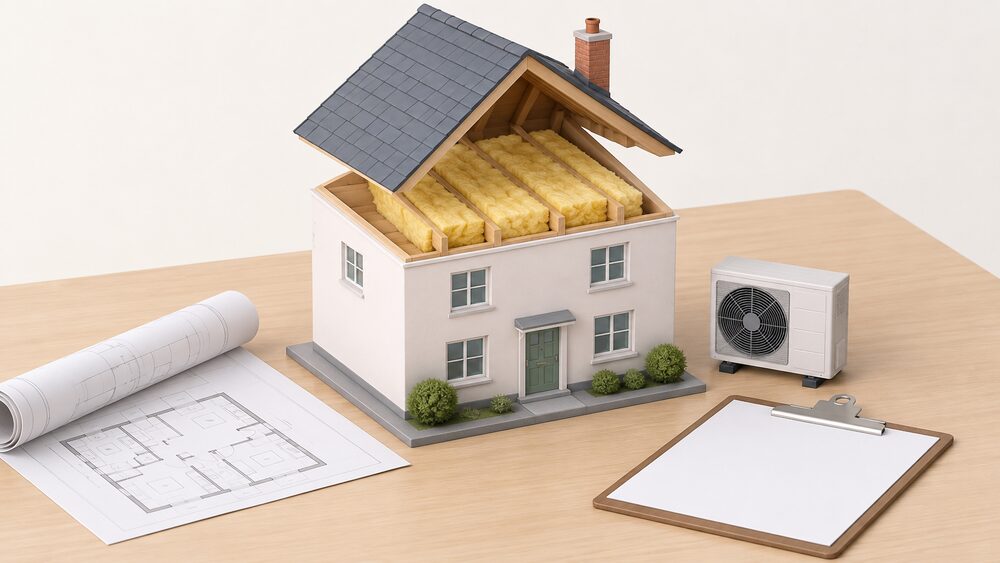
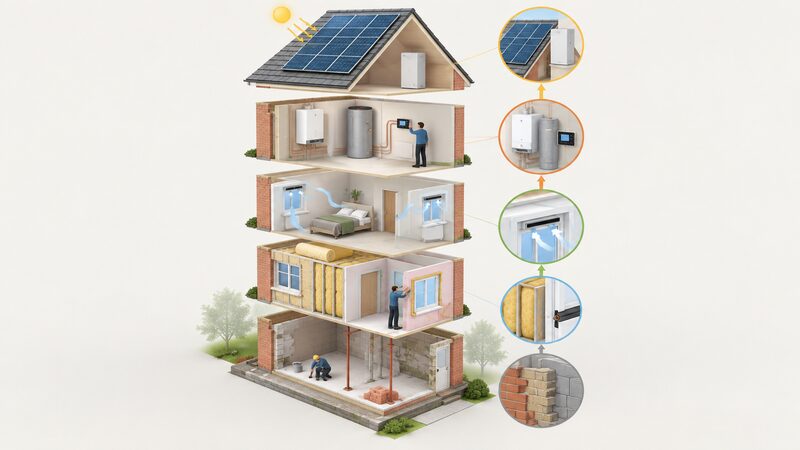
There is a settled sequence behind almost every official statement on home energy work, and it runs: repair the building, cut the heat it wastes, ventilate the tighter result, then change the heat source, then add generation and storage. The clearest written expression of it in UK guidance comes from Scottish work on tenement retrofit, which states that the order of priority must be repair, then maintenance, then energy efficiency, then zero direct emissions heat1. The Heat in Buildings Strategy puts the same idea more simply: making buildings waste less energy through energy efficiency is the first step to zero emissions2.
The reasoning is not aesthetic. Measures installed out of order get undone by the ones that follow. A heat source sized for an uninsulated house is oversized once the loft and walls are done. A floor or wall lined without attention to airflow changes how the building handles moisture, which is why Scottish building standards guidance treats airtight construction, high performance insulation, thermal bridge free design, ventilation and optimised energy use as five considerations held together rather than a list to work down3. The Future Homes and Buildings Standards consultation frames the same fabric-first logic as an energy security measure: reduce the energy demand of homes by requiring high performing building fabric and building services, thereby improving energy security4.
For most households the practical question is narrower: what to do this year, and what that commits them to next. This page sets out the sequence, what drives it, how the four nations differ, which parts of it are actual regulation rather than good practice, and what each stage does, and does not do, for independence from the grid and from a supplier.
The short answer: repair, fabric, ventilation, heat, then generation
The sequence that guidance supports has five stages, and the first is not an energy measure at all.
- Repair and maintenance. The building has to be sound and dry before anything is added to it. Scottish tenement guidance places repair and maintenance ahead of energy efficiency in its order of priority, and zero direct emissions heat last1.
- Reduce demand through the fabric. Insulation and draught proofing come next, because everything downstream is sized against the heat the house loses. The measures involved are familiar: loft and cavity wall insulation, hot water cylinder insulation, heating controls and draught proofing at the cheaper end, and a new boiler, new windows and solid wall insulation at the expensive end5.
- Ventilation. Not an afterthought. Airtight construction and ventilation appear together in the same set of considerations in Scottish building standards work3, and Northern Ireland's regulatory uplifts group energy efficiency and carbon performance with ventilation, overheating and electric vehicle infrastructure in one package9.
- Heating system. Ofgem's Boiler Upgrade Scheme guidance for property owners carries a repeated paragraph on energy efficiency measures such as insulation alongside its heating content10, which is the same principle expressed through a grant scheme: the heat source follows the fabric.
- Generation and storage. Solar and batteries sit last because they serve a demand that the earlier stages have already reduced.
Two related pages go further on the detail: what order retrofit measures should be done in and what a fabric first approach means.
The figures behind the sequence
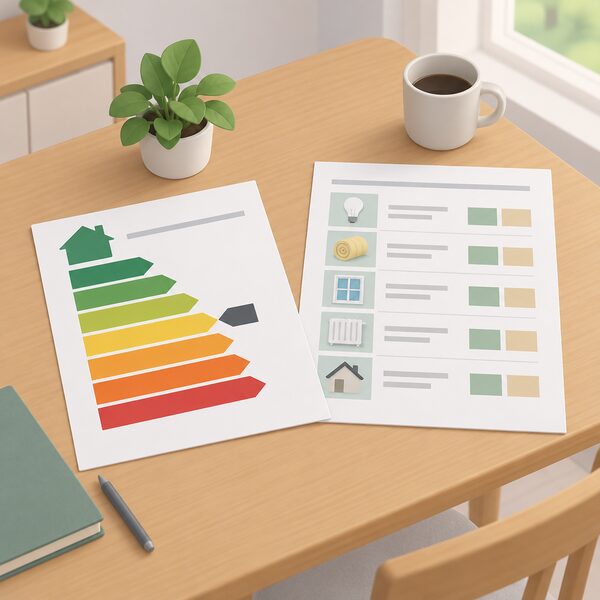
Hard numbers on sequencing are thinner than householders expect, and it is worth being plain about why. The UK's main instrument for telling a household what to do and in what order is the Energy Performance Certificate. Each certificate comes with a report setting out the cost effective measures a homeowner or business can take, such as low energy bulbs or upgrading insulation8. Scottish guidance confirms that report carries an indicative cost for each improvement11, and the domestic version in England gives an indication of cost and typical savings for each improvement over three years12. Buildings are rated from A to G, with A very efficient and coloured green, G inefficient and red8.
That is the ordering tool most people have. It is a list of measures with costs attached, not a designed sequence, and the recommendations report does not model the interactions between measures the way a retrofit design does.
The statistical picture behind the sequence has also been shifting. In England the proportion of homes in the lowest bands, E to G, decreased from 23% to 9% over the last decade7. The Office for National Statistics has decided to discontinue its Energy Efficiency of Housing statistics13. The main EPC series for England and Wales is published as Official Statistics14, while the statistics on energy efficiency characteristics of new dwellings are published as Official Statistics in Development15, a weaker designation that should temper how much weight is put on them.
Reform is in progress. The Energy Performance of Buildings regime consultation set out reform areas including updating what EPCs measure through additional metrics, refining the rules for when certificates are required, managing certificate quality and improving the accessibility of building performance data16. Scottish reforms will add a fabric energy efficiency rating based on annual heat demand in kWh, highlight key insulation measures installed, and provide heating system information with recommendations and modelled costs, with the UK Government's Home Energy Model about to replace SAP17. A fabric rating expressed in heat demand is, in effect, a measure of how far through stage two a house has got.
| What the household gets | What it contains | Source |
|---|---|---|
| EPC rating | A to G, A very efficient and green, G inefficient and red | 8 |
| Recommendations report | Cost effective measures such as low energy bulbs or upgrading insulation | 8 |
| Cost information | An indicative cost for each improvement | 11 |
| Savings information (domestic, England) | Typical savings for each improvement over 3 years | 12 |
| Planned Scottish addition | Fabric energy efficiency rating based on annual heat demand in kWh | 17 |
What drives the order
Three forces set the sequence in practice: physics, funding and the professional standards that govern funded work.
The physical driver is that heat demand determines everything downstream. Reduce it and the heating appliance gets smaller, its running hours fall, and the electrical load a home might later try to cover with its own generation falls with it. This is why the Future Homes and Buildings Standards consultation ties low demand directly to energy security4, and why Scotland's EPC reform is building an indicator that will recommend to building owners the measures needed to reduce demand for heat, and show the measures needed to remove poor energy efficiency18.
The funding driver pushes hard in the same direction, because grant programmes have historically paid for fabric before anything else. Grants for householders to make homes more energy efficient by installing loft and cavity wall insulation and a new boiler or heating system are the standard offer in Northern Ireland19, and English local advice referrals follow the same shape: loft or cavity wall insulation and in some instances a new boiler20. The Home Upgrade Grant Phase 1 aimed to improve energy efficiency and provide clean heat solutions for low-income households21, pairing the two rather than separating them. Scottish research on the lived experience of fuel poverty found that where energy efficiency improvements such as insulation had been made, this was usually as a result of support from government-funded schemes or from social landlords22. For a large share of households, then, the order of works is set by what a scheme will pay for, not by a plan the household wrote.
The third driver is professional. PAS 2035 was introduced in 2019 as a framework for best practice in the energy retrofit of domestic properties, and work under it has to be managed by a qualified Retrofit Coordinator6. On any job where the standard applies, sequencing is a coordinator's responsibility. The role is covered in more detail under retrofit assessors and retrofit coordinators, and the funding question under checking what grant help you can get before you start work.
How the four nations differ

The underlying sequence is shared, but the regulatory machinery around it is not, and the timetables diverge.
Scotland has gone furthest in writing sequence into policy. Beyond the tenement order of priority1, engagement responses on fuel poverty record an intention to regulate for all buildings across all tenures to achieve a good level of energy efficiency by 203324. Draft legislation sets out energy performance regulations whose purpose is to set minimum energy performance standards for buildings in which direct emission heating systems are used25. A consultation on draft private rented regulations proposed that any energy efficiency improvement made to the property on or after 1 April 2027 counts as a qualifying energy efficiency improvement26, which is a date householders in that sector will want to note before committing to work.
England took a different turn. A 2023 consultation position records the decision to abandon proposals to require private landlords to improve the energy efficiency of their properties27. The Climate Change Committee's assessment of the Heat and Buildings Strategy was that the policies needed to drive improvements in energy efficiency in homes that are not fuel poor are currently inadequate28.
Wales is reviewing Part L, seeking views on plans to improve energy efficiency standards in new and existing homes and buildings29.
Northern Ireland has run a discussion document and pre-consultation on a potential next phase, described as Phase 3, of its review of energy efficiency requirements and related areas of building regulations30, with uplifts covering energy efficiency and carbon performance, ventilation, overheating and EV infrastructure9, and guidance to Part F intended to uplift energy efficiency standards and carbon performance requirements for new buildings31.
| Nation | Where the sequence shows up | Source |
|---|---|---|
| Scotland | Repair, maintenance, energy efficiency, zero emissions heat; good efficiency across all tenures by 2033 | 1 |
| England | Landlord improvement proposals abandoned; CCC judged non-fuel-poor policy inadequate | 27 |
| Wales | Part L 2025 review of standards for new and existing homes | 29 |
| Northern Ireland | Uplifts covering efficiency, ventilation, overheating and EV infrastructure; possible Phase 3 | 9 |
Nation-specific advice services are listed under free home energy advice in Scotland, in Wales and in Northern Ireland.
The rules that constrain the order
Very little of the sequence is legally mandatory for an owner-occupier acting voluntarily. Official guidance is explicit that implementing the measures listed on an EPC is not required32. Where rules bite is at the points where work is already happening, or where a property is let.
The clearest live rule concerns replacement. Approved Document L Volume 1 states that where a fixed building service is replaced using the same fuel, it should have an efficiency that is not lower than that of the service being replaced, and where a different fuel is used, it should not produce more carbon dioxide emissions per kWh of heat, nor have a higher primary energy demand per kWh of heat33. That is a floor, not a sequence, but it means a heating replacement cannot quietly step backwards.
"The energy efficiency of historic and traditional dwellings should be improved only if doing so will not cause long-term"
That qualification matters for older housing, where putting repair first is not a preference but a condition of proceeding at all.
Consequential improvements are the one mechanism that would have forced an order. Proposals consulted on in 2012 would have required homeowners to carry out consequential energy efficiency improvements to the rest of their property when they replace a boiler or a proportion of windows, add an extension, or convert a loft or integral garage into living space, drawing on a list of around 30 standard measures5. Householders combining work should read doing energy work as part of a renovation or extension.
For rented homes, the Energy Act 2011 makes provision for the arrangement and financing of energy efficiency improvements by owners and occupiers, for the energy efficiency of private rented properties, and for the promotion by energy companies of reductions in carbon emissions and home-heating costs35. From April 2018, private rented properties had to be brought up to a minimum energy efficiency rating of E36. The reformed Decent Homes Standard consultation response adds a safety condition: any measures taken to meet energy efficiency requirements, such as heating system upgrades or insulation, must comply with relevant building and fire safety regulations and preserve essential safety features37.
In London, planning policy adds a performance step ahead of anything else: residential developments should achieve at least a 10 per cent improvement on Building Regulations from energy efficiency measures alone, and non-residential developments at least 15 per cent38.
What the sequence means for energy independence
Order matters most for independence, because each stage removes a different dependency and the later ones only work well if the earlier ones have happened.
Fabric work reduces dependence on fuel volume outright. Heat that is not lost does not have to be bought from anyone, in any year, whatever the price. It is the only stage whose benefit cannot be switched off by a supplier, a tariff change or an app, and it is the reason the Future Homes consultation connects high performing fabric to energy security directly4.
Changing the heat source moves the dependency rather than removing it: off gas or oil, onto electricity and the grid. That trade is favourable only in proportion to how much demand the fabric stage has already stripped out, which is why Ofgem's Boiler Upgrade Scheme guidance for property owners repeats the point about energy efficiency measures such as insulation alongside the heat pump content10. An undersized fabric and an electrified heat source is a larger electricity bill and a larger grid dependence, not a smaller one.
Generation and storage come last because they are sized against what remains. A household that fits solar and a battery before insulating is sizing its own supply to cover waste. The question of which comes first is set out under solar panels, a battery or a heat pump, and route planning under planning a route to household energy independence.
Some dependencies persist through the whole sequence. Certification is one: energy performance certification of buildings and the inspection of heating systems and air-conditioning systems must be carried out in an independent manner by qualified or accredited experts39. The Energy Efficiency Rating is the first rating to appear on the EPC and is required in adverts for the sale or rental of properties, showing current and potential rating12, so a household's measured standing depends on a third-party assessment it does not control. Funding is another: for many households the order of works follows whatever scheme is open22, not a plan of their own. And advice itself is a dependency worth handling deliberately. Northern Ireland guidance states that homeowners should seek independent advice on solar panels, heat pumps and other energy efficiency measures from appropriate organisations40.

Where the sequence is applied loosely, and where it is not
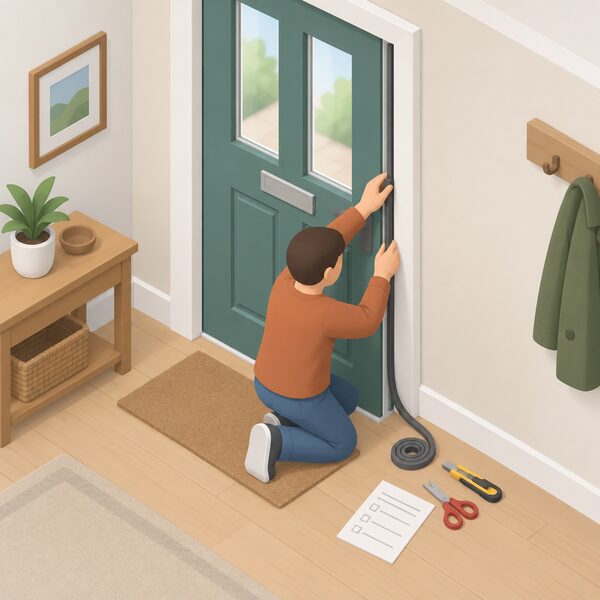
Two situations change the calculus. The first is an unfunded, self-directed householder doing one measure at a time, where nothing compels an order and the risk is simply that later work strands earlier spending. The comparison between phased and single-phase work is covered under should you retrofit all at once or in stages.
The second is work under PAS 2035, where the coordinator holds the sequence and the household does not have to manage it6. The gap between the two is the gap the Climate Change Committee identified: policy that reaches fuel poor homes through schemes, and is judged inadequate for homes that are not fuel poor28. The Committee also described it as disappointing not to see more on energy efficiency and on supporting households to make changes that can cut bills now in the British Energy Security Strategy41.
For a household outside a scheme, the practical implication is that the sequence has to be self-imposed. Starting points are set out in what to do first to make a home more energy efficient, with the wider route in getting started.
Sources41 cited
- Tenements working group final report: energy efficiency and zero emissions heating, Scottish Government, 2023-11-28
- Heat in Buildings Strategy, easy read, Scottish Government, 2022-03-07
- Building standards: Passivhaus equivalent, stage 2 consultation, Scottish Government, 2026
- The Future Homes and Buildings Standards consultation, GOV.UK, 2026
- Consequential improvements under Part L of the Building Regulations, UK Parliament deposited papers, 2012-12
- Home energy efficiency key terms explained, Development Bank of Wales, 2024-10-17
- English Housing Survey 2024 to 2025: housing quality and energy efficiency, GOV.UK, 2024
- Energy Performance Certificates, nidirect, 2026-02-26
- Building regulations discussion document and pre-consultation on next steps, Department of Finance Northern Ireland, 2023-10-11
- Boiler Upgrade Scheme guidance for property owners, version 5, Ofgem, 2026-03
- Energy Performance Certificates: a guide, Scottish Government, 2026-08-24
- Domestic EPC reform consultation, Scottish Government, 2021-07-23
- Energy efficiency of housing in England and Wales, Office for National Statistics, 2026-04-23
- Energy Performance of Building Certificates in England and Wales, April to June 2025, GOV.UK, 2025-07-31
- Energy efficiency characteristics of new dwellings, GOV.UK, 2026-02-04
- Reforms to the Energy Performance of Buildings regime, GOV.UK, 2024-12-04
- Heat in Buildings progress report 2024, Scottish Government, 2024-10-10
- Tackling fuel poverty in Scotland: a strategic approach, Scottish Government, 2021-12-23
- Home heating grants and support, Belfast City Council, 2026
- Energy saving grants and funding, Tameside Council, 2026
- Home Upgrade Grant Phase 1 evaluation, GOV.UK, 2024-12-19
- Research on the lived experience of fuel poverty in Scotland, Scottish Government, 2020-09-03
- Heat Networks Delivery Plan, Scottish Government, 2022-03
- Tackling fuel poverty periodic report 2021 to 2024: engagement responses, Scottish Government, 2025-04-22
- Draft Buildings (Heating and Energy Performance) and Heat Networks (Scotland) Bill explanatory notes, Scottish Government, 2025-11-18
- Consultation on draft Energy Efficiency (Domestic Private Rented Property) (Scotland) Regulations, Scottish Government, 2025-06
- Delivering net zero for Scotland's buildings: Heat in Buildings Bill proposals, Scottish Government, 2023-11-28
- Taking stock of the UK Government's Heat and Buildings Strategy, Climate Change Committee, 2022-03-09
- Building Regulations Part L: 2025 review, Welsh Government, 2025-08-26
- Building regulations discussion document 2023, Department of Finance Northern Ireland, 2026
- Technical Booklet guidance to Part F consultation, Department of Finance Northern Ireland, 2026
- Energy Performance Certificates: introduction, Scottish Government, 2015-12
- Approved Document L, Conservation of fuel and power, Volume 1: Dwellings, Welsh Government, 2026-04
- Approved Document L, Conservation of fuel and power, Volume 1: Dwellings, 2021 edition incorporating 2023 amendments, GOV.UK, 2026
- Energy Act 2011, legislation.gov.uk, 2011-10-18
- Tenant consent to energy efficiency improvements, written evidence, UK Parliament, 2018
- Consultation on a reformed Decent Homes Standard: government response, GOV.UK, 2026-01-28
- GLA energy assessment guidance, Greater London Authority, 2022-06
- Directive on the energy performance of buildings, legislation.gov.uk, 2026
- Support to generate your own electricity, nidirect, 2025-09-22
- CCC responds to UK Government's Energy Security Strategy, Climate Change Committee, 2022-04-07
 Planning a Whole-House RetrofitWhich jobs come first when you upgrade a whole house, and which can wait?
 Fabric First ApproachWhy insulate before replacing the boiler or fitting a heat pump?
 Insulation a Heat Pump NeedsWill a heat pump still work if your home is not well insulated, and would you need to add loft, wall or floor insulation first?
 DIY or ProfessionalLoft insulation and draught-proofing are jobs most people can tackle, but anything electrical near a kitchen, bathroom or outdoors needs a registered electrician.
 Insulation Savings and PaybackHow much can you really save by adding insulation, and does it depend on your home, your heating and how you use it?
 Whole-Home Energy DesignHeating and hot water use more energy than anything else at home, so that choice shapes everything.