
In this guide
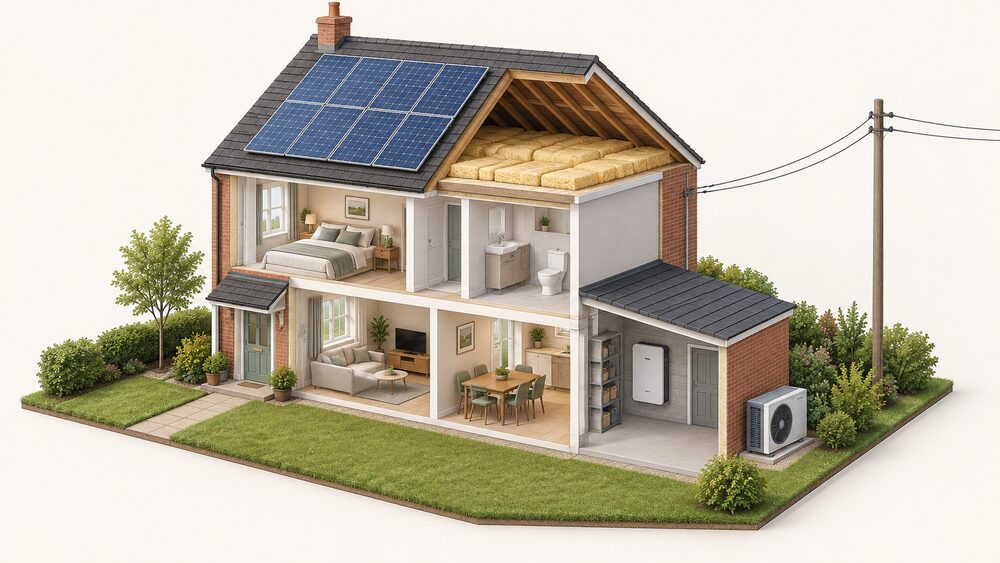
Energy independence for a UK home is not a single purchase. It is a sequence: cut the demand first, then move heat off gas, then generate electricity on the roof, then store what is generated and time its use. Each stage removes one dependency and leaves another in place. A typical solar installation costs around £6,100 and saves between £530 and £650 a year on electricity bills for a home without electrical heating or an electric vehicle1. The government's own estimate of the saving is around £500 a year2. Those two figures are close but not identical, and the difference matters when a household is weighing up a ten to twelve year payback1.
What no stage removes is the connection itself. A grid-connected home with solar, a battery and a heat pump still buys electricity in winter, still relies on a supplier for standing charges and export payments, and still depends on a manufacturer for the inverter, the battery management system and any app that controls it. True self-sufficiency, with no grid at all, is a different and much more expensive proposition. The realistic goal is a home that generates most of what it uses across a year, keeps the lights on when the grid fails, and buys far less imported gas.
The order matters more than the individual choices. Fabric first, then heat, then generation, then storage is the sequence that most official and independent guidance points to, and doing it in that order avoids paying twice for the same outcome.
What energy independence means for a UK home
Independence is best understood as a set of dependencies, each of which can be reduced but rarely eliminated. The first is imported fuel, mostly gas for heating and hot water. The second is the electricity grid, which is the backup for every home that stays connected. The third is the supplier, who bills for what is imported and pays for what is exported. The fourth is the manufacturer, whose inverter, battery or heat pump controller may depend on a cloud service or an app to work at its best.
Official advice services exist precisely because the route is not obvious. Home Energy Scotland offers free advice on improving the energy efficiency of a home, and free impartial advice on energy efficiency and renewable energy in Scotland5. In Northern Ireland, homeowners are directed to seek independent advice on solar panels, heat pumps and other energy efficiency measures from organisations such as the NI Energy Advice service7. A single-entry point for consumer home energy advice on GOV.UK, Home Energy Advice, is intended to help homeowners, landlords and tenants find tailored, impartial and trusted advice on how to heat their homes and make them more energy efficient8.
The practical meaning of independence therefore varies by household. A well-insulated home with solar, a battery and a heat pump might import very little in summer and a moderate amount in winter. A poorly insulated home with the same equipment will import considerably more, because the heat pump has to work harder and the battery empties faster. That is why the demand-reduction stage comes first: it is the cheapest way to shrink everything that follows.
Where a household sits also depends on the four nations. Support, advice bodies and permitted development rules differ between England, Scotland, Wales and Northern Ireland, and the sections below note where that matters.
Solar PV: the foundation of a self-powered home
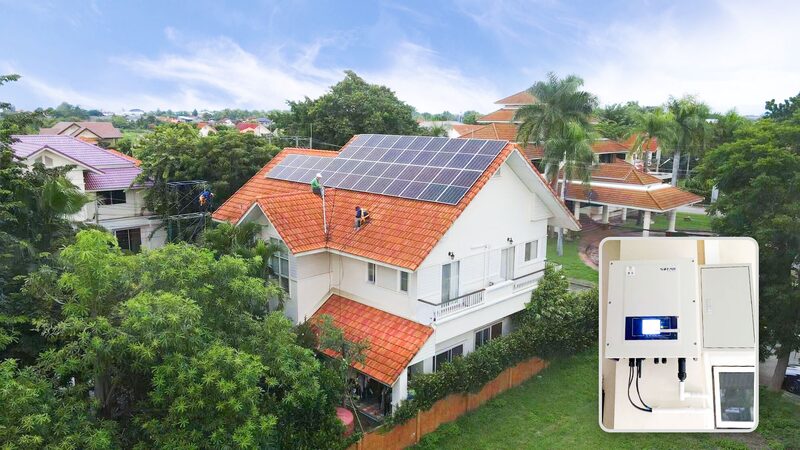
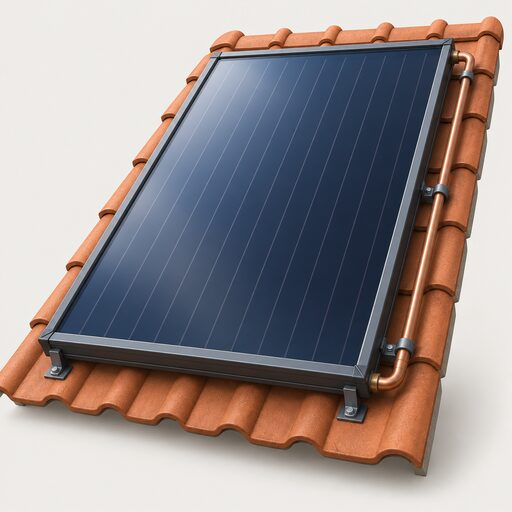
Solar photovoltaic panels capture energy from the sun and turn it into electricity for the home to use1. The Welsh Government's guidance describes solar energy as the use of the sun's free energy to provide electricity using solar photovoltaic panels9. A panel produces direct current, which has to pass through a solar inverter to become alternating current that the home's wiring can use1.
The technology comes in several forms: crystalline cells, thin-film and hybrid9. A typical system for a house is around 3.5 kilowatt peak, covering between 10 and 20 square metres of roof and using between six and 12 panels1. Panels can be installed on both pitched and flat roofs; on a flat roof they need to be tilted and spaced to avoid shading each other1.
There is a distinction worth knowing between a rooftop array and a standalone one. Ofgem's feed-in tariff guidance defines standalone installations as any installation not attached to a building and not wired to provide electricity to an occupied building10. Northern Ireland legislation uses the same idea, defining stand alone solar as solar PV or solar thermal equipment which is not installed on a building11. A ground-mounted array in a garden is therefore treated differently from a roof array, and the rooftop or ground mount question is worth settling before design work begins.
For a household's independence, solar does three things. It reduces the electricity bought from the grid, it provides a second source of power during daylight, and it creates an income stream from exports. What it does not do is remove the grid connection, because a grid-connected inverter shuts down when the grid fails unless the system has specific islanding capability. It also does not remove the supplier, who remains the counterparty for both import and export.
Is your roof suitable? Condition, orientation and shading
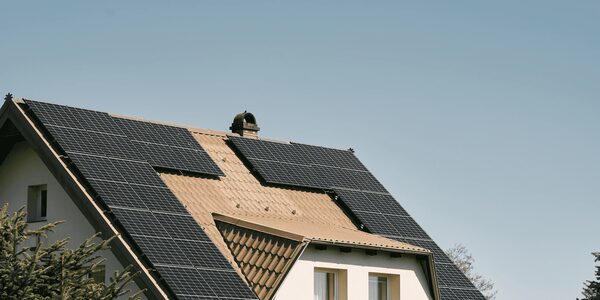
Three things decide whether a roof is worth using: its condition, which way it faces, and how much shade falls on it.
Condition comes first. Official guidance is direct that a roof must be in good condition before panels go on it12. Fitting panels over a roof that needs replacing within a few years means paying for scaffolding and removal twice, so the fabric first logic applies to the roof itself as much as to the walls.
Orientation is the second factor. Independent guidance recommends a south-facing roof with little or no shading, and describes solar PV as worth considering where there is a south, east or west-facing roof with little or no shade and no plan to move home in the near future13. The penalty for east or west is measurable: a system facing east or west tends to get around 15 to 20 per cent less energy than one facing directly south1.
Shading is the third. Official guidance states that if a roof is heavily shaded, solar panels may not be the most suitable option12. Shade from a chimney, a dormer, a neighbouring building or a mature tree affects the whole string in a simple system, which is why shading assessment is part of a proper survey.
For new build or renovation projects, official sustainability guidance goes further and suggests designing the home to take advantage of solar heating, natural ventilation and daylight where possible15. That is a design-stage advantage that a retrofit cannot recover.
| Factor | What suits solar | What does not |
|---|---|---|
| Roof condition | Good condition, sound covering12 | Roof needing replacement soon |
| Orientation | South, east or west facing13 | North facing |
| Shading | Little or no shade13 | Heavy shading12 |
| Roof type | Pitched or flat, with tilt and spacing on flat1 | Flat roof without space for tilt |
Costs and payback: around £6,100 installed, £530 to £650 a year off bills
A typical solar panel installation costs around £6,100 for a system of around 3.5 kWp1. That figure is the headline number for a standard house, and it is the one to hold on to when comparing quotes.
The saving depends heavily on how much of the generation is used in the home. Official guidance gives two figures for the same system: £650 a year if someone is home all day, and £530 a year if everyone is out until 6pm1. The government's separate estimate is that installing solar panels could reduce energy bills by around £500 a year2. The gap between the two sets of figures reflects different assumptions about self-consumption and tariffs, and both are worth stating rather than picking one.
Payback follows from those numbers. Official guidance states that solar panels usually pay for themselves in 10 to 12 years1. That calculation depends on the household using most of what it generates, because rates for selling electricity to the grid are much lower than tariffs for using electricity from the grid1. Using solar electricity in the home is therefore much more cost-effective than exporting it, which is the argument for timing heavy loads into daylight hours or adding a battery.
For a household's independence, the cost and payback figures are the point at which the plan becomes real. A system that pays back in ten to twelve years and then continues generating for another thirteen or more is, in effect, a long-term hedge against electricity prices. The panels themselves are expected to last 25 years or more, while inverters usually need replacing after around 12 years1. One independent source puts panel life at 30 years or more, so the two figures differ and the longer one should be treated as optimistic13.
Air source heat pumps: heating without gas
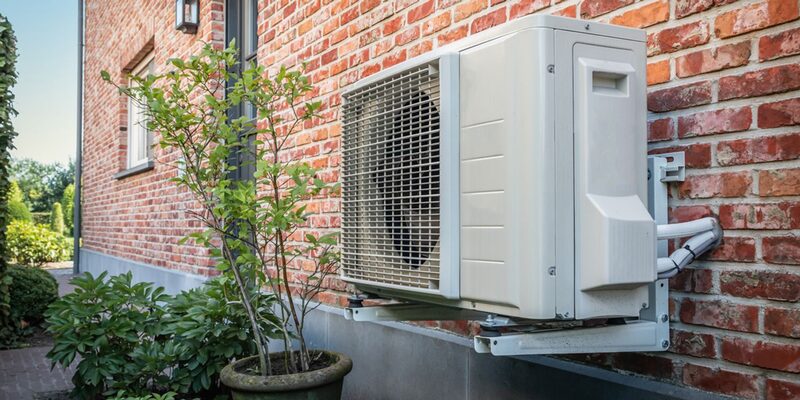
An air-to-water heat pump transfers heat drawn from surrounding air to water in a wet central heating system16. That is the type that replaces a gas boiler, serving both radiators and a hot water cylinder. An air-to-air system is different, and official guidance states plainly that it is not considered to be a renewable system in ECO416.
The case for a heat pump rests on removing gas from the home. Scottish Government analysis of new build archetypes found that the air source heat pump consistently resulted in the lowest delivered energy demand across the archetypes modelled, and that for houses the air source heat pump had the lowest capital cost under the business-as-usual specification17. The same analysis found the relationship did not hold for a block of flats, where the air source heat pump was the highest cost under that specification17. That is a useful reminder that the case is stronger for houses than for flats.
Running a heat pump is not the same as running a boiler. Independent guidance states that in a heat pump home you can save money by leaving the heating on all day, because heat pumps function differently to boilers and rely on good insulation to work efficiently18. That is a behavioural change as much as a technical one, and it is why insulation and draught-proofing come before the heat pump in the sequence. The insulation before heat pump question is the one households ask most often at this stage.
Costs for heat pumps are installer-quoted, and the figures available differ between sources. Some independent guidance puts installation at around £11,000, other guidance at around £12,000, and a further range of £7,000 to £13,000 appears alongside an Energy Saving Trust estimate of around £14,000 typical cost. These figures are not reconciled, and the published estimates disagree. What can be said is that a heat pump is a larger capital outlay than solar, that grant support may reduce it, and that the running cost depends on the efficiency of the home it is fitted to.
Planning and Building Regulations: what you can install without permission
Most domestic renewable installations fall under permitted development, which means no planning application is needed provided the limits and conditions are met. The position differs by technology and by nation.
For solar, official guidance states that the installation of solar panels and equipment on residential buildings and land may be permitted development with no need to apply for planning permission19. A London borough's guidance uses the same wording, adding that this applies to residential buildings12. Solar panels often do not need permission because they are considered permitted development, though there are exceptions for listed buildings and homes in conservation areas1. Installing solar panels may also require approval under the Building Regulations, which is a separate consent from planning12.
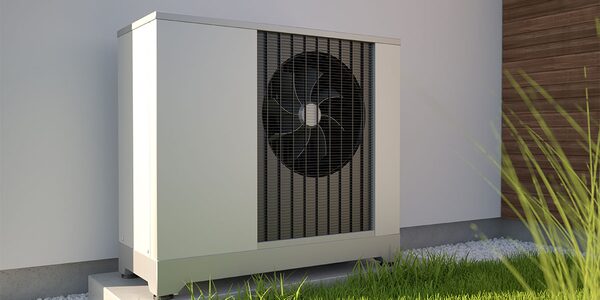
For heat pumps, the permitted development rights apply to the installation, alteration or replacement of an air source heat pump on a house or block of flats, or within the curtilage of either, including on a building within that curtilage21. The conditions are specific:
- The installation must comply with the Microgeneration Certification Scheme Planning Standards (MCS 020a)21.
- The outdoor compressor unit, including housing, must not exceed 1.5 cubic metres on a house or 0.6 cubic metres for a block of flats21.
- Only the first installation is permitted development on a house which is not detached, or on a block of flats; for detached houses, the first two air source heat pumps are permitted development21.
- All parts must be at least one metre from the property boundary3.
- Installations on pitched roofs are not permitted development21.
- On a flat roof, all parts must be at least one metre from the external edge of that roof21.
- Permitted development rights do not apply within the curtilage of a Listed Building or within a site designated as a Scheduled Monument21.
- There must be no existing wind turbine on the building or within the curtilage21.
- Additional wind turbines or air source heat pumps at the same property require an application for planning permission21.
- The unit must not be used solely for cooling purposes, and must be removed as soon as reasonably practicable when no longer needed for microgeneration21.
- It must be sited, so far as is practicable, to minimise its effect on the external appearance of the building and on the amenity of the area21.
In a Conservation Area or World Heritage Site, the heat pump must not be installed on a wall or roof which fronts a highway, or be nearer to any highway which bounds the property than any part of the building21. On land outside those designations, it must not be installed on any part of a wall above the level of the ground floor storey if that wall fronts a highway21.
Other technologies follow their own rules. Planning permission is not normally needed when installing a biomass system in a house if the work is all internal22. Installing a fuel tank is considered permitted development, subject to limits and conditions24. Domestic wind turbines can in some cases be installed without an application for planning permission, so long as specified limits and conditions are met25. More generally, projects that will have no impact on neighbours or the environment might not need planning permission at all27.
Scotland consulted on expanding permitted development for domestic air source heat pumps, with the anticipated outcome that many houses and some flats would be able to install them without the need for planning permission28. That consultation dates from 2015, so it describes a proposal rather than the current position in every detail.
Earning from what you export: the Smart Export Guarantee
The Smart Export Guarantee is a scheme where a household can be paid for energy it generates, for example through solar panels, and exports to the grid14. It is the replacement for the older feed-in tariff arrangements, and it is the mechanism by which a generating household turns surplus electricity into income.
There is a hard condition attached. Official guidance states that in order to qualify for the Smart Export Guarantee, generators must have a smart meter to monitor exports2. Without one, the export cannot be measured and the payment cannot be calculated.
A storage battery changes the picture. Independent guidance states that exports, and therefore payments, reduce if there is a storage battery, and that a storage battery may render a household ineligible for some SEG tariffs13. The logic is straightforward: a battery exists to store generation for later use, and electricity used in the home is not exported. That is usually the better financial outcome anyway, because export rates are much lower than import tariffs1, but it does mean the two options pull against each other.
For independence, the SEG is a partial offset rather than a route to self-sufficiency. It pays for surplus, which by definition is electricity the household did not need. A home that exports a great deal is a home that has either oversized its array or failed to shift its consumption into daylight hours. The scheme rewards generation, but the household's own economics favour self-consumption.
Batteries, smart meters and timing your usage
Storage and timing are the stages that turn generation into something closer to independence, because they decide whether solar electricity is used in the home or sold cheaply.
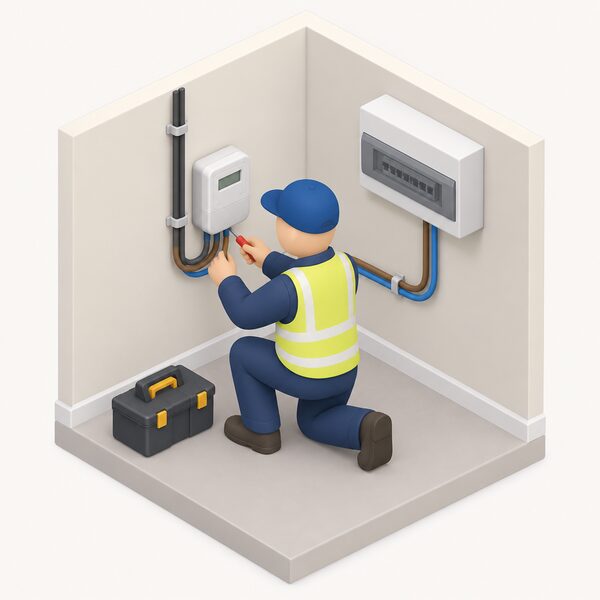
Smart meters are the enabling infrastructure. Official guidance states that smart meters enable accurate billing by automatically recording energy use in half-hour periods, and that the meter sends usage data to the supplier using a secure network31. Installation is arranged through the energy supplier, typically takes about 90 minutes, and is free of charge32. Any household that pays for energy, whether owning or renting, should be able to book a smart meter installation where it is expected to work in the property31.
Smart meters and smart heating controls are separate things, but they work well together. Welsh Government guidance notes that while smart meters are independent of smart heating controls, combining the two can enhance the ability to manage a home's heating and energy use remotely32. Official sustainability guidance for self-build homes recommends installing smart systems that control lighting, heating and cooling based on occupancy and time of day15.
The half-hourly data a smart meter produces is what makes time-of-use tariffs and export payments possible. It also makes the household's own pattern visible: how much is drawn in the evening peak, how much solar is exported rather than used, and whether a battery would actually earn its keep. For a household planning a route to independence, that data is the evidence base for the next decision, and it is the reason the baseline exercise comes before the spending.
What remains dependent at this stage is worth stating plainly. A battery does not remove the grid connection, and most home batteries are configured to keep some capacity in reserve rather than run the house indefinitely. A smart meter depends on a communications network, and the smart meter network will transition to 4G before the 2G and 3G networks are switched off by 203314. A battery and an inverter depend on a manufacturer for firmware, monitoring and, in many cases, an app. Independence, at this stage, means buying less and timing better, not disconnecting.
Sources32 cited
- Solar panels, London Borough of Hammersmith and Fulham, 2025
- POST Note 771: Residential solar, Parliamentary Office of Science and Technology, 2026
- Building regulations and renewables guidance, Bedford Borough Council, 2026
- Renewable energy installation, Electricity North West, 2026
- Financial help for energy efficiency and low carbon heating improvements, City of Edinburgh Council, 2026
- Who to contact, Ofgem, 2026
- Support to generate your own electricity, nidirect, 2025
- Reforming consumer protection for home upgrade schemes, GOV.UK, 2026
- Generating your own energy: solar electricity, Welsh Government, 2018
- Guidance for FIT generators, Ofgem, 2024
- The Planning (General Permitted Development) Order (Northern Ireland) 2015, legislation.gov.uk, 2015
- Solar photovoltaic (PV) panels, London Borough of Bromley, 2026
- Solar panel installation, Which?, 2026
- Are solar panels worth it?, Uswitch, 2026
- Self-build homes: sustainability, Planning Portal, 2026
- ECO4 new measures and products guidance, Ofgem, 2026
- Identification and assessment of improvements to the energy standard of new domestic buildings, Scottish Government, 2026
- The best way to run your central heating to save money, ivie, 2026
- Solar panels guidance, Islington Council, 2026
- Guidance on retrofitting homes: solar panels, Lambeth Council, 2026
- Air source heat pump planning permission, Planning Portal, 2026
- Biomass fuelled appliances: planning permission, Planning Portal, 2026
- Planning permission: biomass fuelled appliances, Welsh Government, 2026
- Fuel tanks, Planning Portal, 2026
- Wind turbines, Planning Portal, 2026
- Wind turbines: planning permission introduction, Planning Portal, 2026
- When you don't need planning permission, GOV.UK, 2026
- Permitted development rights consultation, Scottish Government, 2015
- Permitted development rights: page 8, Scottish Government, 2015
- Permitted development rights: page 2, Scottish Government, 2015
- Smart meters: your rights and expectations, GOV.UK, 2025
- Smart meters, Welsh Government, 2026
 Grants and Energy IndependenceCan you get a grant for solar panels or a battery?
 Heating and Energy IndependenceCan you heat your home without relying on gas or oil, and what would that take?
 Cost of Energy IndependenceA heat pump and better insulation are the usual starting point, but what does the whole job really cost, and what help is there with the bill?
 The Full Energy Independence GuideCan you really run your home on your own power in the UK, and how far can that go before the grid still matters?
 Leaving the Electricity GridCan you really cut your home off the grid completely, and what does it cost to have your electricity supply removed for good?
 Charging and Energy IndependenceCharging an electric car at home can cut your fuel costs, but how much does it really free you from the grid?