
In this answer
Short answer
Solar panels sit on top of the roof covering, not instead of it. When the tiles or slates beneath an array reach the end of their life, the array has to come off first, the roof renewed, and the panels put back or replaced. There is no published national figure for removal and refit alone, because the work is priced by the installer against the roof, the access and the mounting system. For context, a typical domestic solar system is put at around £6,100 in 20261, a rooftop system at around £7,600 on average2, and a retrofit at £5,000 to £10,0003.
The regulatory frame is straightforward. Building regulations will normally apply to installing a solar panel on your roof, because of the additional loading on the roof structure and the associated electrical works4. The adequacy of the existing roof to carry the load from the panel will need to be checked and proven, and some strengthening work may be needed5. That check applies just as much to a refit as to a first installation, and it is the reason a roof renewal under an array is a structural question as well as a roofing one.
For a household, the practical consequence is a period with no generation. If panels are not producing electricity, the household loses out on any feed-in tariff or Smart Export Guarantee payments for that time6. The tariff itself survives the works. What does not survive is the assumption that the old mounting can simply be bolted back down: fixings, flashings and the roof build-up all change when a covering is renewed.
Why the panels come off before the roof is renewed
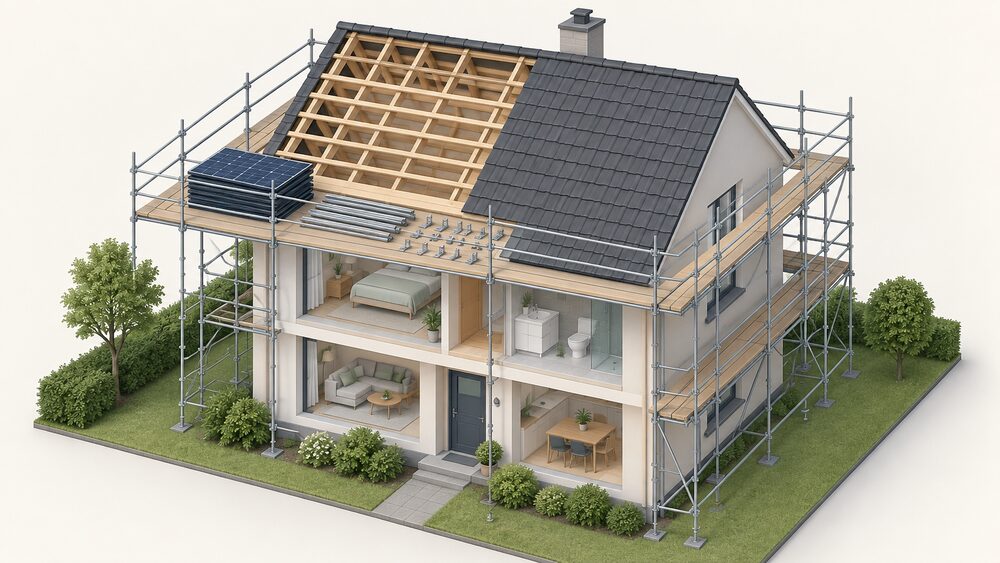
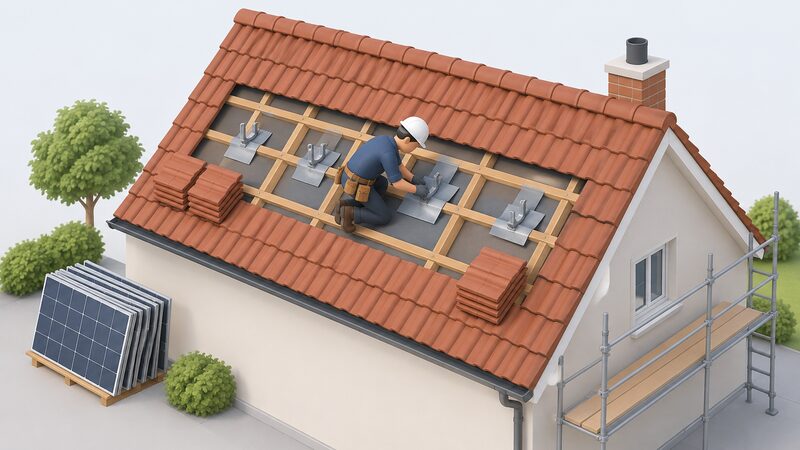
The roof covering is the layer the array is fixed through. Roof hooks, rails and flashings penetrate it, and the tiles or slates around each fixing have to be lifted and replaced when the covering is renewed. Guidance for historic buildings states the principle plainly: panels should be mounted over existing slates, rather than replacing the historic fabric with PV roof shingles, to protect the integrity of the building8. The same logic applies to any roof: the covering is renewed first, the array goes back on top.
Official guidance also requires that the reinstatement should ensure the roof has adequate weather resistance where roof tiles are removed or omitted to locate and fix the panel9. That is the standard the roofing work has to meet before the array returns. It is also why the sequence matters: renewing a roof in sections around a live array leaves the weatherproofing compromised at every penetration.
There is a second reason, less obvious but recorded in the same guidance. It is important to minimise any damage to the roof covering by carefully planning how the array is installed, maintained, and removed at the end of its useful life10. Removal for roof works is exactly that end-of-life moment in miniature, and planning it properly is what keeps the covering sound.
Where a listed building consent order applies, the condition is explicit: the solar equipment is maintained in good order and removed as soon as reasonably practicable when no longer needed, with making good finished to match the adjacent work11. Council planning guidance repeats the same expectation for panels generally, that any solar panels no longer needed for micro-generation are removed as soon as is reasonably practicable12. Temporary removal for roof works is not that situation, but it shows the regulatory instinct: arrays are expected to be removable without wrecking the roof.
Who removes and refits the panels: roofer, installer or both
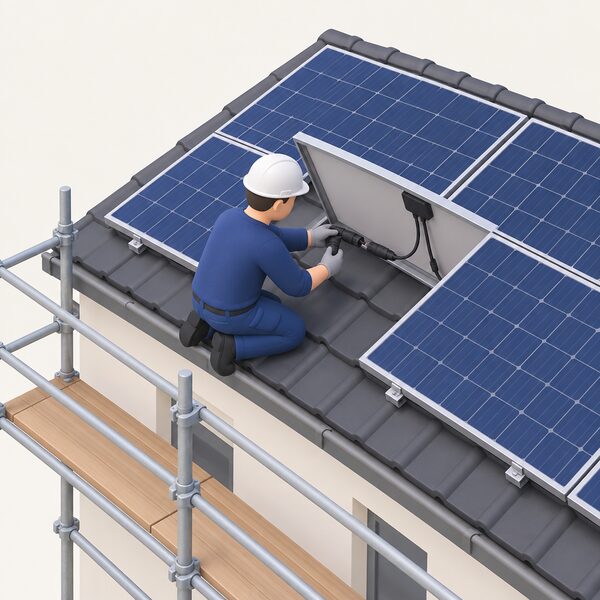
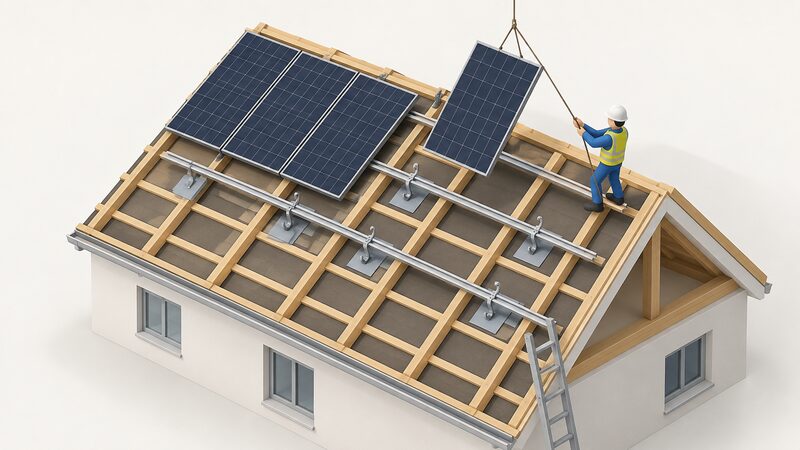
This is usually a two-trade job, and the split follows the work rather than the paperwork. The roofer renews the covering; the solar installer isolates, disconnects, removes and later reinstates the array and its electrical connections. Solar installations should always be carried out by a trained and experienced installer13, and any necessary testing and modifications of the building's electrical system shall only be performed by professional electricians14.
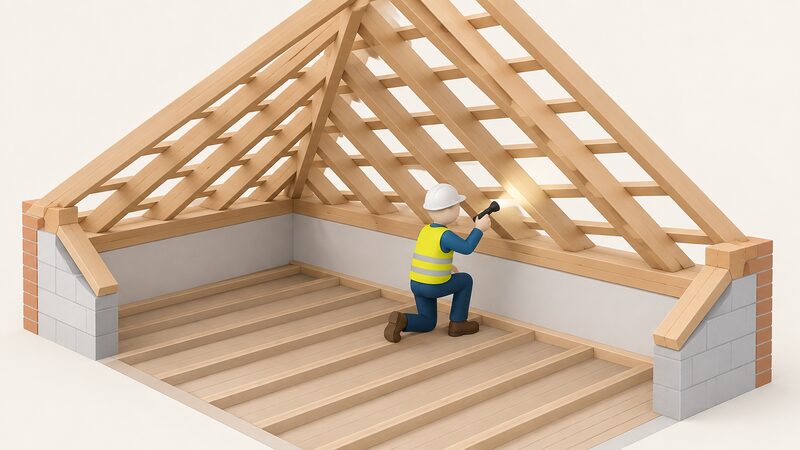
The structural side is a third discipline. A qualified surveyor should go into your loft to check the integrity of the roof and the rafters first15, and a structural engineer will need to check the roof for its strength, with some strengthening work possibly needed5. Council guidance is direct that this must be done by a qualified structural engineer10. Where a group-buying scheme is used, a surveyor visits the property to assess whether the roof is suitable and to confirm the number of panels, their location, cabling locations and colour5.
Access is the practical constraint that shapes the quote. If the solar panels are being installed on your roof, scaffolding is probably going to be needed15, and the same scaffold serves the removal, the roofing and the refit if it is kept up for the whole programme. Official advice is to get various quotes to compare prices of different installers4, and on a job that spans two trades it is worth establishing in writing who is responsible for what, and who holds the array while it is off the roof.
Cost of taking panels down and putting them back
No published figure exists for removal and refit as a standalone job, and any number quoted for it is installer-specific. What the published figures do is set the scale. The Energy Saving Trust's assessment of replacing panels with solar roof tiles during a renovation is that it would not be very cost effective, as you would have costs to uninstall the existing solar panels, then to remove existing roof tiles, then the costs of the new installation16. That is the cost structure of the job in one sentence: three separate operations, each with its own labour and access.
For context on the asset being handled, a typical domestic solar panel system is 3.5 kW and costs around £6,100 in 20261, a rooftop solar panel system costs around £7,600 on average2, and a typical retrofit runs at £5,000 to £10,0003. A plug-in system, by contrast, is put at £400 to £500 estimated17. Those figures describe installation, not removal, and they are given here only to show what is at stake when an array is taken down and put back.
| Item | Published figure | Source |
|---|---|---|
| Typical domestic system, 3.5 kW | around £6,100 in 2026 | 1 |
| Rooftop system, average | around £7,600 | 2 |
| Typical retrofit | £5,000 to £10,000 | 3 |
| Plug-in system, estimated | £400 to £500 | 17 |
| Panel cleaning, per panel | around £4 to £15 | 18 |
Two smaller costs recur. Cleaning costs range from around £4 to £15 per panel and depend on how easy they are to access and how dirty they are18, and solar panel cleaning kits are available online and from some hardware stores, typically costing around £10019. Neither is a removal cost, but both are the kind of line that appears on a quote once the array is down and accessible.
What to check before the panels come off
The load check is the first item and it is not optional. The adequacy of the existing roof to carry the load from the panel will need to be checked and proven9, and the same requirement is stated in Welsh building regulations guidance20 and in council guidance10. The check covers more than static weight: the roof must be able to support the additional wind, snow and static load imposed by the solar panels, and comply with Part A: Structure10.
Condition comes next. It is important to make sure the roof structure, walls and existing coverings are in sound repair prior to installation21. On a roof renewal this is the whole point of the exercise, but it also means the survey should record the state of the rafters, the battens and the wall plate while the covering is off, not just the tiles.
The electrical side needs recording before anything is disconnected. Building regulations apply to solar installations because of the additional loading on the roof structure and the associated electrical works4, and the associated electrical works are cited separately in council guidance22. A refit is the moment to confirm the isolator positions, the cable routes and the state of the DC connectors, because all of them are disturbed by removal.
Finally, ownership. Where a system was installed under a free solar scheme, the information a household should have includes who will be responsible for removing the system at the end of its useful life23. That question is worth answering before a roof renewal rather than during it, because the answer determines who pays for the removal.
Storing the panels and roof fixings safely during the works
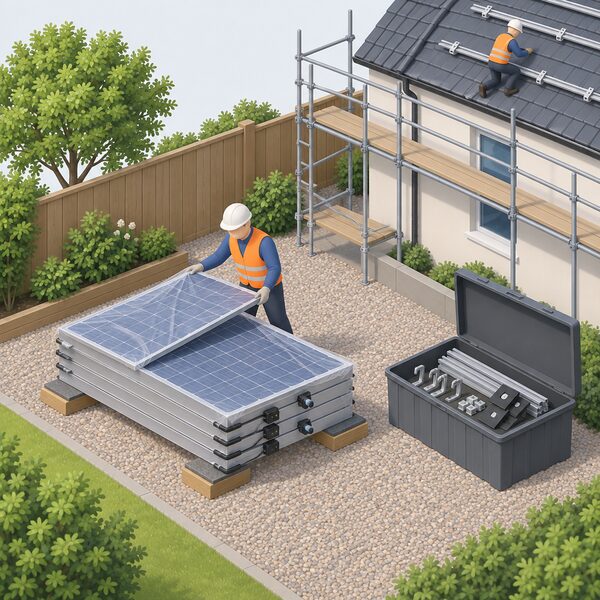
Panels off the roof are fragile in a way they are not when mounted. They should be stored flat and dry, out of the way of the roofing work, with the glass protected from impact and the junction boxes and connectors kept clean and capped. The published guidance on handling is about the roof rather than the store, but it points the same way: it is important to minimise any damage to the roof covering by carefully planning how the array is installed, maintained, and removed10.
The fixings are the part most often lost or damaged. Roof hooks, rails, clamps and flashings are sized to the covering they were fitted through, and a new covering may take a different profile. Keeping the old mounting together and labelled makes it possible to assess reuse; scattering it across a skip makes that impossible.
Two safety points apply while the array is off. Cleaning guidance is explicit that it is always safer to avoid working at heights without the right training or equipment, and that if this is not possible a professional should be used, with the system turned off first and cleaning done in cool weather to avoid streaks24. The same discipline applies to handling panels on a scaffold. Separately, where a planned power cut involves a temporary generator, the advice is to turn off your solar panels before the planned outage and turn them back on once mains power has been restored25. An array that is disconnected for roof works is in the same state, and the inverter should be isolated at the DC and AC sides throughout.
Refitting: reusing the old kit or starting fresh
The decision turns on three things: the condition of the panels, the condition of the mounting, and whether the roof build-up has changed. On the panels, the published expectation is that a roof-mounted solar panel system should last up to 25 years, with some panels carrying a 25-year warranty7, and typical rooftop panel warranties run to 25 years26. An array that is well inside that window is a candidate for refitting; one at the end of it is a candidate for replacement while the scaffold is up.
On the mounting, the structural position governs. The adequacy of the existing roof to carry the load from the panel will need to be checked and proven, and some strengthening work may be needed5. Reuse of brackets is a matter for the installer and the structural assessment, not a default. Where the roof covering changes profile, new flashings and often new hooks follow.
Where replacement is being considered, roof-integrated products are aimed at exactly this moment: solar roof tiles are best suited for installing when renovating a roof or for new build houses16, and your existing panels could be refitted to your renovated roof instead16. The Energy Saving Trust's caution stands alongside that: replacing working panels with tiles during a renovation would not be very cost effective, given the uninstall, the tile removal and the new installation16.
If a battery is part of the system, its age matters as much as the panels'. Solar PV panels can last 25 years or more, so the cost of replacing the battery at least once should be factored into total costs27. A roof renewal is a natural point to review that, because the inverter and battery are usually accessible while the array is down.
What the works mean for energy independence
While the array is off the roof, the household is back on the grid for all of its electricity, buying every unit at retail and earning nothing on export. That is the dependence the works expose: the panels, the inverter and the mounting are a single chain, and breaking any link returns the home to full reliance on a supplier. The feed-in tariff or Smart Export Guarantee payments stop for the duration because the panels are not producing6.
The dependence that remains after refit is the ordinary one. A grid-connected array still relies on the network for the times it does not generate, on a supplier for billing and export payments, and on the manufacturer for the warranty on the panels and the inverter. Where the system was installed under a free solar scheme, the removal responsibility at end of life sits with whoever the agreement names23, which is a contractual dependence rather than a technical one.
There is a policy direction worth noting. Changes to permitted development rights are intended to mean more homeowners and businesses will be able to install solar panels on their roofs without going through the planning system28, which makes the remove-and-refit cycle easier to plan. Building regulations, however, are unchanged: they will normally apply to installing a solar panel on a roof4, and the load check has to be proven each time9.
For a household weighing the job, the honest summary is that removal and refit is a real cost with no published benchmark, that it interrupts generation and export income, and that it is the moment to settle the structural question, the mounting question and the battery question together rather than in sequence. The solar panel installation process and the building regulations and roof loading requirements set out the standards the refit has to meet, and solar panel warranties and degradation covers what remains claimable on the panels themselves.
Sources28 cited
- Average domestic solar panel cost, 2026, UK Parliament POST, 2026
- Rooftop solar panel system average cost, Energy Saving Trust, 2026
- Watt a Save: typical retrofit costs, Home Builders Federation, 2026
- Building regulations for solar panels, Planning Portal, 2026
- Installing solar panels, Brighton & Hove City Council, 2026
- Most common solar panel problems, Which?, 2018
- Are solar panels worth it?, Which?, 2026
- Generating your own energy: solar water, Welsh Government, 2018
- Building regulations: energy efficiency, Welsh Government, 2026
- Solar panels, East Herts Council, 2026
- Installing solar panels using the Local Listed Building Consent Order, Royal Borough of Kensington and Chelsea, 2026
- Planning frequently asked questions, London Borough of Hammersmith & Fulham, 2026
- Solar thermal water heating, Planning Portal, 2026
- Plug-in solar interim product specification, Department for Energy Security and Net Zero, 2026
- Solar panel installation, Which?, 2026
- Solar roof tiles, Energy Saving Trust, 2026
- Plug-in solar panels, Which?, 2026
- Solar panel myths debunked, Which?, 2026
- Make the most of your solar panels, Which?, 2026
- Building regulations: solar panels, Welsh Government, 2026
- Solar panels, City of York Council, 2026
- Solar photovoltaic (PV) panels, London Borough of Bromley, 2026
- Information regarding free solar PV systems, Renewable Energy Consumer Code, 2026
- Solar panel cleaning and maintenance, Energy Saving Trust, 2026
- Planned power cuts, SSEN Distribution, 2026
- Plug-in solar panels vs rooftop systems, Which?, 2026
- Solar panel battery storage, Which?, 2026
- New planning rules to boost solar rollout, UK Government, 2023
 Panel RecyclingWhat actually happens to a solar panel when it stops working, and what can a household do with one?
 Panel Maintenance and CleaningWhat upkeep a domestic solar array actually needs: inspection intervals, cleaning, bird and debris protection, and checking fixings after storms, with the costs and the safety rules.
 Solar Mounting SystemsWill your roof take the extra weight of solar panels, and will it still keep the rain out afterwards?
 Adding Battery StorageCan you add a battery to solar panels you already have, or does the whole system need replacing?
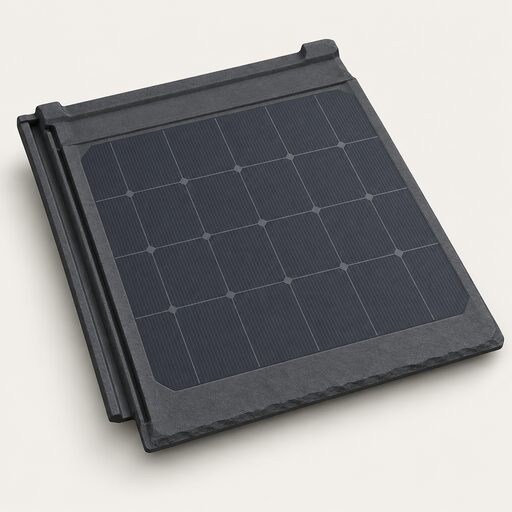 Roof-Integrated SolarSolar tiles replace your roof covering instead of sitting on top of it, so the finished roof looks like a roof.
 Free Solar Panels vs Rent-a-RoofOffers of free panels usually mean a company owns the system and keeps the generation income or charges a monthly fee.