
In this answer
Short answer
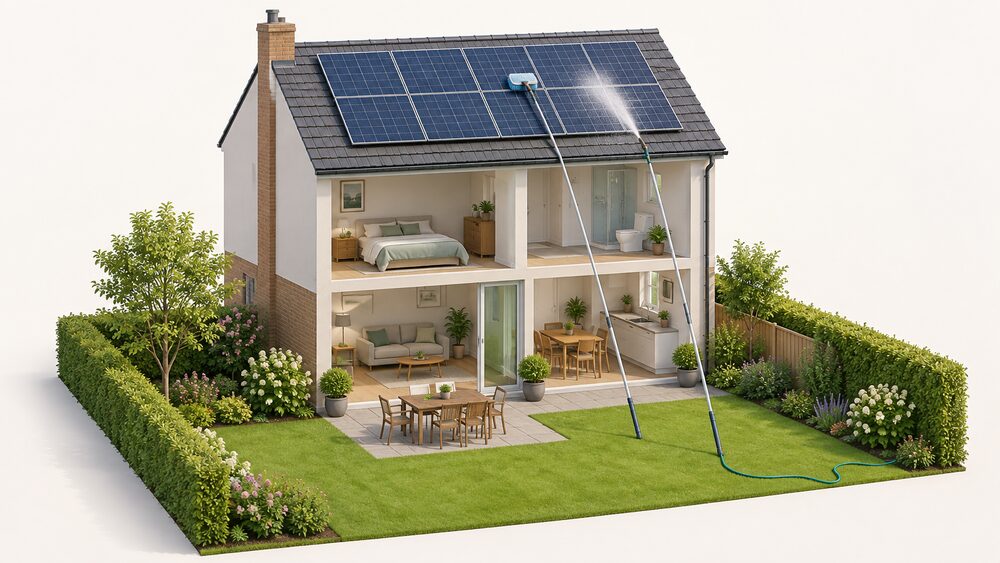
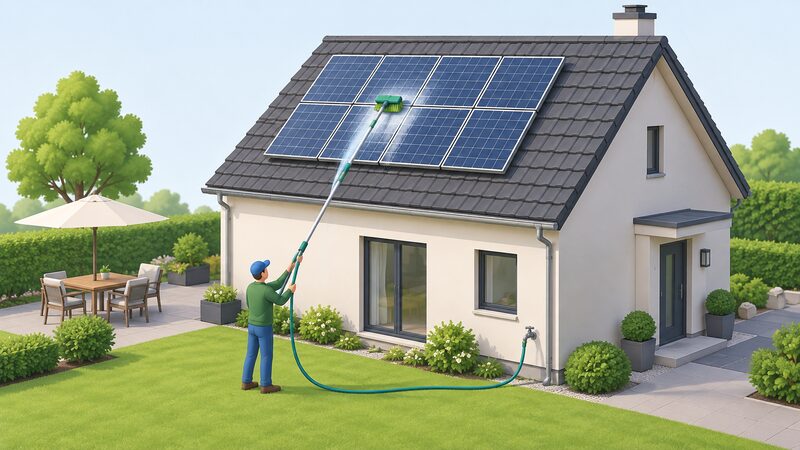
Cleaning solar panels from the ground is the safe default for a roof-mounted array. Independent guidance is direct on the point: it is always safer to avoid working at heights without the right training or equipment, and where that is not possible the job belongs with a professional1. The kit is modest, a hosepipe with a jet that reaches the panels plus a soft, long-handled brush or sponge, and the method is a light wipe rather than a scrub1.
How often it is needed is less than most owners assume. Rain does a good job of keeping panels clean in most cases, so routine cleaning is not essential; a light clean every 12 to 24 months helps the system operate at its best, and checking every 12 to 18 months and cleaning only where there is visible dirt is a reasonable guide1. Most panels carry a self-cleaning coating that lets rain clear dirt and debris when they are installed at a suitable angle2.
What cleaning buys is output. Dirty panels can reduce how much electricity a system generates, because dirt affects how much sunlight reaches the cells1. What it costs to hand the job over varies widely: independent guidance puts professional cleaning at around £60 to £100 for a standard system1, while maker figures run from around £100 to £2503.
Why cleaning from the ground is the safe option
The case for staying at ground level rests on two separate risks: falling, and damaging the array. Independent guidance is that it is always safer to avoid working at heights without the right training or equipment, and that where ground-level cleaning is not possible, a professional should do the work1. Official guidance on solar installation in Northern Ireland is equally plain that work of this kind will need scaffolding or similar equipment, and that people should be kept away from the area below the work7.
The second risk is the panels themselves. They are not designed to support the weight of a person and can crack or break completely, and they can carry slippery coatings that make a roof treacherous even in dry conditions1. One maker's product page states that its SunWare panels can be walked on in deck shoes, but that is a claim about one specific product, not a general rule for roof-mounted arrays9.
There is also an electrical dimension. Guidance for cleaning includes turning the system off first, and one maker notes that panels need to remain switched off for the one to two hours a clean usually takes1. That is a practical point about timing as much as safety: a system that is isolated is not generating, so the job is best placed where lost generation matters least.
For a household, ground-level cleaning is the version of maintenance that keeps the array independent of specialist call-outs. It uses a tap, a brush and an hour of time, and it leaves the roof, the mounting system and the wiring untouched. The dependence it avoids is the one that matters most here: no ladder work, no scaffolding, no contractor booking, and no risk of a cracked module that would need replacing under a warranty whose terms may not cover the damage.
What you need: hosepipe, jet attachment and long-handled brush
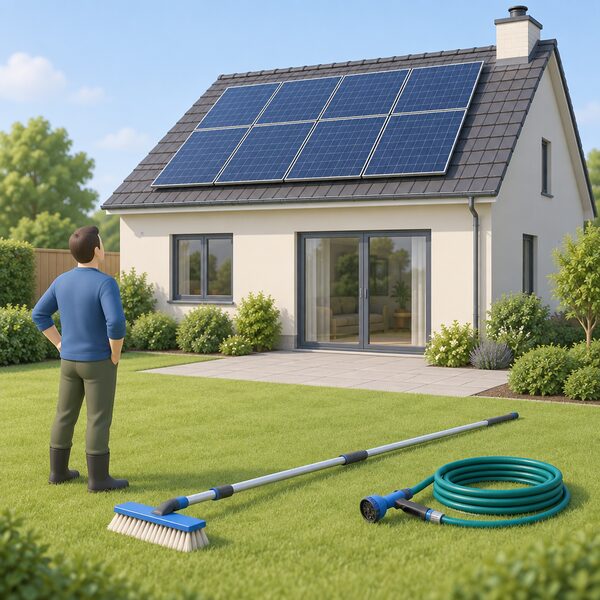
The equipment list is short and cheap. Independent guidance specifies a hosepipe with a jet that can reach the panels, and a soft, long-handled brush or sponge to lightly wipe the surface1. A maker's maintenance article adds a soft-bristle brush, deionised water and a rubber squeegee to the same idea10, and a supplier's handover guidance describes a long-handled wiper used from the ground to keep panels clear of leaves and dirt11.
What to avoid matters as much as what to buy. Independent guidance is that only water should be used, because detergents or abrasive materials could harm the panel surface5. Washing up liquid and other cleaning products can leave a residue that may affect performance1. High-pressure power washers should be avoided because they can interfere with seals and wiring, leading to water damage1. Where panels do need cleaning, one independent source advises purified water rather than tap water12.
"Only use water to clear your solar panels. Detergents or abrasive materials could harm their surface."
A ready-made cleaning kit is available online and from some hardware stores, typically costing around £1005. That is a one-off outlay against the recurring cost of a professional visit, and it is the piece of kit that makes ground-level cleaning repeatable rather than a one-off.
| Item | Purpose | Source |
|---|---|---|
| Hosepipe with a jet that reaches the panels | Rinsing and reaching the array from the ground | 1 |
| Soft, long-handled brush or sponge | Lightly wiping the panel surface | 1 |
| Soft-bristle brush, deionised water, rubber squeegee | Maker's recommended tool set | 10 |
| Long-handled wiper | Keeping panels clear of leaves and dirt from the ground | 11 |
| Cleaning kit, around £100 | Complete off-the-shelf option | 5 |
How to clean roof-mounted panels from the ground, step by step
The sequence below follows independent and supplier guidance. It assumes a roof-mounted array reached from ground level with an extendable brush and a hosepipe.
- Pick the conditions. Guidance suggests an overcast day, early morning or late evening, when morning dew can help soften grime13. Cleaning in cool weather also helps avoid streaks1.
- Isolate the system. Turn the system off before cleaning1. A clean usually takes around one to two hours, and the panels need to remain switched off for that time6.
- Reach the array from the ground. Use a long-handled brush or wiper so that no ladder or roof access is needed1.
- Rinse with water only. Use the hosepipe jet to reach the panels, and avoid detergents, abrasives and high-pressure washers1.
- Wipe lightly. Use the soft brush or sponge to lightly wipe the surface rather than scrub it1.
- Check for anything else. Keep panels clear of leaves and dirt, and check for shading that could affect output11.
The step that most often gets skipped is the first. Cleaning at midday on a hot, sunny day is the worst combination: the surface dries quickly, streaks form, and the system is switched off during its peak generating hours. An overcast morning costs almost nothing in lost output and gives the water time to work.
For a household, the method is the whole point of the exercise. It is a job that can be done with a tap and a brush, on a schedule the owner controls, without booking anyone. The dependence that remains is on the weather: rain does most of the cleaning in most UK locations, and a dry, dusty spell or a nearby tree is what turns a self-cleaning array into one that needs a hand1.
Will cleaning improve output, and how often is it needed?
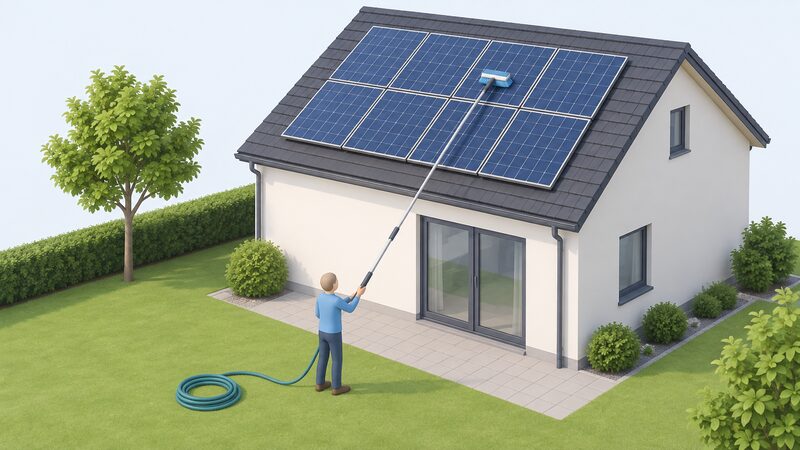
Dirty panels can reduce how much electricity a system generates, because dirt affects how much sunlight reaches the cells1. That is the mechanism, and it is the reason cleaning has any value at all. The counterweight is that most panels are self-cleaning: their coating allows rainwater to wash away dirt and debris, and a heavy rain storm should usually be enough to wash off most dirt4. One independent source notes that solar panels should be self-cleaning especially where the roof has the right incline, with an occasional heavy rain shower enough to clean them5.
The recommended intervals cluster tightly. Independent guidance suggests a light clean every 12 to 24 months, and checking every 12 to 18 months and cleaning if there is visible dirt1. A consumer guide reports the same 12 to 18 month recommendation15. Makers tend to be more frequent: one suggests professional cleaning and inspection one to two times per year16, another says annual cleaning is sufficient in most cases17, a third suggests a professional clean every one to two years especially near trees or heavy pollen18, and a fourth says once or twice a year is usually enough19.
| Guidance | Interval | Source |
|---|---|---|
| Light clean | Every 12 to 24 months | 1 |
| Check and clean if dirty | Every 12 to 18 months | 1 |
| Consumer guide recommendation | Every 12 to 18 months | 15 |
| Maker: professional clean and inspection | 1 to 2 times per year | 16 |
| Maker: annual cleaning | Sufficient in most cases | 17 |
| Maker: professional clean near trees or pollen | Every 1 to 2 years | 18 |
The gap between independent and maker advice is worth naming. Independent sources start from the position that rain does the work and cleaning is occasional; makers of panels and cleaning equipment start from the position that soiling costs output and regular attention protects it. Both are describing the same array. The practical difference is location: a coastal or dusty site, or one under trees, sits at the frequent end, while a clean, exposed roof sits at the occasional end12.
When to hire a professional instead
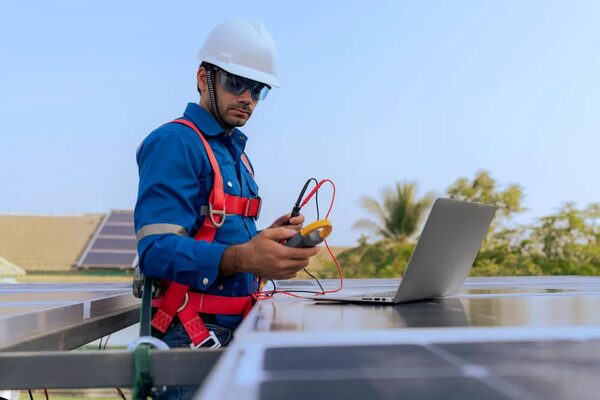
Some jobs should not be attempted from the ground at all. Heavy snow may need to be cleared, but independent guidance is that this should not be done by the householder and a professional should be hired20. Where roof access is genuinely required, official guidance points to scaffolding or similar equipment7. One supplier's guidance is blunt that in most cases cleaning of roof mount systems is a job for the professional, and that where a householder does proceed, it should only be from the ground using an extendable cleaning brush13.
A professional visit is also the moment for inspection. Independent guidance recommends a full professional service to inspect for small cracks or inverter issues, and notes that some installers require a full service within a specific period to keep the warranty valid1. That warranty condition is the strongest argument for a periodic professional visit even where cleaning itself is easy: a maker's guidance confirms that improper methods can void a warranty10.
Costs vary by source and by what is counted. Independent guidance puts professional cleaning at around £60 to £100 for a standard system1, or roughly £80 to £150 for a typical home installation of 10 to 16 panels15. Per-panel figures run at around £4 to £154. Maker figures are higher: around £100 to £250 as a typical UK range3, around £100 to £150 for a system with fewer than 20 roof-mounted panels6, and around £250 for a professional clean21. The factors behind the spread are the number of panels, their location, and whether specialist access equipment is needed1.
For a household, hiring in is a trade of money for two things: safety and a documented service history. The dependence it introduces is on a contractor and on the warranty terms that contractor's visit satisfies. Where a system is on a straightforward roof and soiling is light, ground-level cleaning keeps that dependence at arm's length.
Where cleaning from the ground falls short
Ground-level cleaning reaches the panel surface, but it does not reach everything. It cannot inspect the underside of a module, the mounting rails, the DC cabling or the inverter, and it cannot clear snow safely20. It also cannot address the shading that a growing tree or a new obstruction introduces, which independent guidance lists alongside cleaning as part of keeping a system working14.
There is a maintenance baseline that applies regardless of cleaning. Independent guidance is that solar panels are low maintenance, and that the householder needs to keep the panels reasonably clean and make sure any shading is minimised, with the installer providing a maintenance guide14. A maker's guidance describes panels as designed to be low maintenance, with rain helping to keep them clean and occasional checks for leaves or debris22. One flexible panel maker recommends regular cleaning because dust and debris can accumulate and reduce performance, which is a product-specific point rather than a general rule20.
The dependence that remains after a ground-level clean is therefore not on a supplier or the grid, but on the limits of what can be seen and reached from below. A system that is cleaned from the ground still relies on its inverter, its isolators and its connections, none of which are visible from a hosepipe. Where a household wants the array checked as well as cleaned, that is the point at which a qualified professional earns the fee, and official guidance is to always use a qualified installer for work of this kind23.
Sources23 cited
- Solar panel cleaning and maintenance, Energy Saving Trust, 2026-08-25
- Solar panels, Electrical Safety First, 2026-09-17
- Solar panel maintenance, Fuse Energy, 2026-04-15
- Solar panel myths: five common concerns debunked, Which?, 2026-06-09
- Make the most of your solar panels, Which?, 2026-08-12
- Solar panel maintenance and cleaning, E.ON Next, 2026-09-17
- Installing solar panels safely, HSENI, 2014-05-20
- Solar panels guidance, Islington Council, 2026-09-17
- SunWare solar panels, Marlec, 2025-05-06
- Solar panel maintenance: do you really need to clean them?, Astronergy, 2026-09-17
- Solar handover pack, OVO Energy, 2026-09-17
- Solar PV, Flexi-Orb, 2025-04-22
- Cleaning and maintaining your solar panels: an expert guide, JoJu Solar, 2025-12-26
- Solar photovoltaic (PV), MCS, 2026-07-30
- Are solar panels worth it?, Uswitch, 2026-09-16
- How much electricity does solar power produce, Jackery, 2026-07-10
- How solar panel efficiency impacts your savings, SunPower, 2026-07-28
- How many solar panels do I need, EcoFlow, 2025-08-26
- A guide to solar panel maintenance, So Energy, 2026
- Zendure 420W flexible solar panels, Zendure, 2026-09-19
- How can you get the most from your solar panels this winter?, Good Energy, 2026-07-10
- Average solar panel lifespan, Hive, 2026-08-05
- Solar panels, East Herts Council, 2026-09-17
 Panel Maintenance and CleaningWhat upkeep a domestic solar array actually needs: inspection intervals, cleaning, bird and debris protection, and checking fixings after storms, with the costs and the safety rules.
 Solar Mounting SystemsWill your roof take the extra weight of solar panels, and will it still keep the rain out afterwards?
 Panel RecyclingWhat actually happens to a solar panel when it stops working, and what can a household do with one?
 Charging an EV from Solar PanelsCharging your car from solar panels means using the power your roof makes instead of sending it to the grid.
 Panels by Home TypeCan your house have solar panels, and how many will fit?
 Balcony Solar SystemsCan you really plug solar panels into a normal socket, and what will it save you?