

In this guide
Energy advice in Wales is free at the point of use, and it comes from more than one place. The Welsh Government funds the Warm Homes Nest scheme, which provides free, impartial energy advice to help households lower their bills and improve their health and wellbeing, and which also funds home energy improvements for eligible households1. The Welsh Government states that free expert energy advice is available to all householders in Wales via the Nest helpline2. Alongside it sit the UK-wide services: Citizens Advice on 0808 223 1133, with a Welsh language line on 0808 223 1144, and National Energy Action's Energy Advice and Support Service on 0800 304 71593.
The distinction that matters most is between advice and work. Advice is universal in Wales. Improvement work is not: the Warm Homes Nest scheme targets houses with a poor Energy Performance Certificate rating, and the Welsh Government describes the improvements as being for low-income Welsh households6. A household can always get a conversation about bills, tariffs and efficiency; whether it gets a new heating system or insulation depends on the property and the household's circumstances.
Who provides free energy advice in Wales, and what it covers
The Welsh Government's position has been consistent across policy documents. It "remains committed to offering free impartial energy savings advice to all householders in Wales", a commitment repeated in the New Warm Homes Programme policy statement and in the integrated impact assessment that preceded it10. That universality is the foundation of the Welsh advice landscape: no household in Wales is outside the advice offer, whatever its tenure, fuel or income.
The Nest scheme is the delivery vehicle for most of it. Nest provides free, impartial energy advice to help households lower their energy bills and improve their health and wellbeing, and the scheme also provides funding for home energy improvements1. Local authority pages across Wales point residents to the same service: Bridgend's energy and decarbonisation pages note that all households in Wales have access to free, impartial advice to help reduce energy bills and maximise income11. The Welsh Government's own fuel poverty written statement confirms that "our free expert energy advice is available to all householders in Wales via the Nest helpline"2.
Beyond Nest, the advice map includes services with a wider footprint. National Energy Action offers advice and support to help people across England, Wales and Northern Ireland stay warm and manage energy costs, and its Energy Advice and Support Service runs on 0800 304 71595. Citizens Advice covers England and Wales, with a consumer service for supplier and billing problems3. The Energy Saving Trust provides free and impartial advice on how to reduce carbon emissions, how to use water more sustainably and how to save money on energy bills, and runs a helpline on 0300 123 123412. Its Energy Savings Advice Service gives free impartial advice on energy and renewables in England and Wales13.
For a household, the practical consequence is that there is no single door. A question about a bill, a question about a heat pump and a question about a grant may each be answered by a different organisation, and the referral routes between them are well established. What the household does not need is a commercial intermediary: every service described here is free and impartial, and none of them sells installations.

Nest Wales: free advice for all, upgrades for eligible households

Nest is the Welsh Government's Warm Homes scheme, and it operates on two levels. The first is advice: free, impartial energy advice to help lower bills and improve health and wellbeing, available to every household in Wales1. The second is funded work: the scheme provides funding for home energy improvements, and the Welsh Government describes it as offering free energy efficiency advice and improvements to low-income Welsh households11.
The eligibility test for the funded work has two parts. The property must have a poor Energy Performance Certificate rating, and the household must be on a low income7. The Welsh Government's heat pump guidance puts the same point in household terms: "with the Warm Homes Nest scheme, eligible households can get free energy advice and even a suite of home energy efficiency improvements"14. The phrase "even a suite" is doing real work: the advice is the entry point, and the improvements follow only if the assessment supports them.
Nest is contacted on 0808 808 2244, which the Green Homes Wales scheme rules describe as the route to "free and impartial general advice on current support options available to you"8. That framing matters, because the helpline is not only a gateway to Nest's own work. It is a signposting service for whatever support currently exists, which in Wales changes as programmes open and close.
The Welsh Government has also funded work on off-gas homes. It has publicised help for thousands of Welsh households with oil and LPG heating costs, which matters in rural Wales where mains gas does not reach6. For those households the advice conversation is different in kind, because the fuel itself is bought rather than supplied, and the leverage a supplier has over a bill does not exist in the same way.
Citizens Advice: bills, suppliers and complaints on 0808 223 1133
Citizens Advice is the route for problems with a supplier rather than with the fabric of the home. The consumer service takes calls on 0808 223 1133, with a Welsh language line on 0808 223 1144, and opening hours of Monday to Friday, 9am to 5pm3. Ofgem directs consumers to the same number for supplier complaints15.
The issues that belong with the supplier are set out by Ofgem: late, incorrect or missing bills, back billing, being overcharged, a faulty meter, poor customer service, and refusing to refund credit from an account16. These are not matters for an energy adviser, because they are contractual. The supplier holds the account, the meter and the credit balance, and the first step is always to raise the problem with the supplier directly.
Where that fails, the escalation route runs through Citizens Advice. The consumer service may refer a case to the Extra Help Unit if the household needs support with a difficult or urgent complaint, cannot deal with its energy supplier alone because of personal circumstances, is considered vulnerable, or is at risk of being disconnected from an energy supply16. That last criterion is the one that turns a billing dispute into an emergency.
Citizens Advice also covers the wider money picture. It offers information and support on struggling to pay bills, problems with an energy supplier or supply, saving energy at home, and getting a better energy deal9. In Wales the route in is Advicelink Cymru, which can be reached on 0800 702 20209. For households in England the equivalent number is 0808 144 8844, which is a reminder that the Welsh and English advice lines are not the same service even where the branding is9.
National Energy Action and the Energy Advice and Support Service
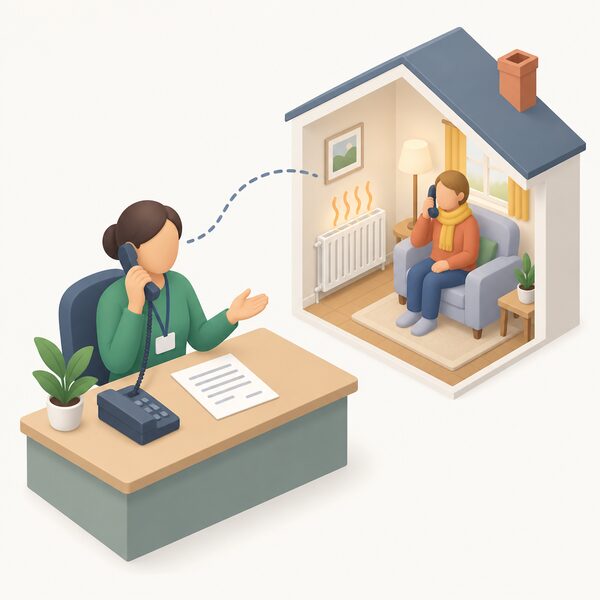
National Energy Action is a fuel poverty charity rather than a government scheme, and its Energy Advice and Support Service runs on 0800 304 71595. The service covers England, Wales and Northern Ireland, offering advice and support to help people stay warm and manage energy costs5. Its remit is the overlap between energy and money: households in or near fuel poverty, where the bill problem and the income problem are the same problem.
That places it differently from Nest. Nest is a Welsh Government programme with a funded improvement stream attached; National Energy Action is an advice and advocacy organisation without installation work. A household that is not eligible for Nest's funded improvements, or that is waiting for an assessment, can still use the National Energy Action line for help with bills and warmth.
The Energy Ombudsman is the other body worth knowing about at this point. It handles disputes between consumers and energy companies that have not been resolved through the supplier's own complaints process, and it publishes guidance for consumers worried about their energy bills17. The sequence is consistent across sources: supplier first, then the consumer service, then the ombudsman or the Extra Help Unit depending on the nature of the problem.
Energy Saving Trust: impartial guidance on saving energy at home
The Energy Saving Trust provides free and impartial advice on how to reduce carbon emissions, how to use water more sustainably and how to save money on energy bills, and its helpline is 0300 123 123412. Its Energy Savings Advice Service gives free impartial advice on energy and renewables in England and Wales13. It does not install anything and does not sell a brand, which is what makes it useful as a second opinion on a measure a household is considering.
The Trust's role in Wales sits alongside rather than inside the devolved advice structure. Home Energy Scotland gives free impartial advice on energy efficiency and renewable energy in Scotland, and NI Energy Advice offers independent and impartial energy advice to domestic householders in Northern Ireland plus referrals to energy grants and other sources of help13. Wales has its own government scheme in Nest, and the Trust's England and Wales services operate across the border.
The Trust also administers grant schemes under contract in Scotland. It was awarded a contract from 1 December 2023 to administer and manage Scottish Government Heat and Energy Efficiency live and closed grant and loan schemes, with an initial term running until November 202620. That is a Scottish arrangement, but it illustrates the Trust's dual role: an advice body that also administers public money, which is worth knowing when a household is trying to work out who is speaking.
What the advice covers: bills, fuel debt, switching, efficiency and retrofit
The scope of Welsh energy advice is broader than bill queries. At the practical end, suppliers can agree a payment plan, a payment break or a reduction, review payments and debt repayments, and give access to hardship funds for households struggling to pay for energy or expecting to get into difficulty9. That is a set of options a household can ask for by name, and an adviser will typically work through them in order.
At the fabric end, the advice reaches retrofit. Green Homes Wales offers fully funded access to a Retrofit Coordinator to create a detailed home assessment providing energy-efficiency and decarbonisation recommendations8. The Welsh Government has described the programme as including fully funded expert advice alongside its funding for households investing in greener homes21. That is a different kind of conversation from a bill query: it produces a document, and the document sets out what the property needs and in what order.
Between those two ends sit the standard topics: saving energy at home, getting a better energy deal, and understanding what a tariff or a price cap actually means. Climate Action Wales publishes an energy price cap explainer for Welsh households, which is the devolved counterpart to the UK-wide material22. Local authority pages add their own framing, with Bridgend pointing residents to advice on reducing bills and maximising income, and Carmarthenshire publishing guidance on minimum energy efficiency standards for the rented sector11.
For a household, the useful mental model is a ladder. Bills and debt first, because nothing else is affordable while a payment crisis is running. Then the cheap fabric measures. Then the assessment, which tells the household what the property actually needs. Then the funded work, if the household qualifies. Advice services in Wales are set up to meet a household at whichever rung it is on.
How to get in touch: helplines, webchat, self-referral and accessibility
The routes in are deliberately varied, because the households that need advice most are often the least able to navigate a single channel.
- Nest: 0808 808 2244 for free and impartial general advice on current support options8.
- Citizens Advice consumer service: 0808 223 1133, or 0808 223 1144 for a Welsh-speaking adviser, Monday to Friday, 9am to 5pm3.
- Advicelink Cymru: 0800 702 2020, or through the Advicelink Cymru website9.
- National Energy Action: 0800 304 71595.
- Energy Saving Trust: 0300 123 123412.
- Warm Wales: self-referral through the getting support pages at warmwales.org.uk11.
Warm Wales is the regional route in South, Mid and West Wales, and it is a self-referral service rather than a referral-only one11. That matters for households that would otherwise wait to be sent by a council or a health professional. Anglesey's cost of living pages and its consumer advice pages provide the local authority route for north Wales residents, covering both household costs and problems with services24.
Accessibility runs through the design of these services. The Welsh language line at Citizens Advice is a distinct number rather than an option on the main line, and the Welsh Government publishes its advice material bilingually3. For households without internet access, every service listed here has a telephone route, and the Nest helpline is the single number that covers both advice and the funded improvement scheme.
Simple Energy Advice and the wider UK picture
Simple Energy Advice is the England and Wales service for energy efficiency advice and for help with schemes such as the Warm Home Discount. Ofgem's guidance states that if you live in England or Wales and would like advice on energy efficiency or about how to get help with energy bills with schemes like the Warm Home Discount Scheme, the Simple Energy Advice website offers impartial energy efficiency advice18. It sits alongside the devolved Welsh scheme rather than replacing it.
The four nations do not have the same advice architecture, and the differences are worth stating plainly. England has Citizens Advice on 0808 144 8844 and the Simple Energy Advice service9. Scotland has Home Energy Scotland, giving free impartial advice on energy efficiency and renewable energy13. Northern Ireland has NI Energy Advice, offering independent and impartial energy advice to domestic householders plus referrals to energy grants and other sources of help18. Wales has Nest, plus access to the England and Wales services1.
Policy divergence shows up in other places too. The Planning Portal's solar thermal guidance states that the guidance relates to the planning regime for England and that the policy in Wales may differ, directing households to their local planning authority if in doubt26. Permitted development rights, grant schemes and minimum efficiency standards are all devolved or partly devolved, which is why a Welsh household reading an English advice page can end up with the wrong answer.
Wales also has its own energy policy direction. The Welsh Government's response to the Preparing Wales for a Renewable Energy report sets out recommendations including a 10% local ownership offer for any Wales-based organisation on new renewable energy developments, and notes that if adopted the recommendations will likely mean more rapid deployment of renewable energy27. The Welsh Government Energy Service supports renewable energy projects in Wales from the concept stage through to financial close and completion27. None of that is household advice, but it shapes what community energy and local generation look like in Wales over the period a household is planning its own improvements.
Grants and schemes behind the advice: ECO4 and what happens after it ends
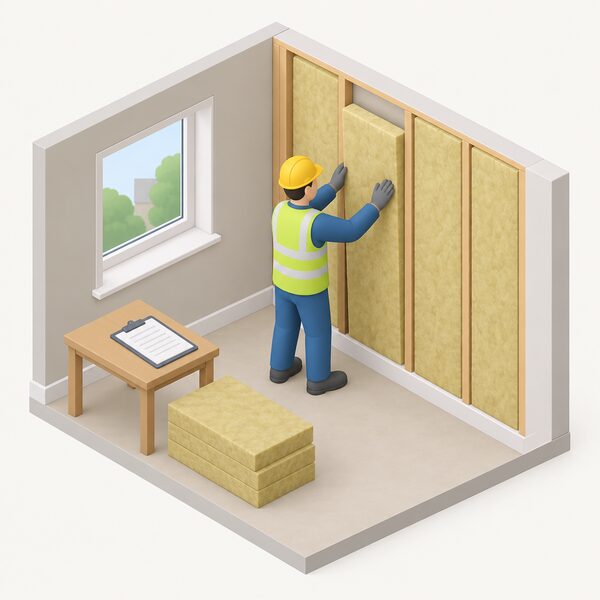
The Energy Company Obligation is the main UK-wide grant mechanism behind much of the work an adviser will discuss. ECO4 runs from 27 July 2022 and is split into four phases, with phase 4 covering 1 April 2025 to 31 December 202629. The scheme's flexible eligibility route allows local authorities, and the Scottish and Welsh governments as devolved administrations, to refer households who do not qualify through the standard route18.
The end date is not settled across the documents. Ofgem's supplier administration guidance states that ECO4 will run until 31 December 202629. Other published guidance states that the fourth wave of the scheme runs to 31 March 202612. Ceredigion's ECO flexibility funding page records that the scheme was due to end on 31 March 2026 with no subsequent ECO5 replacement19.
That audit tail is worth understanding. Ceredigion's scheme rules state that applications and declarations may be subject to Ofgem audits during the time that ECO4 is in effect and up to three years after the schemes end19. Work installed under the scheme can therefore be examined long after completion, which is one reason the paperwork matters as much as the installation.
For Welsh households, the practical position is that ECO4 and Nest are separate routes to similar outcomes. ECO4 Flex allows the Welsh Government to refer households, and Nest assesses Welsh households directly18. A household that is not eligible for one may be eligible for the other, which is exactly the kind of question the Nest helpline exists to answer.
Spotting a genuine adviser: who will and will not cold call
The advice services described here do not sell installations, and that is the single most useful fact for a household trying to judge an approach. The Energy Saving Trust provides free and impartial advice, and for properties in England and Wales it has developed a service allowing users to verify that an approach genuinely comes from the Trust12. A cold call or doorstep visit claiming a Trust connection can be checked rather than taken on trust.
Some legitimate services do involve home visits. The Local Energy Advice Programme offers a free home visit from a qualified Home Energy Advisor, and a free telephone advice service to help with benefits, money and bill problems12. The distinguishing feature is not whether someone visits, but whether the visit is arranged through a known service and whether anything is being sold.
"For properties in England and Wales, the Energy Saving Trust (EST) has developed a service allowing users to verify that an approach genuinely comes from the Trust."
Consumer protection law applies to any contract signed at the door or over the phone, and the GOV.UK consumer protection rights pages set out the baseline4. Anglesey's trading standards consumer advice pages provide the local enforcement route for residents in north Wales who have a problem with a service24. For a household, the safe pattern is straightforward: initiate contact through a published number, never through an inbound call, and treat any offer of grant-funded work that arrives unsolicited as something to verify before signing.
Sources29 cited
- New Warm Homes Programme: policy statement, Welsh Government, 2023-06-15
- Written statement: fuel poverty, Welsh Government, 2026-02-26
- Problems with services: consumer advice, Isle of Anglesey County Council, 2025-10
- Consumer protection rights, GOV.UK, 2026-09-17
- Worried about your energy bills, Energy Ombudsman, 2026-03-24
- Thousands of Welsh households get help with oil and LPG heating costs, Welsh Government, 2026-03-31
- The Warm Homes Nest Scheme, Parliamentary Office of Science and Technology, 2026-06-25
- Green Homes Wales, Development Bank of Wales, 2026-09-17
- Get help with your home or business energy bills, Ofgem, 2026
- New Warm Homes Programme: integrated impact assessment, Welsh Government, 2024-03-08
- Home energy efficiency, Bridgend County Borough Council, 2026-09-17
- Energy saving grants and funding, Tameside Metropolitan Borough Council, 2026-09-17
- Getting help if you can't afford your energy bills, Ofgem, 2026-09-17
- Your essential guide to heat pumps, Climate Action Wales, 2025-02-20
- Complain about your energy supplier, Ofgem, 2026
- Complain about your energy supplier or network operator, Ofgem, 2026
- Get help with your energy bills, Ofgem, 2026-09-17
- Energy Company Obligation: homeowners and tenants, Ofgem, 2026-09-17
- ECO flexibility funding, Ceredigion County Council, 2026-09-17
- FOI 202500462873, Scottish Government, 2025-07-22
- £5 million to help Welsh households invest in greener homes, Welsh Government, 2026-03-05
- Energy price cap explained, Climate Action Wales, 2026-09-17
- Minimum energy efficiency standards, Carmarthenshire County Council, 2026-09-20
- ECO4 delivery guidance version 4.0, Ofgem, 2026-03-26
- Help with household costs, Isle of Anglesey County Council, 2026-09-20
- Solar thermal water heating, Planning Portal, 2026-09-17
- Annex: Welsh Government response to each recommendation of the Preparing Wales for a Renewable Energy 2050 report, Welsh Government, 2024-06-14
- Preparing Wales for a renewable energy 2050, Welsh Government, 2023-10
- ECO4 guidance: supplier administration guidance, Ofgem, 2026-07-06
 Energy Policy in WalesWhat help can you get in Wales to make your home warmer and cheaper to run?
 The Full Scotland, Wales and Northern Ireland GuideWhy a householder in Glasgow, Cardiff or Belfast faces different schemes, standards, targets and markets from one in England.
 Housing Stock Data for WalesHow energy efficient are Welsh homes, and how many have a rating?
 The Full Rules and Regulation GuideConfused about who actually decides what you pay for gas and electricity, or why rules differ in Scotland and Wales?
 Why Energy Grants DifferWhere you live in the UK changes which home energy grants you can get.
 Energy Consumer BodiesWho do you call about an energy problem where you live?